
The pursuit of efficient, flexible, and sustainable energy systems has driven significant research into distributed generation. Among these, Combined Cooling, Heating, and Power (CCHP) systems stand out for their ability to cascade energy utilization—using high-grade energy for power generation and recovering low-grade waste heat for thermal applications—thereby significantly improving overall energy efficiency. This work focuses on the design, modeling, and comprehensive performance analysis of a CCHP system synergistically coupled with a Battery Energy Storage System (BESS). The integration of a battery energy storage system is crucial for addressing the temporal mismatch between energy generation and demand, enhancing operational flexibility, and improving system economics and reliability. We present a detailed, first-principles mathematical model of the integrated system, developed using a modular modeling approach. This model enables a thorough investigation into the system’s performance across all operating conditions, including the critical influence of ambient temperature and component efficiencies, which are often oversimplified in existing literature.
The core of our designed CCHP system is a 1 MW-class gas turbine (GT) equipped with a recuperator to preheat combustion air, thereby lowering exhaust temperature and boosting simple-cycle efficiency. The waste heat from the GT exhaust is recovered by a heat pipe-type LiBr absorption chiller/heat pump unit. This unit acts as a chiller in summer, providing cooling, and as a heat pump in winter, providing heating. A network of valves facilitates the seamless switching between these two operational modes. The electrical side of the system integrates a battery energy storage system to balance the electrical load. The system operates under a “cooling-led” or “heating-led” strategy, where the GT output is primarily modulated to follow the thermal load. The battery energy storage system discharges when GT power is insufficient to meet the electrical demand and charges when there is a surplus, effectively shaving peak loads and valley filling.
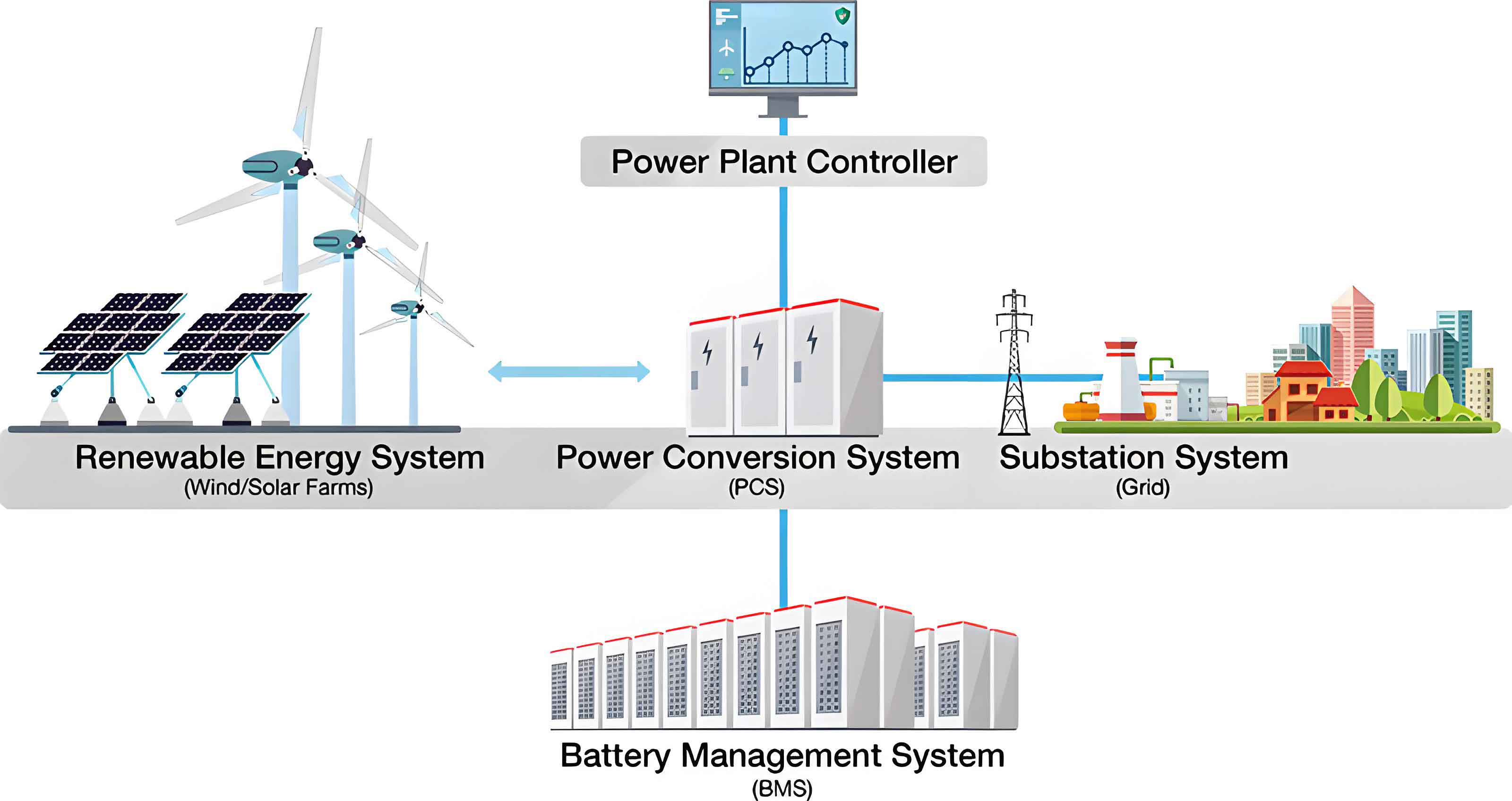
A key contribution of this work is the development of refined, mechanistic mathematical models for all key components, moving beyond simplistic linear approximations. The model library, developed on a proprietary platform, includes modules for the compressor, combustion chamber, turbine, recuperator, heat pump (absorber, generator, condenser, evaporator, solution heat exchanger), and the battery energy storage system.
Mathematical Modeling of System Components
1. Compressor
The compressor’s off-design performance is characterized using scaled generalized performance curves. Given the common unavailability of proprietary manufacturer data, known curve shapes are corrected with available design point and operational data to achieve accurate modeling. The corrected curves for pressure ratio and isentropic efficiency are expressed as functions of corrected mass flow and corrected speed.
$$ \epsilon = f(\dot{m}_c, n_c) $$
$$ \eta_c = g(\dot{m}_c, n_c) $$
where $\epsilon$ is the pressure ratio, $\eta_c$ is the isentropic efficiency, $\dot{m}_c$ is the corrected mass flow rate, and $n_c$ is the corrected rotational speed.
The compressor exit temperature $T_2$ and pressure $p_2$ are calculated as:
$$ T_2 = T_1 \left[ 1 + \frac{(\epsilon^{(k-1)/k} – 1)}{\eta_c} \right] $$
$$ p_2 = p_1 \cdot \epsilon $$
where $T_1$ and $p_1$ are the inlet temperature and pressure, and $k$ is the specific heat ratio. The compressor power consumption $W_c$ is derived from the enthalpy rise:
$$ W_c = \dot{m}_2 h_2 – \dot{m}_1 h_1 $$
2. Combustion Chamber
Applying mass and energy conservation, the fuel mass flow rate $\dot{m}_f$ is determined by:
$$ \dot{m}_3 = \dot{m}_2 + \dot{m}_f $$
$$ \dot{m}_f = \frac{\dot{m}_3 h_3 – \dot{m}_2 h_2}{h_f + LHV \cdot \eta_{cb}} $$
where $\dot{m}_3$ is the turbine inlet gas flow, $h_f$ is the fuel enthalpy, $LHV$ is the lower heating value, and $\eta_{cb}$ is the combustor efficiency. The combustor pressure drop is accounted for by a pressure recovery coefficient $\sigma_{cb}$: $p_3 = p_2 \cdot \sigma_{cb}$.
3. Gas Turbine
The turbine’s mass flow is governed by the Stodola (Ellipse) law for off-design conditions:
$$ \dot{m}_3 = \dot{m}_{3d} \frac{p_3}{p_{3d}} \sqrt{\frac{T_{3d}}{T_3}} $$
where the subscript $d$ denotes design conditions. The turbine exhaust pressure is $p_4 = p_a / \sigma_{ex}$, with $p_a$ as ambient pressure and $\sigma_{ex}$ as the exhaust pressure recovery coefficient. The actual exhaust enthalpy $h_4$ and turbine output work $W_t$ are:
$$ h_4 = \frac{(1-\eta_t) \dot{m}_3 h_3 + \eta_t \dot{m}_4 h_{4s}}{\dot{m}_4} $$
$$ W_t = \dot{m}_3 h_3 – \dot{m}_4 h_4 $$
where $\eta_t$ is the turbine isentropic efficiency and $h_{4s}$ is the isentropic exhaust enthalpy.
4. Heat Exchangers
The recuperator, solution heat exchanger, condenser, and evaporator are modeled based on the fundamental heat transfer equation. The heat transfer rate $Q_{ht}$ is:
$$ Q_{ht} = k \cdot F \cdot \Delta T_m $$
The log-mean temperature difference $\Delta T_m$ for no-phase-change and with-phase-change scenarios is calculated accordingly:
$$ \Delta T_m = \frac{\Delta T_{max} – \Delta T_{min}}{\ln(\Delta T_{max} / \Delta T_{min})} $$
The overall heat transfer coefficient $k$ is simplified by neglecting wall conduction resistance:
$$ k \approx \frac{\alpha_h \alpha_c}{\alpha_h + \alpha_c} $$
where $\alpha_h$ and $\alpha_c$ are the hot-side and cold-side convective heat transfer coefficients, often calculated using the Dittus-Boelter correlation for turbulent flow: $Nu = 0.023 Re^{0.8} Pr^{n}$. For condensation in the condenser, the Nusselt filmwise condensation theory is applied.
$$ \alpha_{cond} = 1.13 \left[ \frac{g \rho^2 \lambda^3 r}{\mu (T_{sat} – T_w) L} \right]^{0.25} $$
Energy balances yield the outlet enthalpies:
$$ h_{h,out} = h_{h,in} – Q_{ht} / \dot{m}_h $$
$$ h_{c,out} = h_{c,in} + Q_{ht} / \dot{m}_c $$
5. Absorber and Generator
These components are specialized heat and mass exchangers for the LiBr-H$_2$O solution. For the absorber, mass balances for total mass and LiBr yield:
$$ \dot{m}_{RLB} + \dot{m}_s = \dot{m}_{LLB} $$
$$ \dot{m}_{RLB} \xi_{RLB} = \dot{m}_{LLB} \xi_{LLB} $$
where $\dot{m}_{RLB}$, $\dot{m}_{LLB}$ are the rich (strong) and lean (weak) solution mass flow rates, $\dot{m}_s$ is the refrigerant vapor flow, and $\xi$ denotes mass concentration. The energy balance for the absorber is:
$$ \dot{m}_s h_s + (\dot{m}_{RLB} h_{RLB,in} – \dot{m}_{LLB} h_{LLB,out}) = \dot{m}_w c_{p,w} (T_{w,out} – T_{w,in}) $$
Similarly, the generator’s energy balance is:
$$ \dot{m}_s h’_s + \dot{m}_{RLB} h_{RLB,out} = \dot{m}_{LLB} h_{LLB,in} + \dot{m}_g (h_{g,in} – h_{g,out}) $$
6. Battery Energy Storage System (BESS) Model
The dynamic behavior of the battery energy storage system is represented by a first-order Thevenin equivalent circuit model. This model captures the open-circuit voltage, internal resistance, and polarization dynamics.
The terminal voltage $U_L(t)$ is:
$$ U_L(t) = U_{ocv}(SOC(t)) – U_p(t) – I_L(t) R_s $$
The polarization voltage $U_p(t)$ dynamics are described by:
$$ \frac{dU_p(t)}{dt} = \frac{I_L(t)}{C_p} – \frac{U_p(t)}{R_p C_p} $$
The current $I_L(t)$ is related to the power $P_b(t)$ (positive for discharge, negative for charge):
$$ I_L(t) = \frac{P_b(t)}{U_L(t)} $$
The State of Charge (SOC) is updated as:
$$ SOC(t+1) = SOC(t) – \frac{\int I_L(t) dt}{3600 \cdot Q_{nominal}} $$
where $Q_{nominal}$ is the battery’s nominal capacity in Ah. The integration of this battery energy storage system model is vital for simulating its charge/discharge characteristics over daily cycles.
7. Performance Evaluation Metrics
Key performance indicators are defined as follows. The simple-cycle gas turbine electrical efficiency $\eta_{gt}$:
$$ \eta_{gt} = \frac{W_{gt}}{\dot{m}_f \cdot LHV} = \frac{(W_t – W_c) \eta_m \eta_g}{\dot{m}_f \cdot LHV} $$
The Coefficient of Performance for cooling $COP_c$ and heating $COP_h$ of the absorption unit:
$$ COP_c = \frac{Q_{evap}}{Q_{gen}}, \quad COP_h = \frac{Q_{abs} + Q_{cond}}{Q_{gen}} $$
The overall system Primary Energy Utilization Coefficient (PEUC) $\eta_{total}$, which accounts for the contribution of the battery energy storage system (charging power is an input, discharging power is an output), is defined as:
$$ \eta_{total} = \frac{P_{e,load} + Q_{r}}{\dot{m}_f \cdot LHV + P_{b,charge} / 1000} $$
where $Q_r$ is the useful cooling or heating output, $P_{e,load}$ is the met electrical load, and $P_{b,charge}$ is the charging power of the battery energy storage system (zero or positive).
Comprehensive Performance Analysis and Results
Model Validation
The GT model was validated against manufacturer data for an ISO condition (15°C, 1 atm). The comparison showed excellent agreement, with maximum relative errors below 1%, confirming the model’s accuracy for engineering analysis. The baseline GT without a recuperator had an efficiency of 24.43%, highlighting the significant efficiency gain possible with exhaust heat recovery.
Design Point Performance
The system’s performance was evaluated at design conditions for both summer chilling and winter heating modes. A key finding is the profound impact of ambient temperature on GT performance, which in turn affects the entire CCHP system.
| Parameter | Summer Chilling Mode | Winter Heating Mode |
|---|---|---|
| Ambient Temperature (°C) | 30 | 5 |
| GT Net Power (kW) | 975.0 | 1325.9 |
| GT Simple-Cycle Efficiency (%) | 34.61 | 39.80 |
| Exhaust Temp. After Recuperator (°C) | 316.8 | 287.5 |
| Generator Heat Input (kW) | 1239.1 | 1045.7 |
| Useful Cooling/Heating Output (kW) | 965.4 (Cooling) | 1777.9 (Heating) |
| COPc / COPh | 0.779 | 1.700 |
| Overall PEUC ($\eta_{total}$) | 0.689 | 0.932 |
The results show superior performance in heating mode due to the higher GT efficiency at lower ambient temperature and the dual use of heat from both the condenser and absorber. The influence of ambient temperature on the system’s maximum capability was further quantified. As ambient temperature rises from -10°C to 40°C, GT net power decreases by approximately 48%, and its efficiency drops by about 9 percentage points. Consequently, the system’s maximum heating capacity decreases with lower ambient temperature, while its maximum cooling capacity decreases with higher ambient temperature, defining the operational envelope.
Full-Load Daily Operation Analysis
Simulations were conducted for typical summer and winter days to analyze the dynamic interaction between the CCHP system and the battery energy storage system under realistic, fluctuating loads.
Summer Chilling Mode
The cooling load and electrical demand show significant diurnal variation, closely tied to occupancy and external temperature. During non-office hours (00:00-08:00, 18:00-24:00), the GT operates at minimum load, resulting in lower electrical efficiency. The battery energy storage system discharges to support the base electrical load when GT power is insufficient. During office hours, both cooling load and GT output rise, peaking around 13:00-14:00. The battery energy storage system charges during periods of GT power surplus (mainly midday).
| Summer Chilling Mode – Daily Summary | Value |
|---|---|
| Average Cooling Load (kW) | 559.8 |
| Average GT Power (kW) | 484.9 |
| Average Load Factor (% of GT Rated Power) | ~39.9% |
| BESS Total Discharge (kWh) | 1638.6 |
| BESS Total Charge (kWh) | 1631.0 |
| Daily Avg. Overall PEUC ($\eta_{total}$) | 0.712 |
| BESS SOC Swing (Min / Max) | 0.28 / 0.72 |
The low average load factor underscores the risk of oversizing equipment if sized for peak cooling demand alone, highlighting the value of the flexible battery energy storage system.
Winter Heating Mode
In heating mode, the thermal and electrical loads are more stable and strongly correlated with ambient temperature. The GT operates at a consistently high load factor. The battery energy storage system follows a complementary pattern, charging during night-time low-load periods and discharging during evening high-demand periods.
| Winter Heating Mode – Daily Summary | Value |
|---|---|
| Average Heating Load (kW) | 1397.7 |
| Average GT Power (kW) | 1019.2 |
| Average Load Factor (% of GT Rated Power) | ~84.2% |
| BESS Total Discharge (kWh) | 3419.9 |
| BESS Total Charge (kWh) | 3444.8 |
| Daily Avg. GT Efficiency ($\eta_{gt}$) | 39.3% |
| Daily Avg. Overall PEUC ($\eta_{total}$) | 0.936 |
| BESS SOC Swing (Min / Max) | 0.29 / 0.76 |
The performance metrics in heating mode—GT efficiency, $COP_h$, and overall PEUC—exhibit minimal fluctuation and are significantly higher than their counterparts in chilling mode, demonstrating the inherent performance advantage of the CCHP system in meeting heating demands.
Conclusion
This comprehensive analysis of a CCHP system integrated with a battery energy storage system yields several critical insights. First, the performance of the gas turbine, and by extension the entire CCHP system, is highly sensitive to ambient temperature. Implementing a recuperator is an effective measure to elevate GT efficiency by reducing exhaust loss. Second, the operational characteristics differ markedly between chilling and heating modes. The heating mode offers superior and more stable performance with a high load factor, whereas the chilling mode experiences wide load fluctuations, resulting in a lower average load factor and slightly reduced overall efficiency. Third, the integration of a battery energy storage system is proven essential for managing the temporal decoupling of generation and demand, especially under the highly variable loads of chilling mode. The BESS effectively shaves peak electrical demand, stores excess generation, and ensures a stable power supply, with its state of charge undergoing predictable daily cycles. The refined mathematical models developed herein, particularly for the compressor, turbine, and the battery energy storage system, provide a reliable tool for accurate system simulation, optimization, and design, ensuring that performance predictions align closely with real-world operational physics.