
This study investigates the thermal runaway characteristics of energy storage batteries under external heating conditions, focusing on 3.2 V 100 Ah LiFePO4 batteries and 3.6 V 90 Ah LiNi0.5Co0.2Mn0.3O2 (NCM523) ternary batteries. Key parameters including temperature profiles, heat release rates, gas emissions, and voltage dynamics are analyzed to establish early warning criteria for battery safety.
1. Experimental Methodology
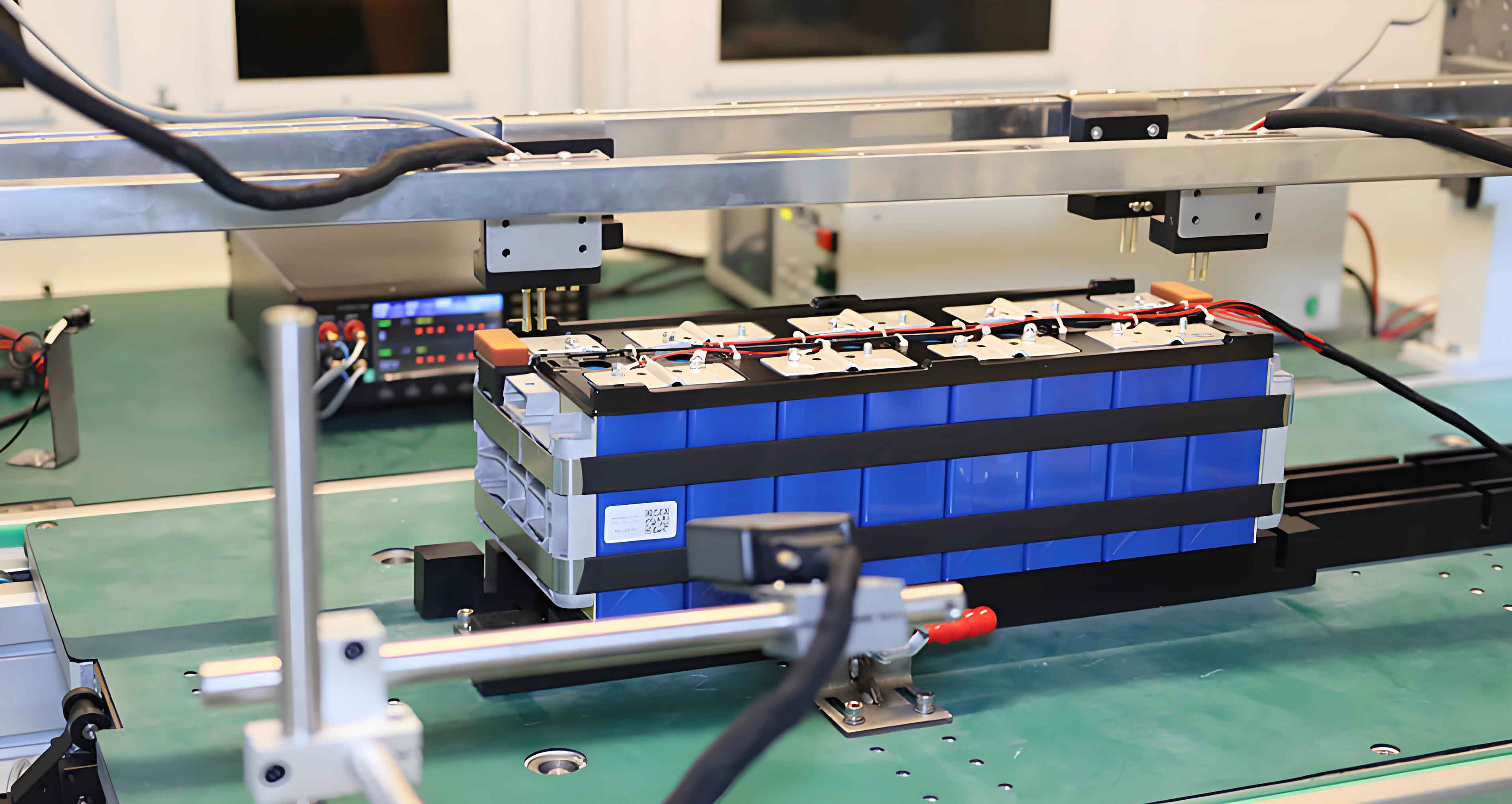
Both battery types were preconditioned to 100% SOC using standardized charge-discharge protocols. Thermal runaway was triggered by a 500 W heating plate, with temperature monitored at six critical locations (TC1-TC6). Gas composition analysis employed FTIR spectroscopy, while heat release parameters were calculated using oxygen consumption calorimetry.
2. Temperature Evolution
The LiFePO4 battery exhibited gradual temperature rise with maximum $T_{max}$ = 534.2°C, while the ternary battery reached 1,052.4°C within shorter timeframe:
| Parameter | LiFePO4 | NCM523 |
|---|---|---|
| Average Heating Rate | 0.79°C/s | 10.52°C/s |
| Thermal Runaway Duration | 294 s (max) | 148 s (max) |
The temperature differential between surface and internal locations followed:
$$ \Delta T_{LiFePO4} = T_{TC5} – T_{TC4} = 534.2 – 289.0 = 245.2°C $$
$$ \Delta T_{NCM} = T_{TC4} – T_{TC3} = 1,052.4 – 520.9 = 531.5°C $$
3. Heat Release Characteristics
Significant differences in energy release were observed:
| Metric | LiFePO4 | NCM523 |
|---|---|---|
| Total Heat Release (THR) | 0.162 MJ | 3.147 MJ |
| Peak HRR | 1.81 kW | 134.85 kW |
The heat release equation for LiFePO4 batteries demonstrates lower exothermicity:
$$ \frac{dQ}{dt}_{LiFePO4} = 1.81 \times e^{-0.012t} $$
$$ \frac{dQ}{dt}_{NCM} = 134.85 \times e^{-0.098t} $$
4. Gas Emission Analysis
Both battery types released similar gas species but with different proportions:
| Gas Component | LiFePO4 (%) | NCM523 (%) |
|---|---|---|
| H2 | 31.2 | 28.7 |
| CO | 24.5 | 19.8 |
| CO2 | 22.1 | 38.4 |
Critical gas generation mechanisms include:
$$ \text{PVDF decomposition: } \text{CH}_2\text{CF}_2 + \text{Li} \rightarrow \text{LiF} + \frac{1}{2}\text{H}_2 $$
$$ \text{SEI decomposition: } (\text{CH}_2\text{OCO}_2\text{Li})_2 \rightarrow \text{Li}_2\text{CO}_3 + \text{C}_2\text{H}_4 + \text{CO}_2 $$
5. Voltage Response Dynamics
Both batteries exhibited two-stage voltage drop:
| Event | LiFePO4 Time (s) | NCM523 Time (s) |
|---|---|---|
| First Voltage Drop | 2,237 | 1,949 |
| Second Voltage Drop | 2,576 | 1,960 |
The voltage-time relationship follows:
$$ V_{LiFePO4}(t) = 3.388 – 0.621 \times \tanh(0.005(t – 2237)) $$
$$ V_{NCM}(t) = 4.154 – 0.525 \times \text{erfc}(0.12(t – 1949)) $$
6. Early Warning Parameters
Key indicators for LiFePO4 battery safety monitoring:
| Parameter | Threshold | Lead Time |
|---|---|---|
| Voltage Drop Rate | > 0.5 V/s | 373 s |
| H2 Concentration | > 500 ppm | 294 s |
| Surface Temp Gradient | > 15°C/cm | 215 s |
The thermal runaway prevention equation for LiFePO4 batteries:
$$ \tau_{warning} = \min\left(\frac{\Delta V}{\frac{dV}{dt}}, \frac{\Delta T}{\frac{dT}{dt}}\right) \geq 300 \text{ s} $$
7. Conclusion
LiFePO4 batteries demonstrate superior thermal stability with 81% lower peak temperatures and 95% reduced total heat release compared to NCM523 batteries. The dual-stage voltage drop phenomenon provides critical early warning signals, enabling 300+ second advance detection. Gas composition analysis confirms H2 and CO as reliable indicators for early thermal runaway detection in LiFePO4 battery systems.