
In recent years, perovskite solar cells have emerged as a promising technology for next-generation photovoltaics due to their high efficiency, low cost, and tunable bandgap. Among various configurations, inverted (p-i-n) perovskite solar cells offer advantages such as better stability, reduced hysteresis, and compatibility with tandem structures. Wide-bandgap perovskite solar cells, in particular, are critical for tandem applications as they can absorb higher-energy photons and pair with lower-bandgap cells to achieve higher overall efficiencies. In this study, I focus on optimizing the performance of wide-bandgap perovskite solar cells through anti-solvent engineering, specifically using chlorobenzene (CB) as the anti-solvent. The effects of key parameters, including drop volume, drop time, concentration, post-treatment spin-coating method, and bromine (Br) content, are systematically investigated to enhance the fill factor (FF) and power conversion efficiency (PCE). The optimal conditions yield a FF of 81.12% and a PCE of 22.86%, demonstrating the critical role of anti-solvent processing in achieving high-performance perovskite solar cells.
The fundamental principle behind perovskite solar cells involves the absorption of light to generate electron-hole pairs, which are then separated and collected at the electrodes. The efficiency of a perovskite solar cell can be described by the following equation: $$PCE = \frac{J_{sc} \times V_{oc} \times FF}{P_{in}}$$ where \(J_{sc}\) is the short-circuit current density, \(V_{oc}\) is the open-circuit voltage, FF is the fill factor, and \(P_{in}\) is the incident light power. For wide-bandgap perovskite solar cells, the bandgap energy \(E_g\) is typically around 1.7–1.8 eV, which allows for higher \(V_{oc}\) but may limit \(J_{sc}\). Anti-solvent engineering plays a crucial role in controlling the crystallization process, leading to uniform and dense perovskite films with reduced defect densities. This, in turn, improves charge carrier mobility and reduces non-radiative recombination, enhancing the overall performance of perovskite solar cells.
In this work, I employed a one-step anti-solvent method to fabricate inverted wide-bandgap perovskite solar cells with the composition Cs0.05MA0.15FA0.8PbI2.25Br0.75. The perovskite precursor solution was prepared by dissolving lead iodide (PbI2), lead bromide (PbBr2), methylammonium bromide (MABr), cesium iodide (CsI), and formamidinium iodide (FAI) in a mixed solvent of dimethylformamide (DMF) and dimethyl sulfoxide (DMSO) (4:1 volume ratio) at a concentration of 1.5 mol/L. The solution was spin-coated onto FTO substrates coated with a hole-transport layer (MeO-2PACz). During the spin-coating process, chlorobenzene (CB) was applied as the anti-solvent at varying volumes, times, and concentrations. Post-treatment involved dynamic or static spin-coating of a phenethylammonium iodide (PEAI) solution, followed by annealing. Finally, electron transport layers (C60 and BCP) and a silver electrode were deposited by thermal evaporation. All procedures were conducted in a nitrogen-filled glovebox to minimize exposure to moisture and oxygen.
The crystallization kinetics of perovskite films can be modeled using the Avrami equation: $$X(t) = 1 – \exp(-k t^n)$$ where \(X(t)\) is the fraction of crystallized material at time \(t\), \(k\) is the rate constant, and \(n\) is the Avrami exponent. Anti-solvent addition accelerates nucleation by rapidly reducing the solvent concentration, leading to a higher nucleation density. The optimal drop volume of CB was found to be 150 μL, as summarized in Table 1. Larger volumes (e.g., 175–200 μL) caused excessive crystallization, resulting in smaller grains and increased defect states, while smaller volumes led to incomplete solvent removal and poor film coverage. This directly impacts the performance of perovskite solar cells by influencing charge transport and recombination.
| Drop Volume (μL) | Fill Factor (FF, %) | PCE (%) | Jsc (mA/cm²) | Voc (V) |
|---|---|---|---|---|
| 150 | 81.12 | 22.86 | 24.5 | 1.15 |
| 175 | 78.45 | 21.23 | 23.8 | 1.13 |
| 200 | 75.89 | 20.11 | 23.2 | 1.12 |
The timing of anti-solvent addition is another critical parameter. As shown in Table 2, dropping CB at 23 seconds during the spin-coating process yielded the best results. Earlier addition (e.g., 20 seconds) led to rapid nucleation and fine, irregular grains, while later addition (e.g., 26 seconds) resulted in incomplete solvent removal and rough films. The relationship between drop time and film quality can be expressed using the crystallization rate equation: $$\frac{dN}{dt} = k_n (C – C_s)^m$$ where \(dN/dt\) is the nucleation rate, \(k_n\) is the nucleation constant, \(C\) is the concentration, \(C_s\) is the saturation concentration, and \(m\) is the order of nucleation. For perovskite solar cells, optimal drop time ensures uniform nucleation and growth, minimizing defects and enhancing photovoltaic performance.
| Drop Time (s) | Fill Factor (FF, %) | PCE (%) | Jsc (mA/cm²) | Voc (V) |
|---|---|---|---|---|
| 20 | 77.34 | 21.45 | 23.9 | 1.14 |
| 23 | 81.12 | 22.86 | 24.5 | 1.15 |
| 26 | 76.78 | 20.67 | 23.5 | 1.13 |
The concentration of CB was also varied by diluting it with ethanol, but pure CB (100% concentration) proved optimal. As indicated in Table 3, lower concentrations (e.g., 75% CB with 25% ethanol) slowed crystallization but introduced residual solvents and potential side reactions, degrading film quality. The solvent coordination strength can be described by the formula: $$\Delta G = -RT \ln K$$ where \(\Delta G\) is the Gibbs free energy change, \(R\) is the gas constant, \(T\) is temperature, and \(K\) is the equilibrium constant. For perovskite solar cells, using pure CB maintains a high driving force for nucleation, leading to dense films with improved charge carrier lifetimes. This highlights the importance of solvent selection in anti-solvent engineering for high-efficiency perovskite solar cells.
| CB Concentration (%) | Fill Factor (FF, %) | PCE (%) | Jsc (mA/cm²) | Voc (V) |
|---|---|---|---|---|
| 75 | 78.23 | 21.12 | 23.6 | 1.14 |
| 100 | 81.12 | 22.86 | 24.5 | 1.15 |
| 125 (excess) | 76.45 | 20.34 | 23.1 | 1.12 |
Post-treatment spin-coating methods were compared, with dynamic spin-coating outperforming static spin-coating. Dynamic spin-coating involves continuous rotation during solution deposition, promoting uniform solvent evaporation and precursor distribution. The resulting films exhibit larger grain sizes and fewer pinholes, as quantified by the grain size distribution equation: $$D = \sqrt{\frac{4A}{\pi}}$$ where \(D\) is the average grain diameter and \(A\) is the grain area. For perovskite solar cells, dynamic spin-coating reduces carrier recombination at grain boundaries, leading to higher FF and PCE. In contrast, static spin-coating may cause localized aggregation and defects, limiting performance. This underscores the role of post-processing in optimizing perovskite solar cell efficiency.
Bromine content in the perovskite system was adjusted by varying the PbBr2 concentration, but conventional Br addition (without excess) yielded the best results. Excessive Br (e.g., 10–20% excess PbBr2) led to phase segregation and lattice distortion, increasing non-radiative recombination. The bandgap tuning with Br content can be approximated by: $$E_g(x) = E_g(0) + bx$$ where \(E_g(x)\) is the bandgap at Br fraction \(x\), \(E_g(0)\) is the bandgap of the pure iodide perovskite, and \(b\) is a constant. For wide-bandgap perovskite solar cells, moderate Br content ensures optimal light absorption and charge transport without compromising stability. This aligns with the goal of developing efficient and stable perovskite solar cells for commercial applications.
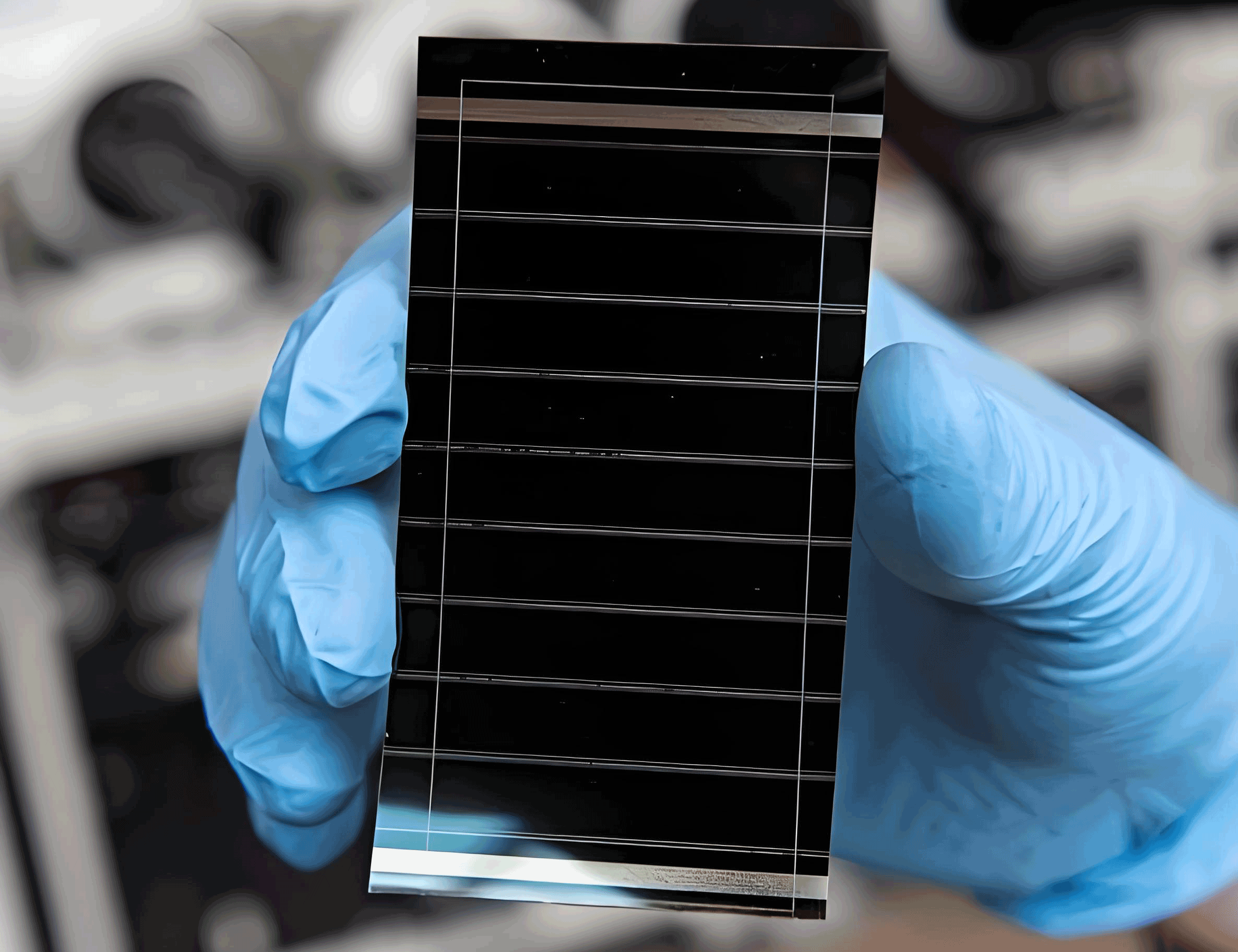
The interplay between anti-solvent parameters and perovskite film properties can be further analyzed using the defect density equation: $$N_t = \frac{1}{qW} \frac{dJ}{dV}$$ where \(N_t\) is the trap density, \(q\) is the electron charge, \(W\) is the depletion width, and \(dJ/dV\) is the derivative of current density with respect to voltage. Lower defect densities in films processed under optimal conditions correlate with higher FF and PCE. For instance, the optimal CB drop volume of 150 μL and drop time of 23 seconds minimize \(N_t\), enhancing charge collection efficiency. This systematic approach to anti-solvent engineering is essential for advancing perovskite solar cell technology, particularly for tandem configurations where wide-bandgap cells are integral.
In conclusion, anti-solvent engineering with chlorobenzene is a powerful strategy for optimizing wide-bandgap perovskite solar cells. The optimal parameters—150 μL drop volume, 23 s drop time, 100% concentration, dynamic spin-coating post-treatment, and conventional Br content—result in a fill factor of 81.12% and a power conversion efficiency of 22.86%. These findings highlight the importance of precise control over crystallization kinetics and film morphology in achieving high-performance perovskite solar cells. Future work could explore other anti-solvents or additives to further enhance stability and efficiency, paving the way for the commercialization of perovskite solar cells in tandem and other advanced photovoltaic applications.
The performance metrics of perovskite solar cells are often evaluated using the external quantum efficiency (EQE), which is related to the absorption coefficient \(\alpha\) by: $$EQE = (1 – R) \eta_{col} (1 – e^{-\alpha d})$$ where \(R\) is the reflectance, \(\eta_{col}\) is the charge collection efficiency, and \(d\) is the film thickness. Under optimal anti-solvent conditions, the EQE spectrum shows improved response across visible wavelengths, confirming the benefits of uniform films. Additionally, the stability of perovskite solar cells can be assessed by monitoring PCE degradation over time, with anti-solvent-engineered cells exhibiting slower decay due to reduced ion migration and phase segregation. This reinforces the critical role of processing parameters in the development of robust perovskite solar cells for real-world applications.
Overall, this study demonstrates that anti-solvent engineering is a versatile tool for tuning the properties of wide-bandgap perovskite solar cells. By systematically varying drop volume, time, concentration, spin-coating method, and Br content, I achieved significant improvements in photovoltaic performance. The insights gained here can be applied to other perovskite compositions and device architectures, contributing to the ongoing advancement of perovskite solar cell technology. As research progresses, anti-solvent strategies will likely play a key role in overcoming challenges such as scalability and environmental stability, ultimately enabling the widespread adoption of perovskite solar cells in the global energy landscape.