
Lithium plating remains a critical safety concern in lithium-ion batteries, particularly in energy storage systems. This work proposes a transfer learning-based framework for monitoring irreversible lithium plating by combining electrochemical-thermal-aging simulations with experimental validation. The methodology addresses data scarcity through physics-based modeling while ensuring practical applicability via domain adaptation techniques.
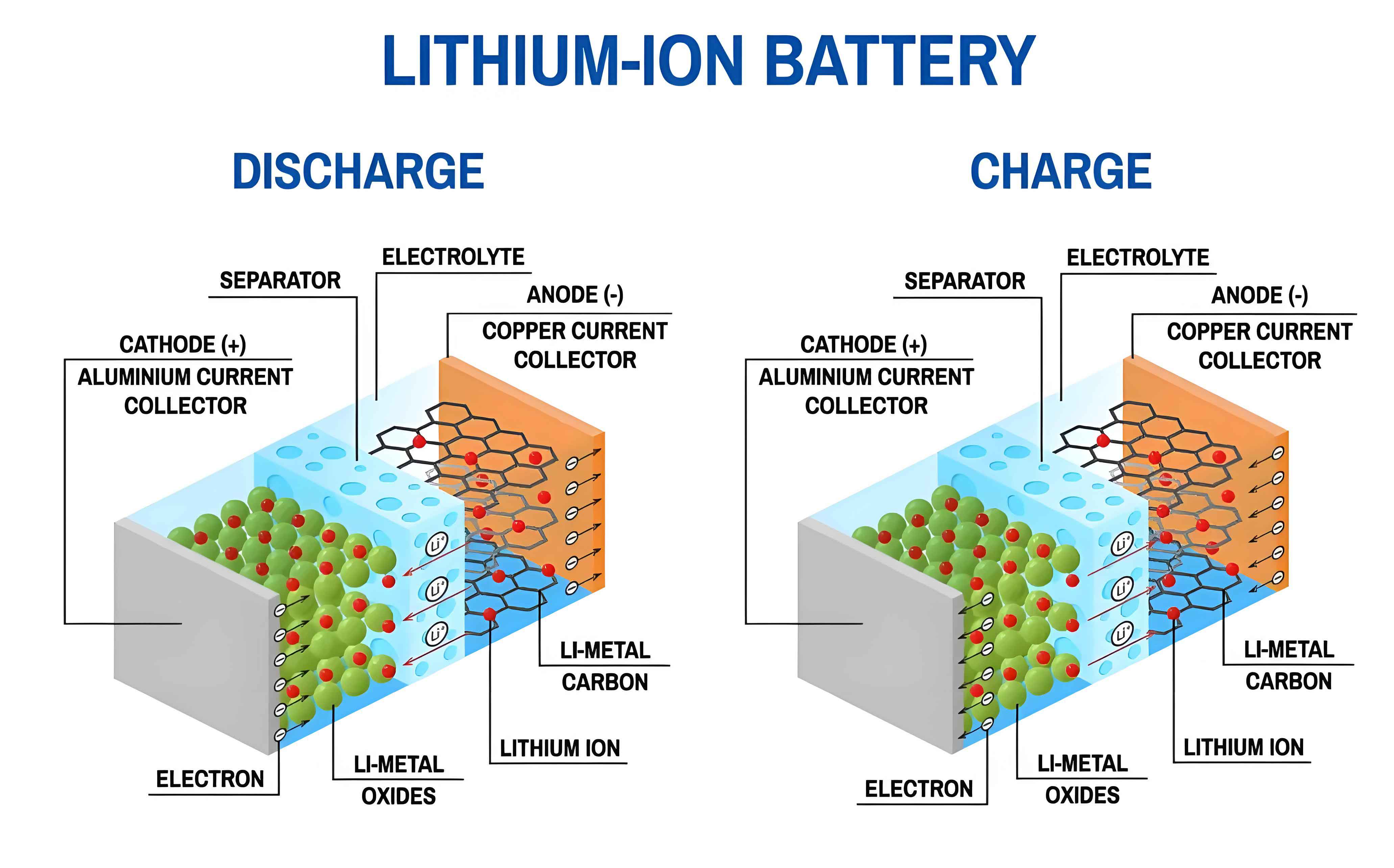
Electrochemical-Thermal-Aging Model
The pseudo-two-dimensional (P2D) model coupled with thermal effects and aging mechanisms forms the foundation for lithium plating simulation. Key electrochemical reactions governing lithium deposition/dissolution are expressed as:
$$i_{\text{SEI}} = -i_{0,\text{SEI}} \cdot e^{-\frac{\alpha_c F}{RT}\eta_{\text{SEI}}}$$
$$i_{\text{lpl}} = i_{0,\text{lpl}}\left(e^{\frac{\alpha_a F}{RT}\eta_{\text{lpl}} – e^{-\frac{\alpha_c F}{RT}\eta_{\text{lpl}}}\right)$$
$$i_{\text{lst}} = i_{0,\text{lst}}\left(e^{\frac{\alpha_a F}{RT}\eta_{\text{lst}} – e^{-\frac{\alpha_c F}{RT}\eta_{\text{lst}}}\right) \cdot f\left(\frac{g(\text{cycle})q_{\text{lpl}} – q_{\text{lst}}}{q_{\text{cor}}}\right)$$
| Temperature (°C) | Charge Rate (C) | Discharge Rate (C) |
|---|---|---|
| -10, -5, 0, 10, 25 | 2 | 1 |
| -10, -5, 0, 10, 25 | 1 | 0.05 |
| -10, -5, 0, 10, 25 | 2 | 0.5 |
Feature Engineering for Lithium Plating Detection
Thirteen discriminative features extracted from discharge curves enable effective lithium plating monitoring:
$$U_{r1} = \frac{U_A – U_{\min}}{U_{\max} – U_{\min}}$$
$$t_{r1} = \frac{t_A}{t_{\max}}$$
| Feature | Correlation Trend |
|---|---|
| ΔU (Initial voltage drop) | Positive |
| U50 (Midpoint voltage) | Negative |
| R (DC resistance) | Positive |
Transfer Learning Framework
The domain adaptation architecture combines feature extractor G, task classifier C, and domain discriminator D:
$$\mathcal{L}_y = -\frac{1}{n_s}\sum_{i=1}^{n_s}y_i\log C(G(x_i^s))$$
$$\mathcal{L}_d = -\frac{1}{n_s+n_t}\sum_{i=1}^{n_s+n_t}[d_i\log D(G(x_i)) + (1-d_i)\log(1-D(G(x_i)))]$$
| Algorithm | Accuracy | Precision |
|---|---|---|
| SVM | 98.31% | 96.98% |
| KNN | 99.16% | 99.13% |
| MLP | 99.28% | 98.29% |
Experimental Validation
Low-temperature cycling tests on LiFePO4 cells demonstrate the method’s effectiveness:
$$Q_{\text{irr}} = \int_0^{t_{\text{cyc}}} (i_{\text{lpl}} – \eta_{\text{diss}}i_{\text{lst}})dt$$
| Cell Group | Capacity Retention | Plating Detection |
|---|---|---|
| 25°C Cycling | 82.34% ± 6.12 | Negative |
| -11°C Cycling | 41.79% ± 10.45 | Positive |
Conclusion
This transfer learning approach enables accurate irreversible lithium plating detection in lithium-ion batteries, achieving 99.28% accuracy on simulation data and consistent experimental validation. The framework demonstrates strong potential for real-world battery management systems through effective domain adaptation between simulated and experimental conditions.