
The evaluation of energy storage systems within modern power grids, particularly microgrids, increasingly relies on understanding the long-term behavior and degradation of their core component: the li ion battery. These batteries, prized for their high energy and power density, low self-discharge, and relatively long cycle life, form the backbone of Battery Energy Storage Systems (BESS). The economic viability and operational reliability of a BESS are critically dependent on the accurate prediction of battery lifetime, as premature failure and replacement drive costs upward. However, the degradation of a li ion battery is not a simple function of time or cycles; it is a complex process accelerated by the dynamic operating conditions encountered in real-world applications, such as fluctuating temperatures, varying depths of discharge, and changing charge/discharge rates. This work aims to develop a robust, adaptable model for capacity fade prediction in li ion battery systems under such multi-stress conditions.
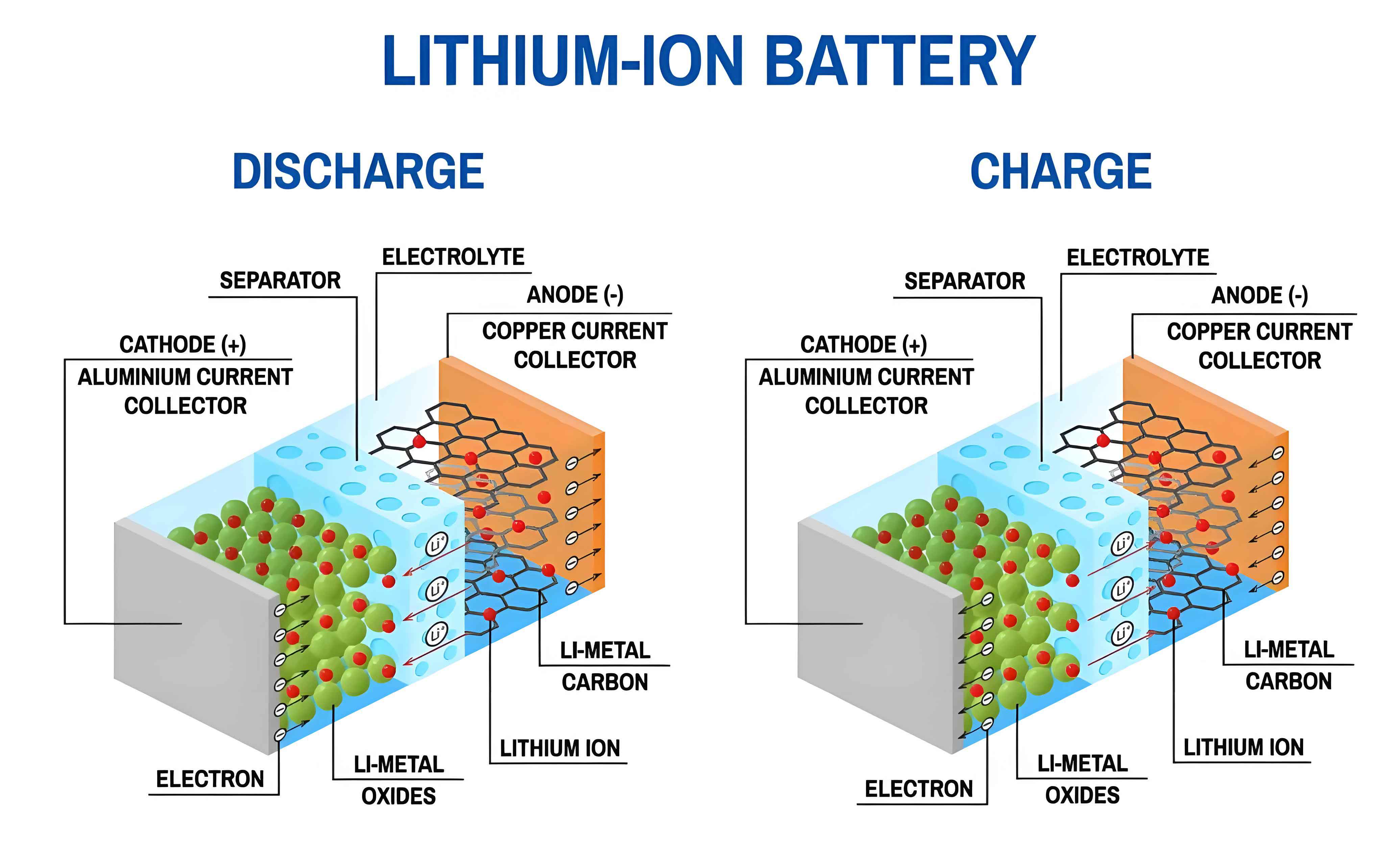
Existing models range from purely empirical correlations to complex electrochemical formulations. While multi-factor empirical models improve upon single-stress models by accounting for conditions like State-of-Charge (SOC), temperature, and Depth-of-Discharge (DOD), they often assume a linear degradation rate. This contradicts observed behavior where a li ion battery typically exhibits a “rapid-slow-rapid” capacity fade trajectory. Furthermore, models developed for specific applications may not generalize well, necessitating costly and time-consuming aging tests for each new use case. To address these limitations, this article presents a semi-empirical degradation model. It integrates a multi-stress framework with a mechanistic representation of the Solid Electrolyte Interphase (SEI) layer growth, a primary cause of early-life capacity loss in li ion battery cells. The model is parameterized using degradation data from Graphite/LiFePO4 (LFP) cells and validated against experimental cycle life tests, demonstrating superior predictive accuracy compared to conventional models.
Modeling Capacity Fade Under Multiple Operational Stresses
The total irreversible capacity loss of a li ion battery in operation arises from two distinct yet concurrent aging modes: calendar aging and cycle aging. Calendar aging occurs during idle periods and is driven primarily by time, average SOC, and temperature. Cycle aging results from the charge-discharge processes and is influenced by factors like DOD, C-rate, SOC swing, and temperature during cycling. A comprehensive model must aggregate the damage from both modes.
We define the total normalized capacity loss, \( L \) (where \( L=0 \) for a new battery and \( L=0.2 \) at End-of-Life typically defined as 80% of initial capacity), as a function of operational history. The linear degradation rate from calendar aging can be expressed as a function of time \(t\), average SOC \(\overline{\phi}\), and average temperature \(\overline{T_c}\):
$$ f_{cal} = f_t(t, \overline{\phi}, \overline{T_c}) $$
Cycle aging is modeled by summing the degradation caused by each individual charge-discharge cycle, identified using a cycle counting algorithm (e.g., rainflow counting). If \(n_i\) represents the weighted count (e.g., 1 for a full cycle, 0.5 for a half-cycle) of the \(i\)-th cycle characterized by its specific DOD \(\theta_i\), SOC \(\phi_i\), and temperature \(T_{c,i}\), the cyclic degradation rate is:
$$ f_{cyc} = \sum_i n_i f_c(\theta_i, \phi_i, T_{c,i}) $$
Assuming the effects are additive, the combined linearized capacity loss rate \(f_{loss}\) is:
$$ f_{loss}(t, \theta, \phi, T_c) = f_t(t, \overline{\phi}, \overline{T_c}) + \sum_i n_i f_c(\theta_i, \phi_i, T_{c,i}) $$
For simplified cases, this can be reduced. For pure calendar aging (no cycles):
$$ f_{loss} = t \cdot f_d^t $$
where \(f_d^t\) is the capacity loss per unit time. For repetitive cycles with identical stress profiles \(\theta\), \(\phi\), \(T_c\), and duration \(t_c\):
$$ f_{loss}^{cyc}(N) = N \left( f_t(t_c, \phi, T_c) + f_c(\theta, \phi, T_c) \right) = N \cdot f_{loss,1} $$
where \(N\) is the number of equivalent full cycles and \(f_{loss,1}\) is the linearized loss per cycle. The functions \(f_t\) and \(f_c\) are typically decomposed into stress factor models. Each stress factor \(S_x\) models the accelerating effect of a single variable \(x\) on the degradation rate relative to a reference condition.
$$ f_c(\theta, \phi, T_c) = S_{\theta}(\theta) \cdot S_{\phi}(\phi) \cdot S_T(T_c) $$
$$ f_t(t, \phi, T_c) = S_t(t) \cdot S_{\phi}(\phi) \cdot S_T(T_c) $$
The specific forms of these stress factor models for a li ion battery, particularly LFP chemistry, are often derived from experimental data. A common representation is:
| Stress Factor | Model Form | Description |
|---|---|---|
| Depth of Discharge (DOD), \(S_{\theta}\) | \(k_{\theta 1} \cdot \theta^{\,k_{\theta 2}}\) | Power-law relationship. Exponent \(k_{\theta 2}\) is typically negative, indicating higher degradation per cycle at higher DOD. |
| State of Charge (SOC), \(S_{\phi}\) | \(\exp\left(k_{\phi} (\phi – \phi_{ref})\right)\) | Exponential acceleration with increasing average SOC. \(\phi_{ref}\) is a reference SOC (often ~0.5). |
| Temperature, \(S_T\) | \(\exp\left(k_T (T_c – T_{c,ref}) \cdot \frac{T_{c,ref}}{T_c}\right)\) | Arrhenius-type dependence. \(T_c\) is in Kelvin, \(T_{c,ref}\) is reference temperature (e.g., 298.15K). |
| Time, \(S_t\) | \(k_t \cdot t\) | Linear dependence on storage time for calendar aging. |
Therefore, the overall linear loss from combined operation can be summarized as:
$$ f_{loss} = [S_{\theta}(\theta) + S_t(t)] \cdot S_{\phi}(\phi) \cdot S_T(T_c) $$
While this multi-stress framework is powerful, its fundamental assumption of a constant degradation rate per stress event (\(f_{loss,1}\)) is a significant limitation. Experimental data from li ion battery cycling reveals a non-linear trajectory, challenging this linearity assumption.
Integrating Mechanism and Experience: The Semi-Empirical Approach
Observed degradation data for a li ion battery, such as from accelerated cycle testing of an LFP cell, consistently shows non-linear behavior. The capacity fade rate is high in the initial cycles, stabilizes to a slower, relatively steady rate in the mid-life, and then accelerates again as the battery approaches end-of-life. This “non-linear” reality necessitates a modification to the linear damage accumulation model.
The actual loss of normalized capacity \(L\) per cycle is not constant but is related to the remaining active material or, more specifically, the remaining cyclable lithium. A key insight is that the degradation rate is proportional to the remaining battery “health” \((1-L)\). This leads to a differential equation:
$$ \frac{dL}{dN} = (1 – L) \cdot f_{loss,1} $$
Solving this gives an exponential capacity fade model:
$$ L = 1 – e^{-N \cdot f_{loss,1}} = 1 – e^{-f_{loss}} $$
This model accounts for the deceleration effect but still fails to capture the initial rapid fade phase commonly observed in a li ion battery. This early-life acceleration is widely attributed to the formation and growth of the Solid Electrolyte Interphase (SEI) layer on the anode surface. During the initial cycles, a significant amount of active lithium is irreversibly consumed to form this passive film. The SEI formation rate is high initially and slows down as the film stabilizes.
To model this, we partition the total lithium inventory. Let \(\alpha_{sei}\) represent the fraction of charge capacity irreversibly lost to form a stable SEI layer. The remaining fraction \((1-\alpha_{sei})\) degrades according to the exponential mechanism above. The SEI formation itself is modeled as a separate exponential process with its own rate factor, \(\beta_{sei} \cdot f_{loss}\), where \(\beta_{sei}\) is a scaling constant. The combined semi-empirical model is a dual-exponential function:
$$ L = 1 – \alpha_{sei} e^{-\beta_{sei} f_{loss}} – (1 – \alpha_{sei}) e^{-f_{loss}} $$
This is the core of the proposed model. It seamlessly blends the physically-motivated SEI growth (mechanistic component) with the stress-dependent exponential decay (empirical component). For a battery that has already passed the initial formation stage (i.e., \(L > 0.9\)), the SEI term becomes negligible, and the model simplifies to the single exponential form, which can be re-initialized with a known current capacity \(L’\):
$$ L = 1 – (1 – L’) e^{-f_{loss}} $$
This allows for field updates if the state of health is periodically diagnosed. The complete semi-empirical model for a li ion battery, integrating all stress factors, is therefore:
$$
\begin{aligned}
L = 1 &- \alpha_{sei} \exp\left(-\beta_{sei} \cdot \left[ (k_{\theta 1}\theta^{\,k_{\theta 2}} + k_t t) \cdot e^{k_{\phi}(\phi – \phi_{ref})} \cdot e^{k_T (T_c – T_{c,ref}) \cdot \frac{T_{c,ref}}{T_c}} \right] \right) \\
&- (1 – \alpha_{sei}) \exp\left(-\left[ (k_{\theta 1}\theta^{\,k_{\theta 2}} + k_t t) \cdot e^{k_{\phi}(\phi – \phi_{ref})} \cdot e^{k_T (T_c – T_{c,ref}) \cdot \frac{T_{c,ref}}{T_c}} \right] \right)
\end{aligned}
$$
For practical parameterization using controlled test data, the model can be applied to cycle aging tests (varying N) and calendar aging tests (varying t) separately:
For Cycle Test Fitting: \(L = 1 – \alpha_{sei} e^{-N \beta_{sei} f_{loss,1}} – (1 – \alpha_{sei}) e^{-N f_{loss,1}}\)
For Calendar Test Fitting: \(L = 1 – \alpha_{sei} e^{-t \beta_{sei} f_d^t} – (1 – \alpha_{sei}) e^{-t f_d^t}\)
This formulation provides a structured method to extract the universal stress factor coefficients (\(k_{\theta 1}, k_{\theta 2}, k_{\phi}, k_T, k_t\)) and the SEI parameters (\(\alpha_{sei}, \beta_{sei}\)) from standard battery aging datasets. Once calibrated, the model can be generalized to predict li ion battery life under arbitrary duty cycles by accumulating the stress factor \(f_{loss}\) over the operational profile.
Parameterization and Model Validation
The proposed semi-empirical model was calibrated and validated using degradation data from Graphite/LFP li ion battery cells. Model parameters were determined by fitting to three key types of experimental data: calendar aging at different temperatures and SOC levels, and cycle life as a function of DOD.
The table below summarizes the calibrated parameters for the model specific to the LFP li ion battery chemistry studied:
| Model Component | Parameter | Value |
|---|---|---|
| SEI Formation | \(\alpha_{sei}\) | 0.055 |
| \(\beta_{sei}\) | 110 | |
| Time (Calendar) | \(k_t\) | \(4.14 \times 10^{-10} \, \text{s}^{-1}\) |
| Temperature | \(k_T\) | 0.071 K\(^{-1}\) |
| \(T_{c,ref}\) | 298.15 K | |
| State of Charge (SOC) | \(k_{\phi}\) | 1.04 |
| \(\phi_{ref}\) | 0.50 | |
| Depth of Discharge (DOD) | \(k_{\theta 1}\) | 5.22 |
| \(k_{\theta 2}\) | -0.046 |
With parameters defined, the model’s predictive accuracy was tested against actual cycle aging data and compared to two common empirical models: a basic Arrhenius-rate model and an Ah-throughput model. The comparison was conducted under two distinct cycling conditions: 50% DOD and 100% DOD, with other conditions held constant at 25°C, 50% average SOC, and a 3C rate.
The results clearly demonstrate the advantage of the semi-empirical approach. Under both test conditions, the proposed model’s fitted curve closely follows the experimental data points across the entire cycle life, accurately capturing the initial curvature and the long-term trend. In contrast, the simpler models show systematic deviations.
A quantitative analysis of the fit at 250 cycles for the 50% DOD test reveals the performance gap. With a measured capacity fade of 5.05%, the predictions and errors were:
| Model | Predicted Fade at 250 cycles | Prediction Error | Fit Correlation (R²) |
|---|---|---|---|
| Proposed Semi-Empirical | 5.20% | 2.97% | 0.9994 |
| Arrhenius Model | 6.02% | 19.20% | 0.9800 |
| Ah-Throughput Model | 6.90% | 36.63% | 0.9983 |
Similarly, for the 100% DOD test, the prediction error for the proposed li ion battery model remained low at approximately 2.50%. This consistent sub-3% error across different stress conditions underscores the model’s robustness and significantly improved accuracy over conventional methods. The high R² values further confirm the excellent fit of the semi-empirical model to the experimental data.
Conclusion and Implications for Li-Ion Battery Storage Systems
Accurate lifetime prediction is paramount for the techno-economic optimization of BESS. This work has developed and validated a generalized semi-empirical capacity fade model for li ion battery cells. The model’s strength lies in its hybrid structure: it incorporates the multi-stress dependency of empirical models while embedding the non-linear degradation dynamics rooted in the physical mechanism of SEI layer growth. This allows it to accurately replicate the characteristic “rapid-slow-rapid” aging trajectory of a li ion battery.
The model formulation provides a practical methodology. The stress factor coefficients (\(k_{\theta}, k_{\phi}, k_T, k_t\)) and the SEI parameters (\(\alpha_{sei}, \beta_{sei}\)) can be calibrated using standard cycle and calendar aging tests from manufacturers or targeted experiments. Once parameterized for a specific li ion battery chemistry and design, the model becomes a powerful tool for life assessment under arbitrary loading profiles. By using cycle counting algorithms to decompose a complex operational duty cycle into equivalent stress events, the cumulative stress factor \(f_{loss}\) can be calculated and fed into the dual-exponential model to predict remaining capacity.
The validation against LFP battery data demonstrated that the model maintains high predictive accuracy, with errors within 3%, significantly outperforming common empirical models. This level of accuracy can lead to more reliable life-cycle cost analyses, optimal sizing of battery banks with consideration for degradation, and improved warranty and maintenance strategies for grid-scale and microgrid li ion battery storage systems. The model’s adaptability means it can be extended to other lithium-ion chemistries, provided the appropriate aging data is available for parameter fitting, making it a versatile framework for energy storage engineering and planning.