
In addressing the critical challenge of dust accumulation on solar panels, particularly in arid regions, I have developed an innovative trackless dry-cleaning robot based on negative pressure adsorption. The efficiency of solar panels is severely compromised by dust deposition, which reduces light transmittance and leads to hotspots, ultimately diminishing power output. Traditional cleaning methods, such as manual labor or rail-based robots, are often inefficient, costly, or unsuitable for large-scale installations in harsh environments like deserts. My design focuses on a portable, autonomous robot that can adhere to inclined solar panel surfaces without tracks, using a combination of brushes and airflow for effective cleaning. This article details the structural design, working principles, and validation of this robot, emphasizing its applicability to solar panel maintenance in distributed and centralized solar farms.
The growing global energy demand and the shift toward sustainable power sources have made solar energy a cornerstone of renewable energy systems. Solar panels, however, are prone to dust accumulation, especially in regions with high solar irradiance like deserts. Studies show that even minimal dust layers can reduce photovoltaic efficiency by over 10%, and in severe cases, cause permanent damage due to uneven heating. Cleaning these solar panels is thus essential, but current methods face limitations. Manual cleaning is labor-intensive and inefficient, while rail-based robots require extensive infrastructure and are prone to failure in sandy conditions. Water-based cleaning systems are impractical in water-scarce areas. My robot overcomes these issues by employing a dry, trackless approach that leverages negative pressure adsorption for stability and mobility on inclined solar panel surfaces.
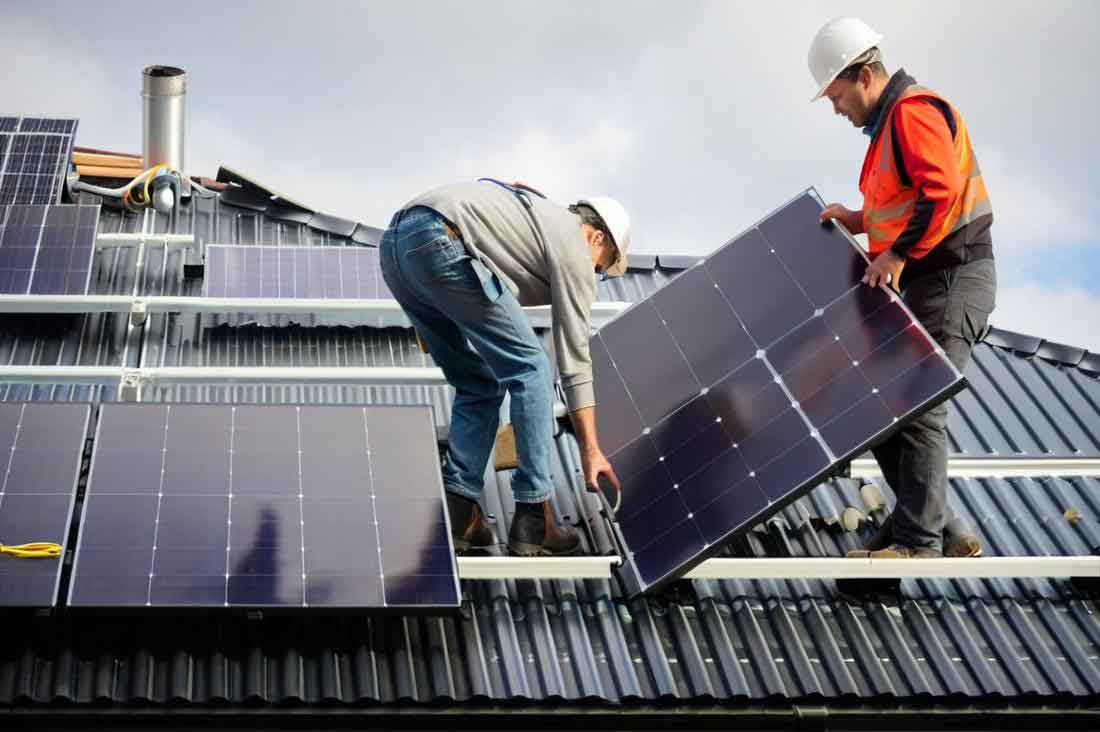
The core innovation lies in the robot’s ability to maintain adhesion on solar panels with tilt angles up to 45°, common in installations for optimal sun exposure. The robot uses eight ducted fans to create a negative pressure chamber underneath, generating an adhesive force that counteracts gravity and prevents slippage. The required negative pressure force \( F \) is derived from the robot’s weight \( G \), the solar panel inclination angle \( \alpha \), the coefficient of friction \( \mu \), and the contact area \( S \). The equilibrium condition is given by:
$$ F \geq \frac{G \sin \alpha – \mu G \cos \alpha}{\mu S} $$
This ensures the robot remains stable on the solar panel surface. The negative pressure is achieved by evacuating air from the chamber, creating a pressure difference \( P_V \) relative to atmospheric pressure. According to the Bernoulli principle, the pressure difference relates to the airflow velocity \( v \) and air density \( \rho \):
$$ P_V = \frac{\rho v^2}{2} $$
The minimum airflow rate \( Q_{\text{min}} \) needed to maintain adhesion depends on the chamber geometry, specifically the perimeter \( L \) and the gap distance \( d \) between the robot底盘 and the solar panel surface:
$$ Q_{\text{min}} = \sqrt{\frac{2(G \sin \alpha – \mu G \cos \alpha)}{\rho \mu S}} \cdot L d $$
This relationship highlights that a smaller gap \( d \) reduces the required airflow, enhancing efficiency. For typical solar panel installations with \( \alpha = 45^\circ \), \( G = 15 \, \text{kg} \), \( \mu = 0.5 \), \( S = 0.64 \, \text{m}^2 \), \( \rho = 1.2 \, \text{kg/m}^3 \), \( L = 3.2 \, \text{m} \), and \( d = 0.01 \, \text{m} \), the calculated \( Q_{\text{min}} \) is approximately \( 0.15 \, \text{m}^3/\text{s} \). The ducted fans are selected to exceed this value, ensuring robust performance across various solar panel conditions.
The robot’s overall structure is compact, measuring 800 mm × 800 mm × 350 mm, and comprises three main components: a导流罩 (airflow guide cover), a dust collection箱, and a底盘 assembly. The chassis houses the control system, sensors, and drive mechanisms, all designed for quick disassembly to facilitate maintenance and upgrades. Key specifications are summarized in Table 1.
| Parameter | Value | Description |
|---|---|---|
| Dimensions | 800 × 800 × 350 mm | Length × width × height |
| Weight | 15 kg | Including batteries and components |
| Ducted Fans | 8 units | 70 mm 6S 2300 kV, max thrust 2.24 kg each |
| Total Thrust | 17.92 kg | Maximum adhesive force |
| Battery | 18650 Li-ion | Provides up to 2 hours of operation |
| Control Unit | STM32 microcontroller | Manages sensors and motors |
| Cleaning Speed | 150 m²/h | Efficiency on dusty solar panels |
| Tilt Angle Range | 30° to 45° | Compatible with typical solar panel installations |
The底盘 is the heart of the robot, integrating multiple systems for autonomous operation. It features four dual-brush cleaning units, each consisting of a dry brush and a silicone brush, arranged to form a semi-enclosed negative pressure chamber. The dry brushes dislodge dust from the solar panel surface, while the silicone brushes sweep residual particles into the airflow path. The ducted fans, mounted on the chassis, exhaust air from the chamber, creating suction that draws dust into the collection箱 via the导流罩. This “three-in-one” cleaning method—combining mechanical brushing, airflow suction, and silicone wiping—ensures thorough cleaning without water or chemicals, which is ideal for arid regions where water scarcity affects solar panel maintenance.
Mobility on the solar panel is achieved through the dual-brush units, which serve dual roles: cleaning and propulsion. Each brush is driven by a stepper motor controlled by the STM32 microcontroller. The primary drive motor rotates the brushes to provide traction, allowing the robot to move along the solar panel surface. A secondary flip motor adjusts the tilt angle of the brushes on the sides, modulating the chamber’s密封性 to control negative pressure and enable steering. For instance, when the robot approaches the edge of a solar panel, the side brushes can be pressed down to increase adhesion and prevent falls. This adaptive control is crucial for navigating the smooth, inclined surfaces of solar panels, especially during跨板 maneuvers over gaps up to 40 mm wide.
Sensors play a vital role in autonomous functionality. The robot is equipped with laser distance sensors, ambient light sensors, gyroscopes, and force sensors, all interconnected via a CAN bus system. The laser sensors measure the distance to the solar panel surface, detecting edges or seams to guide movement. Gyroscopes monitor orientation, allowing the microcontroller to correct deviations from the intended path. Ambient light sensors compare reflectivity before and after cleaning to assess effectiveness; if the change is insufficient, the robot alerts for re-cleaning. Force sensors on the brush mounts provide real-time feedback on pressure分布, enabling dynamic adjustment of fan speeds to maintain stability. This sensor fusion ensures reliable operation without human intervention, from initial positioning on the solar panel to automatic edge detection,偏差 correction, acceleration, deceleration, and obstacle crossing.
The cleaning performance is quantified through a detailed analysis of dust removal efficiency. For a solar panel with an initial dust density of \( \delta_0 \) (e.g., 0.64 g/m² as cited in literature), the power loss reduction \( \Delta P \) after cleaning can be expressed as:
$$ \Delta P = \eta \cdot A \cdot (\delta_0 – \delta_f) $$
where \( \eta \) is the cleaning efficiency coefficient (typically 0.8–0.9 for this robot), \( A \) is the solar panel area, and \( \delta_f \) is the final dust density. In field tests, the robot achieved \( \delta_f < 0.1 \, \text{g/m}^2 \) on solar panels with \( \delta_0 = 0.64 \, \text{g/m}^2 \), corresponding to a power recovery of over 12%. The清洁 process is further optimized by the airflow dynamics within the negative pressure chamber. The pressure distribution \( P(x,y) \) across the solar panel surface under the robot can be modeled using the Navier-Stokes equations simplified for steady, incompressible flow:
$$ \nabla P = -\rho (\mathbf{v} \cdot \nabla) \mathbf{v} + \mu \nabla^2 \mathbf{v} $$
where \( \mathbf{v} \) is the velocity field. Practically, the ducted fans generate a uniform suction that ensures dust particles are entrained and directed to the collection箱. The dust collection efficiency \( \epsilon \) is defined as the ratio of captured dust mass to total dislodged dust, and for this design, \( \epsilon \approx 0.85 \) based on experimental data. This high efficiency prevents re-deposition on the solar panel, a common issue with other dry methods.
To validate the design, I constructed a prototype using lightweight alloys and 3D-printed parts. The key验证 focused on adhesion stability, cleaning effectiveness, and autonomy. On solar panels tilted at 45° in a desert-like environment, the robot maintained adhesion even under wind loads up to 10 m/s, thanks to the redundant fan system. The cleaning tests involved solar panels with自然积尘 over one month; the robot cleaned at a rate of 150 m²/h, covering standard solar panel arrays efficiently.跨板 tests confirmed seamless transition over 40 mm gaps without loss of pressure or balance. Table 2 summarizes the performance metrics compared to traditional methods, highlighting advantages for solar panel maintenance.
| Method | Cleaning Efficiency (m²/h) | Water Usage | Infrastructure Need | Cost per m² ($) | Suitability for Arid Regions |
|---|---|---|---|---|---|
| Manual Cleaning | 50 | High | None | 0.5 | Low |
| Rail-based Robot | 100 | Low | Extensive tracks | 0.3 | Medium |
| Water-based Vehicle | 200 | Very High | Flat terrain | 0.4 | Low |
| This Robot (Negative Pressure) | 150 | None | None | 0.2 | High |
The robot’s control algorithm, implemented on the STM32, uses a PID (Proportional-Integral-Derivative) controller to regulate brush speeds and fan outputs based on sensor inputs. The system state is described by variables such as position \( x \), velocity \( v \), and adhesion force \( F_a \). The control law for maintaining a constant velocity on the solar panel surface is:
$$ u(t) = K_p e(t) + K_i \int_0^t e(\tau) d\tau + K_d \frac{de(t)}{dt} $$
where \( e(t) = v_{\text{desired}} – v_{\text{actual}} \), and \( u(t) \) is the motor output. This ensures smooth acceleration and deceleration, preventing jerks that could compromise adhesion on the solar panel. For edge detection, the laser sensor data is processed to identify discontinuities; when an edge is detected, the robot executes a turn sequence by differentially driving the brushes. The energy consumption is primarily from the ducted fans and motors, with the battery providing 2 hours of runtime, sufficient for cleaning multiple rows of solar panels in a typical farm.
In terms of scalability, this robot is designed for both large-scale solar farms and distributed solar panel systems. Its trackless nature eliminates the need for rails, reducing installation costs and avoiding issues like sand clogging. The modular design allows for easy replacement of parts, such as brushes or fans, minimizing downtime. Future iterations could integrate solar charging to extend operation time, or AI-based path planning for optimized cleaning schedules based on weather and dust accumulation patterns on solar panels. Environmental benefits are significant, as regular cleaning boosts solar panel output by 10–15%, enhancing the return on investment for solar energy projects.
In conclusion, I have presented a comprehensive design for a negative pressure adsorption trackless cleaning robot tailored for solar panel maintenance. The robot combines mechanical brushing, airflow suction, and smart control to achieve efficient, water-free cleaning on inclined solar panel surfaces. Its autonomous capabilities, driven by advanced sensors and algorithms, make it a practical solution for arid regions where dust accumulation severely impacts solar panel performance. The design验证 confirms its reliability and effectiveness, offering a cost-effective alternative to existing methods. As solar energy continues to expand, such innovations will play a crucial role in sustaining the efficiency and longevity of solar panel installations worldwide.