
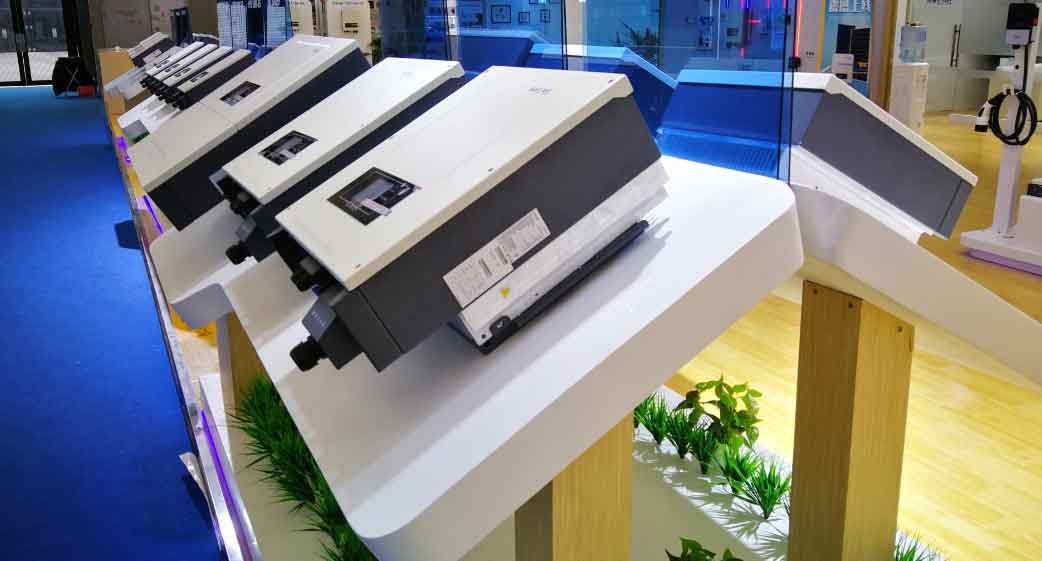
With the increasing global energy demand, energy storage inverters have become critical components for integrating renewable energy sources into power systems. This paper presents a comprehensive analysis of a 20kW three-phase energy storage inverter with multi-mode operation capabilities, focusing on hardware design, control strategies, and intelligent energy management.
1. Topology and Operating Principles
The proposed energy storage inverter employs a T-type three-level topology for DC-AC conversion, offering reduced switching losses and improved waveform quality compared to conventional two-level inverters. The system architecture comprises:
| Topology | Switches | Loss Distribution | Cost |
|---|---|---|---|
| NPC | 12 | Unbalanced | Medium |
| ANPC | 18 | Balanced | High |
| T-Type | 12 | Balanced | Low |
The boost converter in the photovoltaic (PV) side operates with the relationship:
$$V_{bus} = \frac{V_{PV}}{1-D}$$
where \( D \) represents the duty cycle. The battery interface employs bidirectional buck-boost conversion:
$$V_{Bat} = \begin{cases}
D_1V_{bus} & \text{(Buck Mode)} \\
\frac{V_{bus}}{1-D_2} & \text{(Boost Mode)}
\end{cases}$$
2. Hardware Implementation
The power stage design parameters are optimized for 20kW operation:
| Parameter | Value |
|---|---|
| PV Input Range | 200-1000V |
| Battery Voltage | 200-700V |
| Output Power | 20kW |
| Switching Frequency | 20kHz |
The T-type three-level inverter uses IGBT modules with optimized gate drive circuits:
$$R_{drive} = \frac{V_{CC}-V_{GE}}{I_{peak}}$$
where \( V_{GE} \) represents the IGBT gate-emitter voltage and \( I_{peak} \) the peak drive current.
3. Control Strategy Implementation
The energy storage inverter employs adaptive MPPT using perturb and observe algorithm:
$$\Delta P = P(k) – P(k-1)$$
$$\Delta V = \begin{cases}
+\delta V & \text{if } \Delta P > 0 \\
-\delta V & \text{otherwise}
\end{cases}$$
Battery management utilizes dual-loop control:
$$G_{outer}(s) = K_p + \frac{K_i}{s}$$
$$G_{inner}(s) = \frac{1}{sL + R}$$
4. Energy Management Strategy
The system supports ten operational modes through intelligent power allocation:
| Mode | Power Flow |
|---|---|
| PV Bat Off-grid | PV + Battery → Load |
| Grid Charge | Grid → Battery |
| PV Grid Feed | PV → Grid |
Mode transitions achieve seamless switching within 8ms through predictive synchronization:
$$t_{sync} = \frac{|\Delta\theta|}{2\pi f_{grid}}$$
5. Experimental Verification
The prototype demonstrates excellent performance metrics:
| Module | Efficiency |
|---|---|
| PV Converter | 99.2% |
| Battery Interface | 97.8% |
| Inverter Stage | 98.4% |
Waveform quality meets international standards with THD < 3%:
$$THD = \frac{\sqrt{\sum_{n=2}^{50}V_n^2}}{V_1} \times 100\%$$
6. Grid Interaction Performance
The energy storage inverter maintains unity power factor operation:
$$PF = \cos(\theta_v – \theta_i)$$
with less than 0.5% DC current injection:
$$I_{DC} = \frac{1}{T}\int_0^T|i_{grid}(t)|dt$$
This comprehensive design approach enables the energy storage inverter to achieve 96.8% system efficiency while supporting multiple operational modes and seamless grid transitions. The developed prototype has undergone rigorous testing for commercial deployment in residential and commercial energy systems.