
In the contemporary era, the global energy landscape is characterized by increasing demand, environmental degradation, and a pressing need for sustainable solutions. Solar photovoltaic power generation stands out as one of the most promising green industries of the 21st century, driven by heightened environmental awareness and supportive policies. The inherent advantages of a solar system—such as short construction cycles, minimal maintenance, no fuel consumption, and virtually inexhaustible energy—make it increasingly attractive. However, reducing costs and improving efficiency remain critical research challenges. In this article, we systematically analyze and design key aspects of a solar system, focusing on inverter topology, battery capacity, and maximum power point tracking. A comprehensive approach is essential for optimizing the performance and viability of any solar system.
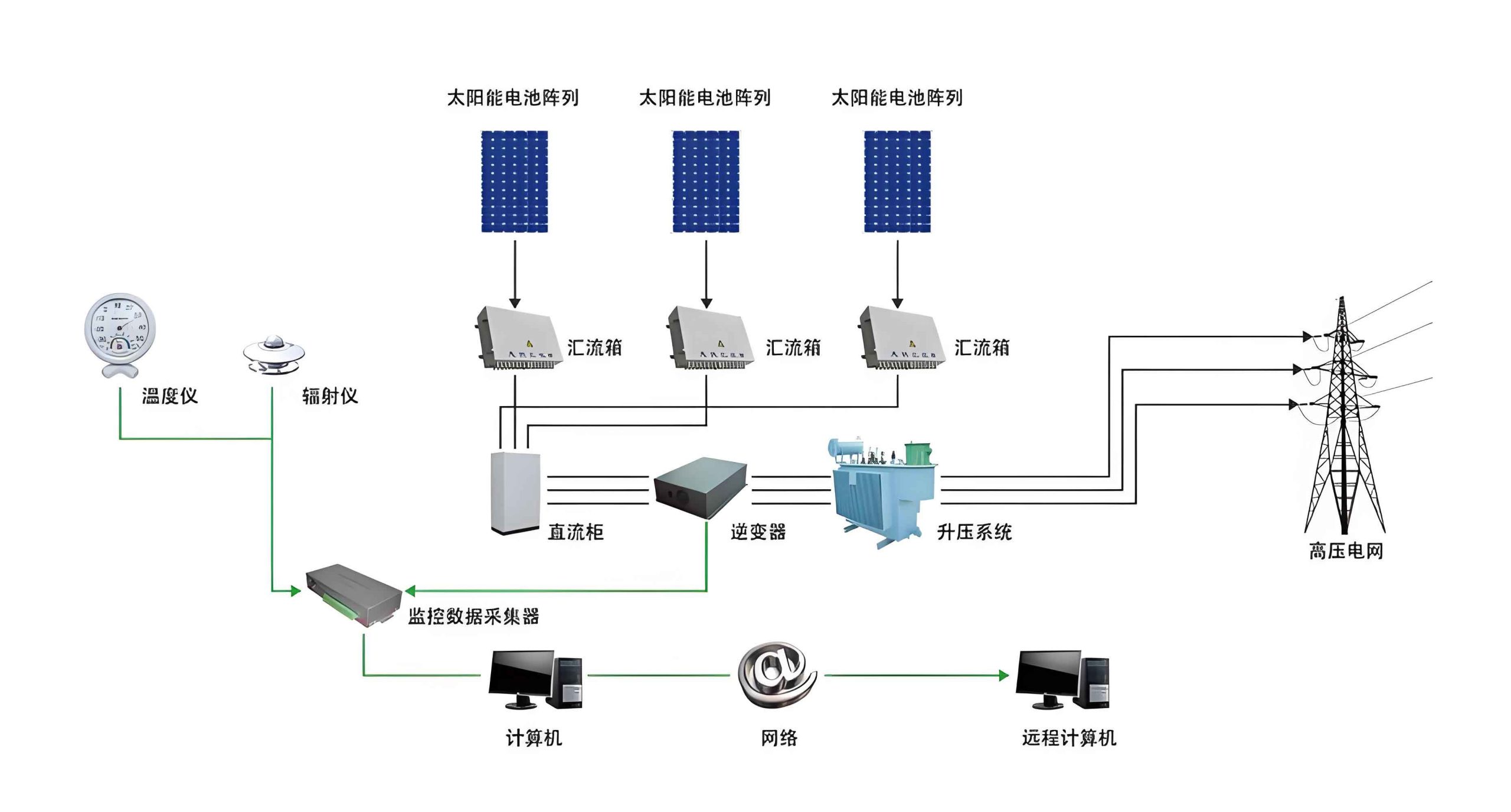
The fundamental components of a solar system include photovoltaic panels, charge controllers, batteries, inverters, and loads. Each element plays a pivotal role in ensuring efficient energy conversion and storage. This design emphasizes the inverter and energy storage subsystems, as they directly impact the overall efficiency and reliability of the solar system. We begin by examining the inverter’s topology, which is crucial for converting DC power from panels or batteries to AC power for practical use.
Inverter Topology Design
The inverter is a core component in any solar system, responsible for transforming DC electricity into AC electricity suitable for grid connection or off-grid applications. Its design significantly influences the system’s efficiency, cost, and durability. We focus on the DC-DC boost stage and the inverter stage, comparing various topologies to select the most appropriate for our solar system.
Comparison of Boost Stage Topologies
The boost stage essentially functions as a DC-DC switch-mode power supply. Since it serves as the DC boost link in an inverter power supply, electrical isolation is required. Several DC-DC converter topologies exist, each with distinct advantages and limitations. Below is a comparative analysis relevant to a solar system application.
| Topology | Advantages | Disadvantages | Suitability for Solar System |
|---|---|---|---|
| Forward Converter | Simple circuit topology | Only suitable for low-voltage input; duty cycle typically less than 0.5; transformer performance highly dependent on工艺水平 | Limited due to voltage constraints |
| Push-Pull Converter | Simple structure; good for low-voltage, high-current scenarios | Requires excellent circuit symmetry | Highly suitable for independent solar systems |
| Full-Bridge Converter | Effective for high-power applications | Complex control and driving; more power devices | Overkill for medium-power solar systems |
| Flyback Converter | Similar to forward; current源 output | Output cannot be open-circuited; less efficient for higher power | Moderate, but not optimal for high-efficiency needs |
Based on this analysis, we select the push-pull converter topology for the boost stage in our solar system. Its simplicity and suitability for low-voltage, high-current environments align well with the typical output of photovoltaic panels and batteries in an independent solar system. The push-pull configuration ensures reliable performance while maintaining cost-effectiveness, a key consideration for widespread solar system adoption.
System Structure of the Photovoltaic Inverter Power Supply
The overall inverter power supply structure for our solar system is designed as follows: Input DC voltage (from panels or batteries) is first boosted via the push-pull converter, filtered to obtain high-voltage DC, and then inverted to AC. Specifically, the push-pull circuit operates at a high frequency of 50 kHz, utilizing a high-frequency magnetic core transformer to minimize size and weight. After high-frequency inversion, the output is transformed into high-frequency AC, which is then rectified and filtered to produce a stable 350 V DC bus. The subsequent stage employs a single-phase full-bridge inverter controlled by Sinusoidal Pulse Width Modulation (SPWM), followed by filtering to deliver a clean 220 V, 50 Hz AC output. This structured approach ensures efficient power conversion tailored to the demands of a robust solar system.
The efficiency of this solar system inverter can be modeled mathematically. The overall conversion efficiency ηinv is the product of the boost stage efficiency ηboost and the inverter stage efficiency ηinv_stage:
$$ \eta_{\text{inv}} = \eta_{\text{boost}} \times \eta_{\text{inv\_stage}} $$
For our design targets, with ηboost ≈ 95% and ηinv_stage ≈ 95%, the overall inverter efficiency approaches 90%, which is critical for maximizing the energy yield of the solar system.
Control Circuit Design
The control circuit is integral to regulating the boost stage and ensuring stable operation of the solar system. The main circuit for the boost stage comprises the push-pull inverter, output rectification and filter, control circuitry, and protection mechanisms. We adopt a current-mode control scheme for the push-pull converter due to its rapid transient response, high stability, and inherent ability to suppress transformer core saturation—a common issue in push-pull topologies. This enhances the reliability of the solar system under varying load conditions.
Transformer Design
Transformer design is a meticulous process that directly impacts the performance of the boost stage in the solar system. The steps involve selecting a magnetic core based on output power requirements, calculating turns, and determining wire specifications. For our solar system, the specifications are:
- Input voltage: 22 V to 28 V
- Operating frequency: f = 50 kHz
- Output power: Pout = 1000 W
- Output voltage: Vout = 350 V
- Efficiency at rated load: η = 90%
- Output voltage ripple: < 200 mV
- Overload capability: 110% operation
The transformer design begins with estimating the apparent power PT required. Considering efficiency, the input power Pin is:
$$ P_{\text{in}} = \frac{P_{\text{out}}}{\eta} = \frac{1000}{0.9} \approx 1111.11 \, \text{W} $$
The apparent power for the transformer is typically higher due to losses; we use the formula:
$$ P_T = P_{\text{out}} \left(1 + \frac{1}{\eta}\right) / 2 $$
However, a more straightforward approach is to select a core based on the area product (Ap) method. The area product is given by:
$$ A_p = A_w A_e = \frac{P_T \times 10^4}{K_f K_u f B_m J} $$
where:
- Aw is the window area (cm²)
- Ae is the core cross-sectional area (cm²)
- Kf is the waveform factor (4.44 for sinusoidal)
- Ku is the window utilization factor (0.2 for push-pull)
- f is the frequency (50 kHz = 50,000 Hz)
- Bm is the maximum flux density (T), we choose 0.2 T for ferrite
- J is the current density (A/cm²), assumed 400 A/cm²
Calculating PT ≈ 1050 W for design margin, we get:
$$ A_p = \frac{1050 \times 10^4}{4.44 \times 0.2 \times 50000 \times 0.2 \times 400} \approx 0.295 \, \text{cm}^4 $$
This corresponds to a medium-sized ferrite core such as EI33 or equivalent. After selecting the core, the primary turns Np can be calculated using Faraday’s law:
$$ N_p = \frac{V_{\text{in,min}} \times 10^4}{4.44 f B_m A_e} $$
Assuming Ae = 1.2 cm² for the chosen core, and Vin,min = 22 V:
$$ N_p = \frac{22 \times 10^4}{4.44 \times 50000 \times 0.2 \times 1.2} \approx 4.13 \rightarrow 5 \, \text{turns} $$
The secondary turns Ns are determined by the turns ratio:
$$ \frac{N_s}{N_p} = \frac{V_{\text{out}}}{V_{\text{in,min}} \times D} $$
where D is the duty cycle, typically 0.45 for push-pull. Thus:
$$ N_s = N_p \times \frac{V_{\text{out}}}{V_{\text{in,min}} \times D} = 5 \times \frac{350}{22 \times 0.45} \approx 176.8 \rightarrow 177 \, \text{turns} $$
Wire gauge is selected based on current ratings. The primary current Ip at full load is:
$$ I_p = \frac{P_{\text{in}}}{V_{\text{in,min}}} = \frac{1111.11}{22} \approx 50.51 \, \text{A} $$
Considering RMS values and split windings, appropriate AWG sizes are chosen to minimize losses. This detailed transformer design ensures efficient energy transfer in the solar system’s boost stage.
Power Semiconductor Selection
The choice of power switches is crucial for the reliability of the solar system. In the push-pull circuit, each switch withstands a maximum steady-state voltage equal to twice the maximum input voltage. With Vin,max = 28 V:
$$ V_{DS,\text{max}} = 2 \times 28 = 56 \, \text{V} $$
Accounting for voltage spikes due to transformer leakage inductance, we apply a safety factor k = 1.3:
$$ V_{DS,\text{rated}} > k \times V_{DS,\text{max}} = 1.3 \times 56 = 72.8 \, \text{V} $$
The peak current can be up to three times the maximum current during transients. The maximum primary current Ip,max is approximately 55.56 A (derived from overload conditions), so the peak current Ipeak is:
$$ I_{\text{peak}} = 3 \times 55.56 \approx 166.7 \, \text{A} $$
Based on these requirements, we select the IXFN230N10 MOSFET from IXYS, with parameters: VDSS = 100 V, ID = 230 A, RDS(on) = 0.0065 Ω, and td < 250 ns. This MOSFET ensures robust performance in the solar system’s inverter under varying operational stresses.
To summarize the boost stage design, we present key parameters in Table 2.
| Parameter | Value | Unit |
|---|---|---|
| Input Voltage Range | 22-28 | V |
| Output Voltage | 350 | V |
| Output Power | 1000 | W |
| Switching Frequency | 50 | kHz |
| Transformer Core Type | Ferrite EI33 | – |
| Primary Turns | 5 | Turns |
| Secondary Turns | 177 | Turns |
| MOSFET Model | IXFN230N10 | – |
| Estimated Efficiency | 90 | % |
Battery Selection and Design
Energy storage is a vital component of any off-grid or hybrid solar system, ensuring power availability during periods of low solar irradiation. Batteries, typically lead-acid maintenance-free types, are employed due to their cost-effectiveness and reliability. In a solar system, batteries often operate in float charge mode, with voltages fluctuating based on charge and discharge cycles. Proper capacity design is essential to meet load demands while considering factors like solar generation variability, temperature effects, and autonomy days.
Two common methods for battery capacity calculation are the voltage control method and the current conversion method. The voltage control method calculates capacity based on ampere-hour consumption during fault conditions, checking voltage levels at the end of discharge. The current conversion method, which we adopt, computes capacity using discharge current and time, leveraging the battery’s capacity recovery特性 after high-current discharges. This method is simpler and does not require voltage validation, making it suitable for solar system applications.
For our solar system, we consider a nominal DC bus voltage of 220 V and 108 cells in series for a lead-acid battery bank. The discharge termination voltage per cell Ud is calculated with a voltage coefficient of 0.885:
$$ U_d = \frac{0.885 \times 220}{108} \approx 1.80 \, \text{V} $$
The battery capacity CC (in ampere-hours) is given by:
$$ C_C = \frac{K_{\text{rel}} C_S}{K_{CC}} $$
where:
- CS is the事故放电容量 (fault discharge capacity) in Ah, determined by load profile and autonomy requirements.
- KCC is the capacity coefficient, which depends on discharge rate and temperature; for typical solar system conditions, we assume KCC = 0.8.
- Krel is the reliability factor, generally taken as 1.40.
Assuming a daily load of 5 kWh and an autonomy of 2 days, with system voltage of 220 V DC, the average daily load current Iload is:
$$ I_{\text{load}} = \frac{5000 \, \text{Wh}}{220 \, \text{V} \times 24 \, \text{h}} \approx 0.946 \, \text{A} $$
For 2 days, CS ≈ 0.946 A × 48 h = 45.41 Ah. Then:
$$ C_C = \frac{1.40 \times 45.41}{0.8} \approx 79.47 \, \text{Ah} $$
We round up to a standard capacity of 100 Ah to provide margin. This capacity ensures reliable energy storage for the solar system under typical usage scenarios.
Key parameters for battery design in a solar system are summarized in Table 3.
| Parameter | Value | Unit |
|---|---|---|
| Battery Type | Lead-Acid Maintenance-Free | – |
| Nominal System Voltage | 220 | V DC |
| Number of Cells | 108 | – |
| Discharge Termination Voltage per Cell | 1.80 | V |
| Calculated Capacity (CC) | 100 | Ah |
| Autonomy Days | 2 | Days |
| Reliability Factor (Krel) | 1.40 | – |
| Capacity Coefficient (KCC) | 0.8 | – |
Maximum Power Point Tracking Design
Maximizing the energy harvest from photovoltaic panels is essential for the efficiency of a solar system. Two primary factors affect photovoltaic inverter efficiency: losses from power semiconductor switching and发热, and the control algorithm’s ability to track the maximum power point (MPP). While advanced switching designs minimize former losses, the latter relies on effective MPPT techniques. In this solar system, we employ the Constant Voltage Tracking (CVT) method due to its simplicity and robustness.
CVT operates on the principle that the MPP of a photovoltaic array approximately corresponds to a constant voltage, regardless of irradiance and temperature variations to some extent. Thus, MPPT control simplifies to voltage regulation, enhancing stability and avoiding oscillations common in other methods like Perturb and Observe (P&O). The control flowchart for CVT in our solar system involves measuring the array voltage, comparing it to a reference voltage (set near the MPP voltage), and adjusting the duty cycle of the DC-DC converter to maintain that voltage. Mathematically, the MPP voltage VMPP is often related to the open-circuit voltage VOC by:
$$ V_{\text{MPP}} \approx k \times V_{\text{OC}} $$
where k is a constant typically between 0.75 and 0.85. For our solar system, we set the reference voltage Vref = 0.8 × VOC, assuming VOC = 45 V for the panel configuration, so Vref = 36 V. This fixed voltage is then maintained by the boost converter’s control loop.
The advantages of CVT for a solar system include:
- Simple implementation, often via hardware circuits.
- No oscillation around the MPP, ensuring steady operation.
- High reliability, crucial for remote or unattended solar systems.
However, CVT may not achieve absolute maximum power under rapidly changing conditions, but for many stationary solar system installations, it provides a satisfactory compromise between complexity and performance.
To illustrate the effectiveness, consider the power-voltage characteristic of a photovoltaic panel. The power P at voltage V is:
$$ P = V \times I = V \times I_{\text{ph}} – V \times I_0 \left( e^{\frac{V + I R_s}{n V_t}} – 1 \right) – \frac{V + I R_s}{R_{\text{sh}}} $$
where Iph is the photocurrent, I0 is the diode saturation current, Rs is series resistance, Rsh is shunt resistance, n is the ideality factor, and Vt is the thermal voltage. CVT avoids solving this nonlinear equation in real-time by锁定 to a pre-determined voltage, simplifying control in the solar system.
Comprehensive System Integration and Optimization
Integrating the inverter, battery, and MPPT designs into a cohesive solar system requires careful consideration of interactions between components. The overall efficiency of the solar system can be expressed as a product of subsystem efficiencies:
$$ \eta_{\text{system}} = \eta_{\text{PV}} \times \eta_{\text{MPPT}} \times \eta_{\text{battery}} \times \eta_{\text{inverter}} $$
where:
- ηPV is the photovoltaic panel efficiency (typically 15-20%).
- ηMPPT is the MPPT efficiency (≈ 98% for CVT).
- ηbattery is the battery charge-discharge efficiency (≈ 85%).
- ηinverter is the inverter efficiency (≈ 90% as designed).
Thus:
$$ \eta_{\text{system}} \approx 0.18 \times 0.98 \times 0.85 \times 0.90 \approx 0.135 \text{ or } 13.5\% $$
This overall efficiency metric highlights the importance of optimizing each subsystem to improve the solar system’s performance.
To further optimize the solar system, we explore advanced topologies and control strategies. For instance, incorporating a bidirectional inverter can enable grid-tied operations with energy storage, enhancing the flexibility of the solar system. Additionally, using lithium-ion batteries instead of lead-acid can improve energy density and cycle life, though at higher cost. The choice depends on the specific application and budget constraints of the solar system.
Table 4 compares key aspects of our optimized solar system design with conventional approaches.
| Aspect | Optimized Design | Conventional Design | Benefit for Solar System |
|---|---|---|---|
| Inverter Topology | Push-Pull Boost + Full-Bridge Inverter | Single-Stage Inverter | Higher efficiency, better isolation |
| MPPT Method | Constant Voltage Tracking (CVT) | No MPPT or Basic P&O | Stable, simple, reliable |
| Battery Technology | Lead-Acid with Capacity Calculation | Oversized or Undersized | Cost-effective, adequate storage |
| Control Scheme | Current-Mode Control | Voltage-Mode Control | Faster response, anti-saturation |
| Estimated System Efficiency | 13.5% (overall energy conversion) | 10-12% | Improved energy yield |
Conclusion
In this article, we have systematically analyzed and optimized the design of a solar photovoltaic power supply, focusing on inverter topology, battery capacity, and maximum power point tracking. By selecting a push-pull converter for the boost stage, designing a transformer with high-frequency operation, choosing appropriate power semiconductors, and implementing CVT for MPPT, we have developed a robust and efficient solar system. The battery capacity calculation ensures reliable energy storage, catering to typical load demands. This holistic approach addresses the common challenges of high cost and low efficiency in solar systems, paving the way for more sustainable and economically viable implementations. Future work could involve integrating smart grid features or advanced MPPT algorithms to further enhance the solar system’s adaptability and performance in diverse environments.
The optimization of a solar system is an ongoing process, driven by technological advancements and practical needs. By continuously refining component selection and control strategies, we can unlock the full potential of solar energy, contributing to a greener and more resilient energy future. Each improvement in the solar system brings us closer to widespread adoption, reducing reliance on fossil fuels and mitigating environmental impact.