
The proliferation of non-linear and single-phase loads in modern distribution networks has led to increasingly pronounced power quality (PQ) issues. Harmonic distortion, voltage deviations, and three-phase current unbalance are prevalent problems that degrade the efficiency and reliability of the grid, potentially damaging sensitive equipment and increasing losses. While dedicated solutions like Active Power Filters (APFs) and Static Var Generators (SVGs) exist, their deployment requires significant additional investment.
Concurrently, distributed photovoltaic (PV) generation has seen rapid growth due to its environmental benefits and the principle of local consumption, which reduces transmission burdens. A standard grid-connected solar inverter and an APF share a remarkably similar core structure: a voltage-source converter (VSC) bridge coupled to the grid via filters. Their fundamental difference lies in their control objective; the former is designed to inject fundamental frequency active power from the PV panels, while the latter is controlled to inject compensating currents (harmonic, reactive, negative sequence) to cancel grid disturbances.
This functional similarity presents a significant opportunity. A PV solar inverter rarely operates at its full rated capacity continuously, as its output is dictated by available solar irradiance. This inherent “redundant capacity” can be repurposed to provide ancillary services. This article explores a control strategy and system architecture that enables a distributed PV inverter to perform comprehensive power quality compensation—termed DG-FACTS (Distributed Generation – Flexible AC Transmission System)—without interfering with its primary function of injecting active power. The goal is to integrate the functionalities of an APF, an SVG, and a negative-sequence compensator into a single, multifunctional solar inverter unit, thereby enhancing asset utilization and grid support capabilities.
System Architecture and Operational Principles
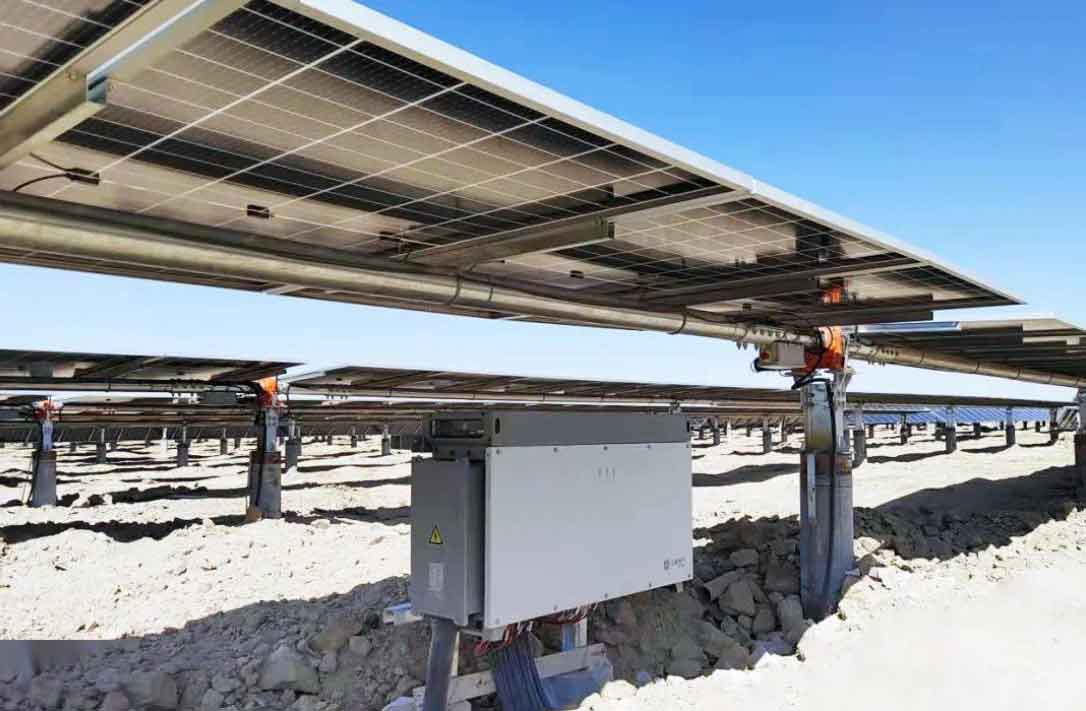
The hardware platform for the DG-FACTS system is a standard three-phase, three-wire PV inverter. The PV array is connected to the DC-link, optionally through a DC-DC converter for Maximum Power Point Tracking (MPPT). An LCL filter interfaces the inverter’s AC output with the grid to attenuate switching harmonics. The core innovation lies in the enhanced controller, which synthesizes a composite reference current comprising multiple components.
The control system performs several parallel functions:
- MPPT & Active Current Generation: It samples PV array voltage and current to determine the maximum power point, generating the fundamental active current reference \(i_{p}^*\).
- PQ Disturbance Detection: It samples either the load current (for shunt compensation) or the grid current, and employs specialized algorithms to extract:
- Harmonic current components \(i_{h}^*\)
- Reactive current component \(i_{q}^*\)
- Negative-sequence current component \(i_{-}^*\)
- Reference Synthesis & Prioritization: All current references are combined into a final compensation reference \(i_{c}^*\), considering the available inverter current capacity and user-defined priorities.
- Current Tracking: A closed-loop current controller (e.g., based on Repetitive Control or Proportional-Resonant controllers) forces the inverter output to accurately track the total reference current \(i_{ref}^* = i_{p}^* + i_{c}^*\).
The physical principle is that by injecting compensating currents equal in magnitude but opposite in phase (or with appropriate phase shifts) to the disturbance currents present in the load, the grid-side current becomes sinusoidal, balanced, and in phase with the voltage. Thus, a single solar inverter device can simultaneously deliver clean solar power and act as a local grid conditioner.
Detection Algorithms for Power Quality Disturbances
Accurate, fast, and digitally efficient detection of disturbance components is critical for effective compensation. The choice of algorithm must consider the typical spectrum of disturbances in distribution networks and the processing capabilities of a standard inverter digital signal processor (DSP).
1. Selective Harmonic Detection via Sliding-Window Iterative DFT
Given that significant low-order harmonics (e.g., 3rd, 5th, 7th, 11th, 13th) dominate in distribution grids, and a PV solar inverter has limited bandwidth, selective compensation of specific orders is practical. The Discrete Fourier Transform (DFT) is ideal for this. A standard DFT for the \(n\)-th harmonic over a window of N samples is:
$$a_n = \frac{2}{N}\sum_{i=k-N+1}^{k} i_s(i\tau)\cos(n\omega i\tau)$$
$$b_n = \frac{2}{N}\sum_{i=k-N+1}^{k} i_s(i\tau)\sin(n\omega i\tau)$$
Where \(i_s\) is the sampled current, \(\tau\) is the sampling interval, and \(\omega\) is the fundamental angular frequency. The sliding-window iterative DFT optimizes this for real-time DSP implementation. It updates the Fourier coefficients each sampling period by adding the contribution of the newest sample and subtracting the contribution of the oldest sample from the previous window.
Let \(k\) be the current sample index. The iterative update for coefficient \(a_n\) is:
$$a_n(k) = a_n(k-1) + \frac{2}{N}[i_s(k\tau)\cos(n\omega k\tau) – i_s((k-N)\tau)\cos(n\omega (k-N)\tau)]$$
A similar update rule applies for \(b_n(k)\). This reduces computational load to a few additions and multiplications per sample, per harmonic. The detected instantaneous value of the \(n\)-th harmonic for phase A, \(i_{a_n}(k)\), is then:
$$i_{a_n}(k) = a_n(k)\cos(n\omega k\tau) + b_n(k)\sin(n\omega k\tau)$$
The total harmonic reference \(i_{h}^*\) is the sum of selected harmonic orders. This method provides excellent selectivity and is straightforward to implement on a solar inverter controller.
2. Reactive Current Detection via Instantaneous Power Theory (p-q Theory)
For reactive power compensation under potentially distorted grid voltages, the \(i_p\)-\(i_q\) method based on instantaneous reactive power theory is robust and widely used. It requires a Phase-Locked Loop (PLL) to generate sine and cosine signals synchronized with the grid voltage fundamental positive-sequence.
First, the three-phase load currents \(i_{La}, i_{Lb}, i_{Lc}\) are transformed into the \(\alpha-\beta\) stationary frame using the Clarke transformation \(C_{32}\):
$$
\begin{bmatrix}
i_{\alpha} \\ i_{\beta}
\end{bmatrix} = \sqrt{\frac{2}{3}}
\begin{bmatrix}
1 & -\frac{1}{2} & -\frac{1}{2} \\[6pt]
0 & \frac{\sqrt{3}}{2} & -\frac{\sqrt{3}}{2}
\end{bmatrix}
\begin{bmatrix}
i_{La} \\ i_{Lb} \\ i_{Lc}
\end{bmatrix}
$$
Subsequently, they are transformed into instantaneous active and reactive currents \(i_p\) and \(i_q\) in a rotating frame aligned with the voltage vector:
$$
\begin{bmatrix}
i_{p} \\ i_{q}
\end{bmatrix} =
\begin{bmatrix}
\sin(\omega t) & -\cos(\omega t) \\[6pt]
-\cos(\omega t) & -\sin(\omega t)
\end{bmatrix}
\begin{bmatrix}
i_{\alpha} \\ i_{\beta}
\end{bmatrix}
$$
The signals \(i_p\) and \(i_q\) contain DC components corresponding to the fundamental active and reactive currents, plus AC components corresponding to harmonics. Low-pass filters (LPF) extract the DC components \(\overline{i_p}\) and \(\overline{i_q}\). The fundamental reactive current components in the \(\alpha-\beta\) frame are obtained by the inverse transformation:
$$
\begin{bmatrix}
i_{\alpha q} \\ i_{\beta q}
\end{bmatrix} =
\begin{bmatrix}
\sin(\omega t) & -\cos(\omega t) \\[6pt]
-\cos(\omega t) & -\sin(\omega t)
\end{bmatrix}^{-1}
\begin{bmatrix}
\overline{i_p} \\ \overline{i_q}
\end{bmatrix}
$$
Finally, the inverse Clarke transform yields the three-phase fundamental reactive current reference \(i_{q}^*\). This algorithm is computationally efficient and shares the PLL with other control functions in the solar inverter.
3. Negative-Sequence Current Detection via Synchronous Reference Frame Separation
For three-wire systems, unbalanced loads generate negative-sequence currents. These can be extracted using double synchronous reference frame transformations. The three-phase load currents are first transformed into a positive-sequence synchronous rotating frame (\(d^+q^+\)) rotating at \(\omega\). In this frame, the positive-sequence fundamental component appears as a DC value, while the negative-sequence fundamental component appears as a component at \(2\omega\). The reverse is true in a negative-sequence synchronous frame (\(d^-q^-\)) rotating at \(-\omega\).
The process involves:
- Transform \(i_{La}, i_{Lb}, i_{Lc}\) to the positive-sequence \(d^+q^+\) frame via the Park transform using a PLL angle \(\theta^+ = \omega t\).
- Apply a Low-Pass Filter (LPF) to the \(d^+q^+\) components to isolate the DC parts, which represent the positive-sequence fundamental current.
- Subtract these filtered DC components from the original \(d^+q^+\) signals. The remainders contain the negative-sequence component (and harmonics).
- Transform these remainders back to the stationary \(\alpha\beta\) frame, then into the negative-sequence \(d^-q^-\) frame using \(\theta^- = -\omega t\).
- In the \(d^-q^-\) frame, the negative-sequence fundamental component appears as a DC value. An LPF extracts it.
- This filtered DC value is transformed back to the \(\alpha\beta\) frame and then to the three-phase abc frame to obtain the negative-sequence current reference \(i_{-}^*\).
This method accurately isolates the fundamental negative-sequence component, which the solar inverter can then inject to cancel the unbalance in the grid currents.
| Component | Algorithm | Key Principle | Advantages for Solar Inverter | Considerations |
|---|---|---|---|---|
| Harmonics | Sliding-Window Iterative DFT | Selective frequency extraction via recursive Fourier coefficient update. | Selective compensation saves inverter bandwidth; computationally efficient for DSP. | Inherent one-cycle delay; requires buffer management. |
| Reactive Current | Instantaneous p-q Theory (ip-iq) | Coordinate transformation synchronized to grid voltage vector. | Robust to voltage distortion; fast dynamic response; shares PLL. | Performance depends on PLL accuracy under distorted conditions. |
| Negative Sequence | Dual Synchronous Frame Separation | Separation of sequence components based on their relative rotational speed in dq frames. | Accurate extraction of fundamental negative-sequence component. | More computationally intensive; requires careful filter design to separate components. |
Reference Current Synthesis and Priority Management Strategy
The solar inverter has a finite current rating \(I_{n}\). The active current reference \(i_{p}^*\) varies with solar power. The available capacity for compensation is the dynamic residual current \(i_{AMP}^*\):
$$i_{AMP}^* = I_{n} – |i_{p}^*|$$
The total demanded compensation current \(i_{c,demanded}^* = i_{q}^* + i_{h}^* + i_{-}^*\) may exceed \(i_{AMP}^*\). A sophisticated synthesis and prioritization strategy is therefore essential to manage the multi-functional solar inverter under all operating conditions.
The strategy involves mode recognition and a user-configurable priority scheme:
- Mode Detection: The controller continuously monitors if disturbance components exceed a negligible threshold \(\epsilon\) (e.g., \( |i_{q}^*| > \epsilon \)).
- Capacity Check: It compares the magnitude of the total demanded compensation current \(|i_{c,demanded}^*|\) with the available capacity \(|i_{AMP}^*|\).
- Unconstrained Operation: If \(|i_{c,demanded}^*| \leq |i_{AMP}^*|\), all compensation requests are fulfilled: \(i_{c}^* = i_{q}^* + i_{h}^* + i_{-}^*\).
- Constrained Operation & Prioritization: If \(|i_{c,demanded}^*| > |i_{AMP}^*|\), a user-defined priority order is invoked (e.g., 1. Reactive, 2. Unbalance, 3. Harmonics). Let the prioritized components be \(i_{1}^*, i_{2}^*, i_{3}^*\).
The synthesis follows a sequential, capacity-aware logic using an Amplitude Scaling Algorithm (ASA):
- If \(|i_{1}^*| > |i_{AMP}^*|\), then the first priority component is scaled to fit: \(i_{c}^* = i_{AMP}^* \cdot (i_{1}^* / |i_{1}^*|)\).
- If \(|i_{1}^*| \leq |i_{AMP}^*|\), it is fully compensated. The remaining capacity is \(i_{AMP1}^* = i_{AMP}^* – |i_{1}^*|\).
- The algorithm then checks if \(|i_{2}^*| > |i_{AMP1}^*|\). If yes, \(i_{2}^*\) is scaled: \(i_{c}^* = i_{1}^* + (i_{AMP1}^* \cdot i_{2}^* / |i_{2}^*|)\). If not, it is fully compensated, and the process repeats for \(i_{3}^*\) with the new remaining capacity \(i_{AMP2}^*\).
This logic can be generalized by the equation:
$$i_{c}^* = k_{1} i_{1}^* + k_{2} i_{2}^* + k_{3} i_{3}^*$$
where the coefficients \(k_{1}, k_{2}, k_{3} \in [0, 1]\) are determined dynamically by the capacity-check and priority algorithm described above. The final reference for the solar inverter current controller is:
$$i_{ref}^* = i_{p}^* + i_{c}^*$$
| Mode | Solar Input | Primary Function | Compensation Action | Reference Current \(i_{ref}^*\) |
|---|---|---|---|---|
| 1. PV Generation Only | High | Maximize active power feed-in | None | \(i_{p}^*\) |
| 2. PV Generation + Full PQ Compensation | Medium | Active power feed-in + Grid support | Full \(i_{q}^*, i_{h}^*, i_{-}^*\) as per capacity | \(i_{p}^* + i_{c}^*\) |
| 3. PV Generation + Partial PQ Compensation | Low/Medium | Active power feed-in + Limited grid support | Priority-based, scaled \(i_{c}^*\) | \(i_{p}^* + (k_{1}i_{1}^*+k_{2}i_{2}^*+k_{3}i_{3}^*)\) |
| 4. PQ Compensation Only (Night Mode) | Zero (Night) | Dedicated grid conditioner | Full compensation up to \(I_n\) | \(i_{c}^*\) (where \(|i_{c}^*| \leq I_n\)) |
Simulation Analysis and Validation
A detailed simulation model of a three-phase DG-FACTS system was built in MATLAB/Simulink to validate the concept. The model includes a PV array model, a three-phase VSC solar inverter with an LCL filter, and a local load comprised of an unbalanced RL load and a non-linear diode rectifier load. The control system implements the detection algorithms, priority-based synthesis, and a Repetitive Current Controller for accurate tracking. Key simulation parameters are listed below:
| Component | Parameter | Value |
|---|---|---|
| Grid | Voltage (L-L, RMS) | 400 V |
| Frequency | 50 Hz | |
| Source Impedance | 0.1 mH, 0.5 mΩ | |
| PV Inverter | Rated Power / Current | 50 kVA / 72 A |
| DC-Link Voltage | 700 V | |
| Switching Frequency | 10 kHz | |
| LCL Filter | Inverter-side Inductor \(L_1\) | 0.4 mH |
| Grid-side Inductor \(L_2\) | 0.04 mH | |
| Filter Capacitor \(C_f\) | 20 μF | |
| Load | Unbalanced R-L (A-phase) | 1 Ω, 3 mH |
| Unbalanced R-L (B-phase) | 1 Ω, 3 mH | |
| Unbalanced R-L (C-phase) | 3 Ω, 10 mH | |
| Non-linear Load | 3-Phase Diode Rectifier with RL load |
The simulation sequence was designed to demonstrate the dynamic activation of different DG-FACTS functions:
- t = 0.05 s: The PV inverter is connected to the grid.
- t = 0.14 s: Negative-sequence current compensation is activated.
- t = 0.34 s: The MPPT controller is enabled, and the inverter starts injecting active power from the PV (~35 kW).
- t = 0.54 s: Reactive power compensation is activated.
- t = 0.74 s: Selective harmonic compensation (5th, 7th, 11th, 13th) is activated.
Simulation Results:
- Grid Current Waveforms: Before compensation, the grid current was highly distorted and unbalanced. After the sequential activation of all DG-FACTS functions, the grid current became sinusoidal, balanced, and in phase with the voltage.
- Power Tracking: The inverter accurately delivered the PV active power command of 35 kW and the reactive power command of approximately 10.6 kVar, with a tracking error of less than 1% in steady state.
- Power Factor: The system power factor at the Point of Common Coupling (PCC) improved from approximately 0.70 (lagging) before compensation to nearly unity (0.998) after full compensation.
- Total Harmonic Distortion (THD): A Fast Fourier Transform (FFT) analysis on the grid current before and after harmonic compensation showed a dramatic reduction. The current THD decreased from 24.12% to 2.93%, well within the limits prescribed by standards such as IEEE 519.
These results conclusively demonstrate the technical feasibility of using a single distributed solar inverter platform to perform simultaneous active power injection and comprehensive multi-objective power quality compensation. The control strategy successfully manages the dynamic allocation of the inverter’s current capacity between its primary and ancillary functions.
Conclusion and Future Perspectives
The integration of DG-FACTS functionality into distributed PV inverters presents a compelling and economically attractive solution to dual challenges: enhancing the penetration of renewable energy and mitigating deteriorating power quality in distribution networks. This approach transforms the solar inverter from a simple power conversion unit into an intelligent, multi-functional grid asset.
Key contributions of this methodology include:
- Unified Control Framework: It provides a cohesive control strategy that seamlessly blends Maximum Power Point Tracking (MPPT) for PV generation with advanced algorithms for harmonic, reactive, and negative-sequence current detection and injection.
- Practical Algorithm Selection: The adoption of a sliding-window iterative DFT for selective harmonic compensation, the \(i_p\)-\(i_q\) method for reactive current, and dual-frame separation for negative-sequence currents offers a balanced combination of accuracy, dynamic performance, and digital implementability on standard solar inverter hardware.
- Intelligent Capacity Management: The priority-based reference current synthesis strategy with amplitude scaling is crucial for the reliable and predictable operation of the inverter under all insolation conditions, ensuring that primary generation is never compromised while maximizing available grid support.
Future work may focus on several advanced areas:
- Adaptive and Predictive Control: Implementing model-predictive control or adaptive algorithms that can optimize compensation in real-time based on changing grid conditions and forecasted PV generation.
- Wider Compensation Scope: Extending the functionality to include voltage support (e.g., low-voltage ride-through with reactive current injection) and the mitigation of supraharmonics (frequencies above 2 kHz).
- Communication and Coordination: Enabling multiple DG-FACTS-enabled inverters within a feeder to communicate and coordinate their compensation efforts for optimal system-wide power quality improvement, potentially as part of a microgrid or virtual power plant.
- Hardware Optimization: Re-evaluating the design of the LCL filter and DC-link capacitor in the solar inverter to better accommodate the broader frequency spectrum of reference currents required for full DG-FACTS operation, potentially leading to next-generation inverter designs.
In conclusion, leveraging the inherent redundant capacity of photovoltaic systems for local power quality management is not only feasible but highly advantageous. It represents a significant step towards smarter, more resilient, and self-healing distribution grids where distributed energy resources actively participate in maintaining grid stability and power quality.