
In recent years, perovskite solar cells have emerged as a promising third-generation photovoltaic technology due to their high absorption coefficients, low exciton binding energies, long carrier lifetimes, and low manufacturing costs. Among various configurations, inverted planar perovskite solar cells utilizing nickel oxide (NiOx) as the hole transport layer (HTL) have garnered significant attention because of their simple fabrication process, reduced hysteresis effect, and cost-effectiveness. However, the performance of NiOx-based inverted planar perovskite solar cells is often limited by issues such as high defect density at the NiOx/perovskite interface and imperfect energy level alignment, which lead to charge recombination and energy loss. To address these challenges, buried interface engineering strategies have been developed, where an interfacial modification layer is introduced between the NiOx HTL and the perovskite active layer. Organic small molecules, with their diverse structures and tunable properties, offer a viable approach for such modifications. In this study, we propose the use of tricarballylic acid (TCA), a molecule containing three carboxyl groups distributed in three dimensions, as a buried interface modifier to enhance the performance and stability of NiOx-based inverted planar perovskite solar cells.
Our investigation begins with the characterization of the TCA molecule and its interaction with the NiOx film. The electronic density distribution of TCA, calculated using density functional theory (DFT), reveals high electron density at the carboxyl groups, which can serve as coordination sites for interaction with NiOx and perovskite components. This multi-dimensional coordination capability is expected to passivate interfacial defects and improve charge transport. We first examine the effect of TCA modification on the NiOx film. X-ray diffraction (XRD) patterns of both NiOx and TCA-modified NiOx (NiOx/TCA) films show characteristic peaks corresponding to the cubic crystal structure of NiOx, indicating that TCA modification does not alter the crystallinity of NiOx. However, atomic force microscopy (AFM) measurements demonstrate a reduction in surface roughness from 4.15 nm for NiOx to 3.56 nm for NiOx/TCA, which promotes better interfacial contact and facilitates the growth of high-quality perovskite films.
To understand the chemical interaction between TCA and NiOx, we perform X-ray photoelectron spectroscopy (XPS) analysis. The Ni 2p and O 1s core-level spectra show shifts in binding energy after TCA modification, suggesting strong coordination between the carboxyl groups of TCA and the NiOx surface. Specifically, the reduction in the -OH peak intensity in the O 1s spectrum indicates that TCA passivates surface hydroxyl groups on NiOx, thereby reducing defect states. Ultraviolet photoelectron spectroscopy (UPS) is used to determine the energy level alignment. The valence band maximum of NiOx shifts from -5.20 eV to -5.36 eV after TCA modification, leading to a more favorable energy level match with the perovskite layer. This optimization reduces the energy loss at the interface and enhances hole extraction, which is crucial for improving the open-circuit voltage (Voc) of perovskite solar cells.
Next, we investigate the impact of TCA modification on the perovskite film. Water contact angle measurements reveal that the NiOx/TCA surface is more hydrophobic than the pristine NiOx surface, which reduces nucleation sites and promotes the growth of larger perovskite grains. Fourier-transform infrared (FTIR) spectroscopy confirms the interaction between TCA and lead iodide (PbI2), as evidenced by shifts in the -C=O and -OH peaks. This interaction regulates the crystallization process of the perovskite, resulting in improved film quality. XRD patterns of perovskite films deposited on NiOx and NiOx/TCA substrates show enhanced intensity of the α-FAPbI3 peaks and reduced PbI2 residues for the NiOx/TCA-based film, indicating better crystallinity and more complete conversion to the perovskite phase. Scanning electron microscopy (SEM) and AFM images further demonstrate that the NiOx/TCA-based perovskite film has larger grain sizes, fewer pinholes, and lower roughness compared to the NiOx-based film, which is beneficial for charge transport and reducing non-radiative recombination.
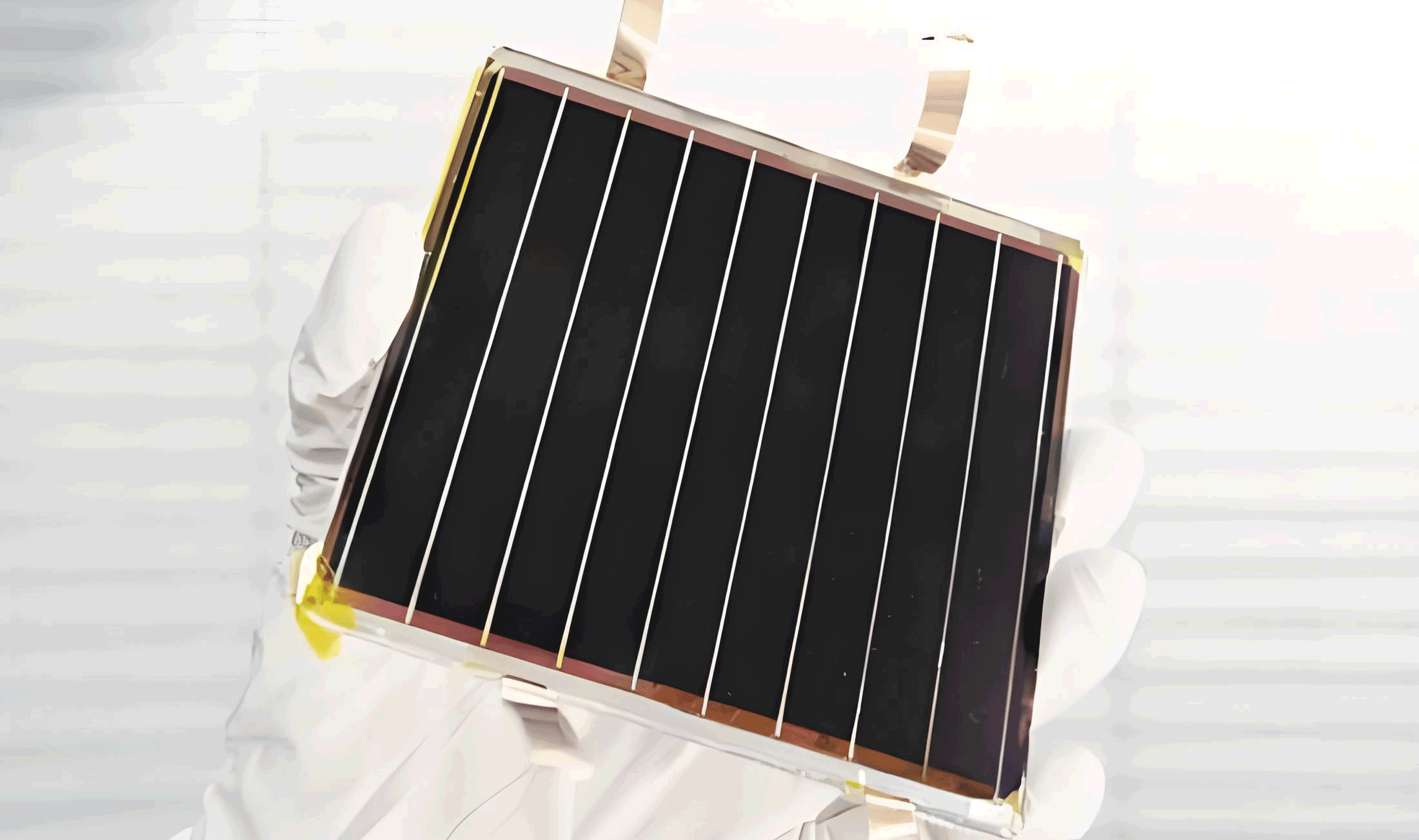
The device performance of perovskite solar cells with the structure ITO/NiOx (or NiOx/TCA)/perovskite/PC61BM/BCP/Ag is evaluated under AM 1.5G illumination. The current density-voltage (J-V) curves are measured for devices with different TCA concentrations, and the photovoltaic parameters are summarized in Table 1. The pristine NiOx-based device exhibits a power conversion efficiency (PCE) of 18.39%, with a Voc of 1.05 V, a short-circuit current density (Jsc) of 22.33 mA/cm², and a fill factor (FF) of 78.78%. After TCA modification, the device performance improves significantly. At an optimal TCA concentration of 0.50 mg/mL, the PCE reaches 21.59%, with a Voc of 1.09 V, a Jsc of 24.02 mA/cm², and an FF of 82.81%. The enhancement in Jsc and FF is attributed to improved charge extraction and reduced recombination at the buried interface. The external quantum efficiency (EQE) spectra of the NiOx/TCA-based device show higher values across the 300–800 nm wavelength range, consistent with the increased Jsc. Steady-state power output measurements at the maximum power point confirm the superior performance of the TCA-modified devices, with a stabilized PCE of approximately 21.5%.
| Device | Voc (V) | Jsc (mA/cm²) | FF (%) | PCE (%) |
|---|---|---|---|---|
| NiOx | 1.05 | 22.33 | 78.78 | 18.39 |
| NiOx/TCA (0.25 mg/mL) | 1.08 | 23.40 | 80.41 | 20.34 |
| NiOx/TCA (0.50 mg/mL) | 1.09 | 24.02 | 82.81 | 21.59 |
| NiOx/TCA (0.75 mg/mL) | 1.09 | 23.33 | 82.46 | 20.89 |
To elucidate the mechanism behind the performance improvement, we conduct photoluminescence (PL) and time-resolved photoluminescence (TRPL) measurements. The PL intensity of the perovskite film on NiOx/TCA is significantly quenched compared to that on pristine NiOx, indicating more efficient hole extraction at the buried interface. The TRPL decay curves are fitted with a bi-exponential function, and the average carrier lifetime decreases from 787.76 ns for the NiOx-based film to 268.31 ns for the NiOx/TCA-based film. This reduction in lifetime further confirms enhanced charge transfer, which minimizes recombination losses. The hole defect density in the perovskite film is calculated from the space-charge-limited current (SCLC) measurements using hole-only devices. The defect density decreases from 6.823 × 10¹⁵ cm⁻³ for the NiOx-based device to 5.835 × 10¹⁵ cm⁻³ for the NiOx/TCA-based device, demonstrating effective passivation of interfacial defects by TCA.
Electrochemical impedance spectroscopy (EIS) is employed to analyze the charge transport and recombination dynamics. The Nyquist plots show a larger recombination resistance (Rrec) for the NiOx/TCA-based device (7,659 Ω) compared to the NiOx-based device (3,106 Ω), indicating suppressed charge recombination. This enhancement in Rrec is consistent with the improved FF and Voc, as it facilitates more efficient charge collection. The relationship between the recombination resistance and the interface quality can be described by the following equation:
$$ R_{rec} = \frac{kT}{qJ_0} \exp\left(\frac{qV}{nkT}\right) $$
where \( k \) is Boltzmann’s constant, \( T \) is temperature, \( q \) is electron charge, \( J_0 \) is reverse saturation current density, \( V \) is voltage, and \( n \) is ideality factor. The increase in Rrec after TCA modification suggests a reduction in \( J_0 \), which correlates with lower recombination rates.
The stability of the perovskite solar cells is evaluated under ambient and thermal conditions. XRD patterns of perovskite films stored in a humid environment (60 ± 5% relative humidity) for 40 days show that the NiOx/TCA-based film maintains better structural integrity with minimal degradation, whereas the NiOx-based film exhibits significant decomposition into PbI2 and δ-FAPbI3 phases. The normalized PCE of devices under continuous illumination in humid air reveals that the NiOx/TCA-based device retains 78% of its initial efficiency after 30 days, compared to only 58% for the NiOx-based device. Thermal stability tests at 65°C in a nitrogen atmosphere show that the NiOx/TCA-based device maintains 83% of its initial PCE after 30 days, outperforming the NiOx-based device. The enhanced stability is attributed to the defect-passivating effect of TCA, which mitigates ion migration and degradation at the buried interface.
In conclusion, our study demonstrates that TCA buried interface engineering effectively addresses the challenges associated with NiOx-based inverted planar perovskite solar cells. The TCA molecule passivates interfacial defects, optimizes energy level alignment, and improves the crystallinity of the perovskite film. As a result, the power conversion efficiency of the perovskite solar cell increases from 18.39% to 21.59%, with significant enhancements in stability. This work highlights the potential of multi-functional organic molecules for interface engineering in high-performance perovskite solar cells and provides a scalable strategy for improving the efficiency and durability of photovoltaic devices.
Further analysis of the energy level alignment can be quantified using the following formula for the energy offset at the interface:
$$ \Delta E = E_{VB, NiOx} – E_{VB, perovskite} $$
where \( E_{VB} \) represents the valence band maximum. After TCA modification, \( \Delta E \) decreases, leading to a more favorable hole injection barrier. Additionally, the defect passivation efficiency can be modeled using the Shockley-Read-Hall recombination theory, where the recombination rate \( R \) is given by:
$$ R = \frac{np – n_i^2}{\tau_p (n + n_1) + \tau_n (p + p_1)} $$
Here, \( n \) and \( p \) are electron and hole concentrations, \( n_i \) is intrinsic carrier concentration, \( \tau_n \) and \( \tau_p \) are carrier lifetimes, and \( n_1 \), \( p_1 \) are parameters related to defect energy levels. The reduction in defect density after TCA treatment results in longer carrier lifetimes and lower recombination rates, as observed in the TRPL and SCLC measurements.
Overall, the integration of TCA as a buried interface modifier offers a comprehensive solution for enhancing the performance of perovskite solar cells. The multi-dimensional coordination of TCA with both NiOx and perovskite components ensures effective passivation and improved charge transport, making it a promising candidate for future developments in perovskite photovoltaics. The strategies and findings presented here can be extended to other types of perovskite solar cells and contribute to the advancement of sustainable energy technologies.