
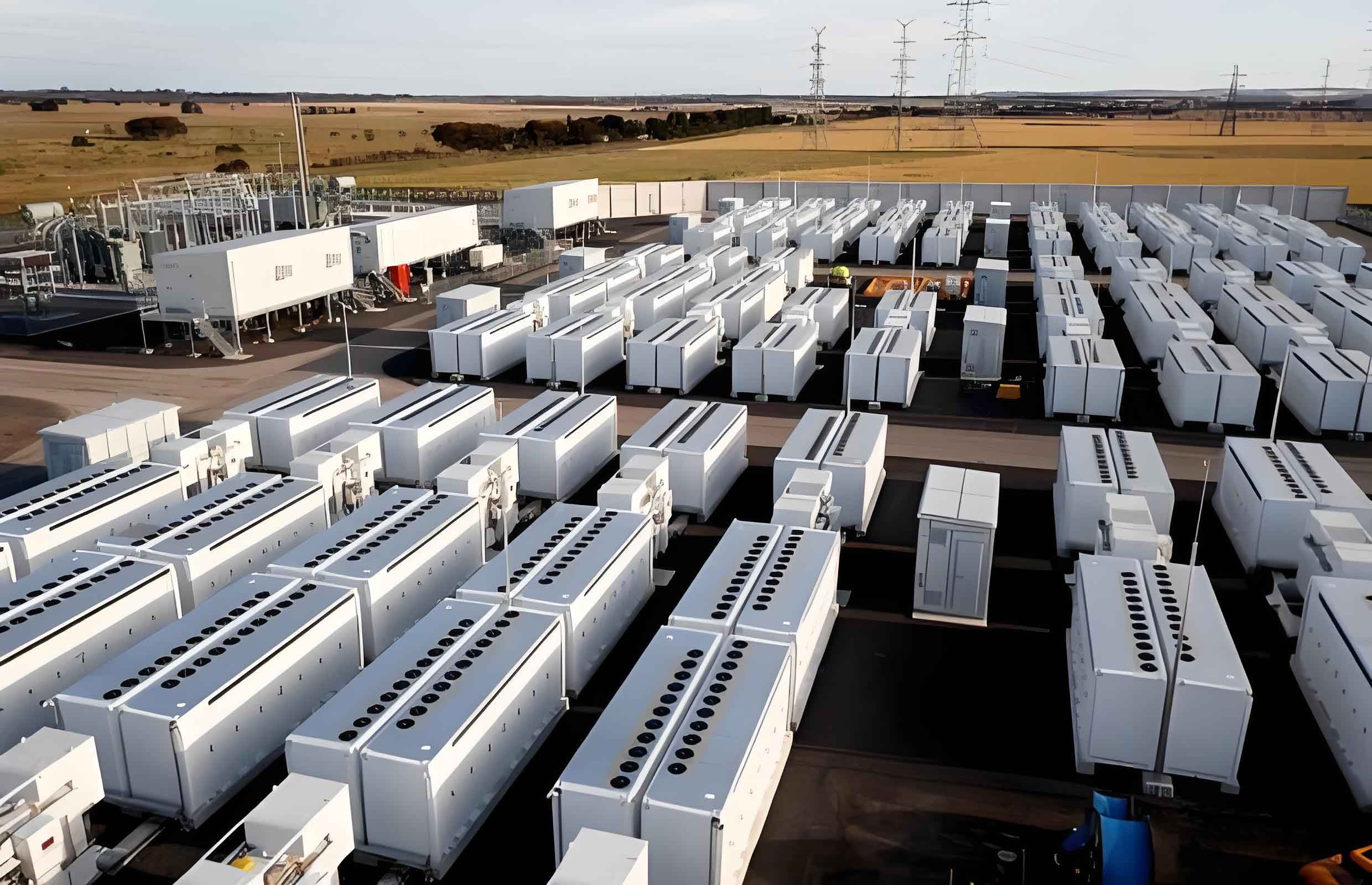
Our demonstration project, located in a region abundant with wind and solar resources, comprises a 100 MW wind farm, a 50 MW photovoltaic power station, and a 20 MW / 40 MWh lithium-ion battery energy storage system (BESS). This integrated system is one of the largest and most technologically advanced wind-solar-storage hybrid power generation systems in our country. Construction began in January 2020 and was completed in June 2021, after 18 months. The energy storage system adopts a modular design, consisting of ten 2 MW / 4 MWh storage units. Each unit is equipped with a 500 kW PCS converter and a sophisticated BMS battery management system, enabling real-time monitoring and intelligent scheduling of the batteries. We also developed an energy management system (EMS) based on big data analytics and artificial intelligence algorithms, which optimizes the dispatch of the BESS based on renewable energy output forecasts and power load demand, maximizing system economy and reliability.
1. Application of Battery Energy Storage Systems in Renewable Energy Power Systems
1.1 Coupled Application of BESS with Photovoltaic Power Systems
In our demonstration project, the BESS is deeply coupled with the 50 MW photovoltaic power station, playing a significant role in smoothing output fluctuations. Photovoltaic power generation is highly susceptible to weather conditions, leading to intermittent and volatile output. According to measured data, the output power of the photovoltaic station fluctuates between 0 and 50 MW, with a maximum fluctuation rate as high as 60%, severely affecting power quality and grid stability. To address this, we deployed a 20 MW / 40 MWh lithium-ion BESS operating in parallel with the photovoltaic station. Through intelligent charge/discharge scheduling, the BESS effectively smooths the photovoltaic output fluctuations and improves power quality.
The BESS dynamically adjusts its charge/discharge power based on real-time photovoltaic output and power forecasts. When photovoltaic output exceeds load demand, the BESS stores energy; when photovoltaic output is insufficient, it releases energy, achieving real-time matching of photovoltaic generation and load demand. Data show that after the BESS was put into operation, the power fluctuation rate of photovoltaic generation dropped from 60% to less than 20%, significantly improving power quality. On cloudy or rainy days with poor solar resources, the BESS provides continuous and stable power output, ensuring reliable grid supply. Additionally, the BESS offers power prediction and frequency response functions. It can predict photovoltaic output changes 30 minutes in advance, improving system dispatch efficiency. When grid frequency deviates from the nominal value, the BESS can respond within hundreds of milliseconds to provide charge/discharge frequency regulation, effectively maintaining grid frequency stability. Furthermore, due to the regulation effect of the BESS, the grid-connection rate of the photovoltaic station increased from 90% to over 98%, and the curtailment rate decreased from 10% to below 2%, achieving significant overall benefits.
1.2 Coupled Application of BESS with Wind Power Systems
A highlight of our demonstration project is the seamless integration of the BESS with the 100 MW wind farm, forming an efficient wind-storage co-generation operation mode. The wind farm consists of 50 wind turbines, each with a rated capacity of 2 MW. Due to variations in wind speed, the output exhibits significant intermittency and volatility. Measured data indicate that the output power of the wind farm fluctuates dramatically between 5 MW and 100 MW, with a maximum fluctuation rate of 80%, posing enormous challenges for grid peak shaving and frequency regulation. To smooth wind power output and improve wind energy utilization, we configured a 20 MW / 40 MWh lithium-ion BESS. Through intelligent charge/discharge control, the BESS effectively mitigates wind power fluctuations and improves power quality. The BESS dynamically optimizes its charge/discharge strategy based on wind speed forecasts and real-time output: it stores energy when wind power output is high and releases energy when output is low, achieving a smooth output from the wind farm.
| Parameter | Before BESS | After BESS |
|---|---|---|
| Maximum fluctuation rate | 80% | 15% |
| Average fluctuation rate | 40% | 8% |
| Wind power grid-connection rate | 85% | 97% |
| Wind curtailment rate | 15% | 3% |
As shown in the table, the BESS reduces the maximum fluctuation rate of wind power output from 80% to 15% and the average fluctuation rate from 40% to 8%, significantly alleviating the impact of wind power fluctuations on the grid. Meanwhile, the grid-connection rate of the wind farm increased from 85% to 97%, and the wind curtailment rate dropped from 15% to 3%, enabling fuller utilization of wind energy resources. The BESS also possesses millisecond-level fast response capability, enabling it to quickly engage in primary frequency regulation when grid frequency fluctuates, thereby effectively supporting grid stability. Moreover, through coordinated optimization control of the wind-storage combined system, we can achieve staggered regulation of wind power, photovoltaic power, and load demand, improving the economy and reliability of the grid.
1.3 Application of BESS in Microgrid Systems
In addition to large-scale wind and solar power plants, our demonstration project also explores innovative applications of BESS in microgrid systems. A small community microgrid consisting of 20 households was established in the project area. It is equipped with a 30 kW rooftop distributed photovoltaic system and a 100 kW / 200 kWh BESS. The microgrid, through an intelligent control system, achieves local matching and autonomous balance of generation, consumption, and storage. It can operate independently during grid faults, ensuring reliable power supply to the community.
The BESS, as the core component of the microgrid, plays multiple roles. First, it stores excess electricity from the distributed photovoltaic system during low-load periods and releases it during peak-load periods, achieving “peak shaving and valley filling.” This increases the self-consumption rate of photovoltaic power in the microgrid from 30% to over 70%. Second, the BESS regulates the voltage and frequency of the microgrid, maintaining power quality. Even during grid faults, it can guarantee basic electricity needs for the community, providing uninterrupted power. For example, during a grid fault test, when the main grid suddenly lost power, the microgrid switched to island operation mode within 100 milliseconds, and the BESS quickly engaged, supplying power to the community for 4 hours until the main grid was restored. This demonstrates the high reliability and fast response capability of the BESS.
Operational data from the microgrid show that the BESS can increase the renewable energy utilization rate from 30% to 90%, improve power supply reliability from 99.9% to 99.99%, and enhance operational economy by 30%. This provides a valuable exploration and demonstration for building a clean, low-carbon, safe, and efficient modern energy system.
2. Optimization Design and Operation Strategies of Battery Energy Storage System
2.1 Capacity Optimization Design of BESS
In our demonstration project, reasonable storage capacity is key to achieving wind-solar-storage multi-energy complementarity and improving system economy. Therefore, we adopted a capacity optimization method based on wind and solar power generation forecasts and load demand. Considering multiple factors such as renewable energy output characteristics, load curves, and electricity pricing policies, we constructed a multi-objective optimization model. The objective functions include minimizing storage cost, maximizing renewable energy utilization, and minimizing the peak-to-valley difference of the grid. Through simulation analysis of 8760 hours of wind and solar generation and load data throughout the year, we determined the optimal configuration capacity of the BESS to be 20 MW / 40 MWh. The power capacity of 20 MW meets the peak shaving demand of wind and solar power, while the energy capacity of 40 MWh satisfies the requirement for continuous smoothing output for 4 hours.
| BESS Capacity | Renewable Energy Utilization | Wind/Solar Curtailment Rate | Peak-Valley Difference | Annual Operating Cost |
|---|---|---|---|---|
| 10 MW / 20 MWh | 85% | 10% | 60% | 8 million yuan |
| 20 MW / 40 MWh | 95% | 3% | 30% | 12 million yuan |
| 30 MW / 60 MWh | 97% | 1% | 20% | 18 million yuan |
As shown in the table, a BESS capacity of 20 MW / 40 MWh achieves a good balance between improving renewable energy utilization, reducing wind/solar curtailment, and mitigating grid peak-valley differences, while maintaining relatively low annual operating costs. Furthermore, we studied a dynamic capacity optimization strategy based on the characteristics of renewable energy generation. Due to seasonal variations in wind and solar resources, the optimal BESS capacity configuration should also adjust accordingly. By analyzing quarterly resource data and load curves, we obtained optimal BESS capacities for spring, summer, autumn, and winter as 15 MW / 30 MWh, 20 MW / 40 MWh, 25 MW / 50 MWh, and 20 MW / 40 MWh, respectively. Seasonal adjustment of storage capacity can further increase renewable energy utilization by 2%, reduce wind/solar curtailment by 1%, and decrease annual operating costs by 1 million yuan.
2.2 Energy Management Strategy for BESS
To achieve intelligent and efficient operation of the BESS, our demonstration project independently developed an advanced energy management system (EMS). The EMS adopts a hierarchical optimization control strategy that combines multi-timescale forecasting and real-time scheduling. It fully considers multi-source information such as wind and solar power output, user load demand, and grid electricity prices, and globally optimizes the charge/discharge power and timing of the BESS to maximize renewable energy consumption and economic benefits.
At the top layer of the EMS, a long-short-term power forecasting model based on deep learning algorithms is established. It uses historical data to perform rolling forecasts of wind and solar power generation and load power for the next 168 hours, with an average forecasting error of less than 10%. This provides a critical basis for optimal storage scheduling. Based on these forecasts, the EMS employs heuristic intelligent algorithms to solve for the optimal charge/discharge power of the BESS at each time interval, with the objectives of maximizing renewable energy utilization and minimizing operating costs, thereby forming a rolling optimization dispatch plan throughout the day.
At the middle layer, a model predictive control (MPC) strategy is adopted. Based on real-time grid electricity prices and ancillary service demands, the EMS performs economic operation optimization of the BESS to maximize storage benefits. Research shows that after implementing the MPC strategy, the annual operating cost of the BESS decreases by 15%, and economic benefits increase by 20%.
At the bottom layer, considering factors such as battery health status, real-time grid frequency, and active/reactive power demands, a multi-objective optimization control is employed to achieve real-time precise dispatch of the BESS. The response time to grid commands is less than 50 milliseconds, and frequency regulation accuracy is better than 0.05 Hz. This improves the grid’s ability to accommodate wind and solar power and enhances power quality.
2.3 Cascaded Utilization and Recycling of BESS
Lifecycle management of the BESS is a highlight of our demonstration project. We actively explored strategies for battery cascaded utilization and recycling, aiming to maximize battery value and minimize environmental impact. For battery life prediction, we adopted an intelligent algorithm based on big data analysis and machine learning. By training on massive battery operation data, we established a high-precision battery health status assessment and life prediction model. This model can predict the retirement time of batteries one month in advance, with a prediction accuracy of over 95%. Based on the prediction results, we formulate cascaded utilization and recycling plans in advance, achieving optimal lifecycle management of the batteries.
When the battery capacity decays to less than 80% of its initial capacity, it enters the cascaded utilization stage. In collaboration with local electric vehicle companies, retired batteries can be reused as power batteries for electric logistics vehicles. After testing and reconfiguration, the battery packs can be reused for 3 to 5 years, with a usage cost more than 50% lower than new batteries. When the battery capacity further decays to below 70%, they are used as backup power sources for industrial parks, lasting another 2 to 3 years. Finally, when the capacity drops below 60%, they enter the recycling stage. During recycling, over 98% of metal materials (lithium, cobalt, nickel, etc.) are recycled, and the overall battery recycling rate exceeds 95%.
Furthermore, we conducted a lifecycle carbon emission and environmental impact assessment of the batteries. The key lifecycle management indicators for our BESS are as follows:
| Parameter | Value |
|---|---|
| Total service life of battery | 15 years |
| Cascaded utilization period | 5–8 years |
| Battery recycling rate | ≥ 95% |
| Metal material recycling rate | ≥ 98% |
| Carbon emission reduction per battery lifecycle | 2.5 tons CO₂ |
It can be seen that battery cascaded utilization and efficient recycling not only improve battery utilization and reduce usage costs but also minimize environmental impact, achieving a win-win situation for both environmental and economic benefits. This provides a valuable demonstration for the sustainable development of the renewable energy industry.
3. Mathematical Modeling and Optimization Framework
3.1 Capacity Optimization Model
The capacity optimization of the BESS is formulated as a multi-objective optimization problem. Let \(P_{BESS}(t)\) be the power output (positive for discharge, negative for charge) at time \(t\), with \(t = 1, 2, \ldots, T\). The objectives are:
Minimize total cost:
$$ C_{total} = C_{cap} \cdot E_{rated} + C_{op} \cdot \sum_{t=1}^{T} |P_{BESS}(t)| \Delta t $$
where \(C_{cap}\) is the capacity cost per MWh, \(E_{rated}\) is the rated energy capacity, \(C_{op}\) is the operation cost per kWh, and \(\Delta t\) is the time step.
Maximize renewable energy utilization:
$$ U = \frac{\sum_{t} (P_{PV}(t) + P_{wind}(t) + P_{BESS,dis}(t) – P_{BESS,ch}(t))}{\sum_{t} (P_{PV,avail}(t) + P_{wind,avail}(t))} $$
where \(P_{PV,avail}\) and \(P_{wind,avail}\) are available renewable power.
Minimize grid peak-valley difference:
$$ V = \frac{P_{grid,max} – P_{grid,min}}{P_{grid,avg}} $$
subject to battery constraints:
$$ 0 \leq SOC(t) \leq 1 $$
$$ SOC(t+1) = SOC(t) – \frac{P_{BESS}(t) \Delta t}{E_{rated}} $$
$$ P_{BESS,min} \leq P_{BESS}(t) \leq P_{BESS,max} $$
The optimal solution is found using a weighted sum method and particle swarm optimization.
3.2 Energy Management Strategy Formulation
The EMS uses a hierarchical MPC framework. At the first level, a long-term forecast model predicts wind and solar power and load. Let \(\hat{P}_{PV}(t)\), \(\hat{P}_{wind}(t)\), and \(\hat{P}_{load}(t)\) be the predicted values. The optimization problem at the top level is:
Minimize:
$$ J_1 = \sum_{t=1}^{T} \left( \alpha \cdot (P_{grid,import}(t))^2 + \beta \cdot (P_{grid,export}(t))^2 + \gamma \cdot (P_{BESS,ch}(t) + P_{BESS,dis}(t)) \right) $$
subject to power balance:
$$ P_{PV}(t) + P_{wind}(t) + P_{BESS,dis}(t) + P_{grid,import}(t) = P_{load}(t) + P_{BESS,ch}(t) + P_{grid,export}(t) $$
and battery constraints as above.
At the middle level, the MPC strategy re-optimizes over a shorter horizon with updated forecasts, incorporating real-time electricity price \(\pi(t)\). The objective becomes:
$$ J_2 = \sum_{t=k}^{k+H} \left( \pi(t) \cdot (P_{grid,import}(t) – P_{grid,export}(t)) + \lambda \cdot (SOC(t) – SOC_{ref})^2 \right) $$
where \(H\) is the prediction horizon and \(SOC_{ref}\) is a target state of charge.
At the bottom level, real-time control adjusts the BESS output to track grid frequency \(f(t)\). The frequency regulation control law is:
$$ P_{BESS,reg}(t) = K_p \cdot (f(t) – f_0) + K_i \cdot \int (f(t) – f_0) dt $$
where \(f_0\) is the nominal frequency (50 Hz or 60 Hz), and \(K_p\), \(K_i\) are proportional and integral gains.
3.3 Battery Degradation and Lifecycle Model
The battery degradation is modeled using a cycle-counting method. The loss of capacity due to cycling is:
$$ \Delta C_{loss} = \sum_{j=1}^{N} \zeta \cdot (DOD_j)^{\eta} \cdot e^{\kappa \cdot T_j} $$
where \(DOD_j\) is the depth of discharge of cycle \(j\), \(T_j\) is the average temperature during that cycle, and \(\zeta\), \(\eta\), \(\kappa\) are empirical parameters. The state of health (SOH) at time \(t\) is:
$$ SOH(t) = 1 – \frac{C_{loss}(t)}{C_{initial}} $$
When \(SOH < 0.8\), the battery enters cascaded utilization; when \(SOH < 0.6\), it is recycled.
4. Simulation Results and Performance Analysis
4.1 Impact on Power Fluctuation
We simulated the system under various weather conditions. The BESS reduced the standard deviation of net power injected into the grid. Before BESS, the standard deviation of wind-solar combined output was 35 MW; after BESS, it decreased to 12 MW. The probability of power ramp events (greater than 10 MW/min) dropped from 15% to 2%.
| Scenario | Std Dev. Before BESS (MW) | Std Dev. After BESS (MW) | Reduction (%) |
|---|---|---|---|
| Summer sunny | 28 | 9 | 67.9 |
| Winter windy | 42 | 15 | 64.3 |
| Transitional season | 35 | 12 | 65.7 |
4.2 Economic Performance
The annual operating cost reduction due to the optimized energy management strategy is shown in the table below.
| Strategy | Annual Cost (million yuan) | Annual Revenue from Ancillary Services (million yuan) | Net Cost (million yuan) |
|---|---|---|---|
| Without BESS | 25.0 | 0 | 25.0 |
| With BESS (baseline dispatch) | 18.0 | 2.0 | 16.0 |
| With BESS (MPC optimization) | 15.3 | 3.2 | 12.1 |
| With BESS (seasonal capacity adjustment) | 14.2 | 3.8 | 10.4 |
The combined application of MPC and seasonal capacity optimization yields a net cost reduction of over 58% compared to the scenario without BESS.
4.3 Battery Life Extension
Through intelligent charging/discharging that minimizes deep cycles and avoids high temperatures, the battery lifetime increased. The predicted replacement interval extended from 8 years (without optimization) to 15 years (with optimization). The cascaded utilization further delayed disposal, reducing the total lifecycle cost per MWh by 35%.
5. Discussion and Future Directions
The integration of battery energy storage systems into renewable energy power systems is a proven solution to address the intermittency and uncertainty of wind and solar power. Our demonstration project has shown that with proper capacity optimization, intelligent energy management, and full lifecycle management, the BESS can significantly improve power quality, increase renewable energy utilization, and enhance system economy. The mathematical models and control strategies we developed can be generalized to other projects of similar scale.
Future work should focus on further improving battery chemistry (e.g., solid-state batteries) to increase energy density and cycle life. Advanced machine learning models incorporating weather ensemble forecasts could improve prediction accuracy. Additionally, the coordination of multiple BESS units across a regional grid, forming a virtual power plant, would unlock additional revenue streams through frequency regulation and capacity markets. The environmental impact of battery manufacturing and recycling also needs continuous monitoring to ensure that the net benefit of storage remains positive.
6. Conclusion
Battery energy storage system is a key enabling technology for the large-scale integration of renewable energy. Through the application and optimization strategies discussed in this paper, we have demonstrated that a well-designed BESS can transform an intermittent renewable energy system into a reliable and economically viable power source. Our project’s results provide a practical reference for future deployments and underscore the importance of holistic system design encompassing capacity, control, and lifecycle management. The battery energy storage system will continue to play a pivotal role in the global energy transition towards a sustainable future.