
In recent years, perovskite solar cells have emerged as a promising photovoltaic technology due to their high power conversion efficiencies, tunable bandgaps, and low-cost fabrication potential. However, the transition from lab-scale spin-coating methods to industrial-scale production remains a challenge, particularly for wide-bandgap perovskites used in tandem solar cell applications. In this study, we demonstrate a fully roller-coated approach for fabricating wide-bandgap perovskite solar cells on large-area substrates, achieving uniform film morphology and enhanced device performance through interfacial passivation and additive engineering. Our work focuses on optimizing the micro-groove roller coating technique, which is compatible with roll-to-roll manufacturing, to deposit all functional layers, including electron transport, perovskite, and hole transport layers, without the need for thermal annealing in certain steps. By incorporating a methylammonium iodide (MAI) passivation layer and sodium diethyldithiocarbamate (NaDDTC) additive, we significantly improve the film quality and device efficiency, reaching a record performance for all-roller-coated wide-bandgap perovskite solar cells.
The fabrication process begins with the preparation of precursor solutions. The SnO2 electron transport layer is formulated by diluting a commercial dispersion, while the wide-bandgap perovskite precursor is prepared using a mixture of formamidinium iodide (FAI), cesium iodide (CsI), lead bromide (PbBr2), and lead iodide (PbI2) in a co-solvent system. The hole transport layer employs Spiro-OMeTAD with common additives. For passivation, MAI solutions of varying concentrations are dissolved in isopropanol, and the NaDDTC additive is introduced into the perovskite precursor to suppress iodine oxidation. The roller coating process utilizes a micro-grooved rod to uniformly spread the solutions across 4 cm × 6 cm indium tin oxide (ITO) substrates. Key parameters, such as rod groove depth and coating speed, are optimized to control film thickness and homogeneity. Negative pressure evaporation is applied to the SnO2 and perovskite layers to facilitate solvent removal without high-temperature annealing, followed by thermal treatment for perovskite crystallization. This method enables the deposition of large-area, pinhole-free films essential for high-performance perovskite solar cells.
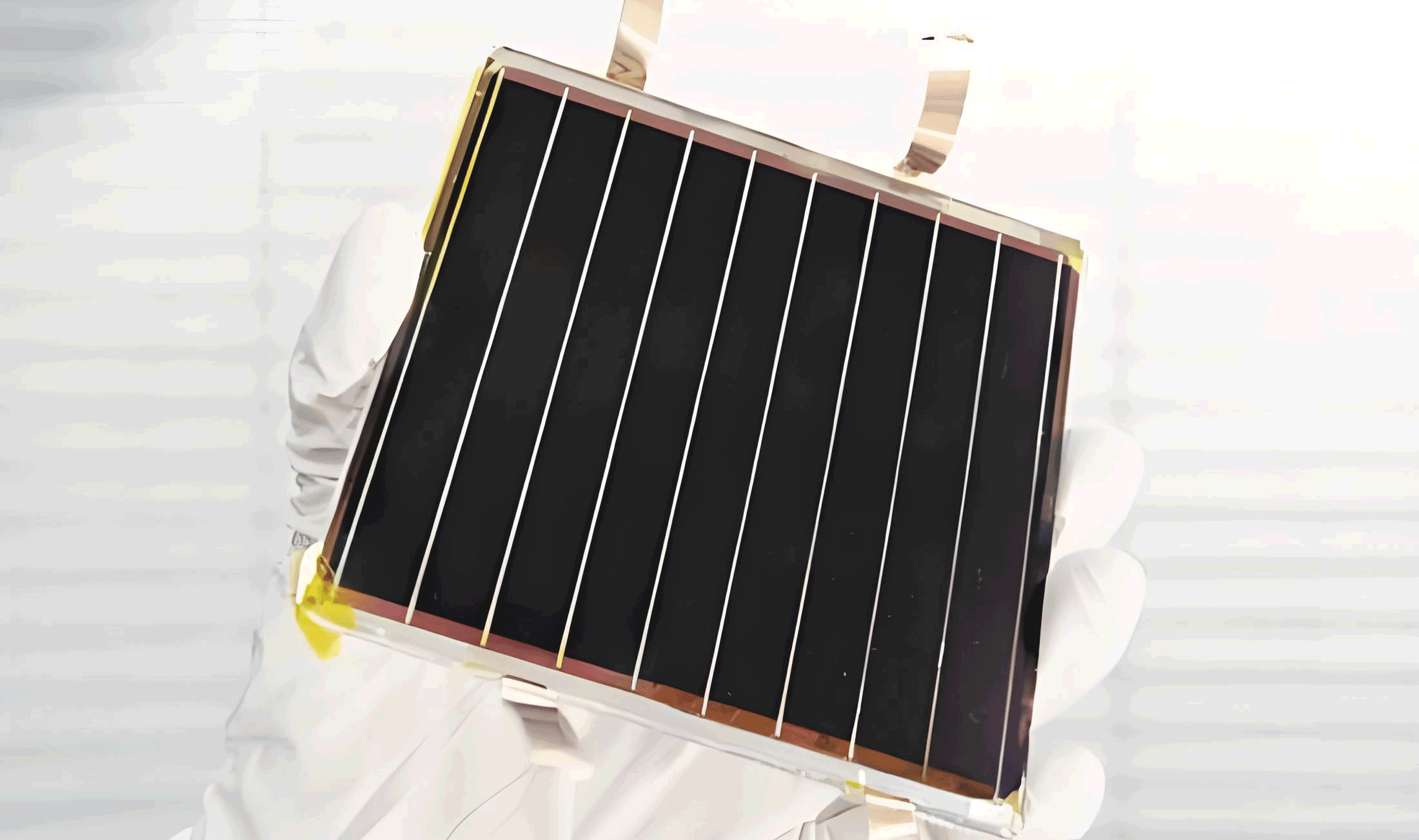
We first evaluate the uniformity and performance of the all-roller-coated perovskite solar cells without any passivation or additives. The devices are segmented into six 2 cm × 2 cm units, and current-density-voltage (J-V) measurements under standard illumination conditions reveal an average power conversion efficiency (PCE) of approximately 17%, with the highest value reaching 17.59% for an active area of 0.089 cm2. The spatial distribution of PCE across the substrate is highly uniform, excluding the initial solution supply region, demonstrating the scalability of the roller coating technique for perovskite solar cell production. This consistency is critical for large-area applications, such as perovskite-silicon tandem cells, where wide-bandgap perovskites can maximize spectral utilization. The basic photovoltaic parameters are summarized in Table 1, highlighting the reproducibility of the fabrication process.
| Device Location | PCE (%) | VOC (mV) | JSC (mA/cm2) | FF (%) |
|---|---|---|---|---|
| 1 | 16.50 | 1105 | 19.95 | 74.80 |
| 2 | 17.20 | 1118 | 20.10 | 76.50 |
| 3 | 17.59 | 1120 | 20.27 | 77.49 |
| 4 | 17.45 | 1115 | 20.15 | 77.00 |
| 5 | 17.30 | 1110 | 20.05 | 76.80 |
| 6 | 17.10 | 1108 | 19.98 | 76.20 |
To further enhance the performance of the perovskite solar cells, we investigate the effect of a roller-coated MAI passivation layer on the perovskite surface. This treatment aims to reduce surface defects and residual PbI2, which are common issues in perovskite films that lead to non-radiative recombination. We analyze the films using time-resolved photoluminescence (TRPL) and X-ray diffraction (XRD). The TRPL decay curves are fitted with a bi-exponential function to extract the carrier lifetimes:
$$Y(t) = M + A_1 e^{-t/\tau_1} + A_2 e^{-t/\tau_2}$$
where \(M\), \(A_1\), and \(A_2\) are constants, and \(\tau_1\) and \(\tau_2\) represent the fast and slow decay lifetimes, respectively. The average carrier lifetime \(\tau_{\text{ave}}\) is calculated as:
$$\tau_{\text{ave}} = \frac{\sum A_i \tau_i^2}{\sum A_i \tau_i}$$
For the control film, \(\tau_{\text{ave}}\) is 290 ns, which increases to 424 ns with 4 mg/mL MAI treatment, indicating reduced recombination. XRD patterns show a decrease in PbI2 peak intensity at approximately 12.7°, confirming the effective removal of unreacted precursors. Scanning electron microscopy (SEM) and atomic force microscopy (AFM) images reveal smoother surfaces with a root-mean-square (RMS) roughness reduction from 28.48 nm to 13.51 nm after MAI coating. This improved morphology enhances light absorption, as evidenced by ultraviolet-visible (UV-Vis) spectroscopy, without altering the bandgap. Additionally, space-charge-limited current (SCLC) measurements on electron-only devices yield a lower trap-filled limit voltage (\(V_{\text{TFL}}\)) for MAI-treated films, calculated using:
$$V_{\text{TFL}} = \frac{e d^2 N_t}{2 \varepsilon \varepsilon_0}$$
where \(e\) is the elementary charge, \(d\) is the film thickness, \(N_t\) is the trap density, \(\varepsilon\) is the dielectric constant, and \(\varepsilon_0\) is the vacuum permittivity. The trap density decreases from \(4.73 \times 10^{15}\) cm−3 to \(3.15 \times 10^{15}\) cm−3, demonstrating defect passivation. Electrochemical impedance spectroscopy (EIS) further shows increased recombination resistance at the perovskite/Spiro-OMeTAD interface, contributing to higher open-circuit voltage (\(V_{\text{OC}}\)) and fill factor (FF) in the perovskite solar cells.
Next, we incorporate NaDDTC as an additive in the perovskite precursor to address iodine oxidation, which generates deep-level traps. The NaDDTC reduces I2 back to I− via the reaction:
$$\ce{(CH3CH2)2N-CS-S-Na+ + I2 -> (CH3CH2)2N-CS-S-CS-N(CH3CH2)2 + 2I- + 2Na+}$$
Steady-state photoluminescence (PL) and TRPL measurements show enhanced intensity and prolonged carrier lifetimes for films with NaDDTC and MAI treatment, with \(\tau_{\text{ave}}\) reaching 449 ns. XRD confirms the near-elimination of PbI2 peaks, and SEM images display improved crystallinity and coverage. These modifications lead to superior optoelectronic properties, as quantified by the external quantum efficiency (EQE) and integrated current density, which increase from 19.60 mA/cm2 to 19.77 mA/cm2. Dark J-V curves are analyzed to determine the reverse saturation current density (\(J_0\)) and ideality factor (\(n\)) using the diode equation:
$$J_{\text{dark}}(V) = J_0 \left( \exp\left(\frac{qV}{n k_B T}\right) – 1 \right)$$
where \(q\) is the charge, \(k_B\) is Boltzmann’s constant, and \(T\) is the temperature. The ideality factor decreases from 2.22 to 1.29, and \(J_0\) drops significantly, indicating suppressed non-radiative recombination. The optimized devices achieve a champion PCE of 19.34%, with \(V_{\text{OC}} = 1.18\) V and FF = 81.32%, as summarized in Table 2. Statistical analysis of multiple devices shows a tight distribution of PCE values around 19%, underscoring the reliability of the approach. The J-V curves exhibit minimal hysteresis, and EQE spectra cover a broad wavelength range, confirming the effectiveness of the all-roller-coated process for high-performance wide-bandgap perovskite solar cells.
| Sample | Scan Direction | PCE (%) | VOC (mV) | JSC (mA/cm2) | FF (%) |
|---|---|---|---|---|---|
| Control | Forward | 16.76 | 1120.08 | 20.19 | 74.10 |
| Control | Reverse | 17.59 | 1120.04 | 20.27 | 77.49 |
| NaDDTC & MAI | Forward | 19.32 | 1180.08 | 20.15 | 81.27 |
| NaDDTC & MAI | Reverse | 19.34 | 1180.08 | 20.15 | 81.32 |
In conclusion, we have successfully developed a fully roller-coated methodology for fabricating wide-bandgap perovskite solar cells on large-area substrates, achieving high efficiency and uniformity. The integration of a MAI passivation layer and NaDDTC additive effectively mitigates defects and non-radiative losses, leading to a record PCE of 19.34% for all-roller-coated devices. This work underscores the potential of roller coating as a scalable, industry-compatible technique for perovskite solar cell production, particularly in tandem configurations. Future efforts will focus on further optimizing the layer interfaces and expanding the process to flexible substrates, paving the way for commercial adoption of perovskite-based photovoltaics.