
Perovskite solar cells have emerged as a promising photovoltaic technology due to their high power conversion efficiency (PCE), tunable bandgaps, and low-cost fabrication potential. The certified PCE for single-junction perovskite solar cells has reached 25.7%, while perovskite-silicon tandem solar cells have achieved a remarkable 32.5% efficiency. However, most high-performance devices are fabricated using spin-coating techniques, which are unsuitable for large-scale production due to limitations in uniformity and scalability. To address this, we explore grooved roller coating—a cost-effective and scalable method—for depositing wide-bandgap perovskite films. In this study, we introduce an air-knife-assisted process to enhance crystallization under ambient conditions, enabling the production of high-quality perovskite solar cells with efficiencies up to 18.51% for wide-bandgap (1.67 eV) formulations. Furthermore, we demonstrate the uniformity of large-area films by fabricating 25 sub-cells from a 10 cm × 10 cm perovskite layer, achieving an average PCE of 17.46%.
The development of large-area perovskite solar cells is critical for commercialization, particularly in tandem applications where wide-bandgap perovskites (∼1.67 eV) are paired with silicon bottom cells. Traditional methods like spin-coating and antisolvent treatments face challenges in controlling nucleation and crystallization over large areas. Grooved roller coating offers a viable alternative, but it requires precise optimization of solvent evaporation to achieve high supersaturation and rapid crystallization. Here, we employ an air-knife system to regulate gas flow velocity, accelerating solvent removal and promoting dense nucleation. The process is governed by the Mazurki equation for solvent evaporation:
$$ GS = (5.38 + 4.1u) \times P_H \times F \times M^{1/2} $$
where \( GS \) is the solvent evaporation rate, \( u \) is the gas flow velocity, \( P_H \) is the saturated vapor pressure, \( F \) is the liquid surface area, and \( M \) is the molecular weight of the solvent. By controlling the air-knife pressure, we modulate \( u \) to achieve optimal supersaturation, leading to improved film quality and device performance.
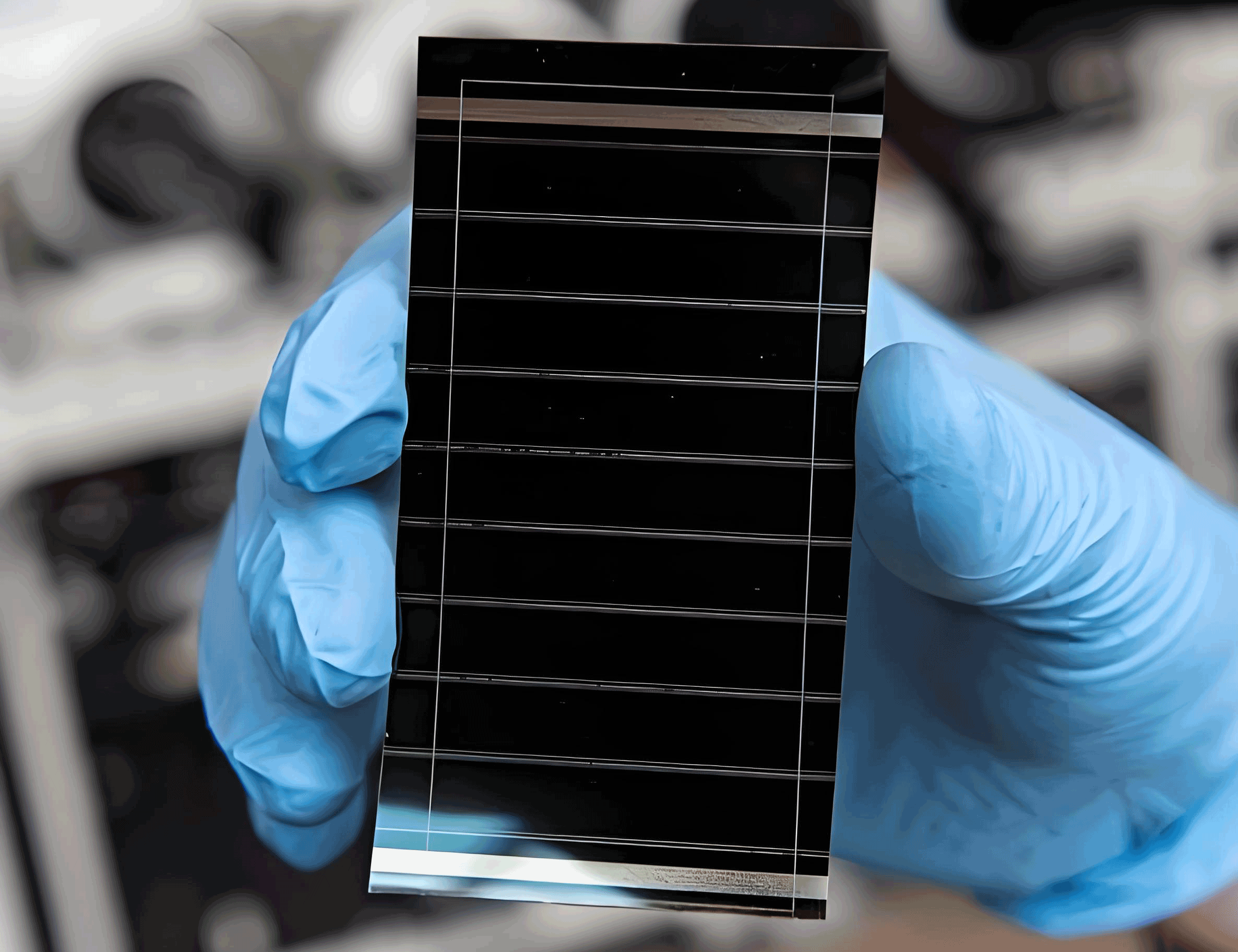
Our experimental setup involves depositing perovskite layers on ITO/SnO₂ substrates using a grooved roller coater at a speed of 5 mm/s. The perovskite precursor solution consists of FA₀.₈₃Cs₀.₁₇Pb(I₀.₈₀Br₀.₂₀)₃ dissolved in a DMF:NMP (9:1 volume ratio) mixture. The air-knife is positioned 5 cm above the substrate at a 45° angle, with varying pressures tested to optimize crystallization. Post-deposition, films are annealed at 130°C for 10 minutes, followed by the application of a Spiro-OMeTAD hole-transport layer and gold electrodes. Characterization techniques include scanning electron microscopy (SEM), X-ray diffraction (XRD), UV-visible spectroscopy, steady-state and time-resolved photoluminescence (PL and TRPL), and current-density-voltage (J-V) measurements.
The quality of perovskite solar cells heavily depends on the crystallization kinetics. According to LaMer theory, nucleation occurs in three stages: (1) concentration increase to saturation, (2) rapid nucleation at critical supersaturation, and (3) crystal growth via monomer diffusion. The air-knife process accelerates stage (2) by enhancing solvent evaporation, leading to a higher density of nucleation sites. We evaluated films under different air-knife pressures (0.12 MPa, 0.24 MPa, and 0.36 MPa). At 0.12 MPa, insufficient gas flow resulted in slow crystallization, leaving residual PbI₂ and voids. In contrast, 0.24 MPa produced uniform, pinhole-free films with large grains, while 0.36 MPa caused film deformation due to excessive flow. The following table summarizes the TRPL parameters fitted using a bi-exponential decay model:
| Sample | A₁ | τ₁ (ns) | A₂ | τ₂ (ns) | τ_avg (ns) |
|---|---|---|---|---|---|
| Control (0.12 MPa) | 0.2106 | 10.37 | 0.7894 | 107.17 | 99.34 |
| Optimal (0.24 MPa) | 0.0344 | 5.28 | 0.9656 | 169.79 | 169.61 |
The increase in average carrier lifetime (\( \tau_{avg} \)) from 99.34 ns to 169.61 ns indicates reduced defect density in optimal samples. XRD patterns confirm the suppression of PbI₂ peaks at 12.7° and the enhancement of perovskite α-phase peaks at 14.1° under optimal conditions. UV-visible absorption spectra show a bandgap of 1.67 eV, with improved light absorption in optimal films. Steady-state PL spectra exhibit higher intensity at 740 nm, consistent with reduced non-radiative recombination.
Device performance was evaluated for perovskite solar cells with an ITO/SnO₂/Perovskite/Spiro-OMeTAD/Au structure. The optimal air-knife pressure of 0.24 MPa yielded a champion PCE of 18.51% with a short-circuit current density (\( J_{sc} \)) of 20.38 mA/cm², open-circuit voltage (\( V_{oc} \)) of 1.20 V, and fill factor (FF) of 75.6%. In comparison, control devices (0.12 MPa) achieved a PCE of 15.82% with lower parameters. The external quantum efficiency (EQE) spectra integrated current densities of 19.97 mA/cm² and 19.60 mA/cm² for optimal and control devices, respectively, validating the J-V measurements. Statistical analysis of 16 devices per condition demonstrates the reproducibility of the air-knife-assisted process:
| Parameter | Control (Avg.) | Optimal (Avg.) |
|---|---|---|
| \( J_{sc} \) (mA/cm²) | 19.54 | 20.38 |
| \( V_{oc} \) (V) | 1.16 | 1.20 |
| FF (%) | 69.7 | 75.6 |
| PCE (%) | 15.82 | 18.51 |
To assess scalability, we fabricated a 10 cm × 10 cm perovskite film using the optimal air-knife parameters and segmented it into 25 sub-cells (2 cm × 2 cm each). The average PCE of these sub-cells was 17.46%, with a standard deviation of less than 0.5%, highlighting the uniformity and potential for large-scale production. The efficiency distribution across the sub-cells can be modeled using a Gaussian function:
$$ PCE(x) = PCE_{avg} \exp\left(-\frac{(x – \mu)^2}{2\sigma^2}\right) $$
where \( PCE_{avg} = 17.46\% \), \( \mu \) is the mean position, and \( \sigma \) represents the uniformity. This result underscores the viability of air-knife-assisted grooved roller coating for manufacturing perovskite solar cells in roll-to-roll processes.
In conclusion, we have developed an air-knife-assisted grooved roller coating technique for fabricating high-efficiency wide-bandgap perovskite solar cells. By optimizing gas flow velocity, we achieve rapid solvent evaporation and dense nucleation, resulting in films with superior optoelectronic properties. The best-performing perovskite solar cell reaches a PCE of 18.51%, and large-area modules demonstrate consistent performance. This approach paves the way for scalable, cost-effective production of perovskite solar cells, particularly for tandem applications. Future work will focus on further improving stability and integrating these cells into commercial photovoltaic systems.
The advancement of perovskite solar cell technology relies on innovative deposition methods that balance efficiency and scalability. Our air-knife process addresses key challenges in crystallization control, offering a robust pathway for industrial adoption. As research progresses, we anticipate that such techniques will enable the widespread deployment of perovskite solar cells in next-generation energy solutions.