
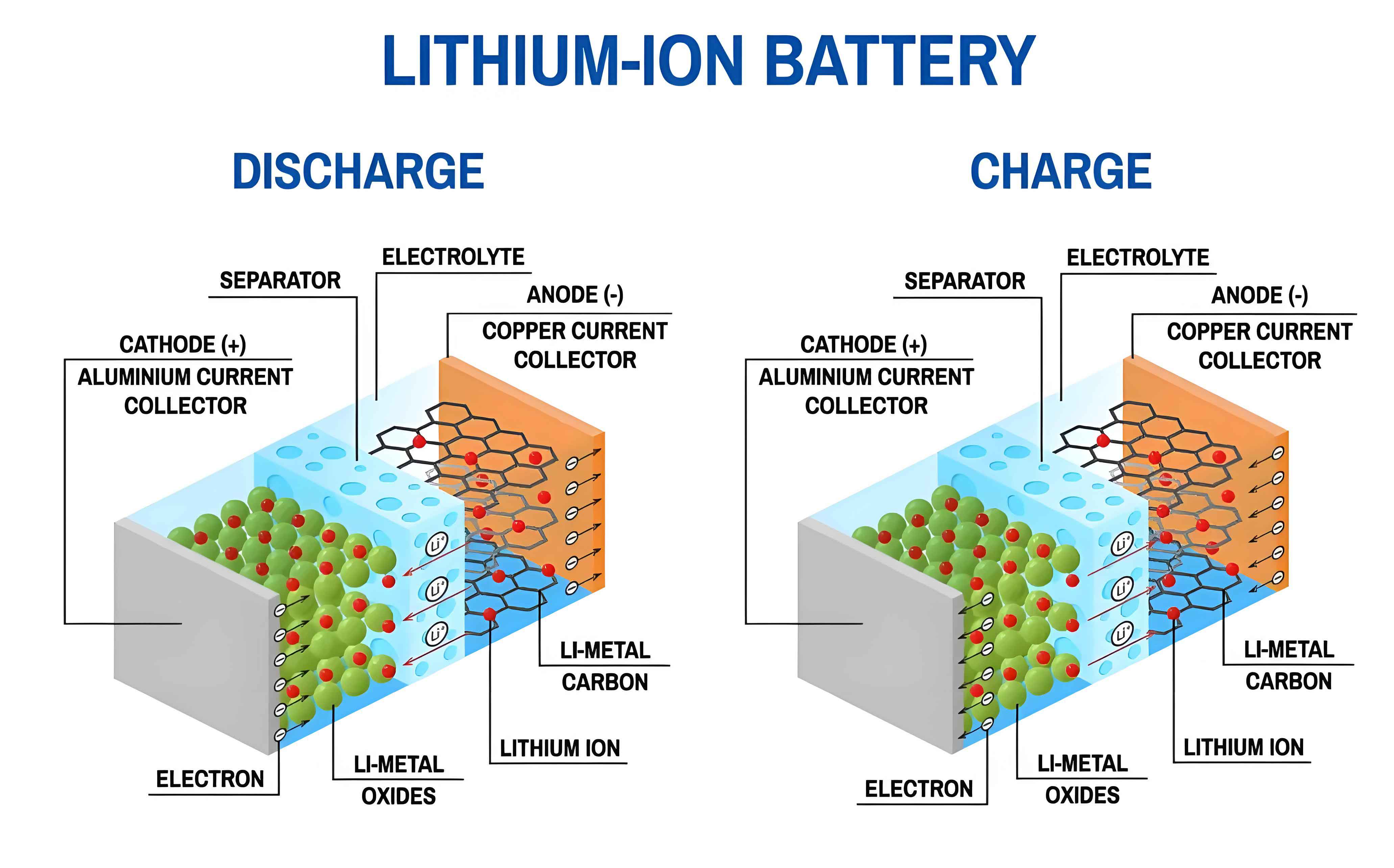
As the core component of new energy vehicles, lithium ion batteries face increasing safety challenges due to rising energy density. This article analyzes global patent trends and technical solutions for thermal runaway prevention, offering insights into early warning systems and safety design methodologies.
1. Thermal Runaway Mechanism
The chain reaction in lithium ion batteries during thermal runaway can be modeled as:
$$
\frac{dQ}{dt} = \sum_{i=1}^{n} \Delta H_i \cdot r_i(T)
$$
Where $Q$ represents heat generation, $\Delta H_i$ denotes reaction enthalpy, and $r_i(T)$ describes temperature-dependent reaction rates. Critical stages include:
| Reaction | Temperature Range | Heat Release (kJ/g) |
|---|---|---|
| SEI decomposition | 80-120℃ | 0.25-0.35 |
| Anode-electrolyte reaction | 120-250℃ | 1.50-1.80 |
| Separator meltdown | 130-190℃ | – |
| Cathode decomposition | 200-300℃ | 0.70-1.20 |
2. Global Patent Landscape Analysis
Patent filings for lithium ion battery thermal management show exponential growth:
| Year | Global Filings | China Filings | China Share |
|---|---|---|---|
| 2015 | 1,208 | 634 | 52.5% |
| 2020 | 3,785 | 2,419 | 63.9% |
| 2023 | 4,578 | 3,942 | 86.1% |
The technology distribution reveals concentrated innovation in three domains:
$$
\text{Innovation Index} = \frac{\text{Patent Quality} \times \text{Technical Diversity}}{\text{Market Coverage}}
$$
3. Core Technical Solutions
3.1 Early Warning Systems
Advanced monitoring systems employ multi-parameter fusion algorithms:
$$
\text{Risk Score} = \alpha \cdot \Delta V + \beta \cdot \frac{dT}{dt} + \gamma \cdot \frac{dP}{dt}
$$
Where $\alpha$, $\beta$, and $\gamma$ represent weighting coefficients for voltage, temperature, and pressure changes respectively.
| Parameter | Detection Accuracy | Response Time | Cost |
|---|---|---|---|
| Voltage | ±5mV | <10ms | $0.12/cell |
| Temperature | ±0.5℃ | 2-5s | $0.35/cell |
| Gas Pressure | ±50Pa | 1-3s | $1.20/module |
3.2 Protection Mechanisms
Novel battery pack designs implement multi-stage safety protocols:
$$
\text{Protection Efficiency} = 1 – \frac{T_{\text{critical}} – T_{\text{trigger}}}{T_{\text{critical}}}
$$
Key innovations include:
- Pressure-sensitive separator membranes with tunable porosity
- Phase-change thermal barrier materials
- Self-terminating electrolyte formulations
4. Technical Challenges and Future Directions
Current limitations in lithium ion battery safety systems include:
$$
\text{Detection Latency} = \frac{\sum_{i=1}^{n} (t_{\text{detection}} – t_{\text{onset}})_i}{n} \geq 38s
$$
Emerging solutions focus on:
- Multi-physics coupling models for thermal propagation
- Solid-state electrolyte integration
- Artificial intelligence-driven predictive maintenance
The evolution of lithium ion battery safety technologies demonstrates significant progress in early warning accuracy and protection reliability. Future development requires synergistic improvements in materials science, thermal management, and intelligent monitoring systems to achieve comprehensive safety assurance for high-energy-density batteries.