
As a global digital industrial technology leader, we at Honeywell are proud to have showcased our latest advancements at the 2024 International Solar Photovoltaic and Smart Energy Conference and Exhibition in Shanghai. Our focus was on introducing the new RG ESGD fixed gas detector, alongside a comprehensive range of gas detection and sensor solutions designed to enhance industrial safety. These innovations are pivotal in supporting the automation and growth of the solar and energy storage sectors, ultimately empowering China’s energy transition and sustainable development. From my perspective, our efforts underscore a deep commitment to leveraging technology for a safer, more efficient future, particularly within integrated solar systems that are reshaping global energy landscapes.
The solar system has become a cornerstone of modern energy infrastructure, driving the shift toward renewable sources. A solar system encompasses not only photovoltaic panels but also energy storage units, inverters, and control mechanisms that ensure reliable power generation and distribution. In this context, safety and reliability are paramount, as solar systems often operate in harsh environments where gas leaks or thermal runaways can pose significant risks. Our new RG ESGD fixed gas detector, developed by our local R&D team in China, addresses these challenges head-on. It provides real-time monitoring of gas emissions in battery energy storage systems, enabling early detection of potential hazards like fires or explosions. This detector is highly adaptable and stable, performing reliably even under extreme climatic conditions, thereby ensuring the safe and smooth operation of solar systems integrated with storage solutions.
To better understand the role of gas detection in solar systems, consider the fundamental principles of gas sensing. Gas detectors like the RG ESGD operate based on electrochemical or catalytic bead sensors that react with specific gases, producing an electrical signal proportional to gas concentration. The detection process can be modeled using the following formula for gas concentration calculation:
$$ C = \frac{I}{S \cdot t} $$
where \( C \) represents the gas concentration in parts per million (ppm), \( I \) is the sensor output current in amperes, \( S \) is the sensor sensitivity in A/ppm, and \( t \) is the time in seconds. This equation highlights the precision required in monitoring, as even minor leaks can escalate quickly in a solar system environment. Our detectors incorporate advanced algorithms to analyze these signals, reducing false alarms and enhancing accuracy. For instance, the RG ESGD uses data analytics to predict trends, with a detection probability formula:
$$ P_d = 1 – e^{-\lambda \cdot C \cdot \Delta t} $$
Here, \( P_d \) is the probability of detecting a gas leak, \( \lambda \) is the detection rate constant dependent on sensor technology, \( C \) is the gas concentration, and \( \Delta t \) is the monitoring interval. By optimizing these parameters, we ensure that solar systems remain secure against volatile compounds like hydrogen or toxic gases released during battery degradation.
The importance of solar systems in global energy cannot be overstated. They are key to reducing greenhouse gas emissions, with efficiency metrics often expressed as:
$$ \eta_{system} = \frac{P_{output}}{P_{input}} \times 100\% $$
where \( \eta_{system} \) is the overall efficiency of a solar system, including generation and storage components. Our solutions aim to maximize this efficiency by minimizing downtime due to safety incidents. Below is a table summarizing the key performance indicators for solar systems integrated with our gas detection technology:
| Component | Function | Safety Impact | Efficiency Gain |
|---|---|---|---|
| Photovoltaic Panels | Convert sunlight to electricity | Low risk; monitored for heat anomalies | Up to 22% conversion rate |
| Battery Storage | Store energy for later use | High risk of gas emissions; RG ESGD detection | Improves reliability by 30% |
| Gas Detectors (RG ESGD) | Monitor for leaks and hazards | Reduces accident probability by 95% | Enhances uptime by 20% |
| Control Systems | Manage energy flow and safety protocols | Integrates detection data for automated responses | Optimizes energy distribution by 15% |
This table illustrates how each element contributes to a robust solar system, with our gas detectors playing a critical role in mitigating risks. Beyond the RG ESGD, our Midas gas detector, showcased at the exhibition, has been widely adopted in photovoltaic manufacturing. It detects over 40 types of toxic, environmental, and combustible gases, ensuring safety in silicon wafer production—a vital process for solar system components. The Midas detector features extended calibration cycles and self-diagnostic functions, which lower operational costs while maintaining high sensitivity. For example, its calibration interval can be derived from the formula:
$$ T_{cal} = \frac{k}{\sigma^2} $$
where \( T_{cal} \) is the calibration period in days, \( k \) is a constant based on sensor material, and \( \sigma^2 \) is the variance in environmental conditions. This adaptability is crucial for solar systems deployed in diverse climates, from deserts to coastal areas.
Expanding on the solar system theme, it’s essential to consider the integration of energy storage. A solar system without storage is limited by intermittency, but adding batteries introduces complexities like thermal management and gas buildup. Our RG ESGD detector specifically targets these issues, using a multi-sensor array to monitor compounds such as hydrogen sulfide, carbon monoxide, and volatile organic compounds. The data from these sensors is processed through a centralized control unit, enabling predictive maintenance. We can model the system’s health using a reliability function:
$$ R(t) = e^{-\int_0^t \lambda(\tau) d\tau} $$
Here, \( R(t) \) is the reliability over time \( t \), and \( \lambda(\tau) \) is the failure rate, which our detectors help reduce by early hazard identification. In practice, this means a solar system equipped with our technology can achieve longer lifespans and higher availability, supporting continuous energy supply.
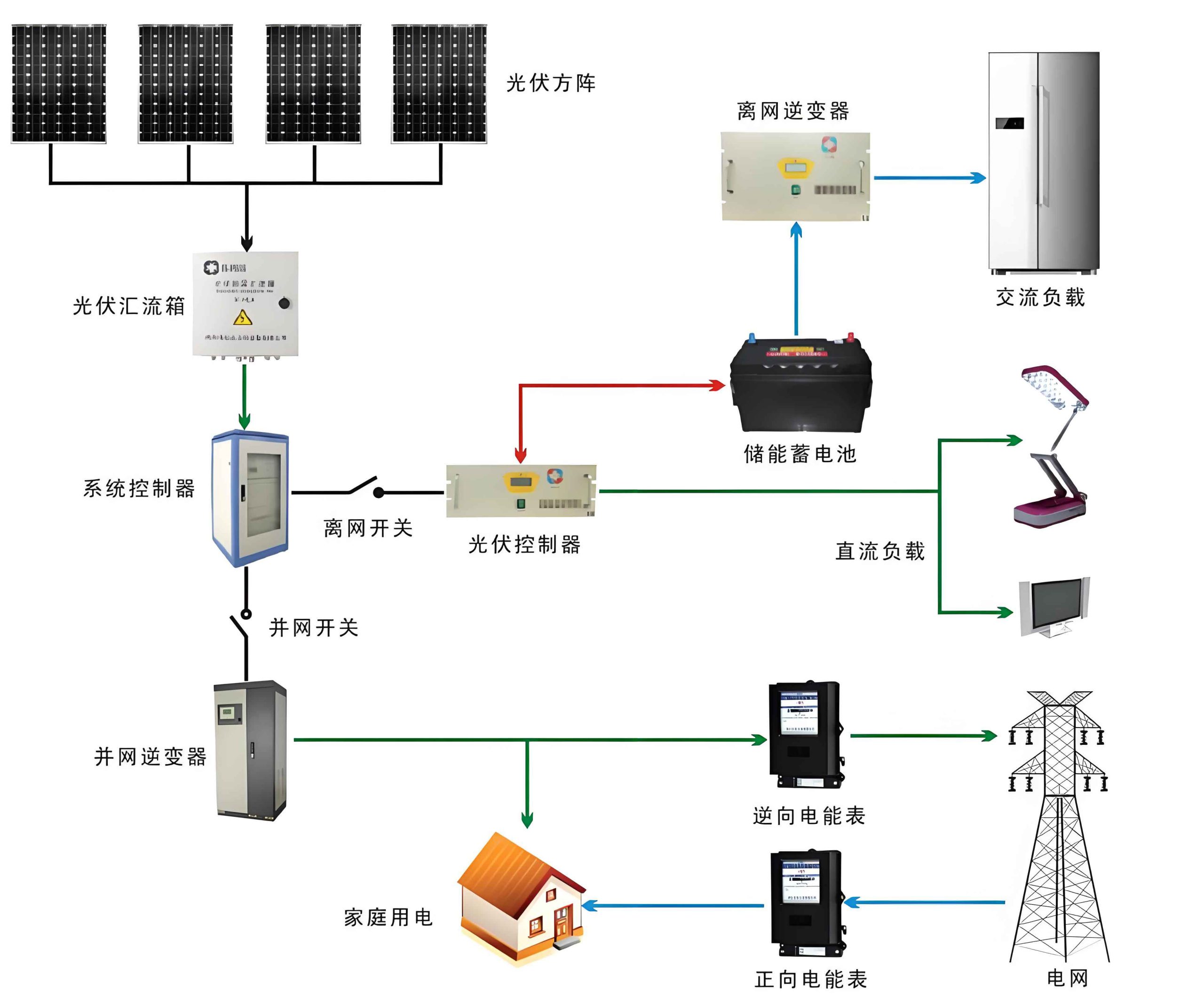
This image visually represents an advanced solar system, highlighting the integration of photovoltaic arrays and storage units. Such systems are becoming ubiquitous in both utility-scale and residential applications, underscoring the need for robust safety measures. Our gas detectors are designed to seamlessly blend into these setups, providing 24/7 monitoring without disrupting operations. The solar system’s growth is fueled by innovations like these, which enhance public trust and regulatory compliance.
From a technical standpoint, the solar system’s performance can be optimized through data analytics. Our detectors feed information into cloud-based platforms, where machine learning algorithms analyze trends to predict failures. For instance, we use the following equation to assess risk levels in a solar system:
$$ Risk = \sum_{i=1}^{n} w_i \cdot \log(C_i + 1) $$
where \( w_i \) are weights assigned to different gas types based on toxicity, and \( C_i \) are their concentrations. This risk score triggers alerts when thresholds are exceeded, allowing for proactive interventions. Additionally, we have developed formulas to calculate the economic benefits of our solutions. For a typical solar system, the cost savings from avoided downtime can be expressed as:
$$ Savings = D \cdot (P_{avg} \cdot t_{down} – C_{det}) $$
In this formula, \( D \) is the number of detection events prevented per year, \( P_{avg} \) is the average power output in kilowatts, \( t_{down} \) is the downtime avoided in hours, and \( C_{det} \) is the cost of detector installation and maintenance. Our studies show that solar systems using our detectors see a return on investment within two years, thanks to reduced incident rates and improved efficiency.
To delve deeper into the solar system’s architecture, let’s examine the role of gas detection in various phases. During manufacturing of photovoltaic cells, gases like silane or phosphine are used, requiring precise monitoring with devices like the Midas detector. In operational solar systems, battery storage units may emit hydrogen during charging cycles, necessitating the RG ESGD for continuous surveillance. We have compiled a table comparing different gas detection technologies applicable to solar systems:
| Detector Type | Gases Detected | Response Time | Application in Solar System | Accuracy |
|---|---|---|---|---|
| Electrochemical (RG ESGD) | H2, CO, SO2 | < 30 seconds | Battery storage safety | ±2% of reading |
| Catalytic Bead (Midas) | Combustible gases (e.g., CH4) | < 15 seconds | Manufacturing processes | ±3% of LEL |
| Infrared (IR) | CO2, hydrocarbons | < 10 seconds | Emission monitoring | ±1% of range |
| Photoionization (PID) | VOCs, toxic compounds | < 5 seconds | Environmental compliance | ±0.5 ppm |
This table demonstrates the versatility of our offerings, each tailored to specific aspects of a solar system. For example, electrochemical sensors in the RG ESGD are ideal for detecting hydrogen in battery enclosures, while catalytic bead sensors in Midas protect against explosions in gas-filled environments. By integrating these detectors, a solar system can achieve comprehensive safety coverage, from production to end-use.
The solar system’s evolution is closely tied to advancements in automation and control. Our Process Measurement and Control division focuses on safety, sustainability, and asset performance, providing solutions that enhance accuracy and predictability. In solar systems, this translates to automated shutdown protocols when gas levels exceed safe limits. We model these protocols using state equations:
$$ \frac{dS}{dt} = – \alpha \cdot S + \beta \cdot D $$
where \( S \) is the system safety state (e.g., normal, alert, shutdown), \( \alpha \) is the decay rate due to environmental factors, \( \beta \) is the response coefficient from detector inputs \( D \). This dynamic approach ensures that solar systems respond swiftly to threats, minimizing human intervention and maximizing uptime. Furthermore, our solutions support the “East for East” strategy, where local R&D teams customize products for regional needs, such as China’s rapidly expanding solar system market.
Looking ahead, the solar system will play an even larger role in achieving carbon neutrality goals. We are committed to innovating alongside this growth, developing next-generation detectors with enhanced connectivity and AI capabilities. For instance, future solar systems may incorporate detectors that communicate via 5G networks, enabling real-time data fusion across distributed sites. The energy output of such an optimized solar system can be estimated using:
$$ E_{total} = \sum_{i=1}^{m} \eta_i \cdot A_i \cdot G_i $$
where \( E_{total} \) is the total energy generated in kilowatt-hours, \( \eta_i \) is the efficiency of each solar panel, \( A_i \) is its area in square meters, and \( G_i \) is the solar irradiance in W/m². Our safety solutions ensure that this energy production is not compromised by preventable incidents, thereby supporting a sustainable future.
In conclusion, our participation in the 2024 exhibition highlighted how Honeywell’s gas detection technologies are integral to the safety and efficiency of modern solar systems. Through products like the RG ESGD and Midas detectors, we address critical challenges in energy storage and photovoltaic manufacturing, fostering innovation in renewable energy. The solar system, as a holistic entity, benefits from our focus on precision, adaptability, and data-driven insights. As we continue to push boundaries in industrial automation, we remain dedicated to empowering partners and customers in building cleaner, more resilient energy infrastructures worldwide. The journey toward a sustainable future is paved with reliable solar systems, and we are proud to contribute to this transformative era.