
In the context of the global energy transformation, energy storage technology has emerged as a critical enabler for addressing the intermittency of renewable energy sources. Over the past decade, I have witnessed remarkable progress in the field of energy storage cells, particularly in electrochemical energy storage. As of June 2025, China’s installed capacity of new energy storage has reached 101.3 GW, surpassing the 100 GW milestone for the first time, a 32-fold increase from the end of the “13th Five-Year Plan” period. This accounts for over 40% of the global total, ranking first worldwide. Among these, lithium-ion battery energy storage dominates, representing approximately 96.4% of the commissioned capacity. Meanwhile, alternative technologies such as compressed air energy storage, flow battery energy storage, and sodium-ion battery energy storage are accelerating, demonstrating a diversified development landscape. In the “15th Five-Year Plan” period, new energy storage will further integrate with the “source-grid-load” links, playing a more important role in promoting large-scale renewable energy consumption, ensuring the safe and stable operation of power systems, and supporting flexible low-carbon energy use for consumers.
However, the energy storage cell industry faces challenges at three levels: technology, market, and industry. Technologically, lithium-ion batteries dominate, supporting 97% of domestic energy storage installations, but the transition from short-duration to long-duration storage requires breakthroughs in flow batteries and solid-state batteries. Market-wise, the sector is moving from policy-driven to market-driven, necessitating a reshaping of business models and revenue mechanisms. Industrially, we are shifting from single-point breakthroughs to clustered development to promote high-quality growth. This article, from a first-person perspective, systematically reviews and analyzes the development trajectories, technical characteristics, and performance advantages of various energy storage cell technologies. By comparing different technical routes, it provides scientific evidence for technology selection and application. Moreover, studying the economic viability and cost reduction pathways of energy storage cells is crucial for driving commercialization and facilitating deployment across broader applications.
Fundamental Theory of Energy Storage Cell
Electrochemical energy storage operates on the principle of reversible electrochemical reactions that convert electrical energy into chemical energy during charging and release it during discharging. The basic reaction can be expressed as:
$$ \text{Positive: } \text{LiMO}_2 \rightleftharpoons \text{Li}_{1-x}\text{MO}_2 + x\text{Li}^+ + x e^- $$
$$ \text{Negative: } \text{C} + x\text{Li}^+ + x e^- \rightleftharpoons \text{Li}_x\text{C} $$
The open-circuit voltage of an energy storage cell is governed by the Nernst equation:
$$ E = E^0 – \frac{RT}{nF} \ln Q $$
where \(E^0\) is the standard electrode potential, \(R\) is the universal gas constant, \(T\) is the temperature, \(n\) is the number of electrons transferred, \(F\) is Faraday’s constant, and \(Q\) is the reaction quotient. The theoretical energy density of a cell is given by:
$$ \text{Energy density} = \frac{nF E}{3600 \times M} \text{ (Wh/kg)} $$
where \(M\) is the molar mass of active materials. The core performance parameters for evaluating an energy storage cell are summarized in Table 1.
| Parameter | Symbol | Definition | Typical Unit |
|---|---|---|---|
| Energy Density | \(E_{\text{vol}}\) / \(E_{\text{grav}}\) | Energy stored per unit volume or mass | Wh/L, Wh/kg |
| Power Density | \(P\) | Rate of energy delivery per unit mass/volume | W/kg, W/L |
| Cycle Life | \(N\) | Number of charge/discharge cycles before capacity drops to 80% | cycles |
| Coulombic Efficiency | \(\eta_{\text{CE}}\) | Ratio of discharge capacity to charge capacity | % |
| Round-trip Efficiency | \(\eta_{\text{RT}}\) | Energy output / energy input over a full cycle | % |
| Self-discharge Rate | \(\%/\text{month}\) | Capacity loss when idle | %/month |
| Operating Temperature Range | \(T_{\text{op}}\) | Safe temperature window for operation | °C |
The classification of energy storage cell technologies based on material systems is shown in Table 2.
| Technology | Positive Material | Negative Material | Electrolyte | Key Characteristics |
|---|---|---|---|---|
| Lithium-ion | LFP, NMC, LCO | Graphite, Si-C | Liquid organic | High energy density, long cycle life |
| Sodium-ion | NaxFeO2, Prussian blue analogs | Hard carbon | Liquid organic/aqueous | Abundant sodium, low cost, good low-temperature performance |
| Solid-state | NMC, Li-rich | Li metal, Si | Solid (polymer, oxide, sulfide) | High safety, high energy density potential |
| Vanadium Redox Flow | V2+/V3+ (negative), V4+/V5+ (positive) | Same vanadium species | Aqueous sulfuric acid | Long cycle life (>20 years), scalable power/energy independently |
Current Development Status of Electrochemical Energy Storage Cell Technologies
Breakthroughs in Lithium-ion Battery Technology and Large-capacity Cell Evolution
Lithium-ion battery technology has continued to advance in the energy storage domain. Since commercialization, energy density has increased nearly four-fold, and cycle life has improved by a factor of 15. Currently, the industry focuses on developing large-capacity cells to reduce costs and improve efficiency. In 2025, CATL and Sungrow Power launched 587 Ah and 684 Ah cells respectively, pushing the technology toward higher energy and larger capacity. Compared to the 320 Ah cells in 2020, the single-cell capacity and system capacity have roughly doubled. In laboratory tests, BYD has even developed a 2,710 Ah cell. Large-capacity cells simplify battery management, reduce interconnections, and enhance system reliability. The development milestones are summarized in Table 3.
| Parameter | Early Commercialization | Current Level (2025) | Improvement Factor |
|---|---|---|---|
| Energy density (Wh/kg) | Baseline | ~4x baseline | 4x |
| Cycle life (cycles) | Baseline | ~15x baseline | 15x |
| Single-cell capacity (Ah) | <320 | 587–684 (mass production) | >2x |
| System capacity (relative) | Baseline | ~2x baseline | 2x |
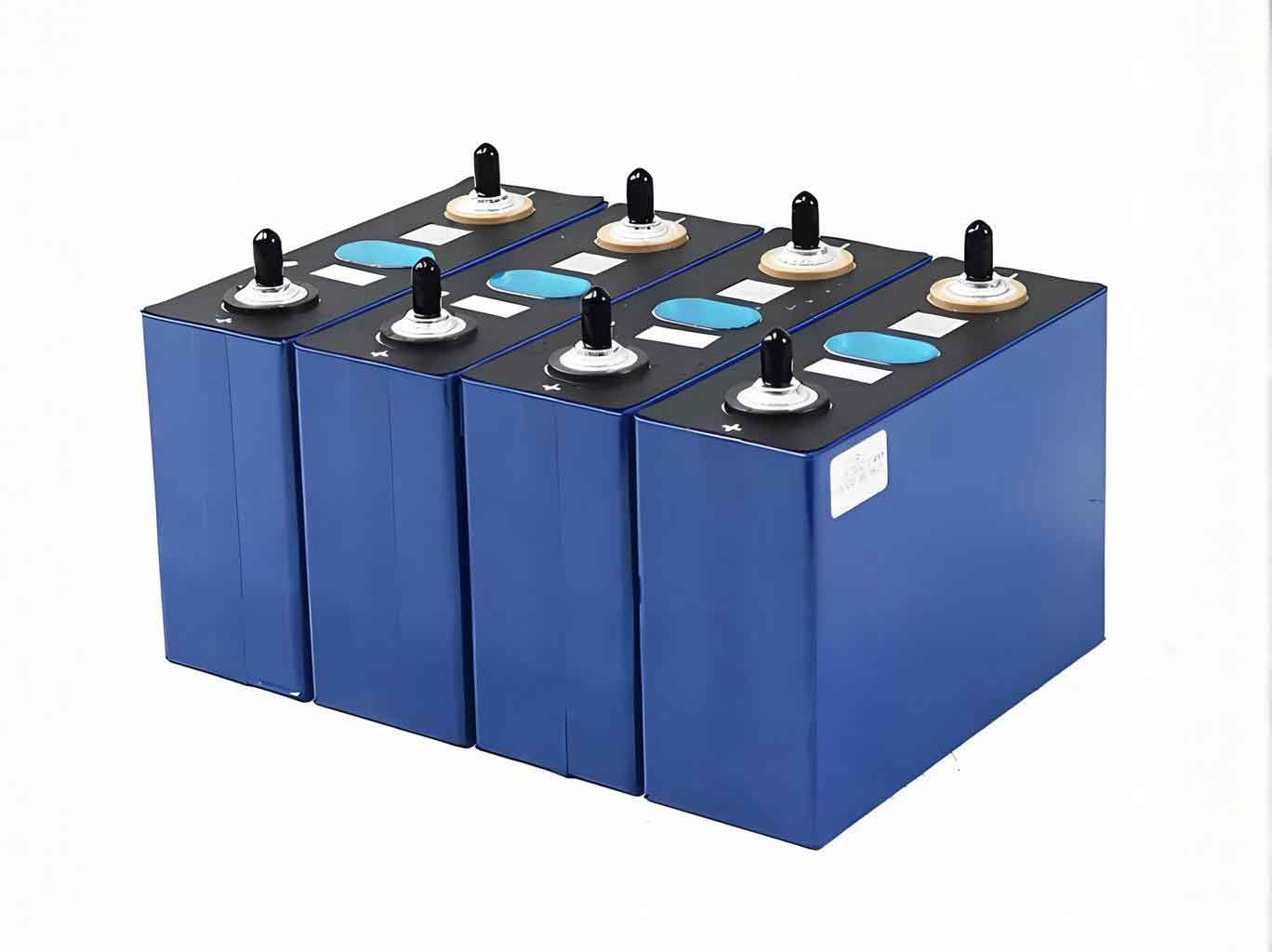
The graph above illustrates the typical structure of a lithium iron phosphate (LFP) energy storage cell, which is the most widely used chemistry in utility-scale applications due to its excellent safety and cycle life.
Sodium-ion Battery Technology Progress and Commercial Application
Sodium-ion batteries (SIBs) have emerged as an important supplement to lithium-ion technology due to the abundance of sodium, lower cost, and superior low-temperature performance. At -40°C, sodium-ion cells can retain over 80% of their capacity, demonstrating excellent wide-temperature adaptability, especially for extreme climate conditions. A recent breakthrough involves a novel two-dimensional topological dichalcogenide monolayer material used as the anode, offering a theoretical storage capacity of up to 1.35 Ah/g for sodium ions, significantly surpassing many existing two-dimensional materials. This material’s unique ion transport characteristics greatly reduce sodium ion migration resistance, thus shortening charging time and enhancing fast-charging capability. Furthermore, its special chemical adsorption properties effectively inhibit polysulfide migration, improving cycling stability. The energy density of a sodium-ion cell can be expressed as:
$$ E_{\text{SIB}} = \frac{C_{\text{theoretical}} \cdot V_{\text{avg}}}{3.6} $$
where \(C_{\text{theoretical}}\) is the theoretical specific capacity (Ah/g) and \(V_{\text{avg}}\) is the average operating voltage (V). Current sodium-ion cells achieve energy densities of 120–160 Wh/kg, with potential to exceed 200 Wh/kg in the coming years.
Solid-state and Semi-solid-state Battery Technology Pathways
Solid-state battery technology represents the frontier of energy storage cell development. By replacing liquid electrolytes with solid electrolytes, it fundamentally eliminates leakage risks and offers higher safety, higher energy density, and a wider operating temperature range. The three main routes are polymer, sulfide, and oxide solid electrolytes. Polymer-based solid-state batteries are relatively mature and have achieved small-scale mass production. Positive electrode materials are evolving toward ultra-high-nickel manganese-rich chemistries, while negative electrodes progress from graphite to silicon-based anodes and ultimately to lithium metal. This material evolution will significantly enhance both energy density and safety. In 2025, solid-state energy storage cells began to appear in tender projects, with megawatt-level demonstration projects expected to be implemented, marking a critical transition from laboratory research to engineering application. The theoretical energy density of a solid-state battery with a lithium metal anode is given by:
$$ E_{\text{SSB}} = \frac{nF(E_{\text{cathode}} – E_{\text{anode}})}{3.6 \cdot (m_{\text{cathode}} + m_{\text{anode}} + m_{\text{electrolyte}})} $$
where \(m\) represents the mass of each component. With optimized materials, solid-state energy storage cells could achieve over 400 Wh/kg.
All-vanadium Redox Flow Battery and Long-duration Energy Storage
All-vanadium redox flow batteries (VRFBs) are a key long-duration energy storage technology. They feature independent power and energy scaling, a cycle life exceeding 20 years, high safety (no thermal runaway), and are ideal for grid-scale storage and renewable energy smoothing. Newly developed VRFB stacks have achieved energy efficiency over 80%, and material costs have been reduced by more than 50% compared to early systems. VRFBs can achieve 100% depth of discharge without damaging battery life, giving them a unique advantage in long-duration applications. Additionally, the vanadium electrolyte can be recycled, offering excellent environmental friendliness. The round-trip efficiency of a VRFB can be modeled as:
$$ \eta_{\text{VRFB}} = \frac{\int P_{\text{discharge}} dt}{\int P_{\text{charge}} dt} \times 100\% $$
Typical voltage efficiency and coulombic efficiency are around 90% each, resulting in an overall energy efficiency of 80–85%.
Current Status of Energy Storage System Integration and Intelligent Technologies
Large String High-voltage System Architecture
A major trend in 2025 is the large string high-voltage system architecture, which achieves higher power density with fewer components, significantly improving integration efficiency and cost-effectiveness. By increasing the number of battery modules per string and reducing parallel branches, system complexity and cost decrease. High-voltage architectures also reduce current losses. Compared to traditional low-voltage designs, large string systems can raise the DC voltage level to 1,500 V or higher, reducing transmission losses by approximately 3–5%. This architecture enhances the economic competitiveness of large-scale energy storage systems.
Grid-forming Energy Storage Technology and Grid Support Capability
Grid-forming (GFM) energy storage technology can actively construct stable voltage and frequency environments to support the grid. Unlike traditional grid-following inverters, GFM systems can provide inertia support during faults and even operate in island mode. The response time reaches millisecond levels. The combination of “grid-forming + conventional grid-following” mode has received policy support and is being demonstrated in multiple locations, with GFM capacity accounting for 10–30% to meet grid requirements. The power output of a GFM energy storage cell system during a transient event can be modeled as:
$$ P_{\text{GFM}} = \frac{V_{\text{cell}} \cdot V_{\text{grid}}}{X} \sin(\delta) $$
where \(V_{\text{cell}}\) and \(V_{\text{grid}}\) are the inverter output voltage and grid voltage, \(X\) is the coupling reactance, and \(\delta\) is the power angle.
AI-based Intelligent Management and Thermal Runaway Warning
AI-based intelligent management has become a key direction for the energy storage industry. AI is applied in thermal management, operation and maintenance, and electricity trading, enabling optimized operation and predictive maintenance. AI platforms include battery vertical large models, intelligent R&D systems, and expert agents. By analyzing historical operating data, machine learning algorithms can identify battery degradation patterns, optimize charging/discharging strategies, and extend battery life by 15–20%. The system can also dispatch storage resources based on grid demand and electricity price signals, improving economic benefits by about 10–15%. The state-of-health (SOH) prediction model can be expressed as:
$$ \text{SOH}(t) = 1 – \sum_{i=1}^{n} \alpha_i \cdot \exp(-\beta_i t) $$
where \(\alpha_i\) and \(\beta_i\) are parameters learned from data, and \(t\) is the number of cycles or time.
Liquid Cooling Technology and Full-range Temperature Control
To meet large-capacity requirements, liquid cooling technology has adopted a “full liquid cooling” approach, combined with AI-based bionic thermal balancing, controlling cell temperature differences with 40–60% higher heat dissipation efficiency than air cooling. Full-range temperature control systems precisely regulate temperature, using AI-optimized cooling strategies and upgraded firewalls with hierarchical temperature control and novel phase-change materials, enhancing system safety and stability. The heat transfer rate in a liquid-cooled system is given by:
$$ Q = \dot{m} c_p (T_{\text{in}} – T_{\text{out}}) $$
where \(\dot{m}\) is the coolant mass flow rate, \(c_p\) is the specific heat capacity, and \(T_{\text{in}}, T_{\text{out}}\) are inlet and outlet temperatures.
Future Development Trends and Market Prospects of Energy Storage Cell Technologies
Diversified Technology Route Development Direction
The future of energy storage cell technology will be characterized by a diversified landscape, with different routes deepening their respective strengths. Lithium-ion batteries will continue to dominate in high-energy-density and fast-response applications, focusing on large-capacity cells, solid-state evolution, and material optimization. Sodium-ion batteries, with their resource abundance and cost advantages, are expected to achieve breakthroughs in large-scale storage and special environments, with a critical industrialization period from 2025 to 2030. Solid-state batteries will gradually move from lab to engineering, with polymer routes achieving small-scale mass production first, followed by sulfide and oxide routes. Flow batteries will play a key role in applications of 4 hours or longer, with promising market prospects as material costs decline and system efficiency improves. The synergistic development of multiple routes will form a complementary energy storage cell technology system.
Hybrid Energy Storage System Trends
Hybrid energy storage systems (HESS) will become an important trend, optimizing performance and economics by combining different technologies. Lithium-ion with sodium-ion, flywheel, electromagnetic storage, or supercapacitors have entered demonstration stages. HESS leverages the strengths of each technology: lithium-ion for high energy density and medium-duration storage, supercapacitors for high power and fast response, and flow batteries for long-duration storage. This combination meets diverse application requirements and optimizes overall technical-economic performance. With advances in control strategies and system integration, HESS will play a vital role in grid frequency regulation, peak shaving, microgrids, and distributed storage. The power management strategy for a HESS can be expressed as:
$$ P_{\text{total}}(t) = P_{\text{Li}}(t) + P_{\text{SC}}(t) + P_{\text{flow}}(t) $$
subject to individual power and energy constraints.
Techno-economic Analysis and Cost Reduction Pathways
The continuous improvement in the techno-economic performance of energy storage cells is the fundamental driver of industrial development. Lithium-ion battery costs are decreasing through large-scale production, material optimization, and manufacturing process improvements. It is projected that costs will fall by another 30–50% between 2025 and 2030. Sodium-ion batteries, with raw material advantages, could be 20–30% cheaper than lithium-ion at scale. Flow batteries have already reduced material costs by over 50% through stack technology upgrades and vanadium electrolyte recycling. Solid-state batteries, despite higher initial costs, have significant cost reduction potential as technology matures and industrialization proceeds. Overall system cost reduction also benefits from integration optimization, lower O&M costs, and improved lifecycle value. The levelized cost of storage (LCOS) can be modeled as:
$$ \text{LCOS} = \frac{\text{Total lifecycle cost}}{\sum_{i=1}^{N} \text{Discharged energy}_i \cdot (1+r)^{-i}} $$
where \(r\) is the discount rate and \(N\) is the number of years. It is expected that by 2030, the LCOS of mainstream energy storage cells will drop to less than half of today’s values, laying a solid foundation for large-scale commercial deployment.
Conclusion
In conclusion, I have observed that energy storage cell technology is undergoing rapid transformation. Lithium-ion technology continues to dominate, with breakthroughs in large-capacity cells and system integration. Meanwhile, new technologies like sodium-ion, solid-state, and flow batteries are developing rapidly, forming a diversified technological landscape. The energy storage system is evolving toward intelligent and integrated directions, with AI and advanced thermal management technologies maturing. I recommend that governments strengthen top-level design, improve policy systems for the energy storage industry, and increase support for R&D of new technologies. Establishing comprehensive technical standards and safety regulations, and promoting energy storage participation in electricity market trading are essential. Enterprises should enhance technological innovation and industrialization capabilities, focusing on key materials, system integration, and intelligent control. International cooperation and participation in global standard-setting should be encouraged. The installed capacity of energy storage cells is expected to exceed 240 million kW by 2030, marking a new era in energy transformation.