
The global landscape of smart home technology is vast and rapidly evolving. While users worldwide increasingly enjoy the convenience brought by technological advancements, their expectations for intelligent home systems continue to rise. These systems, through smart devices and interconnected platforms, enable automated control and intelligent management of household environments. Internationally, brands like Amazon Echo, Google Home, and Apple HomeKit have gained significant popularity, alongside successful products from European manufacturers such as Philips Hue, Bosch Smart Home, and IKEA Trådfri. However, market demands and conditions vary greatly across regions, necessitating careful selection of brands and products based on local realities and specific user needs.
In our context, the development of smart home technology has also accelerated remarkably. Applications now span home security, appliance automation, and even healthcare monitoring. The integration of the Internet of Things (IoT), cloud-based big data analytics, and notably, photovoltaic solar technology, has significantly enhanced the system’s extensibility and integrative capacity. Nevertheless, current smart home solutions still face notable shortcomings. Issues concerning device and system compatibility, security vulnerabilities of connected devices, and overall user-friendliness remain critical challenges that demand effective solutions.
Recognizing smart homes as a definitive future trend, significant national emphasis has been placed on supporting this sector’s growth. A series of policies and measures, including development plans for new urbanization and the smart home industry, have been enacted to foster technological innovation in this field. The future trajectory of smart home technology is poised to focus on four key directions: achieving higher levels of intelligence, enabling more natural human-computer interaction, ensuring greater security, and expanding into richer application scenarios—all aimed at meeting practical market demands. In the development of our embedded smart home remote control system, we have effectively integrated IoT architecture with photovoltaic energy systems, culminating in a smarter, greener, and more convenient domestic ecosystem.
In northern regions, photovoltaic systems are particularly advantageous due to their flexibility, modest scale, and ease of installation, making them well-suited for powering communications and other needs in remote, off-grid pastoral areas. With advancements in battery technology, residential grid-connected photovoltaic systems are gradually permeating both urban and rural settings, indicating a vast market prospect for solar-powered home lighting. For instance, the Inner Mongolia Autonomous Region boasts abundant sunlight, with most areas experiencing over 2,700 hours of annual sunshine, and figures exceeding 3,400 hours in the western part of the Alxa Plateau. Building upon this foundational capability for solar power generation, our research into smart home network applications synthesizes modeling methods for sensors and controllable devices. It leverages the strengths of various underlying technologies—wireless connectivity, data mining, IoT search, big data processing, and cloud storage—to push forward economic development and significantly enhance the quality of life for residents, showcasing broad potential.
Considering the climatic conditions and relevant technological developments in northern areas, we propose a smart home system design that aligns with the trends toward intelligence, environmental protection, energy efficiency, and comfort. This initiative aims to advance daily life further in these directions.
System Design Proposal
The core design involves creating an intelligent residential environment monitoring and control system, powered primarily by photovoltaic generation and based on IoT technology. This system is capable of regulating indoor environmental parameters, implementing corrective actions for irregularities, and triggering alarm notifications. It facilitates seamless monitoring via wireless data transmission to the cloud and user mobile terminals. The integrated system, which combines IoT with photovoltaic power generation, comprises both hardware and software subsystems. Utilizing the MQTT protocol, it establishes efficient connections with the cloud and user terminals to enable communication and remote monitoring/control functionalities.
Hardware System Architecture
The hardware forms the backbone of the smart home system. Through programmed regulation, it drives circuits to provide power for controlling and operating peripherals. It capitalizes on the inherent capability of a photovoltaic solar system to collect and convert sunlight into electricity. Our design philosophy is outlined below.
The primary hardware structure consists of four key components: Sensors, Actuators, Communication Modules, and the Main Control Board. Actuators such as water pumps, air conditioners, lighting, ventilation fans, and heating equipment are high-power devices requiring substantial current drive, which the Arduino UNO development board alone cannot supply. Hence, the role of a dedicated driver board becomes crucial. This driver board facilitates the operation of the photovoltaic-based smart home system, using solar-generated power as the primary energy source to drive indoor environmental sensors and actuator devices. Collected environmental parameters are uploaded to the cloud via Wi-Fi, enabling real-time dynamic observation on mobile terminals. The Arduino UNO employs the ATmega2560 microcontroller from Atmel. Once connected to the driver board via headers, the development board requires no separate power supply. Environmental sensors (e.g., PM2.5, gas sensors) are connected to the main board’s I2C ports, while others like smoke and temperature sensors interface with its analog ports. The communication module uses an EWM3080 Wi-Fi card for cloud connectivity, achieving data exchange between the system and terminals through the main board’s UART port. The main control board coordinates and controls peripherals via the driver board.
The Photovoltaic Solar Subsystem
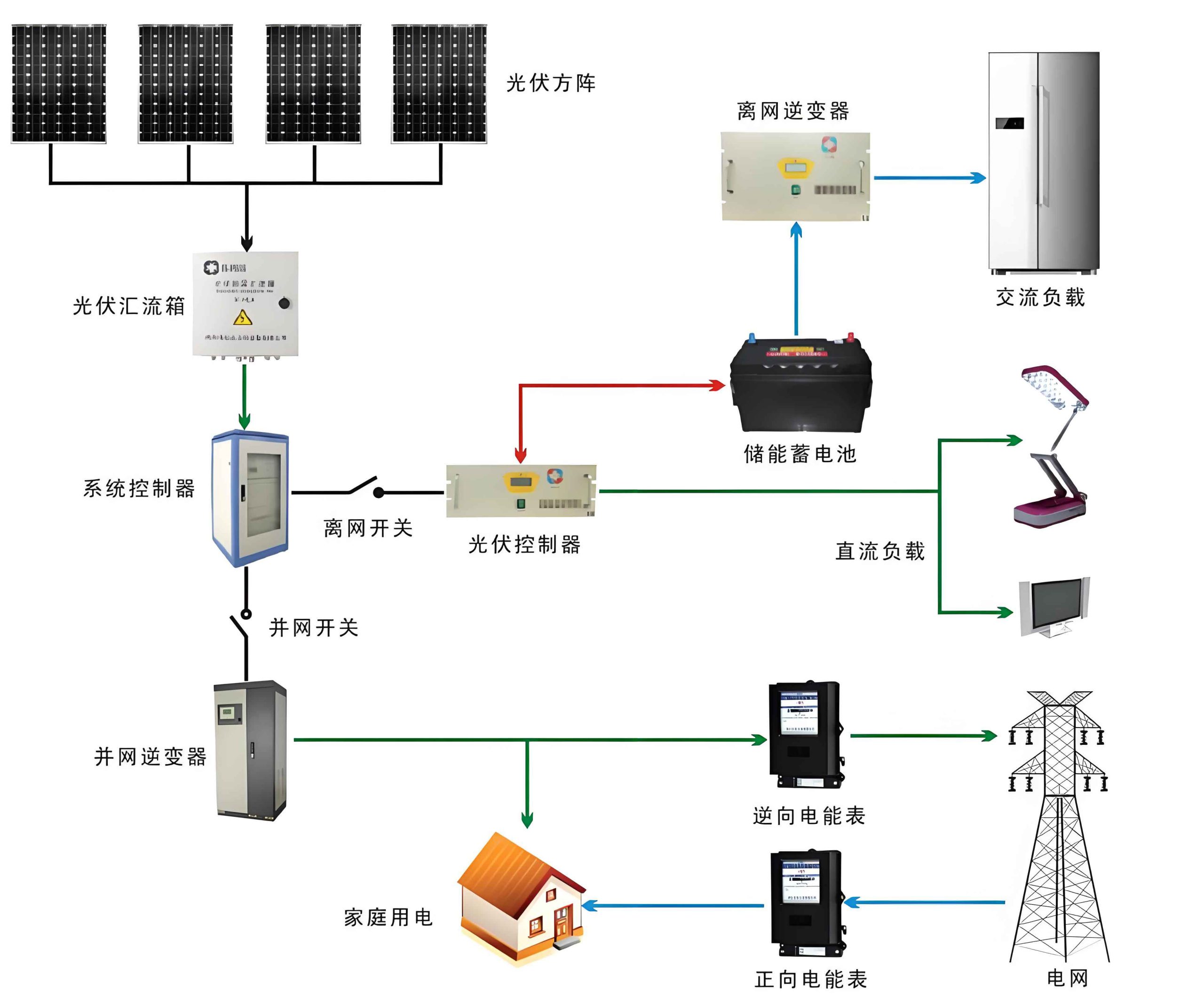
The operation of the smart home system primarily relies on the city grid but is augmented by a photovoltaic solar system that supplies a portion of the required electrical energy. Leveraging the ample sunshine in northern climates, solar energy is captured by monocrystalline silicon panels and converted into electrical energy. An inverter then transforms this DC power into stable AC power for the system, simultaneously charging a lithium battery storage unit. This integrated approach not only provides clean energy but also incorporates emergency power backup functionality. The energy conversion hardware network can be conceptualized as follows, with the energy flow expressed mathematically:
$$ P_{\text{generated}}(t) = \eta_{\text{PV}} \cdot A_{\text{PV}} \cdot G(t) $$
$$ E_{\text{stored}}(t) = \int_{0}^{t} \left( P_{\text{generated}}(\tau) – P_{\text{load}}(\tau) \right) \cdot \eta_{\text{batt}} \cdot d\tau \quad \text{for } P_{\text{generated}} > P_{\text{load}} $$
Where \( P_{\text{generated}}(t) \) is the instantaneous power generated by the PV panels, \( \eta_{\text{PV}} \) is the panel efficiency, \( A_{\text{PV}} \) is the total panel area, \( G(t) \) is the solar irradiance, \( E_{\text{stored}}(t) \) is the energy stored in the battery, \( P_{\text{load}}(t) \) is the system load power, and \( \eta_{\text{batt}} \) is the battery charge/discharge efficiency.
Software System Design
To emphasize low-carbon energy savings, simplicity, and practicality—addressing common issues of high energy consumption and complex operation in smart home systems—we simplified the system’s functionality while retaining its core advantages. The software system’s program execution flow is as follows. The main program incorporates several subroutines: Initialization, Data Acquisition, Data Upload, Data Display, Control, and Alert. A simplified main program flowchart is described.
- Initialization Subroutine: After user authentication, the program executes initialization. This process occurs in five concurrent parts: network transmission module init, status switch init, analog input init, digital input init, and driver device init. The goal is to reset pins, clear temporary buffers, set the data acquisition frequency (e.g., 10–30 seconds per cycle), set the data upload interval (e.g., 30–40 seconds, defaulting to 60 seconds).
- Data Acquisition Subroutine: Sensors deployed at various indoor points collect environmental parameter data upon receiving instructions from the main CPU. The acquired data undergoes digital filtering for noise reduction. A simplified filter can be represented as:
$$ \bar{x}_k = \alpha \cdot x_k + (1 – \alpha) \cdot \bar{x}_{k-1} $$
where \( \bar{x}_k \) is the filtered value at time \( k \), \( x_k \) is the raw sensor reading, and \( \alpha \) is the smoothing factor (\( 0 < \alpha < 1 \)). - Data Upload Subroutine: At the defined intervals, data packets from the preceding period are uploaded to the cloud. Control commands issued from the user terminal are also received through this channel.
- Control Subroutine: Acquired data from all points is evaluated. The results are sent to the main CPU, which processes them to generate control signals. These signals are then executed via the driver unit to operate the corresponding peripheral actuators.
- Alert Subroutine: This monitors the normal operation of all peripherals, alerts on abnormal environmental parameters, and oversees program execution—automatically restarting the system if a “hang” is detected. It also includes a manual reset function and a visual fault indicator on the terminal interface.
Network Architecture Design
The network framework is the core of the smart home system design, serving as the nexus linking all functional hardware, enabling data transfer, and coordinating peripherals. Our system’s network design comprises four parts: the IoT Architecture, Communication Protocol, Cloud Configuration, and Terminal Interface.
IoT Architecture
The IoT stack is structured in four layers:
| Layer | Primary Function | Implementation in Our System |
|---|---|---|
| Perception Layer | Identifies and collects information via sensors. | Arduino UNO main board collecting data from various sensors (I2C, Analog). |
| Network Layer | Securely transmits the collected information. | Using AT commands over Wi-Fi to send data to the IoT platform. |
| Platform Layer | Handles data authentication, access, and forwarding. | Alibaba Cloud platform, using MQTT protocol with required authentication. |
| Application Layer | Utilizes data for specific application needs. | Using IoT Studio to create visual Web/APP interfaces for monitoring and control. |
Communication Protocol Selection
While many IoT control units communicate with clients via HTTP, this protocol can be resource-intensive, exhibit higher latency, and sometimes lack the stability and security required for robust applications. Although Zigbee is common for local home networks, its limited range and susceptibility to interference make it less ideal for comprehensive remote smart home systems. We selected the MQTT (Message Queuing Telemetry Transport) protocol, which is based on a publish-subscribe model over a client-server architecture. Its advantages include a small code footprint, suitability for constrained hardware, and reliable operation over high-latency or bandwidth-limited networks—making it an excellent match for our main controller and the prevailing usage environment.
The Alibaba Cloud platform facilitates remote MQTT communication through its public cloud broker server, offering easy-to-use APIs for connection. Its UI is flat and intuitive, allowing for on-demand feature customization—a significant highlight. It also provides a companion mobile app and supports cloud storage, data processing, and edge computing operations.
Cloud Configuration and Terminal Interface
Monitoring is a primary function of our smart home system. Leveraging sensors and wireless networks, we use Alibaba Cloud as the platform. Data uploaded via the Wi-Fi module is presented on a customizable visual interface, enhancing user experience. Upon logging into the cloud platform, users can select and tailor the properties (e.g., temperature, PM2.5, humidity) they wish to monitor and control, enabling true personalization.
Once properties are set, users access a dedicated status monitoring dashboard for remote oversight of their home environment. This can be combined with network cameras for a more comprehensive, personalized monitoring solution.
The mobile terminal app allows users to log in for real-time home monitoring. The interface provides immediate alerts; for example, if PM2.5 levels exceed a threshold, a red fault indicator illuminates on the app. Users can then remotely trigger actions, such as activating an air purifier or ventilation system, to rectify the issue. Similar remote control functions for lighting, heating, and other appliances are all accessible through the intuitive terminal APP interface.
Performance Analysis and Future Outlook
Our design, tailored to northern climatic conditions and leveraging regional technological strengths like photovoltaics, results in an energy-efficient and environmentally friendly smart home system. By integrating the photovoltaic solar system, IoT technology, and cloud analytics, it fulfills the practical needs for real-time home environment monitoring, safety, and comfort while promoting energy savings and a lower carbon footprint. Cloud-based customization and terminal operation are designed to be easy to learn, simple, and convenient, with comprehensive and highly personalized functionality.
The table below summarizes a comparative analysis of key performance metrics between a traditional grid-only smart home system and our integrated solar-powered system:
| Metric | Traditional Grid-Only System | Our Integrated Solar System |
|---|---|---|
| Primary Energy Source | 100% Grid Power | Grid + Photovoltaic Solar Generation |
| Estimated Energy Autonomy* | 0% | 30-70% (Highly location/season dependent) |
| Operational Cost (Energy) | Higher | Reduced |
| Carbon Footprint | Higher | Significantly Lower |
| Backup Power Capability | None (without separate UPS) | Yes, via integrated battery storage |
| System Complexity | Lower | Higher (requires energy management logic) |
* During daylight hours under favorable conditions.
However, as a product synthesizing IoT, computing, and energy technologies, smart home systems face inherent technical risks. First is the Product Standardization Risk. Currently, with large-scale smart city/home systems not yet universally deployed, there is a lack of unified international technical standards. Various research institutions and companies are vying to influence these standards for competitive advantage. The absence of a governing authority for standard-setting, coupled with the rapid evolution of supporting technologies like 5G, complicates this process, suggesting unified standards may not emerge in the immediate future.
Second is Product Reliability Risk. Our photovoltaic smart home system, designed for indoor environmental management, represents a convergence of energy infrastructure and building management. Its reliability is paramount for municipal and construction authorities. Technical flaws could not only increase project costs but potentially lead to environmental degradation or even harm to occupants and property. Therefore, stringent reliability standards, akin to those in construction materials, are essential.
Finally, there is the Risk of Technological Obsolescence. The smart home system itself is an amalgamation of fast-paced high-tech fields—software, sensor technology, automatic control, microelectronics, and composite materials. The industrial-grade development process inevitably faces continuous technological upgrades and the risk of substitution by newer solutions.
In conclusion, since the implementation of national development plans, significant attention and support have been directed toward innovating and advancing smart home technology to meet growing public demand for improved living standards. The system we have designed presents a viable solution for achieving intelligent, green, and energy-efficient homes. While there remains room for enhancement and iteration based on user feedback and emerging concepts, this scheme effectively meets daily needs and aligns with expectations for modern smart living. It serves as a practical data point and a foundational step in the ongoing evolution of intelligent home technology, demonstrating the critical role a well-integrated photovoltaic solar system can play in sustainable urban development.