
In my years of teaching courses on renewable energy systems, particularly focusing on solar inverters, I have observed that traditional pedagogical approaches often fall short in equipping students with the practical skills and analytical mindset required in the industry. The installation and debugging of solar inverters, a critical component in photovoltaic (PV) systems, demands not only theoretical knowledge but also hands-on experience and adaptive problem-solving abilities. Historically, instruction in this area relied heavily on lectures and limited lab sessions, leading to gaps in student comprehension and engagement. To address these challenges, I have integrated information technology (IT) and a work-integrated learning (WIL) model into the curriculum, transforming how students learn about solar inverters. This article details my first-person perspective on designing and implementing this innovative approach, emphasizing the use of digital tools, collaborative environments, and real-world simulations to enhance learning outcomes. Throughout this discussion, I will repeatedly highlight the centrality of solar inverters in PV systems, as they are pivotal for converting DC power from solar panels into usable AC power, and their proper installation and debugging are essential for system efficiency and safety.
The course on solar inverter installation and debugging is typically offered to second-year students in a higher vocational program specializing in photovoltaic technology. These students come with a foundation in electrical engineering, electronics, and microcontroller basics, but their practical skills, such as using multimeters or oscilloscopes, are often underdeveloped. Moreover, while they are adept at accessing online resources, they tend to disengage from passive, lecture-heavy teaching methods. My goal was to create a dynamic learning environment that leverages their digital literacy while fostering critical thinking and hands-on competency. By combining IT-enhanced pedagogy with a WIL framework, I aimed to simulate professional scenarios where students tackle real-world challenges related to solar inverters. This approach not only deepens their understanding of solar inverters but also prepares them for careers in the rapidly evolving solar energy sector.
To structure the course, I divided it into distinct phases: pre-class, in-class, and post-class activities, each infused with IT and WIL elements. The pre-class phase involves students engaging with online learning platforms where they access curated resources on solar inverters, including videos, interactive simulations, and reading materials. For instance, I provide modules on the principles of solar inverters, covering types such as string inverters, microinverters, and central inverters, along with their key parameters. Students are encouraged to explore topics like maximum power point tracking (MPPT) and grid-tie functionalities, which are crucial for solar inverter performance. They participate in discussion forums to pose questions and share insights, allowing me to gauge their preliminary understanding and address common misconceptions early on. This phase sets the stage for active learning, as students arrive in class with a baseline knowledge of solar inverters and specific queries to drive deeper exploration.
In the in-class phase, I employ a blended learning strategy that combines brief lectures with hands-on tasks. After reviewing pre-class submissions and clarifying doubts, I introduce core concepts through interactive presentations. For example, I explain the efficiency of solar inverters using the formula: $$ \eta = \frac{P_{\text{out}}}{P_{\text{in}}} \times 100\% $$ where \( \eta \) represents the efficiency, \( P_{\text{out}} \) is the AC output power, and \( P_{\text{in}} \) is the DC input power from the PV array. This formula helps students quantify the performance of solar inverters, emphasizing why precise installation and debugging are vital. To reinforce this, I use simulations in software like MATLAB or PVsyst, where students model solar inverter behavior under varying conditions. The table below summarizes the key topics covered in this phase, all centered on solar inverters:
| Topic | Description | IT Tools Used |
|---|---|---|
| Solar Inverter Types | Overview of string, micro, and central inverters | Online videos, interactive diagrams |
| Installation Protocols | Steps for mounting, wiring, and safety checks | Virtual reality (VR) simulations |
| Debugging Techniques | Troubleshooting common issues like voltage drops or faults | Simulation software, digital multimeter tutorials |
| Performance Metrics | Efficiency, harmonic distortion, and grid compliance | Data logging tools, spreadsheet analysis |
Following the theoretical overview, students engage in task-driven activities that mirror real-world workflows. I divide them into small groups, each assigned a specific project involving solar inverters. For instance, one group might design an installation plan for a residential PV system with string inverters, while another focuses on debugging a simulated fault in a commercial setup with central inverters. This is where the WIL model comes into play: I collaborate with industry partners to provide access to a training基地 that replicates actual work environments. Students visit this facility to practice installing and debugging physical solar inverters, using tools like oscilloscopes to measure waveforms and verify performance. The integration of IT is evident here, as they use mobile apps to document their processes and share data via cloud platforms. During these sessions, I emphasize the importance of solar inverters in ensuring system reliability, often referencing standards such as IEC 62109 for safety. To illustrate a common calculation, I introduce the power balance equation for a PV system: $$ P_{\text{PV}} = P_{\text{inv}} + P_{\text{loss}} $$ where \( P_{\text{PV}} \) is the total DC power from panels, \( P_{\text{inv}} \) is the AC power output from the solar inverter, and \( P_{\text{loss}} \) accounts for losses in conversion and wiring. This reinforces how solar inverters impact overall system yield.
The hands-on component is critical for mastering solar inverter installation and debugging. In the training基地, students follow a structured workflow: they first conduct a site assessment, then proceed to mount the solar inverter, connect it to the PV array and grid, and finally perform debugging tests. I provide checklists to guide them, such as verifying grounding, checking insulation resistance, and calibrating MPPT settings. To quantify their observations, they use formulas like the voltage regulation for solar inverters: $$ \text{Voltage Regulation} = \frac{V_{\text{no-load}} – V_{\text{full-load}}}{V_{\text{full-load}}} \times 100\% $$ where \( V_{\text{no-load}} \) and \( V_{\text{full-load}} \) are output voltages under no-load and full-load conditions, respectively. This helps them diagnose issues like overvoltage or underperformance in solar inverters. The table below outlines a typical debugging sequence for solar inverters, highlighting the role of IT tools:
| Step | Action | IT/WIL Integration |
|---|---|---|
| 1. Initial Inspection | Visual check for physical damage or loose connections | Use of tablet apps to log photos and notes |
| 2. Electrical Testing | Measure DC input and AC output with multimeters | Data synced to online platforms for real-time analysis |
| 3. Waveform Analysis | Capture output waveforms using oscilloscopes | Software tools like LTspice for simulation comparison |
| 4. Performance Validation | Compare measured efficiency with specifications | Cloud-based dashboards to track solar inverter performance over time |
| 5. Documentation | Prepare a detailed report with findings and recommendations | Collaborative editing via Google Docs, shared with industry mentors |
To further enrich the learning experience, I incorporate social media and communication tools. For example, after each practical session, students use a dedicated WhatsApp or WeChat group to discuss their findings, share screenshots of waveforms, and seek peer feedback. I moderate these discussions to ensure accuracy and encourage critical thinking about solar inverters. This not only builds a community of practice but also mimics the collaborative nature of real-world engineering teams. Additionally, I assign reflective tasks where students write brief reports on their experiences, focusing on challenges encountered during solar inverter debugging and how they resolved them. These reports are uploaded to a class blog, creating a knowledge repository that future students can access. In one instance, a group documented an issue with a solar inverter’s harmonic distortion, using the formula for total harmonic distortion (THD): $$ \text{THD} = \frac{\sqrt{\sum_{n=2}^{\infty} V_n^2}}{V_1} \times 100\% $$ where \( V_n \) represents the harmonic voltage components and \( V_1 \) is the fundamental voltage. By applying this, they identified a filtering problem and proposed a solution, demonstrating the integration of theory and practice.
The post-class phase involves continuous assessment and improvement. I use a multifaceted evaluation system that includes self-assessment, peer reviews, and instructor feedback. For each project on solar inverters, students receive scores based on criteria such as technical accuracy, teamwork, and innovation. The table below details the assessment rubric, which emphasizes the holistic development of skills related to solar inverters:
| Criterion | Weight | Description |
|---|---|---|
| Pre-class Preparation | 20% | Completion of online modules and participation in forums on solar inverters |
| In-class Performance | 30% | Quality of hands-on work in installing and debugging solar inverters |
| Collaboration and Communication | 15% | Effectiveness in group discussions and use of IT tools for sharing insights |
| Technical Report | 25% | Depth of analysis in documentation, including formulas and data on solar inverters |
| Reflection and Adaptability | 10% | Ability to learn from mistakes and propose improvements for solar inverter workflows |
This approach has yielded positive outcomes. Students show increased engagement and a deeper understanding of solar inverters, as evidenced by their ability to troubleshoot complex issues independently. For example, in a recent project, a team successfully debugged a grid-tie solar inverter by analyzing its power factor using the formula: $$ \text{Power Factor} = \frac{P}{S} $$ where \( P \) is real power and \( S \) is apparent power. They used this to optimize the inverter’s settings, improving system efficiency. However, challenges remain. Some students struggle with unexpected scenarios during solar inverter installation, such as dealing with environmental factors or interfacing with other system components. To address this, I plan to enhance the WIL component by introducing more varied simulations and inviting industry experts for guest sessions. Additionally, I continuously update the IT resources, incorporating augmented reality (AR) apps that allow students to visualize solar inverter internals in 3D, further demystifying their operation.
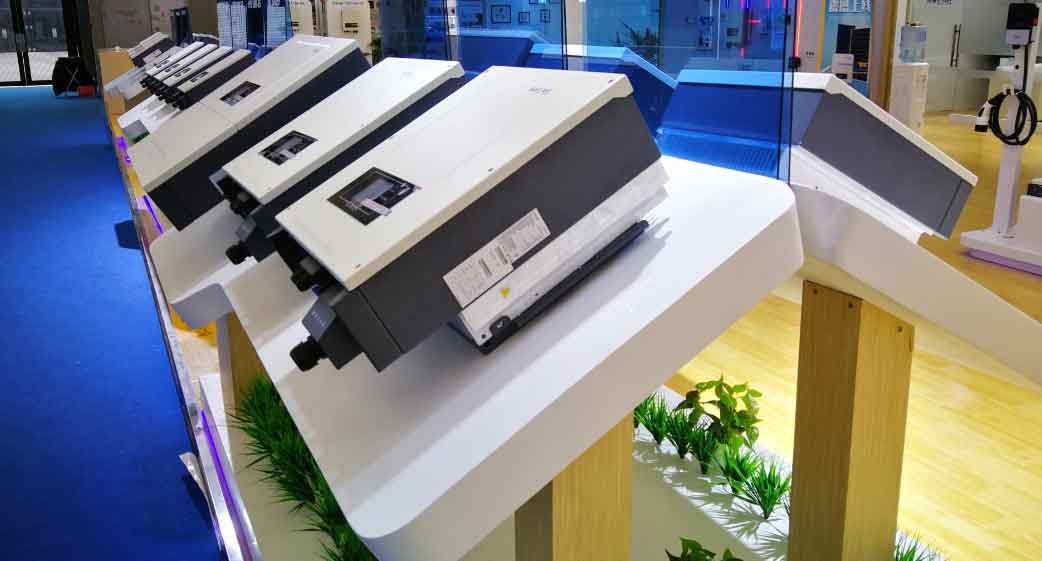
In terms of resource integration, the use of digital platforms has been transformative. I curate a repository of case studies on solar inverters, ranging from residential setups to large-scale solar farms. These cases include data logs and videos that students analyze to identify patterns and best practices. To illustrate the practical application, consider the following formula for sizing a solar inverter based on PV array power: $$ P_{\text{inv}} = k \times P_{\text{PV}} $$ where \( k \) is a derating factor (typically 0.8-1.2) accounting for losses and safety margins. Students use this in design exercises, creating spreadsheets to automate calculations. Moreover, the inclusion of real-world imagery enhances contextual learning. For instance, when discussing the physical installation of solar inverters, I often reference visual aids to show proper mounting techniques. In this context, the image below provides a concrete example of an energy storage inverter, which is a specialized type of solar inverter used in hybrid systems. It helps students visualize the components and connections they will encounter in the field.
Reflecting on the overall implementation, the fusion of IT and WIL has proven effective in teaching solar inverter installation and debugging. Students not only grasp theoretical concepts but also develop pragmatic skills through repeated exposure to solar inverters in simulated and real environments. The iterative process of learning—where they pre-study, practice, and reflect—fosters a growth mindset. For example, by repeatedly calculating efficiency metrics for solar inverters, they internalize the importance of precision in their work. Looking ahead, I aim to expand this model to other courses in the photovoltaic curriculum, leveraging lessons learned to refine the approach. Key to this is maintaining a focus on solar inverters as a core topic, ensuring that every activity, whether online or onsite, connects back to their role in PV systems. In conclusion, by embracing technology and work-integrated learning, we can better prepare the next generation of technicians and engineers to handle the complexities of solar inverters, driving innovation in renewable energy.