
In recent years, perovskite solar cells have emerged as a promising next-generation photovoltaic technology due to their high power conversion efficiency (PCE), low manufacturing cost, and simple solution-based fabrication processes. However, challenges such as long-term stability and potential lead leakage hinder their commercialization. Inverted perovskite solar cells (iPSCs), with a p-i-n structure, offer advantages like low-temperature processing, excellent stability, and minimal hysteresis, making them a focal point of research. Self-assembled monolayers (SAMs) have gained attention as novel hole-selective layers (HSLs) in iPSCs due to their customizable molecular structures and ability to fine-tune interfacial properties. This review comprehensively discusses the progress of SAMs in iPSCs, covering molecular design, deposition methods, mechanisms of action, and advanced strategies like sequential deposition and co-assembled monolayers (Co-SAMs). We emphasize the role of SAMs in energy level alignment, defect passivation, and interface modification to enhance the performance and stability of perovskite solar cells. Finally, we outline future challenges and directions for SAMs technology in large-area fabrication, stability improvement, and cost reduction.
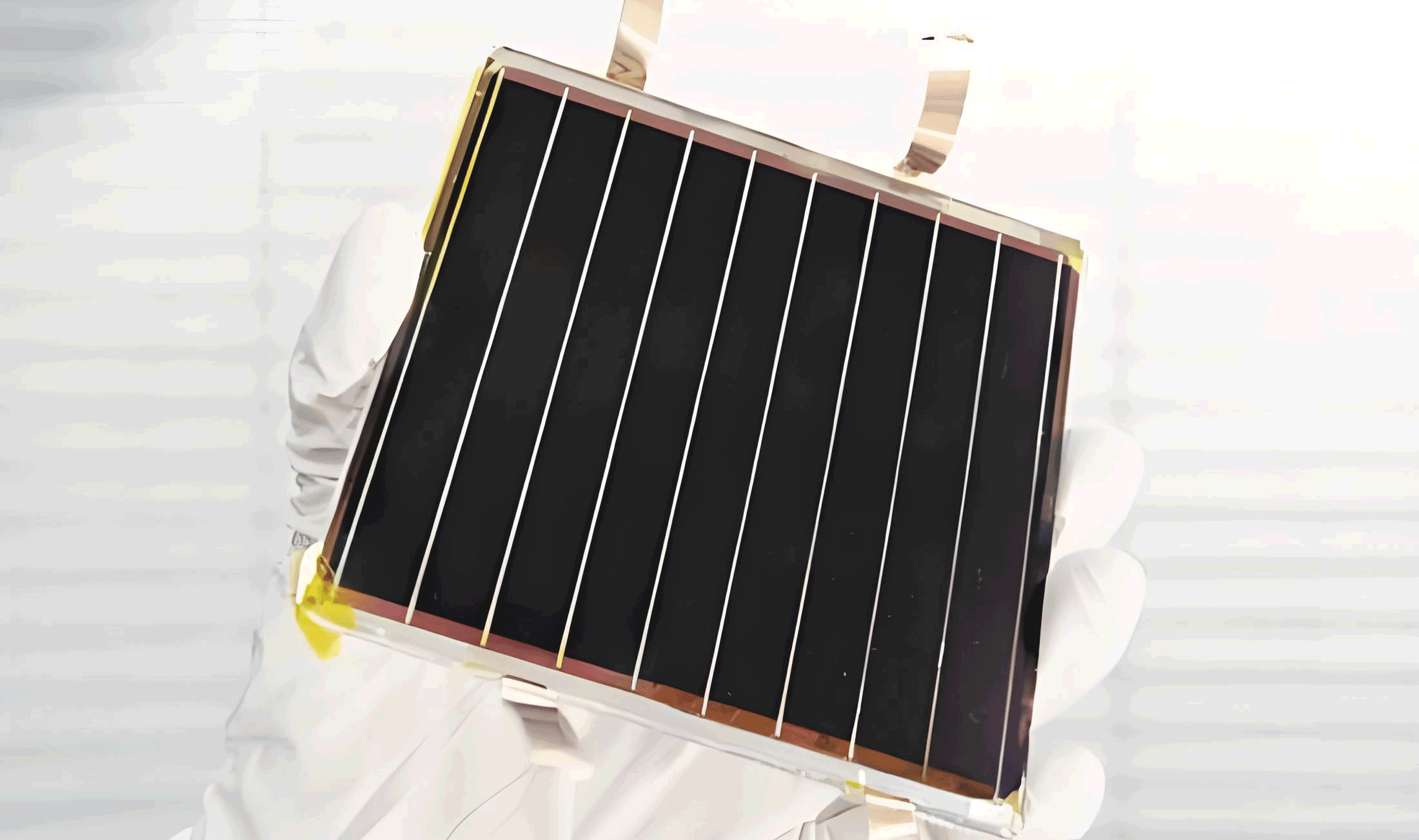
The structure of a typical perovskite solar cell consists of transparent conductive oxide (TCO) substrates, such as indium tin oxide (ITO) or fluorine-doped tin oxide (FTO), electron transport layers (ETLs), hole transport layers (HTLs), and the perovskite light-absorbing layer. In iPSCs, the HTL is often referred to as the hole-selective layer (HSL), which is ultra-thin and facilitates hole extraction via hopping mechanisms. SAMs as HSLs typically comprise three components: an anchoring group (e.g., phosphonic acid, carboxylic acid, or siloxane) for binding to TCOs, a π-conjugated unit (e.g., carbazole, triphenylamine, or phenothiazine) for hole transport, and a linker unit (alkyl or aromatic chains) connecting them. The molecular design of SAMs allows precise control over energy levels, dipole moments, and film morphology, which are critical for optimizing the performance of perovskite solar cells.
In terms of molecular structure, the anchoring group determines the stability and binding strength to the substrate. Phosphonic acid groups form strong bonds with metal ions on TCO surfaces, while carboxylic acid and siloxane groups offer alternatives with varying strengths. The linker unit, often alkyl or aromatic chains, influences the SAMs’ thickness, packing density, and charge transport properties. Longer alkyl chains can enhance film density but may reduce solubility, whereas aromatic linkers promote π-π stacking but risk aggregation. The functional group, such as carbazole derivatives, directly interacts with the perovskite layer, regulating energy levels and passivating defects. For instance, electron-donating groups like methoxy can raise the highest occupied molecular orbital (HOMO) level, while electron-withdrawing groups like halogens lower it, improving alignment with the perovskite valence band maximum (VBM). The general energy level alignment between SAMs and perovskite can be described by the equation: $$\Delta E = E_{\text{HOMO}} – E_{\text{VBM}}$$ where a smaller ΔE reduces energy loss and enhances open-circuit voltage (VOC) in perovskite solar cells.
Deposition methods for SAMs include liquid-phase techniques like spin-coating and dip-coating, which are cost-effective and suitable for large-scale production, and vapor-phase deposition, which offers high-quality films but at higher cost. Spin-coating is widely used due to its speed and uniformity, but parameters like concentration and spin speed must be optimized. Dip-coating involves immersion and washing steps, requiring careful control to avoid defects. The choice of deposition method impacts the coverage and homogeneity of SAMs films, which are crucial for the performance of perovskite solar cells.
The mechanisms of SAMs in iPSCs involve energy level regulation, defect passivation, interface modification, and synergistic effects. SAMs adjust the work function (WF) of TCO substrates through their dipole moments, enabling better hole extraction. For example, the dipole moment (μ) can be calculated as: $$\mu = q \times d$$ where q is the charge and d is the distance, influencing the interfacial energy barrier. Defect passivation occurs when functional groups, such as sulfur or oxygen atoms, coordinate with undercoordinated Pb²⁺ ions or form hydrogen bonds with organic cations in the perovskite, reducing non-radiative recombination. Interface modification improves wettability and perovskite crystallization, leading to higher-quality films with fewer grain boundaries. Synergistic effects, achieved through mixed SAMs or additional modifiers, further enhance coverage and stability.
In recent advances, SAMs have been tailored for energy level control in perovskite solar cells. Molecules like MeO-4PADCB and Br-2EPT incorporate electron-donating or withdrawing groups to optimize HOMO levels. For instance, the HOMO level can be tuned using the formula: $$E_{\text{HOMO}} = E_0 + \sum \delta E_i$$ where E₀ is the base energy and δEᵢ represents contributions from substituents. This tuning reduces the VOC deficit and improves charge extraction. Defect passivation is achieved with SAMs containing Lewis basic atoms, such as sulfur in MeO-BTBT or halogens in I-2PACz, which passivate interface defects and enhance photoluminescence quantum yield (PLQY). Interface modification strategies, like using Ph-4PACz with Al₂O₃ nanoparticles, promote uniform perovskite growth and reduce roughness, boosting fill factor (FF) and PCE.
Functional SAMs strategies, including sequential deposition and Co-SAMs, address limitations of single-component SAMs. Sequential deposition involves layering different SAMs to improve coverage and reduce aggregation. For example, depositing 2PACz followed by PyCA-3F fills gaps and enhances molecular order. Co-SAMs combine molecules like 2PACz with 3-MPA or Me-4PACz with PC to achieve synergistic effects, such as better wettability and defect passivation. These approaches have led to PCEs exceeding 25% in iPSCs and improved stability under thermal and light stress.
The performance of various SAMs molecules in iPSCs is summarized in Table 1, highlighting their HOMO levels, device structures, and photovoltaic parameters. This demonstrates the impact of molecular design on the efficiency of perovskite solar cells.
| Molecular Name | HOMO (eV) | Device Structure | Perovskite Bandgap (eV) | VOC (V) | JSC (mA/cm²) | FF (%) | PCE (%) |
|---|---|---|---|---|---|---|---|
| Me-4PACz | -5.80 | ITO/SAMs/Perovskite/C60/BCP/Ag | 1.68 | 1.220 | 20.70 | 82.00 | 20.80 |
| 2PACz | -5.60 | ITO/SAMs/Perovskite/C60/BCP/Cu | 1.60 | 1.188 | 21.90 | 80.20 | 20.80 |
| MeO-2PACz | -5.10 | ITO/SAMs/Perovskite/C60/BCP/Ag | 1.63 | 1.144 | 22.20 | 80.50 | 20.20 |
| MeO-4PADCB | -5.34 | ITO/NiOx/SAMs/Perovskite/C60/BCP/Ag | 1.53 | 1.190 | 25.40 | 84.60 | 25.60 |
| I-2PACz | -5.98 | ITO/SAMs/Perovskite/C60/BCP/Ag | 1.55 | 1.163 | 25.43 | 85.80 | 25.39 |
| Br-2EPT | -5.47 | TCO/SAMs/Perovskite/C60/BCP/Cu | 1.56 | 1.090 | 25.11 | 82.00 | 22.44 |
Energy level regulation in perovskite solar cells is crucial for minimizing voltage losses. The VOC of a perovskite solar cell can be expressed as: $$V_{\text{OC}} = \frac{E_g}{q} – \frac{kT}{q} \ln\left(\frac{J_{00}}{J_{\text{SC}}}\right)$$ where E_g is the bandgap, q is the elementary charge, k is Boltzmann’s constant, T is temperature, J₀₀ is the reverse saturation current, and J_SC is the short-circuit current density. SAMs with optimized HOMO levels reduce the energy offset at the interface, leading to higher VOC. For example, molecules like DCB-BPA with bromine substituents lower the HOMO level, improving alignment with wide-bandgap perovskites and achieving VOC up to 1.33 V.
Defect passivation with SAMs involves chemical interactions that reduce trap states. The defect density (N_t) can be related to the non-radiative recombination rate (k_nr) by: $$k_{\text{nr}} = \sigma v_{\text{th}} N_t$$ where σ is the capture cross-section and v_th is the thermal velocity. SAMs with functional groups like carboxylic acids or thiophenes coordinate with Pb²⁺ or fill halide vacancies, decreasing N_t and enhancing PLQY. In devices, this results in higher FF and PCE, as seen with TDPA-Cl and Cbz2SMe SAMs.
Interface modification using SAMs improves perovskite film quality. The crystallization process can be described by the nucleation rate (J): $$J = A \exp\left(-\frac{\Delta G^*}{kT}\right)$$ where A is a pre-exponential factor and ΔG* is the activation energy. SAMs with hydrophilic groups, such as GM-4PACz, reduce contact angles and promote uniform nucleation, leading to larger grains and fewer pinholes. This enhances J_SC and stability in perovskite solar cells.
Functional SAMs strategies, such as sequential deposition and Co-SAMs, have advanced the performance of perovskite solar cells. Sequential deposition, like layering 2PACz and Me-4PACz, improves coverage and reduces interface voids. The formation energy (E_form) for SAMs adsorption can be calculated as: $$E_{\text{form}} = E_{\text{total}} – E_{\text{substrate}} – E_{\text{SAMs}}$$ where lower E_form indicates stronger binding. Co-SAMs, such as mixtures of 2PACz and 3-MPA, disrupt aggregation and enhance stability. These approaches have enabled PCEs over 26% in single-junction iPSCs and 28% in tandem perovskite solar cells.
In conclusion, SAMs play a pivotal role in enhancing the efficiency and stability of inverted perovskite solar cells. Through molecular engineering, SAMs optimize energy level alignment, passivate defects, and improve interface properties. Future work should focus on large-area fabrication, long-term stability under operational conditions, cost reduction, and the development of novel SAMs molecules with multifunctional capabilities. By addressing these challenges, SAMs technology can accelerate the commercialization of perovskite solar cells, contributing to sustainable energy solutions.
The progress in SAMs for perovskite solar cells underscores their potential in photovoltaics. As research continues, innovations in molecular design and deposition techniques will further push the boundaries of performance, making perovskite solar cells a cornerstone of renewable energy.