
The safe and efficient operation of modern energy storage and power systems is critically dependent on advanced battery technologies. Among these, the lithium-ion battery stands out due to its high energy density, long cycle life, and relatively low self-discharge rate. Its widespread adoption in applications ranging from portable electronics to electric vehicles and grid-scale storage underscores its technological importance. However, the performance, longevity, and, most critically, the safety of a lithium-ion battery are intimately tied to its thermal management. During operation, particularly under high charge or discharge rates, the electrochemical processes within the cell generate significant heat. If this heat is not effectively dissipated, it can lead to a substantial temperature rise, accelerated degradation, and in extreme cases, trigger a cascading exothermic reaction known as thermal runaway, resulting in fire or explosion. Therefore, precise thermal monitoring is not merely an optimization feature but a fundamental safety requirement for any battery management system (BMS).
Traditional thermal monitoring strategies often rely on sensors attached to the external surface of the battery cell or module. While convenient, this approach provides only a delayed and dampened representation of the internal thermal state. Due to the thermal mass and insulation properties of cell materials, significant temperature gradients can exist between the core and the surface. In common cylindrical cell formats like the 18650, the “jelly roll” winding can lead to radial temperature differences of 5–15°C under normal operation, and even higher during aggressive cycling or thermal abuse. Surface measurements, therefore, cannot provide the most accurate or timely data required for proactive thermal management. An internal, or in-situ, monitoring approach is essential to directly sense the temperature at the heat generation source—the electrochemical interfaces within the electrode stack. This enables the BMS to detect hazardous conditions faster and with greater fidelity, allowing for preventative measures before critical thresholds are crossed.
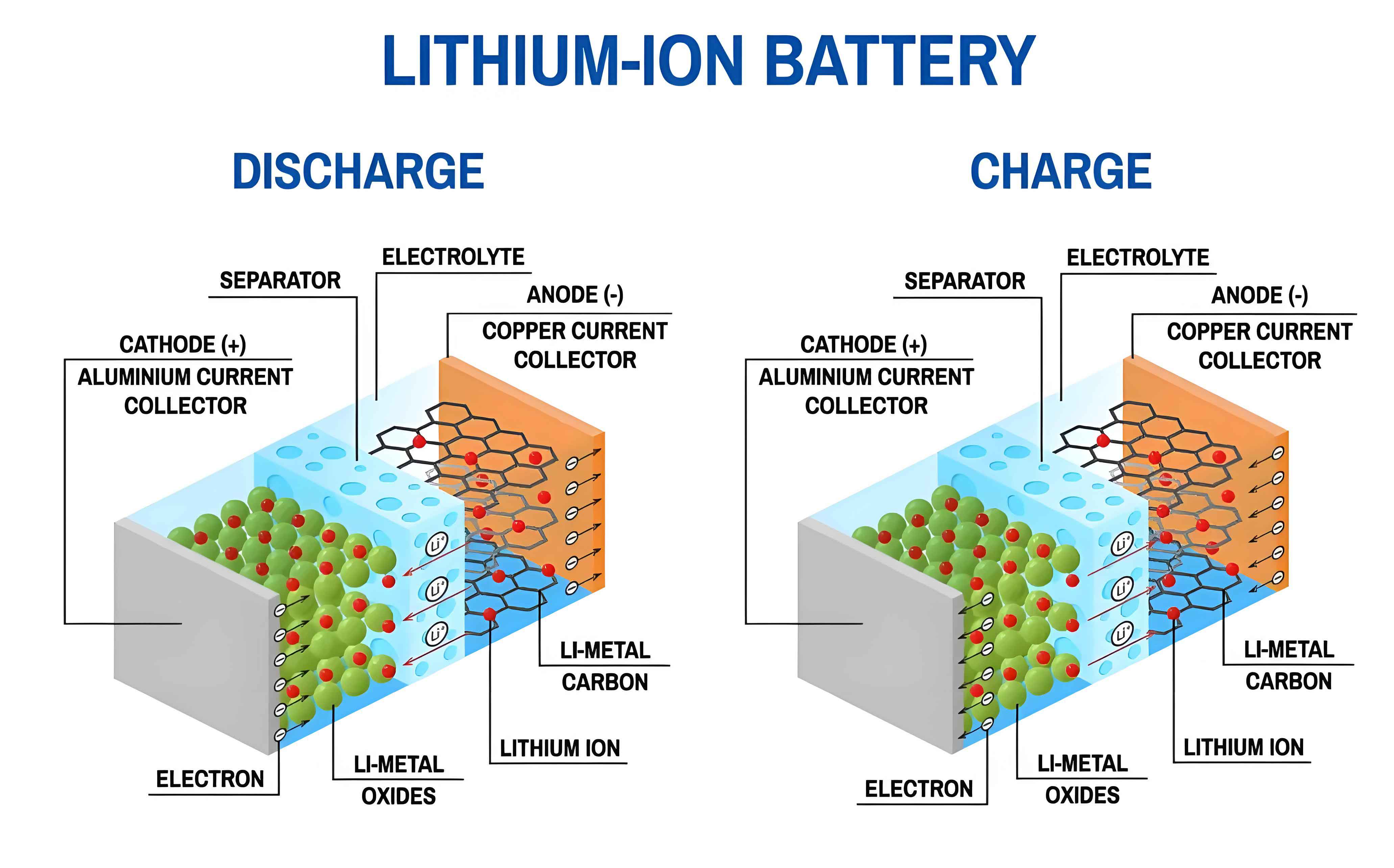
Various sensor technologies have been explored for internal monitoring of lithium-ion batteries. Electrical sensors, such as thermocouples, offer simplicity but face challenges related to electrical isolation, electromagnetic interference (EMI) from power circuits, and long-term compatibility with the corrosive internal environment of a lithium-ion battery. Optical sensors, particularly those based on optical fibers, present a compelling alternative. Fiber optic sensors offer inherent advantages for this application: they are electrically passive and immune to EMI, chemically inert when properly coated, extremely small in diameter (enabling minimal intrusion), and capable of distributed or multiplexed sensing along a single fiber. Among fiber optic sensors, the Fiber Bragg Grating (FBG) has been widely studied for its ability to transduce temperature and strain into a precise wavelength-encoded optical signal.
The fundamental principle of an FBG sensor is based on a periodic modulation of the refractive index in the core of an optical fiber. This structure acts as a wavelength-specific mirror, reflecting a narrow band of light centered at the Bragg wavelength, $$λ_B$$. This wavelength is given by the well-known condition:
$$
λ_B = 2n_{eff}Λ
$$
where $$n_{eff}$$ is the effective refractive index of the fiber core and $$Λ$$ is the grating period. Both parameters are sensitive to external physical perturbations. When the environment surrounding the FBG changes in temperature or when mechanical strain is applied to the fiber, $$n_{eff}$$ and $$Λ$$ are altered, causing a measurable shift in the reflected Bragg wavelength, $$Δλ_B$$. For simultaneous temperature and strain changes, the total shift can be expressed as:
$$
Δλ_B = K_T \cdot ΔT + K_ε \cdot Δε
$$
Here, $$K_T$$ and $$K_ε$$ are the temperature and strain sensitivity coefficients, respectively, which are constants for a given fiber and grating. While this dual sensitivity is powerful for multi-parameter sensing, it poses a challenge for applications like lithium-ion battery monitoring where the goal is to measure temperature accurately but the sensor may also be subjected to mechanical strain from electrode swelling/contraction or from the physical constraints of the jelly roll.
To address this cross-sensitivity issue in internal battery monitoring, a hybrid sensor design is highly advantageous. One effective method is to integrate an additional sensing element on the same optical fiber that is sensitive only to strain (or primarily to strain), allowing for the decoupling of the two effects. A miniature in-fiber Fabry-Perot (F-P) air cavity is an excellent candidate for this purpose. Such a cavity is typically formed by splicing two sections of fiber, where a small air gap or microbubble is trapped between the cleaved end-faces. This cavity creates a low-finesse interference pattern in the reflected optical spectrum. The wavelength of a specific interference minimum (dip), $$λ_m$$, is related to the cavity length $$L$$ and the refractive index of air $$n_{air}$$ by:
$$
λ_m = \frac{4 n_{air} L}{2m + 1}
$$
where $$m$$ is the interference order. The key characteristic of an air-cavity F-P interferometer for this application is its minimal temperature sensitivity. The thermo-optic coefficient of air $$(dn_{air}/dT)$$ is very small (approximately $$-0.86 \times 10^{-6} /°C$$), and the thermal expansion of the silica fiber forming the cavity $$(dL/dT)$$ is also minimal (approximately $$0.55 \times 10^{-6} /°C$$). Consequently, the temperature-induced wavelength shift $$dλ_m/dT$$ is negligible (on the order of $$-0.5$$ pm/°C). However, the cavity length $$L$$ is directly affected by axial strain applied to the fiber. Therefore, the F-P interference spectrum shift, $$Δλ_{FP}$$, can be attributed almost entirely to strain:
$$
Δλ_{FP} = K_{FP} \cdot Δε
$$
By fabricating an FBG and an F-P air cavity in close proximity on the same fiber, a self-compensating temperature sensor is created. The combined reflection spectrum features a narrow FBG peak superimposed on a broader sinusoidal F-P interference pattern. During operation inside a lithium-ion battery, both spectra will shift. By simultaneously monitoring the shifts from both elements ($$Δλ_B$$ and $$Δλ_{FP}$$), and knowing the calibration coefficients ($$K_T, K_ε, K_{FP}$$), the true temperature change $$ΔT$$ and strain change $$Δε$$ can be solved from the system of equations:
$$
\begin{cases}
Δλ_B = K_T ΔT + K_ε Δε \\
Δλ_{FP} = K_{FP} Δε
\end{cases}
$$
This approach effectively eliminates the strain-induced error in the FBG temperature measurement, providing highly accurate internal thermal data for the lithium-ion battery.
The practical implementation of such an implantable sensor for a cylindrical lithium-ion battery, such as the ubiquitous 18650 format, involves critical steps in sensor fabrication, packaging, and integration. Unlike methods that embed sensors during cell assembly (which risks prolonged exposure to electrolytes), a post-manufacturing implantation technique can enhance long-term survivability. The sensor fiber must be coated with a chemically resistant material like polyimide, which can withstand the internal environment of a lithium-ion battery. The implantation process typically involves carefully drilling a small-diameter access hole at the central axis of the cell (often through the negative terminal cap), gently inserting the sensing segment of the fiber into the core of the jelly roll, and subsequently sealing the entry point with an epoxy or adhesive that is compatible with battery materials and provides a hermetic seal. Proper calibration after implantation is crucial to account for any initial static strain imposed by the cell structure on the sensor.
The performance of implantable fiber optic sensors in lithium-ion batteries has been validated through numerous experimental studies. A typical experimental setup involves integrating the sensor-instrumented cell into a controlled charge-discharge cycle tester. The optical system comprises a broadband light source, an optical circulator to direct light to the sensor and return the reflected signal, and an optical spectrum analyzer or an interrogation system to track the FBG and F-P wavelengths in real-time. Voltage and current from the cycler are recorded synchronously. Tests are conducted under various operational profiles to characterize the sensor’s response.
For example, during constant-current (CC) charging, the internal temperature of the lithium-ion battery, as reported by the compensated FBG sensor, shows a characteristic profile. The temperature rises steadily during the main CC phase due to reaction overpotentials and ohmic heating. As the cell voltage approaches its upper limit and the charging regime switches to constant voltage (CV), the current tapers, and the internal temperature often stabilizes or even slightly decreases. The magnitude of the temperature rise is directly correlated with the charge rate (C-rate). The table below summarizes typical observations from such charge tests:
| Charge Current | Max. Temp. Rise | Time to Reach Max. Temp. | Key Observations |
|---|---|---|---|
| 1C (e.g., 1.5A) | ~4.0 °C | ~40 min | Temperature peaks mid-CV phase, then gradually declines. |
| 2C (e.g., 3.0A) | ~3.7 °C | ~36 min | Similar profile, peak temperature may be slightly lower/shorter due to faster transition to CV phase. |
Discharge tests, particularly at high rates, more dramatically reveal the value of internal sensing. The heat generation during discharge can be substantial. The internal temperature measured by the implanted sensor shows a continuous rise throughout the discharge cycle. The rate of increase and the final temperature elevation are strongly dependent on the discharge C-rate. Data from discharge experiments can be summarized as follows:
| Discharge Rate | Max. Temp. Rise | Discharge Time to Cut-off Voltage | Key Observations |
|---|---|---|---|
| 1C | ~11.5 °C | ~63 min (matching capacity spec) | Steady temperature increase correlating with depth of discharge. |
| 2C | ~19.1 °C | ~30 min (matching capacity spec) | Much steeper and higher temperature rise, demonstrating significant thermal load. |
These experiments confirm several key points. First, the implanted fiber sensor successfully survives the integration process and operates reliably during electrochemical cycling of the lithium-ion battery. Second, the measured discharge times align with the rated capacity of the cell, indicating that the minimal physical intrusion of the sensor does not significantly disrupt the internal electrochemistry or ionic pathways—a critical requirement for sensor compatibility. Third, and most importantly, the data reveals internal temperature dynamics that would be severely attenuated and lagged if measured only at the surface. The ability to detect a rapid temperature increase of over 19°C internally during a 2C discharge, for instance, provides the BMS with crucial early warning data that is simply unavailable from external sensors.
While single-point internal sensing is a major advancement, the future of thermal management for lithium-ion battery packs lies in distributed sensing. Fiber optic technology is uniquely suited for this. Multiple FBG sensors can be inscribed at different points along a single optical fiber, creating a quasi-distributed sensing array. Such a fiber could be routed through a module of multiple lithium-ion battery cells, or even wound through a large-format cell to map spatial temperature gradients in two or three dimensions. This would allow the BMS to identify not just overall heating, but localized hot spots—a precursor to failure. The table below compares the key sensing approaches for lithium-ion battery thermal monitoring:
| Sensor Type | Measurement Location | Key Advantages | Key Disadvantages |
|---|---|---|---|
| External Thermocouple/NTC | Cell surface/module busbar | Low cost, simple integration, mature technology. | Slow response, measures peripheral not core temperature, EMI susceptibility, wiring complexity. |
| Implanted Electrical Sensor | Inside cell (jelly roll/core) | Direct access to heat source, faster response. | Risk of short circuit, long-term chemical degradation, EMI susceptibility, complex sealing required. |
| Implanted Single FBG | Inside cell (specific point) | Fast response, direct measurement, EMI immune, small size. | Cross-sensitivity to strain, single-point data, requires careful implantation. |
| Implanted FBG/F-P Hybrid | Inside cell (specific point) | All benefits of FBG, with compensated, strain-independent temperature reading. | More complex fabrication, still single-point data. |
| Distributed Fiber (DTS/DSS) | Along cell surface or inside module | Spatially continuous temperature profile, single fiber for entire module, EMI immune. | Lower spatial/temporal resolution than FBG, higher cost interrogator, challenging internal routing. |
| Multipoint FBG Array | Multiple points inside cell or module | High-precision multi-location data, EMI immune, multiplexing on one fiber. | Highest complexity for internal cell integration, precise grating placement required. |
In conclusion, the imperative for accurate, real-time thermal monitoring in lithium-ion batteries is unequivocal for safety and performance. Implantable fiber optic sensors, particularly those employing self-compensating designs like the FBG/F-P hybrid, represent a sophisticated and highly effective solution to this challenge. By providing direct, strain-isolated temperature measurements from the core of the cell—the very origin of heat generation—these sensors deliver the most reliable and timely data possible for a battery management system. Their dielectric nature, chemical inertness, and multiplexing capability make them ideal for the demanding environment within a lithium-ion battery. As the technology for sensor fabrication, integration, and distributed interrogation continues to mature, fiber optic sensing is poised to become a cornerstone technology for the advanced thermal management and safety assurance of next-generation, high-power lithium-ion battery systems across transportation and grid storage applications.