
As a researcher deeply involved in the field of photovoltaic systems, I have witnessed the rapid evolution of solar inverter technology. The drive for higher efficiency, lower cost, and improved reliability has become paramount in the solar energy industry. In this article, I will share my insights on the key aspects of modern high-efficiency solar inverters, focusing on topologies, power devices, modulation techniques, and future trends. The term ‘solar inverter’ will be frequently discussed, as it is the heart of any grid-connected photovoltaic system, converting direct current from solar panels into alternating current for the grid.
The global demand for solar energy has surged, putting pressure on solar inverter manufacturers to enhance performance while reducing costs. According to industry reports, the total installed capacity of solar inverters is projected to reach significant levels, but with a declining average price. This underscores the need for innovative designs that maximize efficiency without compromising safety. In my view, the transition from transformer-isolated to transformerless solar inverters has been a major step, albeit with challenges such as leakage current. Let me delve into the details.
One critical issue in transformerless solar inverters is leakage current, which arises due to parasitic capacitance between the solar panels and ground. This leakage current, essentially a common-mode current, can pose safety risks if not properly controlled. International standards like IEC 62109-2 and UL 1741 set strict limits on leakage current, ensuring that solar inverters operate safely. For instance, the leakage current magnitude is often related to the rate of change of common-mode voltage, which can be expressed as: $$I_{leakage} = C_{pv} \frac{dV_{cm}}{dt}$$ where \(C_{pv}\) is the parasitic capacitance of the photovoltaic array and \(V_{cm}\) is the common-mode voltage. Complying with these standards is essential for any high-efficiency solar inverter design.
To address leakage current, various transformerless topologies have been developed. These topologies primarily derive from H-bridge and neutral-point clamped (NPC) configurations. Below, I summarize some typical topologies and their characteristics in Table 1.
| Topology Type | Key Features | Advantages | Disadvantages | Efficiency Impact |
|---|---|---|---|---|
| H-bridge with DC Bypass (e.g., H5) | Uses an additional switch to disconnect PV during freewheeling | Reduces switching losses, minimizes leakage current | Increased component count, complex control | High, due to low-frequency switching in some switches |
| H-bridge with AC Bypass (e.g., HERIC) | Employs AC bypass paths during freewheeling modes | Lower conduction losses, improved efficiency | Requires careful modulation to avoid voltage spikes | Very high, especially at partial loads |
| NPC and Derivatives (e.g., ANPC, SNPC) | Utilizes clamping diodes or active switches for voltage balancing | Low leakage current, better EMI performance, scalable to multilevel | Unequal loss distribution in basic NPC, higher cost for active versions | Excellent, with efficiencies often above 99% |
In my experience, the H5 topology, a DC bypass variant, effectively cuts off the photovoltaic array during freewheeling intervals, thereby stabilizing the common-mode voltage. This is achieved by controlling the switch S5 in synchronization with the grid cycle. The modulation strategy plays a crucial role here; for example, unipolar modulation can introduce common-mode voltage fluctuations, but when combined with this topology, it enhances the overall efficiency of the solar inverter.
Another promising approach is the use of multilevel topologies in solar inverters. These topologies, such as NPC, flying capacitor (FC), and modular multilevel converters (MMC), offer inherent redundancy and improved output waveform quality. They contribute to higher efficiency by reducing voltage stress on switches and lowering switching losses. For instance, a five-level solar inverter can achieve superior efficiency compared to traditional two-level designs. The output voltage for an N-level inverter can be represented as: $$V_{out} = \sum_{i=1}^{N-1} V_{dc,i} \cdot S_i$$ where \(V_{dc,i}\) are the DC voltage levels and \(S_i\) are switching functions. Table 2 compares common multilevel topologies used in solar inverters.
| Topology | Number of Levels | Key Components | Efficiency | Leakage Current Suppression |
|---|---|---|---|---|
| NPC | 3 or more | Clamping diodes, capacitors | High | Excellent due to midpoint grounding |
| Flying Capacitor | 3 or more | Flying capacitors, switches | Moderate | Good, but requires capacitor balancing |
| Modular Multilevel | 5 or more | Submodules with capacitors | Very High | Effective, but complex control |
I believe that multilevel solar inverters are particularly advantageous for high-power applications, as they allow for higher voltage operation with lower harmonic distortion. This aligns with the trend towards larger solar farms and grid integration. The development of these topologies has been driven by companies and research institutions worldwide, leading to innovations like stacked NPC and active NPC designs.
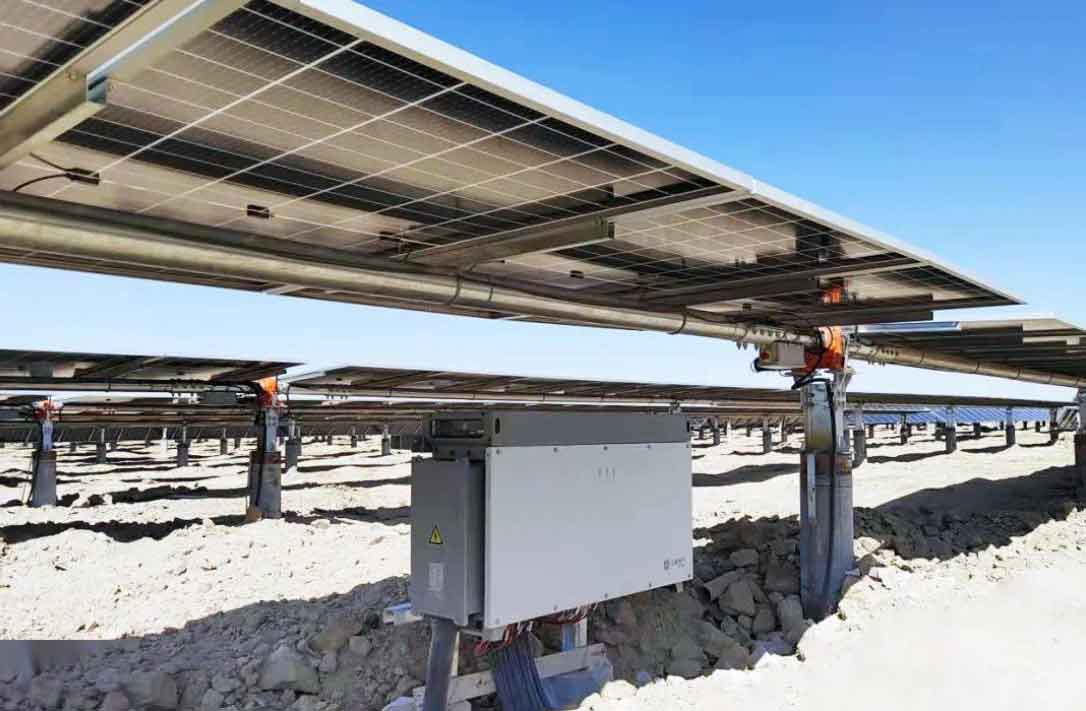
Moving on to power devices, the efficiency of a solar inverter is heavily dependent on the performance of semiconductor switches. Traditional silicon-based IGBTs and MOSFETs have limitations in switching speed and conduction losses. Therefore, combinations of IGBTs and MOSFETs in parallel configurations have been explored to optimize efficiency across different load ranges. For example, in some solar inverter designs, IGBTs handle low-frequency switching while MOSFETs manage high-frequency transitions, reducing overall losses. This hybrid approach can be modeled using loss formulas: $$P_{total} = P_{cond} + P_{sw}$$ where \(P_{cond} = I^2 \cdot R_{on}\) and \(P_{sw} = f_{sw} \cdot E_{sw}\). Here, \(I\) is the current, \(R_{on}\) is the on-state resistance, \(f_{sw}\) is the switching frequency, and \(E_{sw}\) is the switching energy per cycle.
Moreover, the advent of wide-bandgap materials like silicon carbide (SiC) and gallium nitride (GaN) has revolutionized solar inverter efficiency. SiC-based devices, such as Schottky diodes and MOSFETs, offer lower reverse recovery losses and higher temperature tolerance. In my analysis, integrating SiC fast recovery diodes in a solar inverter can boost efficiency by up to 0.5%, which is significant at the system level. The benefits of these materials are summarized in Table 3.
| Device Type | Material | Key Advantages | Typical Efficiency Gain | Application in Solar Inverters |
|---|---|---|---|---|
| Fast Recovery Diode | SiC | Near-zero reverse recovery, high voltage rating | 0.3-0.5% | Used in freewheeling paths to reduce losses |
| MOSFET | GaN | High switching speed, low gate charge | 0.2-0.4% | Suitable for high-frequency DC-DC stages |
| IGBT Module | Si with SiC diodes | Improved thermal performance, lower losses | 0.4-0.6% | Common in high-power solar inverter designs |
From my perspective, the use of these advanced devices is crucial for next-generation solar inverters, enabling higher switching frequencies and compact designs. However, cost remains a barrier, but as production scales, I expect wider adoption.
Beyond hardware, modulation and control algorithms are vital for maximizing the performance of a solar inverter. Techniques like maximum power point tracking (MPPT) ensure that the solar panels operate at their optimal voltage and current. Various MPPT methods exist, such as perturb and observe (P&O) and incremental conductance, which can be described by equations: $$\frac{dP}{dV} = 0$$ at the maximum power point. For a solar inverter, implementing efficient MPPT improves energy harvest, especially under partial shading conditions. Additionally, modulation strategies like space vector modulation (SVM) for three-phase solar inverters or sinusoidal pulse width modulation (SPWM) for single-phase versions affect efficiency and harmonic content. The modulation index \(m_a\) in SPWM is given by: $$m_a = \frac{A_m}{A_c}$$ where \(A_m\) is the amplitude of the modulating signal and \(A_c\) is the carrier amplitude. Optimizing these algorithms can reduce switching losses and improve grid compatibility.
In terms of control, advanced techniques such as model predictive control (MPC) and artificial intelligence-based approaches are being researched for solar inverters. These can enhance dynamic response and fault tolerance. For instance, in a grid-connected solar inverter, maintaining power quality while adhering to grid codes requires robust control loops. The power balance equation is: $$P_{pv} = P_{grid} + P_{losses}$$ where \(P_{pv}\) is the photovoltaic power, \(P_{grid}\) is the injected grid power, and \(P_{losses}\) includes inverter losses. By minimizing losses through intelligent control, the overall efficiency of the solar inverter increases.
Looking ahead, I foresee several trends in solar inverter technology. First, the push for higher efficiency will continue, with targets exceeding 99% for utility-scale solar inverters. This will involve further integration of wide-bandgap devices and advanced cooling techniques. Second, modular and scalable designs will become more prevalent, allowing for easy maintenance and expansion. Third, grid-support functions like reactive power control and frequency regulation will be standard features in solar inverters, enhancing grid stability. Lastly, cost reduction through mass production and design simplification will drive broader adoption.
To summarize, high-efficiency solar inverters are the result of synergistic advancements in topology, power devices, and control algorithms. As the solar industry grows, continuous innovation in these areas is essential. From my viewpoint, future solar inverters will not only be more efficient but also smarter, contributing to a sustainable energy ecosystem. The journey towards perfecting the solar inverter is ongoing, and I am excited to be part of it.
In conclusion, this review has covered the critical aspects of modern solar inverters, emphasizing efficiency improvements. By addressing leakage current through innovative topologies, leveraging multilevel structures, adopting advanced power devices, and refining modulation strategies, we can achieve significant gains. I hope this discussion provides valuable insights for engineers and researchers working on solar inverter development.