
In recent years, the escalating global energy demand has intensified the search for sustainable and efficient renewable energy sources. Solar energy, owing to its abundance and cleanliness, stands out as a promising candidate. Among various photovoltaic technologies, perovskite solar cells have garnered significant attention due to their solution processability, tunable bandgap, high efficiency, low cost, high defect tolerance, and superior carrier mobility. The inverted structure of perovskite solar cells, characterized by its low manufacturing cost and compatibility with established silicon-based solar cell technologies, has become a focal point of research. This structure facilitates easier integration into tandem configurations and flexible devices, making it highly relevant for applications in vehicles, spacecraft, and building-integrated photovoltaics. Interface engineering plays a pivotal role in enhancing the performance and stability of these devices by optimizing charge transport, reducing interfacial defects, and improving energy level alignment. This article employs bibliometric analysis, utilizing tools like CiteSpace for visualization, to systematically review the literature on interface engineering in inverted perovskite solar cells, aiming to delineate research trends, hotspots, and future directions.
The bibliometric analysis is based on data extracted from the Web of Science Core Collection, focusing on publications related to interface engineering in inverted perovskite solar cells. The analysis reveals a steady increase in publication volume since the inception of inverted perovskite solar cells in 2013, when the first reported device achieved a modest efficiency of 3.9%. The breakthrough in 2015, with the development of heavily doped nickel oxide as a hole transport layer, propelled the certified efficiency to 15% for a 1 cm² device, sparking widespread research interest. Currently, inverted perovskite solar cells have surpassed their conventional counterparts in efficiency, reaching a certified efficiency of 26.1%, underscoring their potential for high-performance and stable photovoltaic applications. The publication trend indicates rapid growth, particularly from 2015 onwards, reflecting the increasing importance of interface engineering in advancing this technology.
In terms of research contributions, China leads in the number of publications, followed by the United States, England, India, Germany, and Japan. Germany exhibits the highest centrality in international collaboration networks, highlighting its pivotal role in fostering global research partnerships. Key institutions such as the Chinese Academy of Sciences, Southwest Petroleum University, and Shanghai Jiao Tong University are prominent contributors. Influential authors in the field include those with high publication counts and citation frequencies, such as Wang H, Liu X, and Jiang Q. The collaboration network analysis suggests that while China dominates in output, there is substantial room for enhanced international cooperation to drive further innovations.
The research hotspots, identified through keyword analysis and clustering, primarily revolve around defect passivation, energy efficiency enhancement, interface engineering, hole transport layers, and electron transport layers. These themes are interconnected, as effective interface engineering addresses defects at the perovskite/charge transport layer interfaces, thereby improving charge extraction and reducing non-radiative recombination. The alignment of energy levels at these interfaces is crucial for minimizing energy barriers and optimizing open-circuit voltage. Stability issues, stemming from environmental factors and intrinsic ion migration, are also central to current research efforts, with interface engineering serving as a key strategy to mitigate degradation pathways.
| Year | Device Structure | VOC (V) | JSC (mA/cm²) | FF (%) | PCE (%) |
|---|---|---|---|---|---|
| 2013 | ITO/PEDOT:PSS/MAPbI3/C60/BCP/Al | 0.60 | 10.32 | 63 | 3.9 |
| 2014 | ITO/PEDOT:PSS/CH3NH3PbI3/PCBM/LiF/Al | 0.866 | 20.70 | 78.30 | 14.1 |
| 2015 | FTO/NiMgLiO/MAPbI3/PCBM/Ti(Nb)Ox/Ag | 0.72 | 20.21 | 75 | 15.0 |
| 2016 | ITO/PEDOT:PSS/CH3NH3PbI3/PCBM/BCP/Ag | 1.02 | 22.38 | 82 | 18.72 |
| 2018 | FTO/NiOx/mpCuGaO2/perovskite/PC61BM/BCP/Ag | 1.132 | 22.23 | 79.96 | 20.13 |
| 2021 | ITO/2PACz/Cs0.18FA0.82PbI3/C60/BCP/Ag | 1.161 | 23.4 | 83.2 | 22.33 |
| 2023 | ITO/FAPbI3/PC61BM/BCP/Ag | 1.187 | 25.69 | 84.73 | 25.86 |
The operation of an inverted perovskite solar cell involves the absorption of incident sunlight by the perovskite layer, generating electron-hole pairs that are subsequently separated and collected by the respective charge transport layers. The efficiency of these devices is heavily influenced by the quality of the interfaces between the perovskite and the charge transport layers. Mismatched energy levels can lead to significant charge recombination and voltage losses, whereas well-aligned interfaces facilitate efficient charge extraction. The open-circuit voltage (VOC) is directly related to the quasi-Fermi level splitting and can be expressed as:
$$V_{OC} = \frac{n k T}{q} \ln \left( \frac{J_{SC}}{J_0} + 1 \right)$$
where \( n \) is the ideality factor, \( k \) is Boltzmann’s constant, \( T \) is the temperature, \( q \) is the elementary charge, \( J_{SC} \) is the short-circuit current density, and \( J_0 \) is the reverse saturation current density. Interface engineering aims to minimize \( J_0 \) by reducing recombination losses, thereby enhancing \( V_{OC} \).
Defect passivation at interfaces is a critical aspect of improving the performance of perovskite solar cells. Defects, such as vacancies and interstitials, can act as non-radiative recombination centers, degrading both efficiency and stability. The defect density (\( N_t \)) influences the recombination rate (\( R \)) through the Shockley-Read-Hall model:
$$R = \frac{n p – n_i^2}{\tau_n (p + p_t) + \tau_p (n + n_t)}$$
where \( n \) and \( p \) are the electron and hole concentrations, \( n_i \) is the intrinsic carrier concentration, \( \tau_n \) and \( \tau_p \) are the carrier lifetimes, and \( n_t \) and \( p_t \) are parameters related to the defect energy levels. By introducing passivation layers or functional molecules at the interfaces, the defect density can be reduced, leading to improved carrier lifetimes and device performance.
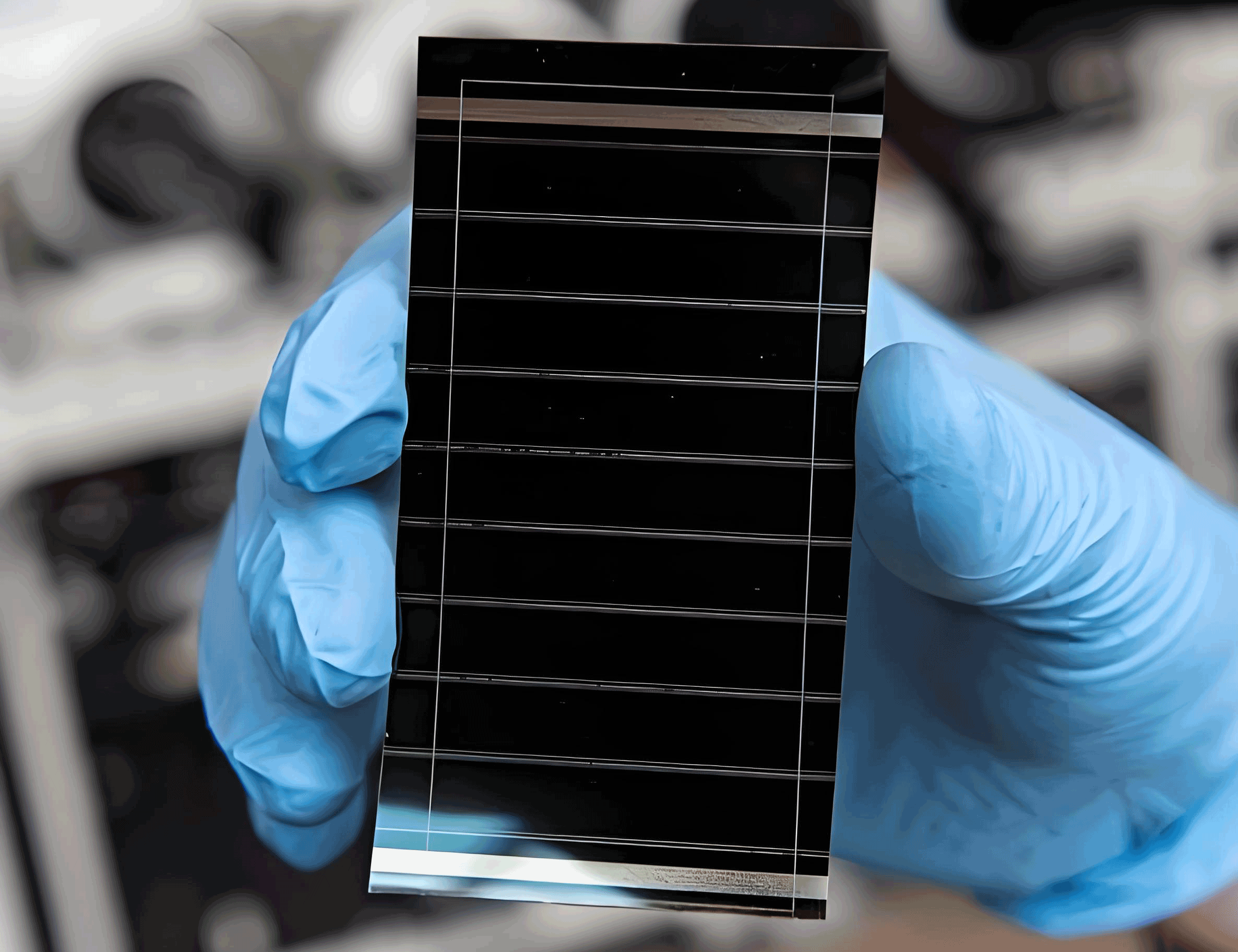
Interface engineering in inverted perovskite solar cells primarily focuses on two key interfaces: the perovskite/hole transport layer (HTL) and the perovskite/electron transport layer (ETL). For the HTL interface, materials like NiOx and PEDOT:PSS are commonly used. However, these materials often suffer from inadequate energy level alignment and high defect densities. Strategies to address these issues include doping, incorporating low-dimensional materials, and introducing buffer layers. For instance, the use of dipolar molecules at the NiOx/perovskite interface can modulate the work function, improving hole extraction and reducing recombination. The energy level alignment can be described by the Schottky-Mott rule, where the barrier height (\( \phi_B \)) is given by:
$$\phi_B = \phi_M – \chi$$
where \( \phi_M \) is the metal work function and \( \chi \) is the electron affinity of the semiconductor. By tailoring the interface with appropriate materials, the energy barrier can be minimized, facilitating efficient charge transfer.
Similarly, at the perovskite/ETL interface, fullerene derivatives such as PCBM are widely employed due to their high electron mobility. However, interfacial defects and poor morphology can hinder electron extraction. The introduction of low-dimensional perovskite layers or strong aromatic molecules has been shown to passivate surface defects and enhance electron transport. The formation of a low-dimensional perovskite layer on top of the three-dimensional perovskite creates a heterojunction that not only passivates defects but also strengthens the built-in electric field, improving device stability. The current density-voltage (J-V) characteristics of these devices can be modeled using the diode equation:
$$J = J_{SC} – J_0 \left( \exp \left( \frac{q V}{n k T} \right) – 1 \right)$$
where \( J \) is the current density and \( V \) is the applied voltage. Interface engineering helps in achieving higher fill factors (FF) by reducing series resistance and enhancing charge collection.
The stability of inverted perovskite solar cells is another major concern addressed through interface engineering. Environmental factors such as moisture, oxygen, and heat can degrade the perovskite layer, while intrinsic ion migration can lead to phase segregation and performance decay. Interface layers can act as barriers against external stressors and suppress ion migration. For example, the incorporation of hydrophobic molecules at the interfaces can enhance moisture resistance. The ion migration current (\( J_{ion} \)) can be described by the Nernst-Plan equation:
$$J_{ion} = -q D \frac{\partial C}{\partial x} + q \mu C E$$
where \( D \) is the diffusion coefficient, \( C \) is the ion concentration, \( \mu \) is the mobility, and \( E \) is the electric field. By introducing blocking layers, the ion migration can be mitigated, thereby improving operational stability.
| Interface | Engineering Strategy | Impact on Performance | Key Materials |
|---|---|---|---|
| Perovskite/HTL | Dipolar molecule insertion | Improved hole extraction, reduced recombination | 2PACz, PEAI |
| Perovskite/ETL | Low-dimensional perovskite capping | Defect passivation, enhanced electron transport | PEA2ZnX4, PCBM |
| Perovskite/HTL | Metal oxide doping | Better energy level alignment, increased stability | NiOx, CuGaO2 |
| Perovskite/ETL | Aromatic molecular layer | Suppressed ion migration, improved thermal stability | C60, derivatives |
Looking ahead, the future of inverted perovskite solar cells lies in further optimizing interface engineering to achieve higher efficiencies and long-term stability. Key research directions include enhancing charge transfer and extraction capabilities at interfaces, improving perovskite crystal quality through advanced deposition techniques, and discovering novel interface materials that simultaneously passivate defects and align energy levels. The use of machine learning and high-throughput screening could accelerate the identification of optimal interface materials. Additionally, the integration of inverted perovskite solar cells into tandem configurations with silicon or other perovskites holds great promise for surpassing the Shockley-Queisser limit. The efficiency of a tandem solar cell can be approximated by:
$$\eta_{tandem} = \eta_{top} + \eta_{bottom} – \eta_{top} \eta_{bottom}$$
where \( \eta_{top} \) and \( \eta_{bottom} \) are the efficiencies of the top and bottom cells, respectively. Interface engineering will be crucial in minimizing optical and electrical losses in these complex architectures.
In conclusion, bibliometric analysis highlights the rapid evolution and growing significance of interface engineering in inverted perovskite solar cells. The steady increase in publications, dominant contributions from certain countries and institutions, and focus on key research themes such as defect passivation and energy level alignment underscore the dynamic nature of this field. By addressing interfacial challenges through innovative materials and strategies, inverted perovskite solar cells are poised to play a pivotal role in the future of photovoltaics, enabling efficient, stable, and flexible energy harvesting solutions.