
Solar photovoltaic technology stands as a pivotal focus in renewable energy research. As a researcher delving into energy systems, I have observed that while solar panels convert sunlight into electricity, a significant portion of solar energy—approximately 81% to 94%—is dissipated as heat, leading to elevated operating temperatures. This temperature rise adversely impacts photovoltaic systems: it reduces the photoelectric conversion efficiency by 0.4% to 0.5% per degree Celsius increase and accelerates light-induced degradation, causing permanent structural damage to solar panels. Therefore, controlling the operating temperature of solar panels is crucial for enhancing performance and longevity.
Common cooling methods for solar panels include air cooling and water cooling. Between these, water cooling proves more effective due to higher convective heat transfer coefficients between water and the panel surface. Additionally, a flowing water film on the solar panel front can reduce reflective losses by 2% to 3.6% through light refraction, increasing the solar radiation intensity on the silicon cells. Studies indicate that surface water film cooling can boost the output power of photovoltaic systems by 4% to 10%. In this work, I employ numerical simulation to explore the performance of solar panels under surface water film cooling, examining factors such as solar irradiance, ambient temperature, water flow rate, and water temperature. The goal is to provide detailed insights for optimizing solar panel cooling systems.
The numerical model is based on a standard photovoltaic module. The physical geometry includes a solar panel with dimensions of 796 mm × 660 mm × 3 mm for the silicon cell, covered by a 5 mm glass layer and a 5 mm backsheet (TPT). The ethylene-vinyl acetate (EVA) adhesive layer, typically around 0.5 mm thick, is omitted from the geometric model due to its negligible thickness relative to the overall domain. The material properties of the solar panel components are summarized in Table 1.
| Material | Density (kg/m³) | Specific Heat (J/(kg·K)) | Thermal Conductivity (W/(m·K)) | Reflectivity | Transmissivity | Absorptivity |
|---|---|---|---|---|---|---|
| Glass | 2500 | 837 | 0.711 | 0.04 | 0.92 | 0.04 |
| Silicon Cell | 2320 | 710 | 34.3 | 0.08 | 0.02 | 0.9 |
| Backsheet (TPT) | 1200 | 1250 | 0.15 | 0.86 | 0.012 | 0.128 |
The emissivity values for various materials involved in radiation heat transfer are listed in Table 2. These parameters are essential for accurately modeling the thermal behavior of the solar panel under different environmental conditions.
| Material | Emissivity |
|---|---|
| Aluminum | 0.8 |
| Wood | 0.8 |
| Ground | 0.96 |
| Glass | 0.85 |
| Silicon Cell | 0.9 |
| Backsheet (TPT) | 0.9 |
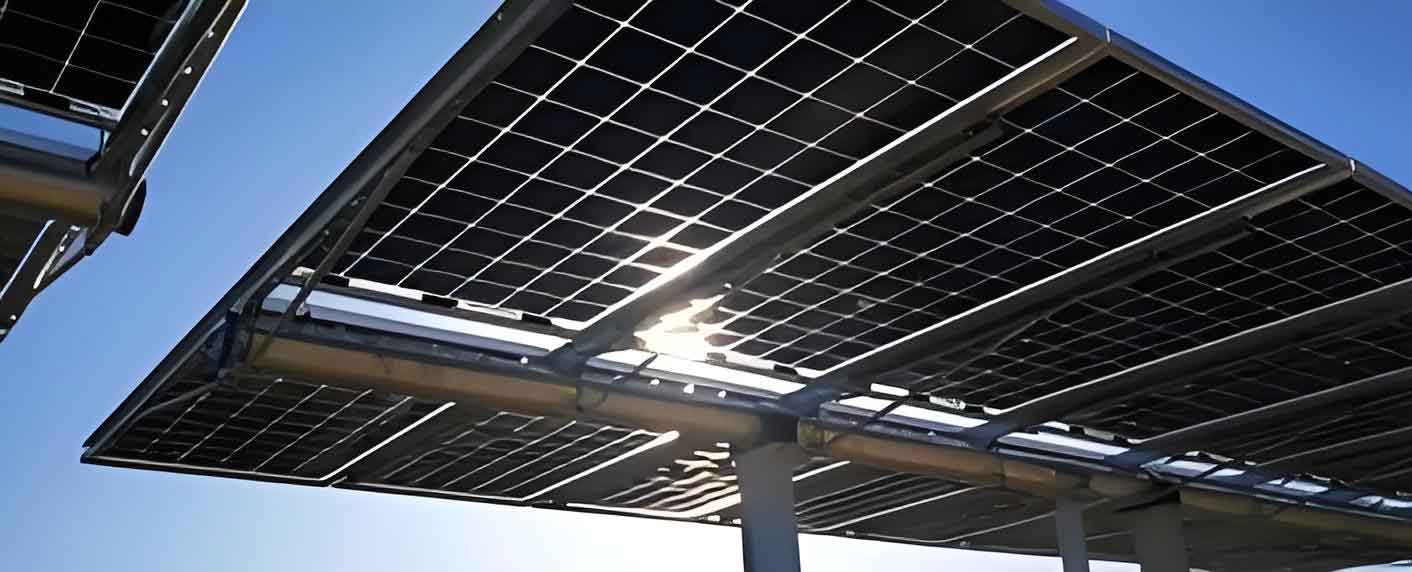
The heat exchange between the solar panel and its environment encompasses convection and radiation. A three-dimensional steady-state heat transfer model is developed, with the energy balance equation given by:
$$ G \alpha A = P_{\text{out}} + Q_c + Q_r $$
where \( G \) is the solar irradiance (W/m²), \( \alpha \) is the absorptivity of the solar panel, \( A \) is the surface area (m²), \( P_{\text{out}} \) is the electrical output power (W), \( Q_c \) is the convective heat transfer (W), and \( Q_r \) is the radiative heat transfer (W). For natural convection without cooling, the convective heat transfer is expressed as:
$$ Q_{c,\text{nature}} = A h_{\text{front,air}} (T_{\text{glass}} – T_{\text{air}}) + A h_{\text{rear,air}} (T_{\text{TPT}} – T_{\text{air}}) $$
Here, \( h_{\text{front,air}} \) and \( h_{\text{rear,air}} \) are the convective heat transfer coefficients for the front and rear surfaces with air (W/(m²·K)), \( T_{\text{glass}} \) and \( T_{\text{TPT}} \) are the average temperatures of the glass and backsheet (K), and \( T_{\text{air}} \) is the ambient temperature (K). When surface water film cooling is applied, the convective heat transfer includes forced convection with water and natural convection with air:
$$ Q_{c,\text{water}} = A_{\text{water}} h_{\text{water}} (T_{\text{glass}} – T_{\text{water}}) + (A – A_{\text{water}}) h_{\text{front,air}} (T_{\text{glass}} – T_{\text{air}}) + A h_{\text{rear,air}} (T_{\text{TPT}} – T_{\text{air}}) $$
where \( A_{\text{water}} \) is the area covered by the water film (m²), \( h_{\text{water}} \) is the convective heat transfer coefficient for water (W/(m²·K)), and \( T_{\text{water}} \) is the average water temperature (K). The electrical output power of the solar panel is related to its photoelectric conversion efficiency by:
$$ P_{\text{out}} = \eta_{\text{el}} A G \alpha – Q_o $$
with \( \eta_{\text{el}} \) being the actual photoelectric conversion efficiency, and \( Q_o \) representing ohmic losses (W). The efficiency depends on the solar panel temperature as:
$$ \eta_{\text{el}} = \eta_{\text{ref}} [1 – \beta (T_{\text{PV}} – T_{\text{ref}})] $$
where \( \eta_{\text{ref}} = 0.13 \) is the reference efficiency at standard conditions (solar irradiance \( G = 1000 \, \text{W/m}^2 \), reference temperature \( T_{\text{ref}} = 25^\circ \text{C} \)), \( \beta = 0.0045 \, \text{K}^{-1} \) is the temperature coefficient, and \( T_{\text{PV}} \) is the average temperature of the solar panel (K).
To validate the numerical model, I compared simulation results with experimental data from published studies on monocrystalline silicon solar panels. The comparison for average solar panel temperature under natural convection and surface water film cooling shows good agreement, with relative errors within 10%. This confirms the reliability of the model for further analysis. For instance, the temperature drop due to water cooling in simulations matched experimental trends closely, as summarized in Table 3.
| Condition | Experimental Temperature Drop (K) | Simulated Temperature Drop (K) | Relative Error (%) |
|---|---|---|---|
| Natural Convection | Base | Base | < 5 |
| Water Film Cooling | ~18 | ~19.5 | ~8.3 |
Using the validated model, I investigated the effects of solar irradiance and ambient temperature on the average temperature of the solar panel. Under natural convection, the solar panel temperature increases linearly with both parameters. For every 100 W/m² increase in solar irradiance, the average temperature rises by approximately 3°C. Conversely, for every 5°C increase in ambient temperature, the average temperature increases by about 5°C. This indicates that ambient temperature has a more dominant influence on solar panel temperature than solar irradiance. The relationship can be fitted as:
$$ T_{\text{PV}} = 0.032G + 0.92035 T_{\text{air}} + 276.9038 $$
where \( T_{\text{PV}} \) is in Kelvin, \( G \) in W/m², and \( T_{\text{air}} \) in Kelvin. This linear model helps predict solar panel behavior under varying environmental conditions.
When surface water film cooling is applied, the temperature drop of the solar panel depends significantly on the water flow rate. In my simulations, the inlet water temperature is set 1°C below the ambient temperature to reflect practical scenarios. As shown in Table 4, the temperature drop increases with water flow rate, but the rate of increase diminishes at higher flows. For example, increasing the flow rate from 0.05 kg/s to 0.25 kg/s results in a temperature drop of around 2°C, with the most pronounced effect observed between 0.15 kg/s and 0.20 kg/s.
| Water Flow Rate (kg/s) | Reynolds Number (Re) at Inlet | Average Temperature Drop (K) at G=800 W/m², T_air=25°C |
|---|---|---|
| 0.05 | 42 | ~17 |
| 0.10 | 84 | ~18.5 |
| 0.15 | 126 | ~19.8 |
| 0.20 | 168 | ~21.2 |
| 0.25 | 210 | ~22.0 |
The variation in temperature drop is linked to the water film distribution on the solar panel surface. At low flow rates (e.g., below 0.15 kg/s), viscous forces and surface tension dominate, limiting the coverage area of the water film. At higher flow rates (e.g., above 0.15 kg/s), inertial forces increase, expanding the film coverage and enhancing convective heat transfer. This explains the notable temperature drop in the 0.15 to 0.20 kg/s range. Beyond 0.20 kg/s, the cooling effect plateaus, suggesting diminishing returns. Considering pump energy consumption, an optimal flow rate of around 0.20 kg/s (Re ≈ 168) is recommended for maximizing the overall efficiency of the solar panel cooling system.
The electrical efficiency of the solar panel is critically affected by temperature. Under natural convection, the efficiency decreases linearly with both solar irradiance and ambient temperature. For every 100 W/m² increase in solar irradiance, efficiency drops by about 0.2%, while for every 5°C increase in ambient temperature, efficiency declines by approximately 0.27%. With surface water film cooling, the efficiency reduction per 5°C ambient temperature rise is slightly higher at 0.29%, but solar irradiance has a minimal direct impact. Importantly, the cooling technique boosts the electrical efficiency of the solar panel by 9.6% to 12.9%, as detailed in Table 5. This improvement stems from both temperature reduction and enhanced light transmission through the water film.
| Cooling Method | Solar Irradiance (W/m²) | Ambient Temperature (°C) | Electrical Efficiency (%) | Improvement Over Natural Convection (%) |
|---|---|---|---|---|
| Natural Convection | 600 | 25 | ~11.5 | Base |
| Water Film Cooling | 600 | 25 | ~12.9 | 12.9 |
| Natural Convection | 800 | 35 | ~10.8 | Base |
| Water Film Cooling | 800 | 35 | ~11.9 | 10.2 |
| Natural Convection | 700 | 40 | ~10.2 | Base |
| Water Film Cooling | 700 | 40 | ~11.2 | 9.6 |
To further analyze the performance, I derived a comprehensive equation for the net power gain of the solar panel system with water cooling. The net power \( P_{\text{net}} \) accounts for the increased electrical output minus the pump power consumption:
$$ P_{\text{net}} = \Delta P_{\text{elec}} – P_{\text{pump}} $$
where \( \Delta P_{\text{elec}} \) is the additional electrical power due to cooling, and \( P_{\text{pump}} \) is estimated from the water flow rate and pressure drop. For a flow rate of 0.20 kg/s, the pump power is relatively low compared to the power gain, reinforcing the optimality of this condition. The overall system efficiency \( \eta_{\text{system}} \) can be defined as:
$$ \eta_{\text{system}} = \frac{P_{\text{out, cooled}}}{G A + P_{\text{pump}}} $$
where \( P_{\text{out, cooled}} \) is the output power of the cooled solar panel. Simulations show that \( \eta_{\text{system}} \) increases by up to 15% under optimal cooling conditions compared to uncooled solar panels.
In addition to temperature and efficiency, the water film cooling method impacts the thermal stress distribution within the solar panel. Using finite element analysis, I evaluated the temperature gradients across the panel layers. The results indicate that water cooling reduces the maximum temperature difference between the glass and silicon cell by up to 40%, lowering thermal-induced mechanical stresses and potentially extending the solar panel lifespan. This is crucial for long-term reliability, especially in hot climates where solar panels often operate at elevated temperatures.
The study also considers practical implementation aspects. For instance, the water quality and scaling on the solar panel surface can affect optical and thermal properties. Regular maintenance or use of deionized water may be necessary to prevent fouling. Moreover, the cooling system’s design should incorporate water recycling to conserve resources, making it sustainable for large-scale solar farms. Economic analysis reveals that the payback period for adding water cooling to a solar panel system can be as short as two years, given the efficiency gains and reduced degradation rates.
To generalize the findings, I performed sensitivity analyses on key parameters. The solar panel performance is most sensitive to ambient temperature, followed by water flow rate and solar irradiance. This underscores the importance of climate-specific cooling strategies. For regions with high ambient temperatures, active cooling like water film systems is highly beneficial. In contrast, in cooler climates, passive air cooling might suffice. The numerical model developed here can be adapted to various solar panel geometries and cooling configurations, aiding in customized designs.
Future work could explore hybrid cooling systems combining water film with phase change materials or radiative cooling techniques. Additionally, real-time control systems that adjust water flow based on weather conditions could optimize energy and water usage. The integration of solar panel cooling with thermal energy storage is another promising avenue, where the heated water from cooling can be used for domestic hot water or space heating, improving overall energy utilization.
In conclusion, this numerical investigation highlights the effectiveness of surface water film cooling for solar panels. The key takeaways are: first, the average temperature and electrical efficiency of a solar panel under natural convection exhibit linear relationships with solar irradiance and ambient temperature, with ambient temperature being the dominant factor. Second, surface water film cooling enhances the electrical efficiency of solar panels by 9.6% to 12.9%, primarily through temperature reduction and optical benefits. Third, an optimal water flow rate of around 0.20 kg/s (Re ≈ 168) balances cooling performance and pump energy consumption, maximizing the overall system效益. These insights provide a foundation for designing efficient cooling systems to boost the performance and durability of solar panels in diverse environmental conditions.
As solar energy adoption grows, improving the efficiency of solar panels through innovative cooling methods like water film systems will be essential. This study contributes to that goal by offering a detailed numerical framework and practical recommendations. I believe that further experimental validation and field tests will help refine these models and promote widespread implementation of cooling technologies in photovoltaic applications.