
As a researcher deeply immersed in the field of energy storage, I have witnessed the transformative role of lithium ion batteries in shaping the modern electric vehicle (EV) industry. Over the years, the growing emphasis on environmental protection and renewable energy has propelled lithium ion batteries to the forefront of automotive innovation. In this article, I will explore the fundamental principles, applications, advantages, disadvantages, and future directions of lithium ion batteries in EVs, drawing from my own observations and analysis. The lithium ion battery stands as a cornerstone technology, and its continued evolution is critical for sustainable transportation.
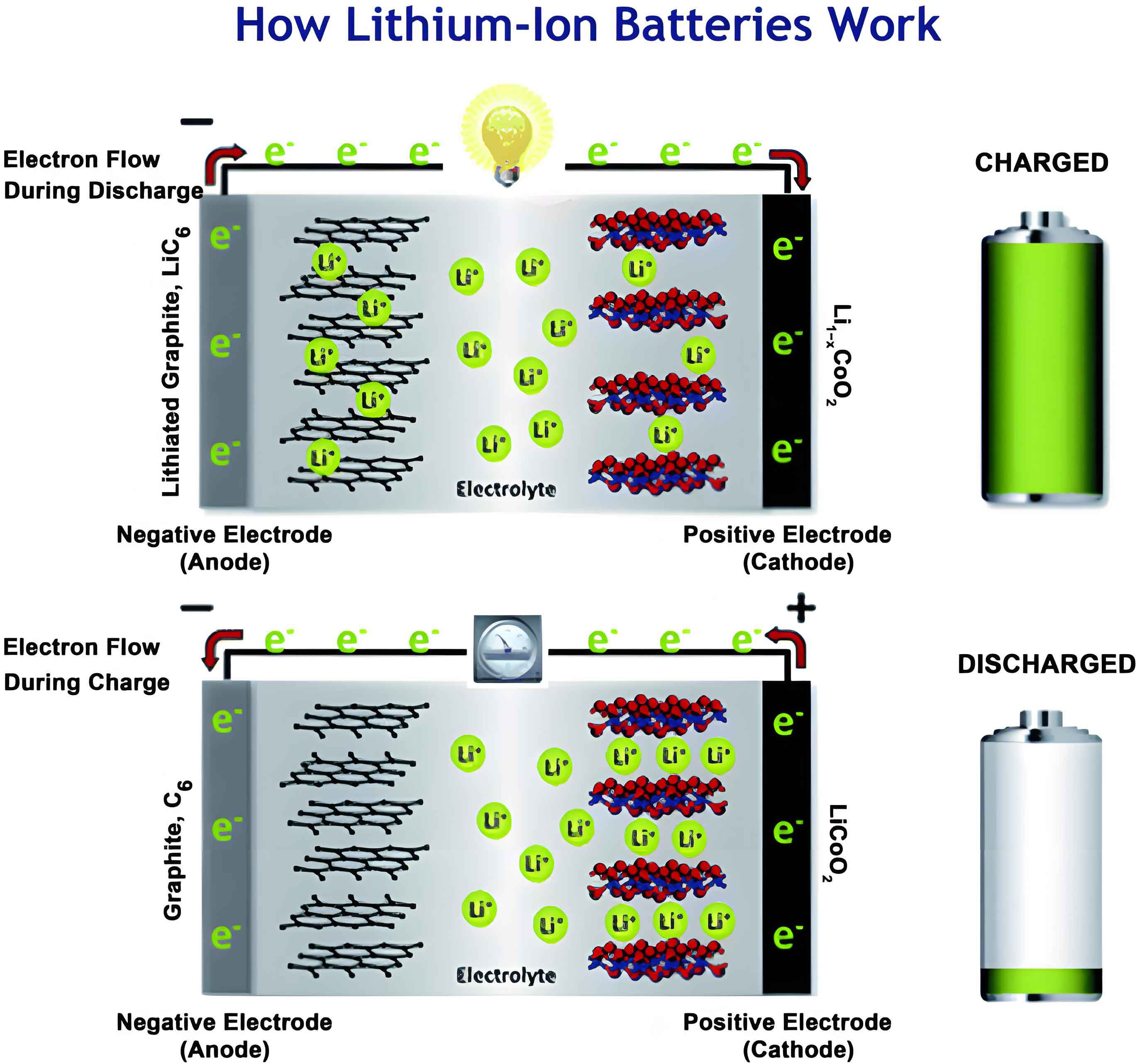
Lithium ion batteries operate on the principle of lithium-ion movement between electrodes during charge and discharge cycles. The basic electrochemical reactions can be summarized as follows:
During charging: $$ \text{LiCoO}_2 \rightarrow \text{Li}_{1-x}\text{CoO}_2 + x\text{Li}^+ + x e^- $$ (at the cathode) $$ \text{C} + x\text{Li}^+ + x e^- \rightarrow \text{Li}_x\text{C} $$ (at the anode)
During discharging: $$ \text{Li}_x\text{C} \rightarrow \text{C} + x\text{Li}^+ + x e^- $$ (at the anode) $$ \text{Li}_{1-x}\text{CoO}_2 + x\text{Li}^+ + x e^- \rightarrow \text{LiCoO}_2 $$ (at the cathode)
These reactions highlight the reversible intercalation and de-intercalation of lithium ions, which underpins the high energy density and efficiency of lithium ion batteries. The lithium ion battery’s characteristics are multifaceted, as summarized in the table below:
| Advantages | Disadvantages |
|---|---|
| High energy density, enabling longer driving ranges for EVs | High production cost due to rare materials and complex manufacturing |
| Long cycle life, often exceeding 10 years or thousands of cycles | Safety risks such as thermal runaway under abuse conditions |
| Low self-discharge rate, retaining charge over extended periods | Environmental sensitivity and recycling challenges |
| Fast charging capabilities, reducing downtime | Limited performance in extreme temperatures |
| Lightweight design, contributing to vehicle efficiency | Dependence on critical raw materials like cobalt and lithium |
In comparison to other battery technologies, the lithium ion battery excels in key metrics. For instance, when evaluating energy density, the lithium ion battery typically offers values between 100 to 300 Wh/kg, far surpassing alternatives. To quantify this, consider the energy density formula: $$ E_d = \frac{Q \times V}{m} $$ where \( E_d \) is energy density, \( Q \) is capacity, \( V \) is voltage, and \( m \) is mass. This high energy density is why the lithium ion battery dominates the EV market. Below is a comparative table of common battery types:
| Battery Type | Energy Density (Wh/kg) | Cycle Life | Cost | Key Applications |
|---|---|---|---|---|
| Lithium Ion Battery | 100-300 | 500-5000 cycles | High | EVs, electronics, grid storage |
| Nickel-Metal Hydride | 50-80 | 500-1000 cycles | Moderate | Hybrid EVs, portable devices |
| Lead-Acid | 25-40 | 200-300 cycles | Low | Starting batteries, backup power |
| Nickel-Cadmium | 30-60 | 300-500 cycles | Moderate | Tools, emergency lighting |
The global landscape for lithium ion battery manufacturing has evolved rapidly, with significant contributions from various regions. In my assessment, the industry is driven by innovations in materials and production scale, though specific company names are omitted to focus on broader trends. The lithium ion battery sector benefits from extensive research into cathode and anode materials, such as lithium iron phosphate (LFP) and nickel-cobalt-manganese (NCM) composites. For example, the voltage of a lithium ion battery cell can be expressed as: $$ V_{\text{cell}} = E_{\text{cathode}} – E_{\text{anode}} $$ where \( E \) represents electrode potentials. This fundamental relationship influences battery design and performance.
In electric vehicles, the lithium ion battery serves as the primary power source, with distinct pathways for pure EVs and hybrid EVs. For pure EVs, the choice often hinges on balancing energy density, safety, and cost. The lithium ion battery variants like LFP and NCM offer trade-offs, as shown in this table:
| Lithium Ion Battery Type | Energy Density (Wh/kg) | Safety Profile | Cost Relative Index | Typical Cycle Life |
|---|---|---|---|---|
| LFP (Lithium Iron Phosphate) | < 200 | High | 0.8 | > 2000 cycles |
| NCM (Nickel Cobalt Manganese) | 200-300 | Moderate | 1.2 | 1000-2500 cycles |
| Cobalt-based Variants | 150-200 | Lower | 1.5 | 500-1000 cycles |
The lithium ion battery in hybrid EVs, particularly plug-in hybrids, often leverages similar chemistries, but non-plug-in hybrids may use nickel-metal hydride batteries due to their superior power density for frequent charge-discharge cycles. However, the lithium ion battery remains pivotal for extending electric range and reducing emissions. From my perspective, the adoption of lithium ion batteries in EVs is bolstered by advancements in battery management systems (BMS), which monitor parameters like state of charge (SOC) and state of health (SOH). The SOC can be estimated using Coulomb counting: $$ \text{SOC}(t) = \text{SOC}_0 – \frac{1}{C_n} \int_0^t I(\tau) d\tau $$ where \( C_n \) is nominal capacity and \( I \) is current.
Testing and recycling are critical aspects of the lithium ion battery lifecycle. In my experience, comprehensive testing ensures reliability and safety. Key tests include capacity measurement, where capacity fade over cycles can be modeled as: $$ C_{\text{cycle}} = C_0 \times e^{-k n} $$ with \( C_0 \) initial capacity, \( k \) degradation rate, and \( n \) cycle number. Safety tests simulate abuse scenarios, such as thermal runaway, which follows Arrhenius kinetics: $$ k = A e^{-E_a/(RT)} $$ where \( E_a \) is activation energy. Recycling technologies for lithium ion batteries are evolving, with hydrometallurgical and pyrometallurgical methods aiming to recover valuable metals like lithium, cobalt, and nickel. The efficiency of recovery can be expressed as: $$ \eta_{\text{recycle}} = \frac{m_{\text{recovered}}}{m_{\text{input}}} \times 100\% $$
Looking ahead, the lithium ion battery is poised for further innovation. In materials science, emerging systems like lithium-sulfur and lithium-air batteries promise higher energy densities. For instance, the theoretical energy density of a lithium-sulfur battery is given by: $$ E_{\text{Li-S}} = \frac{2 \times F \times V_{\text{cell}}}{M_{\text{S}}} $$ where \( F \) is Faraday’s constant and \( M_{\text{S}} \) is sulfur molar mass. However, these systems face challenges in cycle life and stability. The lithium ion battery community is also exploring solid-state electrolytes to enhance safety, with ionic conductivity modeled by: $$ \sigma = \sigma_0 e^{-E_a/(kT)} $$ Structural innovations, such as cell-to-pack (CTP) designs, reduce weight and cost by integrating cells directly into modules. The energy density improvement from such designs can be approximated as: $$ \Delta E_d = \frac{E_{\text{new}} – E_{\text{old}}}{E_{\text{old}}} \times 100\% $$
In terms of battery management, advanced algorithms for state estimation are crucial. The Kalman filter, for example, is used to predict SOC: $$ \hat{x}_{k|k-1} = F_k \hat{x}_{k-1|k-1} + B_k u_k $$ $$ P_{k|k-1} = F_k P_{k-1|k-1} F_k^T + Q_k $$ These mathematical tools underscore the sophistication required to optimize lithium ion battery performance. Additionally, the lifecycle environmental impact of lithium ion batteries is assessed through life cycle analysis (LCA), where total emissions \( E_{\text{total}} \) are summed over stages: $$ E_{\text{total}} = \sum_{i=1}^n E_i $$ with \( i \) representing mining, manufacturing, use, and recycling.
To summarize, the lithium ion battery has revolutionized electric mobility, offering a blend of high energy density, longevity, and adaptability. Its drawbacks, such as cost and safety concerns, are actively addressed through research. As I see it, the future of the lithium ion battery lies in material breakthroughs, enhanced recycling ecosystems, and smarter integration into vehicles. The ongoing evolution of the lithium ion battery will undoubtedly drive the transition to a cleaner transportation sector, solidifying its role as an indispensable technology for years to come. In closing, the lithium ion battery is not just a component but a catalyst for sustainable innovation, and its journey mirrors the broader quest for energy efficiency and environmental stewardship.