
The global automotive industry faces escalating demands for fuel efficiency and emission reduction. As a transitional solution between conventional internal combustion engines and full electrification, 48V mild hybrid systems demonstrate significant potential. This study investigates the lifecycle performance of lithium iron phosphate (LiFePO4) battery packs in 48V architectures through accelerated aging protocols.
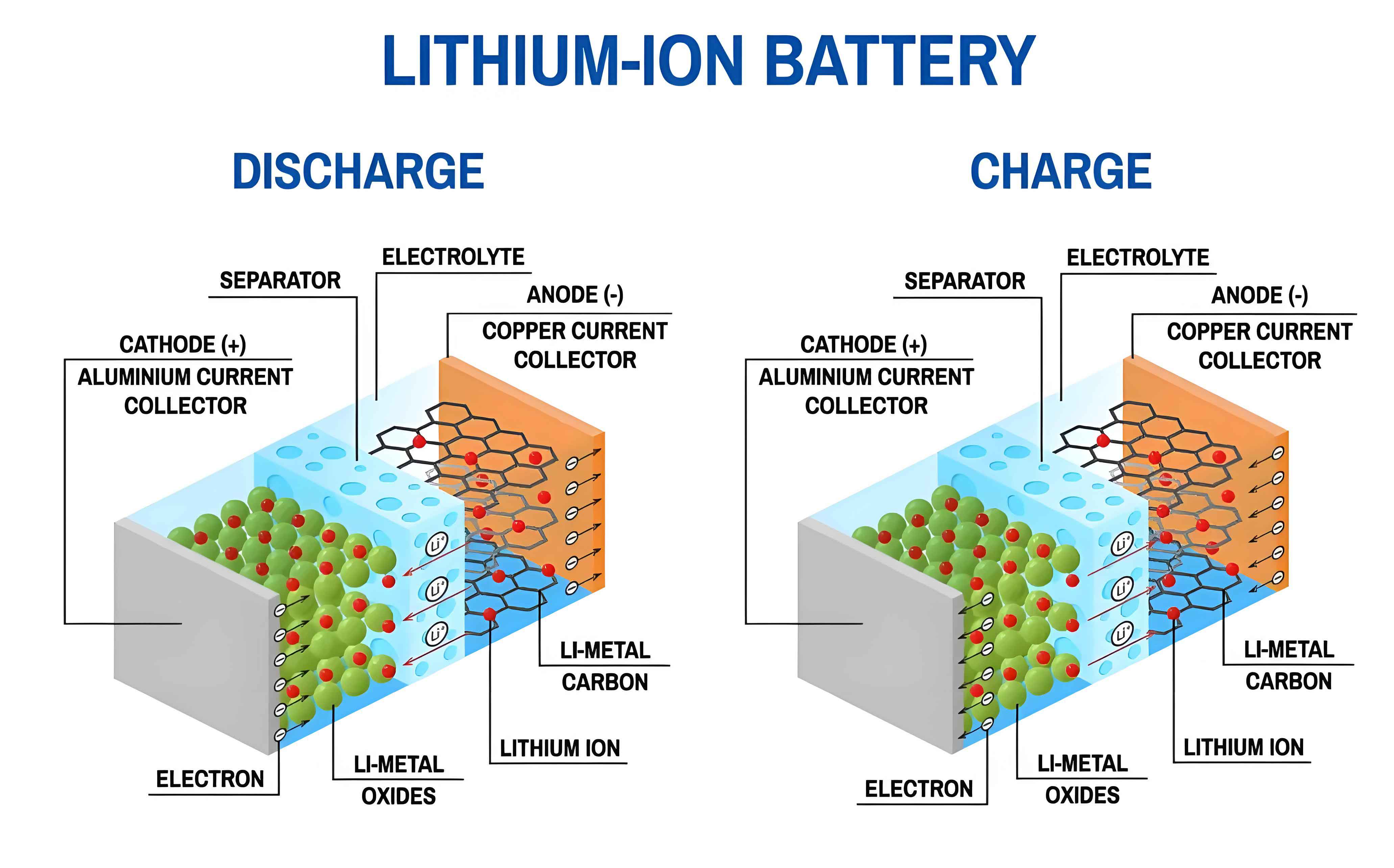
1. Battery Configuration and Fundamental Characteristics
The lithium ion battery module comprises 15 series-connected 37Ah pouch cells (3.2V nominal) with the following parameters:
| Parameter | Value |
|---|---|
| Total Voltage | 48V |
| Nominal Capacity | 37Ah |
| Energy Density | 142Wh/kg |
| Operating Temperature | -30°C to 55°C |
The capacity verification at 25°C yielded:
$$ Q_{discharge} = \frac{1}{n}\sum_{i=1}^{3}Q_i = 37.51\text{Ah} $$
where n = 3 test cycles.
2. DC Internal Resistance (DCR) Analysis
DCR measurements followed the pulse discharge method:
$$ R_{DCR} = \frac{\Delta V}{I} $$
| SOC (%) | Charge RDCR (mΩ) | Discharge RDCR (mΩ) |
|---|---|---|
| 25 | 10.53 | 11.50 |
| 50 | 10.57 | 11.54 |
| 85 | 12.12 | 12.20 |
The lithium ion battery exhibited 5.2% DCR growth after aging, confirming stable power delivery capabilities.
3. WLTP Cycle Life Validation
Accelerated aging tests simulated 334,800km equivalent mileage through 14,400 WLTP cycles at 50°C. Capacity fade followed the logarithmic model:
$$ Q_{loss} = k\cdot\log(N) + C $$
where:
k = 0.042 (degradation coefficient)
N = cycle count
C = 0.896 (capacity retention constant)
| Cycles | Capacity Retention (%) | DCR Increase (%) |
|---|---|---|
| 1,200 | 97.8 | 1.2 |
| 3,600 | 95.1 | 2.7 |
| 7,200 | 92.3 | 3.9 |
| 14,400 | 89.6 | 5.2 |
4. Thermal-Electrochemical Coupling Effects
The lithium ion battery’s aging mechanism follows Arrhenius kinetics:
$$ \tau = A\cdot e^{\frac{-E_a}{RT}} $$
where:
τ = degradation rate
Ea = activation energy (72kJ/mol for LiFePO4)
R = gas constant
T = absolute temperature
This explains the 3.2× acceleration factor at 50°C compared to 25°C baseline operation.
5. Energy Recovery Efficiency
The lithium ion battery system achieved 38.9% regenerative energy recovery during WLTP testing, with power distribution:
$$ \eta_{regen} = \frac{E_{recovered}}{E_{dissipated}} \times 100\% $$
| Phase | Energy In (Wh) | Energy Out (Wh) |
|---|---|---|
| Low Speed | 412 | 158 |
| Medium Speed | 897 | 352 |
| High Speed | 1,235 | 482 |
These results validate the lithium ion battery’s suitability for mild hybrid applications, combining high cycle life with efficient energy recuperation.