
The evolution of the lithium-ion battery stands as a cornerstone of modern technological progress. Its superior energy density, longevity, and decreasing cost have propelled its integration into every facet of our lives, from portable electronics to electric vehicles (EVs) and large-scale energy storage systems (ESS). The global shift towards decarbonization, underscored by ambitious climate goals, has further cemented the lithium-ion battery as a critical enabling technology. However, this rapid and widespread adoption brings to the forefront a paramount challenge that must be addressed with utmost urgency: safety.
As an energy storage device, the lithium-ion battery inherently contains significant chemical energy. Under abnormal conditions such as mechanical damage, electrical abuse (overcharge, short circuit), or thermal exposure, this stored energy can be released in an uncontrolled manner, leading to a dangerous sequence of exothermic reactions known as thermal runaway. The consequences are severe—intense heat generation, ejection of flammable and toxic gases, potential fire, and even explosion. While the absolute probability of such events remains statistically low for individual units, the sheer scale of deployment—hundreds of millions of cells in circulation—translates to a non-negligible number of incidents. Safety, therefore, is not merely an engineering specification; it is the fundamental prerequisite for the sustainable and trustworthy growth of the entire lithium-ion battery ecosystem.
To systematically mitigate risks and ensure the high-quality development of industries reliant on lithium-ion battery technology, a holistic, multi-layered defense strategy is essential. This strategy can be conceptualized as the “Three Lines of Defense.” The ultimate objective is to create a robust safety net where each layer provides a fallback, ensuring that a failure in one layer is intercepted by the next.
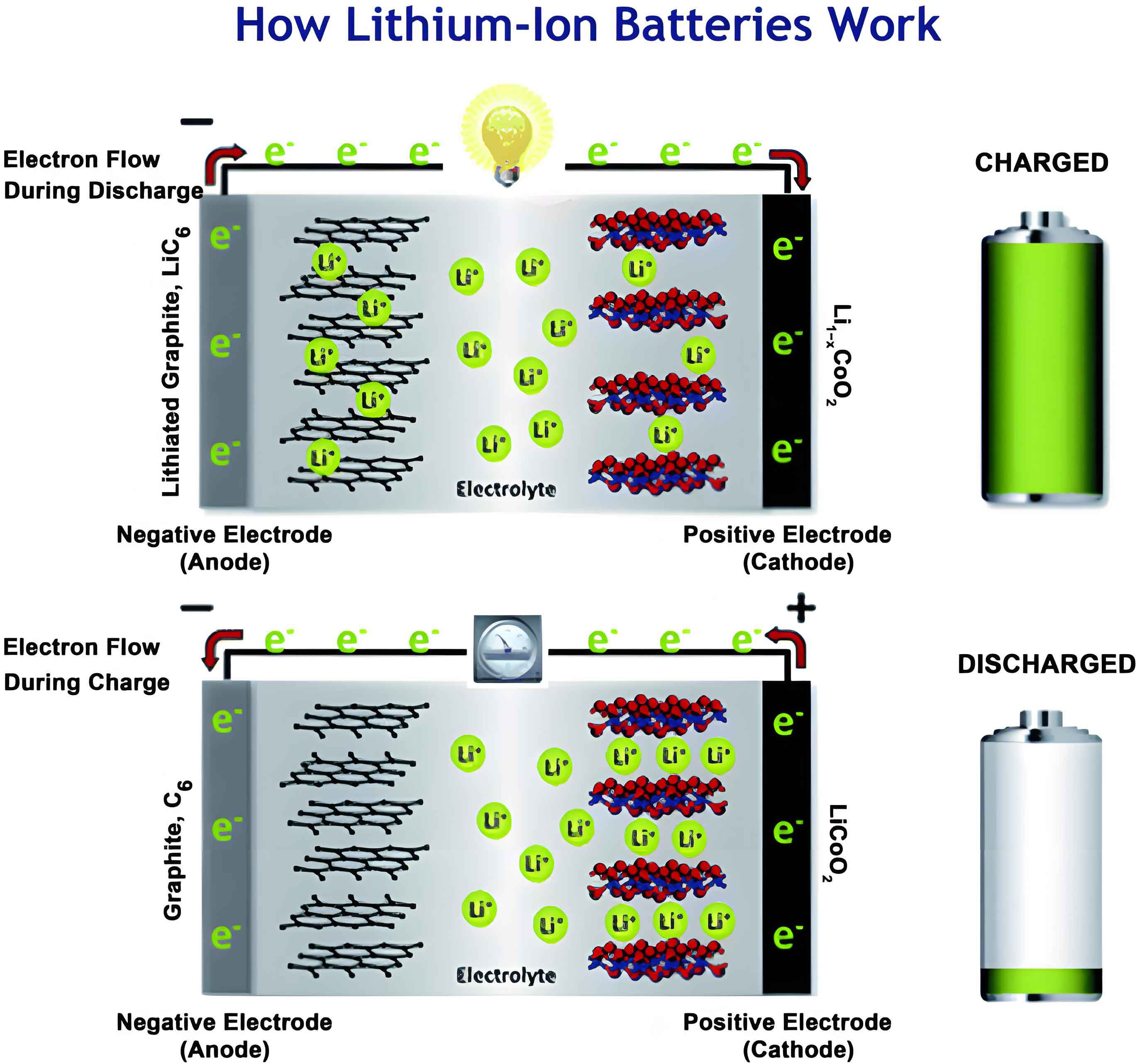
Defense Line 1: Intrinsic Cell Safety – Building a Robust Foundation
The first and most crucial line of defense is to engineer the lithium-ion battery cell itself to be inherently safer. The goal is to push the probability of cell-initiated thermal runaway from the current order of $$P_{current} \sim 10^{-7}$$ to a future target of $$P_{target} \le 10^{-8} \text{ or even } 10^{-9}$$. This requires a deep understanding of thermal runaway mechanisms and targeted innovation at the material level. Thermal runaway is often triggered when the internal temperature of a lithium-ion battery exceeds a critical threshold, $$T_{crit}$$, initiating a chain of decomposition reactions. The self-heating rate ($$\frac{dT}{dt}$$) can be modeled as:
$$
\frac{dT}{dt} = \frac{1}{\rho C_p} \sum_i A_i \exp\left(-\frac{E_{a,i}}{RT}\right) \Delta H_i
$$
where $$\rho$$ is density, $$C_p$$ is heat capacity, $$A_i$$ is the pre-exponential factor, $$E_{a,i}$$ is the activation energy, $$R$$ is the universal gas constant, $$T$$ is temperature, and $$\Delta H_i$$ is the reaction enthalpy for reaction *i*. The key to intrinsic safety lies in manipulating these material parameters to raise $$T_{crit}$$ and reduce the overall reaction enthalpy $$\sum \Delta H_i$$.
Research focuses on several key materials:
- Electrolyte: The conventional organic carbonate-based electrolyte is highly flammable. The strategy is to design novel electrolyte systems with improved stability and flame-retardant properties. This includes:
- High-concentration/Localized High-Concentration Electrolytes (HCE/LHCE): These formulations reduce free solvent molecules, enhancing oxidative stability and forming a robust, inorganic-rich solid electrolyte interphase (SEI).
- Flame-Retardant Additives: Phosphorus- (e.g., trimethyl phosphate), fluorine- (e.g., fluorinated carbonates), and nitrogen-containing compounds can be added. Their effectiveness is often synergistic. The flame-retardant efficiency (FRE) can be evaluated based on the reduction in total heat release (THR).
- Solid-State Electrolytes: Replacing the liquid electrolyte with a solid ion conductor (polymer, oxide, sulfide) eliminates the flammable organic component, representing a potential paradigm shift in lithium-ion battery safety.
- Cathode Material: Layered oxide cathodes (e.g., NMC, NCA) release oxygen at high temperatures, fueling combustion. Strategies include:
- Surface Coating: Applying a thin, stable layer (e.g., $$Al_2O_3$$, $$Li_3PO_4$$, $$AlPO_4$$) on cathode particles acts as a physical barrier, suppressing side reactions and oxygen release.
- Bulk Doping: Introducing alien ions (e.g., Al, Mg, Ti) into the crystal lattice strengthens the metal-oxygen bonds, increasing the structural stability and raising the onset temperature of phase decomposition.
- Anode/SEI Stabilization: Developing electrolytes that form a thermally stable, mechanically robust SEI on the anode (typically graphite or silicon) prevents exothermic reactions between the lithiated anode and the electrolyte at elevated temperatures.
| Material Component | Safety Challenge | Mitigation Strategy | Key Performance Indicator |
|---|---|---|---|
| Electrolyte | High flammability, low thermal stability | Flame-retardant additives, HCE/LHCE, Solid-state | Flash Point, Self-extinguishing time (SET), Thermal runaway onset temp. |
| Cathode (NMC/NCA) | Oxygen release at high T, structural collapse | Surface coating ($$Al_2O_3$$), Bulk doping (Al, Mg) | Oxygen evolution onset temp., Enthalpy of decomposition |
| Anode/SEI | Exothermic reaction with electrolyte | Electrolyte formulation for stable SEI | SEI thermal stability, Reaction heat with lithiated anode |
| Separator | Thermal shrinkage leading to internal short | Ceramic-coated separators, thermally stable polymers (PI) | Shrinkage temperature (>200°C), Melt integrity |
Defense Line 2: Process Safety – Proactive Monitoring and Intervention
Despite best efforts in cell design, absolute intrinsic safety is an asymptotic goal. The second line of defense acknowledges this and focuses on intelligent management during the lithium-ion battery‘s operational life. It involves continuous monitoring, early fault diagnosis, and proactive thermal management to detect and neutralize threats before they escalate into thermal runaway.
1. Advanced Thermal Management with Phase-Change Materials (PCMs) & Thermal Runaway Blocking: Traditional cooling systems (air/liquid) maintain average temperature. Innovative systems integrate materials with variable thermal properties. A key example is using PCMs or specially designed composites that change their thermal conductivity ($$k$$) with temperature:
- Normal Operation (T < TPCM): High $$k$$ to efficiently conduct heat away, ensuring cell-to-cell uniformity and longevity.
- Near Thermal Runaway (T ≈ TPCM): The material undergoes a phase change (solid-liquid), absorbing a large amount of latent heat ($$Q = m \cdot L$$, where *m* is mass and *L* is latent heat), thereby suppressing the temperature rise of the failing cell.
- Post-Thermal Runaway (T >> TPCM): The material (or an adjacent intumescent layer) expands or chars, creating a high thermal resistance barrier ($$R_{th} = \Delta x / k$$) to isolate the propagating heat and prevent cascade failure in a lithium-ion battery pack.
2. In-situ and Non-destructive Fault Diagnosis: Moving beyond traditional voltage and temperature monitoring.
- Ultrasonic Monitoring: By sending ultrasonic waves through a lithium-ion battery and analyzing the time-of-flight and amplitude changes, one can detect internal structural changes like gas generation (precursor to swelling) or electrode delamination. The signal velocity $$v$$ is related to the modulus and density of the internal components.
- Distributed Fiber Optic Sensing (FOS): Embedding fiber Bragg grating (FBG) or Raman scattering fibers enables high-resolution, real-time temperature and strain mapping at thousands of points along a single fiber. The Bragg wavelength shift $$\Delta \lambda_B$$ is directly proportional to strain ($$\epsilon$$) and temperature change ($$\Delta T$$): $$\Delta \lambda_B = \lambda_B (\alpha_\epsilon \cdot \epsilon + \alpha_T \cdot \Delta T)$$.
- Electrochemical Impedance Spectroscopy (EIS): By applying a small AC signal across a range of frequencies, the internal impedance spectrum of the lithium-ion battery is obtained. Changes in the spectrum’s shape (e.g., diameter of semicircles in a Nyquist plot) can indicate degradation modes like SEI growth, contact loss, or lithium plating long before voltage anomalies appear.
- Connection Fault Diagnosis: For series/parallel connections in packs, advanced algorithms analyze current distribution and interconnect resistance to detect loose bolts or busbar degradation, which can lead to localized heating.
3. Hierarchical Early Warning and Precise Localization: The pinnacle of process safety is predicting a fault with sufficient lead time for intervention. This involves fusing multiple sensor data (T, V, $$\Delta V/\Delta t$$, acoustic, pressure) into a state estimation model (e.g., based on equivalent circuit models or machine learning). A multi-stage warning system can be implemented:
- Stage 1 (Early Anomaly): Triggered by subtle deviations in EIS or ultrasonic signals, indicating early degradation. Maintenance can be scheduled.
- Stage 2 (Imminent Risk): Triggered by rapid temperature rise rate ($$\frac{dT}{dt} > \Theta_1$$) or internal pressure build-up detected by FOS. System may limit charge/discharge power or activate targeted cooling.
- Stage 3 (Thermal Runaway Onset): Triggered by detection of volatile organic compounds (VOC) or a critical temperature threshold ($$T > T_{crit, warn}$$). Initiates immediate system shutdown and prepares fire suppression.
Fiber optic systems based on Optical Frequency Domain Reflectometry (OFDR) or Optical Time Domain Reflectometry (OTDR) can pinpoint the exact cell or module where the anomaly originates.
| Monitoring Technology | Measured Parameter | Early Warning Capability | Challenges for Implementation |
|---|---|---|---|
| Voltage/Temperature (Traditional) | Cell terminal V, surface T | Low – detects late-stage faults | Limited resolution, slow response to internal events |
| Ultrasonic Sensing | Internal density/structure | Medium – can detect gas generation | Signal processing complexity, sensor integration |
| Fiber Optic Sensing (FBG/DTS) | Distributed T and Strain | High – real-time, high-resolution mapping | Cost, fragility of fibers, integration in cells |
| Electrochemical Impedance Spectroscopy | Internal impedance spectrum | High – detects degradation mechanisms | Requires interruption of operation, complex online implementation |
| Gas/Aerosol Sensors | VOC, $$H_2$$, $$CO$$, $$HF$$ | Medium-High – specific to thermal runaway chemistry | Cross-sensitivity, placement, response time |
Defense Line 3: Fire Safety – Containing and Extinguishing the Last Resort
When the first two defenses are breached and a lithium-ion battery enters thermal runaway, the third line must act decisively to contain the event, extinguish any fire, and prevent reignition or propagation. The fire chemistry of a lithium-ion battery is complex, involving flammable electrolytes, combustible electrodes, and its own oxidizer source (from the cathode).
1. Intelligent, Multi-Parameter Fire Detection and Alarm Linkage: Traditional smoke or heat detectors may be too slow. A dedicated system for lithium-ion battery enclosures integrates signals from:
- High-sensitivity smoke detectors (for aerosol from venting).
- Rapid response rate-of-rise temperature sensors.
- Gas detectors (for $$CO$$, $$HF$$).
- Optical flame detectors (for UV/IR radiation).
A decision matrix or algorithm fuses these inputs. For instance, an alarm is triggered if: $$(S_{smoke} > \tau_s) \land (dT/dt > \tau_{dT})$$ OR $$(C_{CO} > \tau_{CO})$$. This linked system reduces false alarms and enables faster response than any single sensor.
2. Innovative Suppression and Anti-Reignition Techniques: Extinguishing a lithium-ion battery fire is notoriously difficult because the cell can continue to produce heat and flammable gases internally even after surface flames are out, leading to reignition. The ideal agent must cool the cells rapidly and maintain an inert atmosphere.
- Agent Selection: Water is excellent at cooling but poses electrical conductivity risks. Gaseous agents like $$N_2$$ or $$Ar$$ inert the atmosphere but offer little cooling. Chemical agents like perfluorinated ketones (e.g., C6-FK, Novec 1230) have good insulating properties and moderate cooling via vaporization. A comparative analysis is crucial:
| Suppression Agent | Cooling Capacity | Electrical Insulation | Anti-Reignition for Li-ion | Environmental Impact (GWP) |
|---|---|---|---|---|
| Water Mist/Fog | Excellent (High latent heat) | Poor (Conductive) | Good (if applied continuously) | None |
| Inert Gases ($$N_2$$, $$Ar$$) | Poor | Excellent | Fair (only if concentration is maintained) | None |
| C6-FK (Perfluoroketone) | Good (Vaporization) | Excellent | Good (moderate cooling + inerting) | Low (~1) |
| HFC-227ea / HFC-125 | Fair | Excellent | Fair | High (>3000) |
| ABC Dry Chemical | Poor | Poor (Messy, corrosive) | Poor | N/A |
- Application Strategy – “Burst and Sustain”: A two-phase application protocol is often most effective for a lithium-ion battery pack:
- Phase 1 (Rapid Suppression): A high-concentration burst of agent (e.g., C6-FK) is discharged immediately upon alarm to extinguish open flames and inert the enclosure volume ($$C_{agent} > C_{min, extinguish}$$).
- Phase 2 (Sustained Cooling & Inerting): A lower, sustained flow or periodic pulses are maintained for an extended period (hours). This serves two purposes: it continues to cool the cells through the latent heat of vaporization of the liquid agent, and it maintains the agent concentration above a lower threshold ($$C_{agent} > C_{min, inert}$$) to prevent flammable gas mixtures from forming. The required sustainment time $$t_{sustain}$$ can be estimated based on the pack’s thermal mass and post-thermal runaway heat generation rate.
- System Design: The suppression system must be directly linked to the detection system (Defense Line 2 output). Nozzles should be strategically placed to ensure agent reaches the inter-cell spaces within a module. Enclosures should be designed to withstand slight overpressure from cell venting while allowing for agent retention.
Synergy and the Path Forward
The “Three Lines of Defense” framework is not a collection of independent measures but an integrated, synergistic system. Advances in intrinsic safety (Line 1) raise the threshold for failure, making the job of monitoring systems (Line 2) easier and reducing the likelihood of engaging fire suppression (Line 3). Conversely, robust process safety can compensate for minor weaknesses in cell design, and effective fire safety provides a critical safety net.
However, technology alone is insufficient. The relentless drive for lower costs in a highly competitive market can lead to corners being cut on safety margins, material quality, and system integration. Therefore, the full realization of this safety framework requires a concerted effort from the entire ecosystem:
- Industry Self-Discipline: Manufacturers must prioritize safety over short-term cost advantages in a “race to the bottom.” Quality control, rigorous testing protocols (beyond minimum standards), and transparent reporting of safety performance are essential.
- Regulatory and Standardization Leadership: Governments and standards bodies (like IEC, UL, ISO) must develop and enforce evolving, performance-based safety standards that incentivize the adoption of advanced safety technologies across all three defense lines. Regulations should encourage “safety by design.”
- Informed Consumer and Operator Awareness: End-users, from EV owners to grid operators, need clear guidelines on the safe use, charging, and maintenance of lithium-ion battery systems.
The future of energy is inextricably linked to the advancement of electrochemical storage. The lithium-ion battery, in its current and future iterations, will remain at the heart of this transition. By diligently constructing and reinforcing these Three Lines of Defense—through continuous material innovation, intelligent system engineering, and effective emergency response—we can manage the inherent risks and unlock the full, safe potential of lithium-ion battery technology. This will pave the way for its sustained, high-quality growth, powering a cleaner and more secure energy future for all.