
In the pursuit of higher energy density for modern applications, the lithium-ion battery industry has increasingly turned to silicon-based anode materials due to their exceptional theoretical specific capacity of approximately 4200 mAh/g, which significantly outperforms traditional graphite anodes. This shift is driven by the growing demand for longer-lasting power sources in electric vehicles, portable electronics, and grid storage systems. However, the integration of silicon into lithium-ion battery architectures introduces complex thermal management challenges, as the high reactivity of lithiated silicon phases can exacerbate exothermic reactions during thermal abuse scenarios, potentially leading to thermal runaway—a critical safety concern characterized by rapid temperature rise, gas emission, and even combustion or explosion. Understanding the thermal stability of silicon-based anodes, particularly in high-nickel cathode systems like NCM811, is therefore paramount for developing safer, high-performance lithium-ion batteries. This study delves into the exothermic behavior of silicon-carbon (SiC) composite anodes within an NCM811/SiC@graphite lithium-ion battery configuration, employing differential scanning calorimetry-thermogravimetric analysis (DSC-TG) to dissect the heat release sequences and contributions of individual cell components under various states of charge (SOC). The findings aim to elucidate the thermal triggers and mitigate risks associated with silicon-enhanced lithium-ion batteries, paving the way for more robust thermal management strategies.
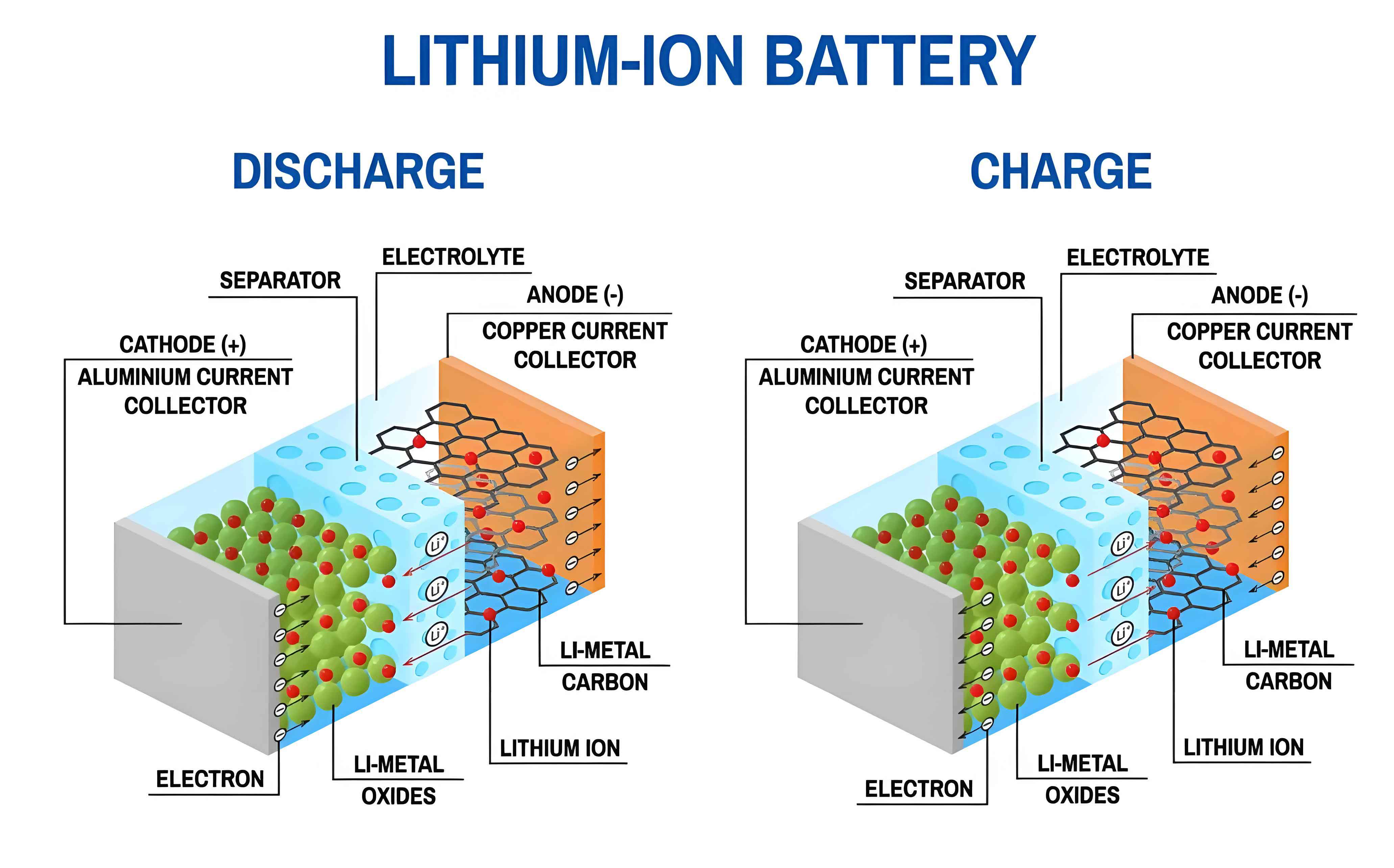
The inherent thermal instability of lithium-ion battery components, especially under fully charged conditions, stems from the delicate balance between energy storage and chemical reactivity. In silicon-based anodes, the alloying reaction with lithium forms phases such as LixSi, which can be categorized into reversible (LizSi) and irreversible (LiySi) components, where x = z + y. These phases exhibit distinct thermal behaviors when exposed to elevated temperatures or in contact with electrolytes. For instance, the solid electrolyte interphase (SEI) layer on the anode surface, composed of decomposition products from electrolyte reduction, may decompose at relatively low temperatures, initiating a cascade of exothermic events. Similarly, high-nickel cathodes like NCM811 undergo structural degradation upon delithiation, releasing oxygen and heat that can fuel further reactions. The interplay between these components—anode, cathode, and electrolyte—dictates the overall thermal safety profile of a lithium-ion battery. This research systematically investigates these interactions through controlled experiments, focusing on the silicon-based anode’s role as a potential thermal trigger in advanced lithium-ion battery systems.
To assess the thermal stability of silicon-based anodes, a commercial 3.3 Ah pouch cell with an NCM811 cathode and a SiC@graphite anode (50 wt% silicon-carbon composite and 50 wt% graphite) was utilized. The electrolyte formulation consisted of 1 mol/L LiPF6 in a solvent mixture of ethylene carbonate (EC), dimethyl carbonate (DMC), and fluoroethylene carbonate (FEC) in a volume ratio of 2:5:1, with 2 wt% vinylene carbonate (VC) as an additive. Cells were conditioned through formation cycles at 0.1 C and then charged to specific SOC levels—0%, 50%, and 100%—using constant current-constant voltage protocols, as outlined in Table 1. Post-conditioning, cells were disassembled in an argon-filled glovebox to harvest electrode materials, which were rinsed with DMC to remove residual salts and solvents, then dried for 2 hours. The active materials were carefully scraped from the current collectors for subsequent analysis.
| Cell ID | Charging Protocol | Achieved SOC |
|---|---|---|
| 1 | Constant current-constant voltage charge: 0.33 C to 4.2 V, then hold at 4.2 V until current drops to 0.05 C | 100% |
| 2 | Constant current-constant voltage charge: 0.33 C to 4.2 V, then hold at 4.2 V until current drops to 0.05 C; followed by constant current discharge: 0.33 C until 1.65 Ah capacity is removed | 50% |
| 3 | Constant current-constant voltage charge: 0.33 C to 4.2 V, then hold at 4.2 V until current drops to 0.05 C; followed by constant current discharge: 0.33 C to 2.5 V cutoff | 0% |
DSC-TG measurements were conducted using a Mettler-Toledo TGA/DSC 3+ instrument under a high-purity argon atmosphere. Samples were prepared by weighing precise amounts of anode, cathode, and electrolyte, mirroring the mass ratios found in the full cell, as detailed in Table 2. These mixtures were sealed in 0.04 mL aluminum crucibles and heated from 25°C to 500°C at a rate of 5°C/min, with an argon flow rate of 40 mL/min. The heat flow data were analyzed to identify exothermic peaks, with peak temperatures indicating thermal stability thresholds and integrated areas representing heat release quantities. For gas evolution studies, fully charged anode strips were combined with 10 g of single-solvent electrolytes (e.g., EC, DMC, FEC-based) in sealed aluminum laminate bags, stored at 60°C for up to 10 days, and gas production rates were calculated using the water displacement method, expressed as:
$$ \text{Gas Production Rate} = \frac{V_{\text{after}} – V_{\text{before}}}{V_{\text{before}}} \times 100\% $$
where \( V_{\text{before}} \) and \( V_{\text{after}} \) are the volumes displaced before and after storage, respectively. This approach allows for a comprehensive evaluation of the thermal reactivity between lithiated silicon anodes and various electrolyte components, critical for advancing the safety of lithium-ion batteries.
| Sample ID | Component Mixture | Mass/Volume |
|---|---|---|
| 1 | Anode (SiC@graphite) | 3.5 mg |
| 2 | Cathode (NCM811) | 3.5 mg |
| 3 | Electrolyte (1M LiPF6 in EC/DMC/FEC) | 0.0035 mL |
| 4 | Anode + Electrolyte | 3.5 mg + 0.0065 mL |
| 5 | Cathode + Electrolyte | 3.5 mg + 0.0015 mL |
| 6 | Anode + Cathode | 6.8 mg (anode) + 1.5 mg (cathode) |
| 7 | Anode + Cathode + Electrolyte | 6.8 mg (anode) + 1.5 mg (cathode) + 0.0027 mL |
The thermal behavior of fully charged (100% SOC) NCM811/SiC@graphite lithium-ion battery components reveals a sequential exothermic response that underscores the silicon-based anode’s role as a primary thermal trigger. DSC curves for individual and combined components, as shown in Figure 1(a), indicate that the electrolyte alone exhibits a broad endothermic peak between 50°C and 90°C, attributed to solvent evaporation—a process that absorbs heat and is common in lithium-ion battery electrolytes under thermal stress. In contrast, the mixture of fully charged anode and electrolyte displays a distinct exothermic peak at approximately 115°C, corresponding to the decomposition of the SEI layer on the silicon-based anode surface. This early-onset exotherm suggests that the anode-electrolyte interface is thermally vulnerable, potentially initiating thermal runaway in lithium-ion batteries if temperatures exceed this threshold.
Further analysis of peak temperatures reveals a hierarchy of thermal stability among components. For the fully charged cathode (delithiated NCM811), an exothermic peak appears at 218°C, likely due to structural collapse and oxygen release from the nickel-rich material. When combined with electrolyte, this peak shifts to 213°C, indicating that electrolyte presence slightly destabilizes the cathode, a phenomenon observed in many high-energy lithium-ion batteries. The anode alone shows an exotherm at 265°C, but with electrolyte, two peaks emerge: one at 227°C and another at 293°C. The first peak (227°C) represents the reaction between lithiated silicon phases and electrolyte, while the second (293°C) may involve further decomposition of electrolyte or interactions with carbon components. Notably, the anode-electrolyte mixture’s first exotherm at 227°C is significantly lower than that of the anode alone (265°C), highlighting the catalytic effect of electrolyte in reducing the thermal stability of silicon-based anodes in lithium-ion batteries.
For the combined anode and cathode without electrolyte, exothermic peaks are observed at 318°C and 412°C, suggesting alloying reactions between lithiated silicon and oxygen species from the cathode. However, with electrolyte added, a pronounced exotherm at 202°C dominates, implying that electrolyte mediates severe heat release at lower temperatures. The sequential order of exothermic peak temperatures, from lowest to highest, is: Anode + Electrolyte (115°C) < Anode + Cathode + Electrolyte (202°C) < Cathode + Electrolyte (213°C) ≈ Cathode (218°C) < Anode + Cathode (318°C) < Anode (265°C). This sequence positions the anode-electrolyte interaction as the earliest thermal trigger in this lithium-ion battery system, emphasizing the need to enhance the SEI layer’s thermal resilience to delay thermal runaway.
Quantifying the heat release from each component provides insights into the severity of exothermic reactions. By integrating the DSC curves, the specific heat release values (in W/g) are calculated and summarized in Figure 1(c). The ranking from highest to lowest heat release is: Anode + Cathode + Electrolyte (1552 W/g) > Anode + Cathode (361 W/g) > Anode (231 W/g) > Anode + Electrolyte (196 W/g) > Cathode (159 W/g) > Cathode + Electrolyte (109 W/g) > Electrolyte (-25 W/g, indicating net endotherm). The exceptionally high heat release for the ternary mixture—over five times that of other combinations—underscores the synergistic effect of combining all active components in a lithium-ion battery, where exothermic reactions are amplified, posing a substantial safety risk. This data reinforces the criticality of managing thermal interactions in silicon-based lithium-ion batteries, especially under full charge conditions.
To elucidate the influence of lithium content on thermal stability, experiments were conducted with anodes at different SOC levels (0%, 50%, and 100%) mixed with electrolyte. The DSC results, depicted in Figure 2(a), show that all SOC levels exhibit an exothermic peak around 230.5°C when combined with electrolyte, attributed to reactions involving irreversible lithium-silicon phases (LiySi) and unreacted silicon with electrolyte. However, a second exothermic peak appears only for 100% and 50% SOC anodes at 291°C and 311.5°C, respectively, which shifts to higher temperatures and diminishes in intensity as SOC decreases. This second peak is absent in the 0% SOC sample, suggesting it corresponds to reactions of reversible lithium-silicon phases (LizSi) with electrolyte. The inverse relationship between SOC and peak temperature can be modeled using an Arrhenius-type equation for reaction kinetics:
$$ k = A e^{-E_a / (RT)} $$
where \( k \) is the rate constant, \( A \) is the pre-exponential factor, \( E_a \) is the activation energy, \( R \) is the gas constant, and \( T \) is the temperature. As SOC decreases, the activation energy for exothermic reactions may increase due to reduced lithium content, leading to higher peak temperatures. This behavior highlights the role of reversible lithium in exacerbating thermal instability in silicon-based lithium-ion batteries.
Separate DSC analysis of anodes alone (Figure 2(b)) reveals a strong exotherm at 265.3°C for 100% SOC, shifting to 287°C for 50% SOC, and disappearing at 0% SOC. This aligns with the second peak in anode-electrolyte mixtures, confirming that reversible lithium-silicon phases contribute to heat release independently of electrolyte. The heat release quantities, derived from curve integration, decrease with reducing SOC for both anode alone and anode-electrolyte mixtures, as shown in Figure 2(c). For instance, the heat release for the anode-electrolyte mixture drops from 196 W/g at 100% SOC to 76 W/g at 50% SOC and 45 W/g at 0% SOC. However, even at 0% SOC, residual heat release persists, indicating that irreversible phases and residual silicon remain thermally active, posing a latent risk in lithium-ion batteries. This finding challenges the notion that fully discharging a lithium-ion battery eliminates thermal hazards, underscoring the need for comprehensive safety designs.
The thermal interplay between cathode and anode was further probed through DSC of combined materials at different SOCs. As illustrated in Figure 3(a), the mixture of fully charged cathode and anode exhibits two exothermic peaks at 220°C and 240°C, which weaken and vanish as SOC decreases, reflecting improved thermal stability with lower lithium content. Additionally, strong exotherms at 318°C and 412°C for 100% SOC shift to lower temperatures at reduced SOCs, possibly due to enhanced oxygen release from the cathode at partial delithiation, accelerating reactions with the anode. When electrolyte is introduced (Figure 3(b)-(c)), all SOC levels show an exotherm around 202°C, but with varying peak shapes and intensities, indicating complex reaction pathways influenced by lithium inventory.
Heat release calculations for these combinations, summarized in Figure 3(d), demonstrate that the ternary mixture (anode + cathode + electrolyte) releases 1552 W/g at 100% SOC, compared to 137 W/g at 50% SOC and 45 W/g at 0% SOC—a reduction of over 90% at lower SOCs. This drastic decline suggests that managing the state of charge in lithium-ion batteries can significantly mitigate thermal hazards. However, the persistence of exothermic activity at 0% SOC (45 W/g) implies that even discharged lithium-ion batteries retain thermal risks, likely from residual reactions between cathode-released oxygen and anode components. Thus, while SOC reduction is beneficial, it alone cannot fully preclude thermal runaway in silicon-based lithium-ion batteries, necessitating additional safeguards such as advanced electrolytes or thermal barriers.
The concept of heat release residual rate, defined as \( \text{Residual Rate} = \frac{X – Y}{X} \times 100\% \), where \( X \) is the heat release at 100% SOC and \( Y \) is at a given SOC, quantifies the impact of SOC reduction on thermal safety. As plotted in Figure 4, for the anode alone, the residual rate decreases by 31% at 50% SOC and 27% at 0% SOC, indicating modest improvements. In contrast, for anode-electrolyte and anode-cathode-electrolyte mixtures, the residual rates drop by 62% and 91% at 50% SOC, respectively, highlighting the pronounced effect of SOC on electrolyte-mediated reactions. At 0% SOC, residual rates remain at 22% for anode-electrolyte and 3% for anode-cathode-electrolyte, confirming that some exothermic potential endures. This analysis underscores that while lowering SOC alleviates thermal risks in lithium-ion batteries, especially for electrolyte-involved reactions, it does not entirely eliminate them, emphasizing the importance of material-level enhancements for silicon-based anodes.
| Component | Heat Release at 100% SOC (W/g) | Heat Release at 50% SOC (W/g) | Residual Rate at 50% SOC | Heat Release at 0% SOC (W/g) | Residual Rate at 0% SOC |
|---|---|---|---|---|---|
| Anode | 231 | 159 | 31% | 126 | 27% |
| Anode + Electrolyte | 196 | 76 | 62% | 45 | 22% |
| Anode + Cathode | 361 | 242 | 27% | 137 | 38% |
| Anode + Cathode + Electrolyte | 1552 | 137 | 91% | 45 | 3% |
Investigating the thermal compatibility between fully charged silicon-based anodes and electrolytes is crucial for formulating safer lithium-ion batteries. Gas evolution studies at 60°C storage provide insights into long-term stability. As shown in Figure 5, when fully charged SiC@graphite anodes are paired with single-solvent electrolytes based on EC, DMC, EMC, DEC, or PC, negligible gas production occurs over 10 days. In stark contrast, FEC-based electrolyte exhibits a gas production rate of 9% after 4 days, escalating to 17% after 10 days. This pronounced gassing is likely due to decomposition of FEC into hydrogen fluoride (HF), which reacts with SEI components like Li2CO3 to generate CO2, as described by:
$$ \text{FEC} \rightarrow \text{VC} + \text{HF} $$
$$ \text{Li}_2\text{CO}_3 + 2\text{HF} \rightarrow 2\text{LiF} + \text{H}_2\text{O} + \text{CO}_2 \uparrow $$
Alternatively, HF may form via reaction with LiPF6 salts. The linear increase in gas production with time suggests ongoing decomposition, rendering FEC-based electrolytes less thermally stable for silicon-based lithium-ion batteries. This finding advocates for reducing FEC content or exploring alternative solvents (e.g., sulfones or ionic liquids) to enhance the thermal resilience of lithium-ion battery electrolytes, particularly for high-energy applications involving silicon anodes.
The thermal degradation pathways in lithium-ion batteries with silicon anodes can be modeled using reaction kinetics. For instance, the heat release rate \( \dot{Q} \) during an exothermic reaction can be expressed as:
$$ \dot{Q} = \Delta H \cdot A \cdot e^{-E_a/(RT)} \cdot f(\alpha) $$
where \( \Delta H \) is the enthalpy change, \( A \) is the frequency factor, \( E_a \) is the activation energy, \( R \) is the universal gas constant, \( T \) is the absolute temperature, and \( f(\alpha) \) is a function of the conversion degree \( \alpha \). In silicon-based systems, multiple reactions may overlap, such as SEI decomposition (\( E_a \approx 100 \text{ kJ/mol} \)), lithium-silicon alloy reactions (\( E_a \approx 150 \text{ kJ/mol} \)), and electrolyte oxidation (\( E_a \approx 200 \text{ kJ/mol} \)). The low activation energy for SEI decomposition correlates with the early exotherm at 115°C, making it a critical focus for improving thermal safety in lithium-ion batteries. By tailoring electrolyte additives to form more stable SEI layers (e.g., using LiFSI salts or cross-linking agents), the onset temperature can be raised, delaying thermal runaway initiation.
Furthermore, the role of silicon content in thermal behavior warrants consideration. In SiC@graphite composites, the silicon fraction influences the quantity of lithiated phases. A higher silicon percentage increases the reversible and irreversible lithium capacity, potentially amplifying exothermic heat release. This relationship can be approximated by:
$$ Q_{\text{total}} = x_{\text{Si}} \cdot Q_{\text{Si}} + (1 – x_{\text{Si}}) \cdot Q_{\text{graphite}} $$
where \( x_{\text{Si}} \) is the mass fraction of silicon, \( Q_{\text{Si}} \) is the specific heat release from lithium-silicon reactions, and \( Q_{\text{graphite}} \) is from lithium-graphite reactions. For the studied composite (50% silicon), \( Q_{\text{total}} \) is substantial, but optimizing silicon loading (e.g., to 10-20%) may balance energy density and thermal safety in lithium-ion batteries. Additionally, nanostructuring silicon (e.g., using porous or coated particles) can mitigate volume expansion and reduce reactive surface area, thereby enhancing thermal stability.
In practical lithium-ion battery packs, thermal runaway propagation between cells is a major concern. The insights from this study inform mitigation strategies. For example, incorporating phase-change materials or fire-retardant additives in electrolytes can absorb heat and suppress exothermic reactions. Moreover, battery management systems (BMS) can be programmed to maintain SOC below 80% during high-temperature operations, leveraging the observed reduction in heat release at lower SOCs. These approaches, combined with robust cell design (e.g., ceramic-coated separators), can significantly improve the safety profile of silicon-based lithium-ion batteries.
Looking ahead, advancing the thermal stability of silicon-based anodes requires interdisciplinary efforts. In-situ characterization techniques, such as synchrotron X-ray diffraction or mass spectrometry coupled with DSC, could unravel real-time decomposition mechanisms. Machine learning models might predict thermal behavior based on material properties, accelerating electrolyte and anode optimization. Furthermore, recycling strategies for silicon-containing lithium-ion batteries must account for thermal hazards during disassembly, underscoring the need for safe end-of-life protocols.
In conclusion, this investigation into the thermal stability of silicon-based anodes within NCM811/SiC@graphite lithium-ion batteries reveals that the anode-electrolyte interface serves as the earliest thermal trigger, with SEI decomposition initiating exothermic reactions around 115°C under full charge conditions. The heat release is most severe when anode, cathode, and electrolyte coexist, exceeding 1550 W/g, highlighting the synergistic danger in lithium-ion battery systems. Reducing the state of charge diminishes heat release, particularly for electrolyte-involved reactions, but does not entirely eliminate exothermic activity, even at 0% SOC, due to persistent reactions involving irreversible lithium phases and cathode-released oxygen. Additionally, FEC-based electrolytes exhibit poor thermal compatibility with fully charged silicon anodes, leading to significant gas evolution at elevated temperatures. These findings emphasize that enhancing the thermal safety of lithium-ion batteries with silicon anodes necessitates a multi-faceted approach: optimizing electrolyte formulations to stabilize the SEI layer, moderating silicon content in composites, implementing smart SOC management, and developing advanced thermal barriers. By addressing these aspects, the lithium-ion battery industry can harness the high energy density of silicon while mitigating thermal risks, paving the way for safer, next-generation energy storage solutions.