
Lithium-ion battery energy storage systems (ESS) have become indispensable for modern power grids due to their high energy density and scalability. However, frequent fire incidents—such as the 2021 Beijing Megapack explosion and the 2022 California Moss Landing incident—highlight the urgent need to address thermal runaway (TR) risks. This article systematically analyzes TR evolution mechanisms, monitoring strategies, suppression technologies, and explosion mitigation approaches for ESS applications, supported by quantitative models and experimental insights.
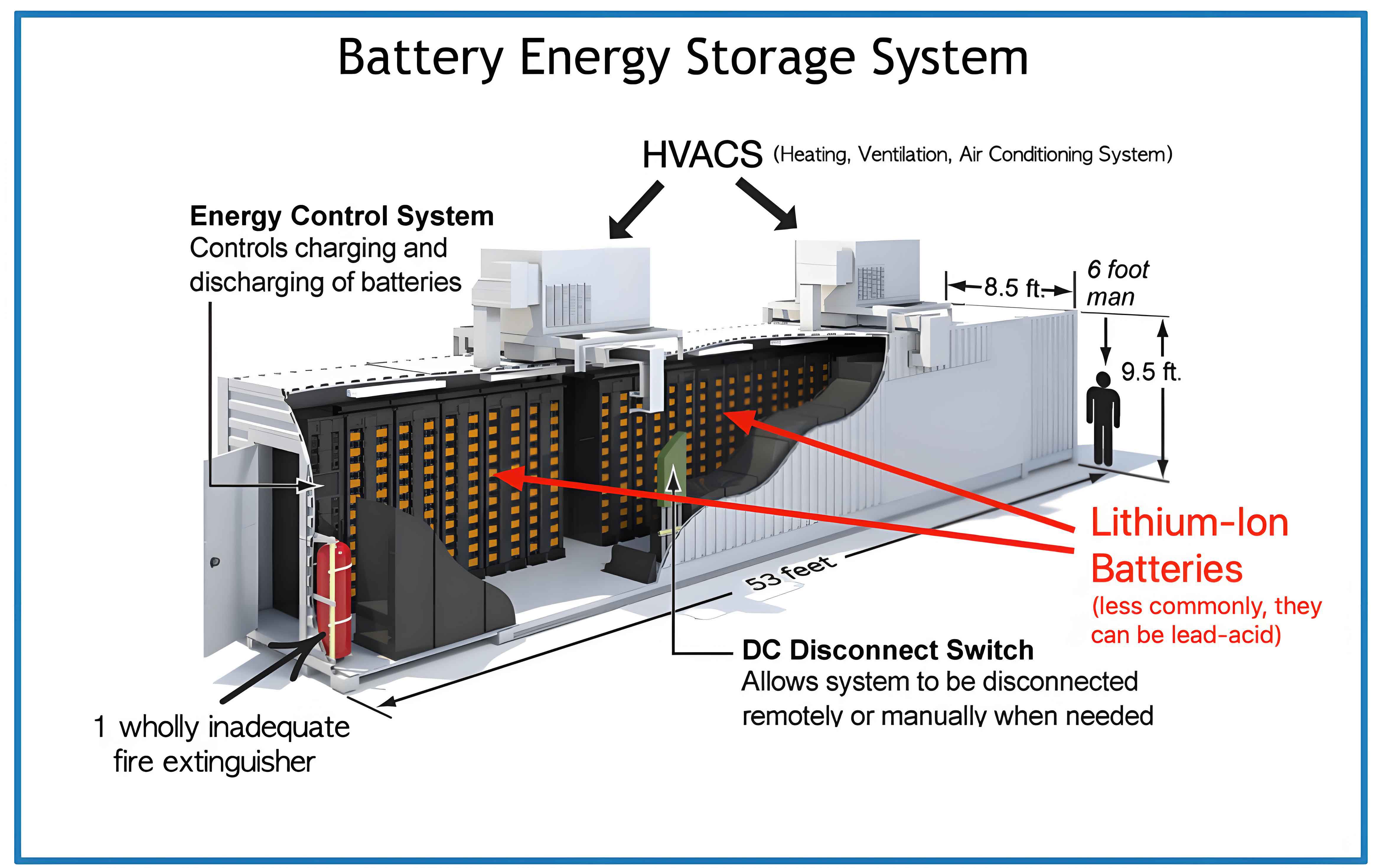
1. Multistage Thermal Runaway Evolution
TR progression in energy storage systems follows three distinct phases with overlapping electrochemical reactions:
| Phase | Key Processes | Characteristic Parameters |
|---|---|---|
| Early Stage | SEI decomposition, electrolyte vaporization | T1 = 80–120°C, dT/dt = 0.1–1°C/min |
| Runaway Onset | Cathode decomposition, internal short circuit | T2 = 180–250°C, dT/dt > 10°C/s |
| Fire Propagation | Jet fires, gas explosions | Qmax = 20–50 kW/cell, LFL = 4–19% vol |
The heat generation rate during TR can be modeled as:
$$
q_{\text{gen}} = \sum_{i=1}^n A_i \exp\left(-\frac{E_{a,i}}{RT}\right) + I^2R_{\text{short}}
$$
where \( A_i \) and \( E_{a,i} \) represent Arrhenius parameters for individual reactions, and \( R_{\text{short}} \) denotes internal short-circuit resistance.
2. Advanced Monitoring Paradigms
Multiparameter fusion algorithms significantly improve TR detection reliability in energy storage systems:
| Sensor Type | Detection Capability | Response Time |
|---|---|---|
| Distributed Fiber Optics | ΔT = ±0.5°C, spatial resolution 5 mm | 30–120 s |
| H2 Gas Sensors | Detection threshold: 50 ppm | Lead time: 600–800 s |
| Impedance Spectroscopy | Detects 5% capacity fade | Continuous monitoring |
A novel entropy-based early warning index demonstrates superior performance:
$$
S_{\text{TR}} = \frac{\partial (\Delta V/\Delta T)}{\partial t} \times \frac{d[CO]}{dt}
$$
Field tests show 92% detection accuracy with <5% false alarms in grid-scale energy storage systems.
3. Suppression and Fire Mitigation
Comparative analysis of TR suppression methods for energy storage systems:
| Method | Cooling Rate | Reignition Prevention |
|---|---|---|
| Water Mist | 150°C/s (SOC < 50%) | Requires >30 min cooling |
| LN2 Spray | 800°C/s (instantaneous) | 100% success at T < 200°C |
| Phase Change Materials | 3–5°C/min reduction | Passive containment |
The critical extinguishing concentration for LiFePO4 systems follows:
$$
C_{\text{ext}} = 0.78 \times \left(\frac{SOC}{100}\right)^{1.2} \times \exp\left(\frac{T_{\text{jet}}}{450}\right)
$$
where \( T_{\text{jet}} \) represents vent gas temperature (K).
4. Explosion Hazard Management
Gas dynamics in energy storage system enclosures require careful analysis:
$$
\frac{\partial \rho Y_i}{\partial t} + \nabla \cdot (\rho \mathbf{v} Y_i) = \dot{\omega}_i + \nabla \cdot (\rho D_i \nabla Y_i)
$$
where \( Y_i \) represents gas species mass fraction and \( D_i \) diffusion coefficients. Experimental data reveals optimal ventilation rates:
| System Capacity | Minimum ACH | Flammability Reduction |
|---|---|---|
| 1 MWh | 15 | 82% lower LFL risk |
| 10 MWh | 23 | 91% lower LFL risk |
Hybrid suppression using fine water mist and nitrogen inertization achieves 99% explosion probability reduction in full-scale energy storage system tests.
5. Future Directions
Emerging solutions for next-generation energy storage systems include:
- Self-extinguishing electrolytes with F/HPO43– additives
- Solid-state battery architectures with TR initiation threshold >300°C
- AI-driven digital twins for real-time TR probability prediction
The safety coefficient for future energy storage systems can be optimized through:
$$
\eta_{\text{safe}} = \frac{t_{\text{detection}} + t_{\text{response}}}{t_{\text{TR}}}
$$
where \( t_{\text{TR}} \) represents total TR evolution time. Industry benchmarks currently achieve \( \eta_{\text{safe}} \) values of 0.6–0.8, with 1.2 being the target for UL9540A compliance.