
My analysis focuses on the critical safety challenge of thermal runaway in li ion battery systems, specifically triggered by convective heat transfer scenarios common in real-world abuse conditions. This phenomenon represents a severe failure mode where internal heat generation surpasses dissipation, leading to uncontrollable temperature rise, cell destruction, and potentially catastrophic fires or explosions. Understanding the coupled thermal-electrical-chemical behavior during this process is paramount for developing effective safety strategies. In this comprehensive review, I delve into the underlying mechanisms, present multiphysics modeling insights, and correlate these with experimental observations of gas generation behavior to build a holistic understanding of thermal runaway in li ion battery.
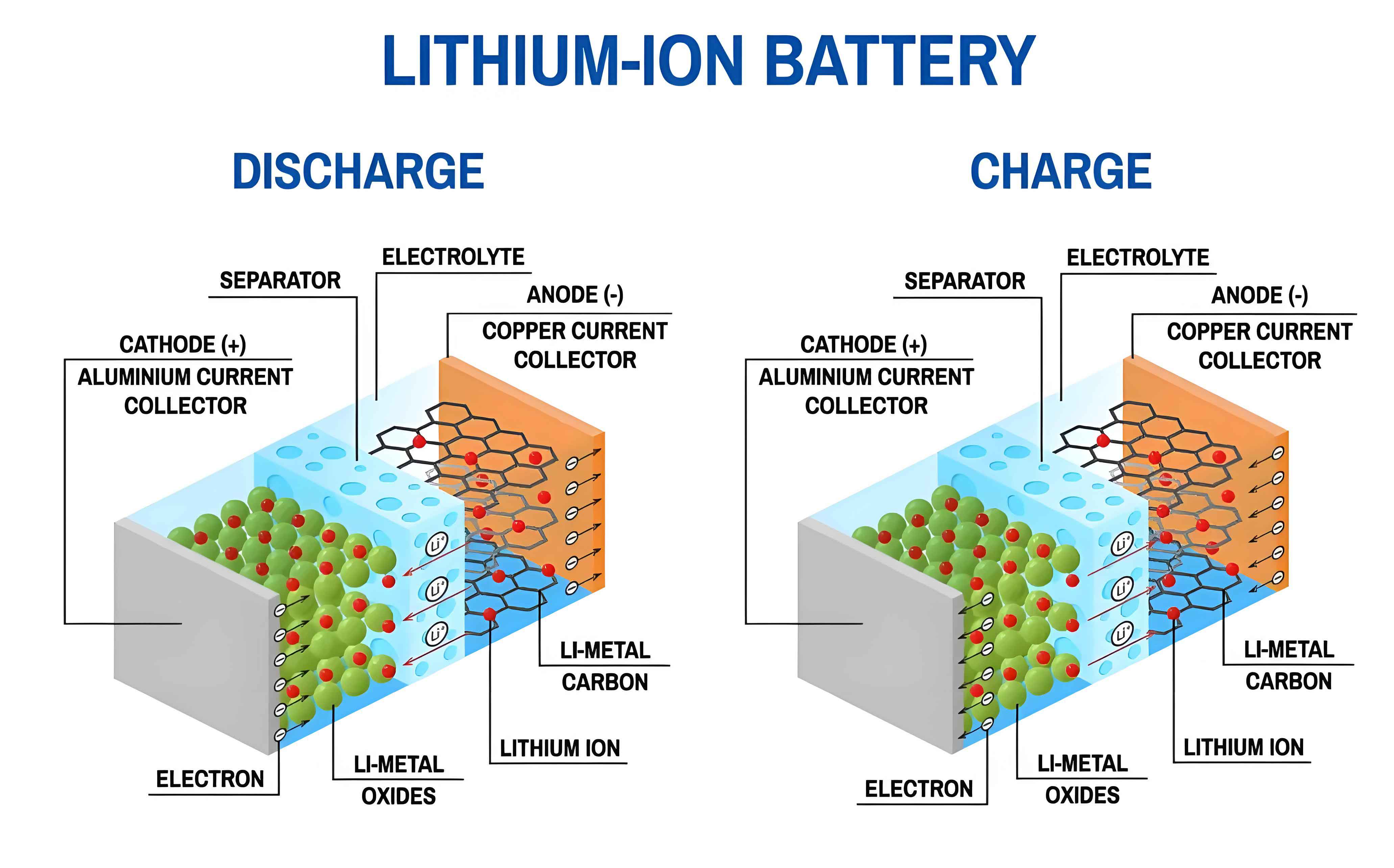
The thermal stability of a li ion battery is governed by a delicate balance between heat generation and dissipation. Under normal operating conditions, the total heat generation rate within a li ion battery can be described by the sum of reversible reaction heat, irreversible Joule heating, and polarization heat:
$$Q_{total} = Q_{rea} + Q_{\Omega} + Q_j$$
Where \(Q_{rea}\) is the entropic heat from the lithium intercalation/de-intercalation reactions, \(Q_{\Omega}\) is the ohmic heat from current passing through the cell’s internal resistance, and \(Q_j\) represents the polarization heat due to charge transfer and concentration overpotentials. For a li ion battery under discharge, the reaction heat can be calculated as:
$$Q_{rea} = \frac{n \cdot m \cdot \Delta H \cdot I}{M \cdot F}$$
Here, \(n\) is the number of electron transfers, \(m\) is the mass of active material, \(\Delta H\) is the total reaction enthalpy, \(I\) is the current, \(M\) is the molar mass, and \(F\) is Faraday’s constant. The polarization heat is often simplified as \(Q_j = I^2 R_j\), where \(R_j\) is the cell’s polarization resistance. During thermal abuse, these normal heat sources become negligible compared to the exothermic heat released from a cascade of decomposition reactions.
The onset of thermal runaway in a li ion battery is typically initiated when the cell temperature exceeds a critical threshold, triggering a series of irreversible exothermic side reactions. My modeling approach considers four primary sequential reactions that dominate the heat release and gas generation. The total heat generation rate from these abusive reactions is:
$$S_{tot} = S_{sei} + S_{ne} + S_{pos} + S_{ele}$$
Where \(S_{sei}\), \(S_{ne}\), \(S_{pos}\), and \(S_{ele}\) are the heat generation rates from Solid Electrolyte Interphase (SEI) layer decomposition, reaction between the lithiated anode and electrolyte, reaction between the cathode and electrolyte, and electrolyte decomposition, respectively. Each reaction follows Arrhenius-type kinetics and consumes its respective component. For instance, the rate of SEI decomposition, the first and most thermodynamically vulnerable reaction in a li ion battery, is given by:
$$R_{sei}(T, C_{sei}) = A_{sei} \exp\left(-\frac{E_{a,sei}}{RT}\right) C_{sei}^{m_{sei}}$$
$$S_{sei} = \Delta H_{sei} \cdot W_{c} \cdot R_{sei}$$
The subsequent reaction between the lithiated carbon anode and the electrolyte begins once the protective SEI layer is consumed. Its rate depends on the remaining SEI layer thickness and the concentration of intercalated lithium:
$$R_{ne}(T, C_{ne}, \tau_{sei}) = A_{ne} \exp\left(-\frac{E_{a,ne}}{RT}\right) C_{ne}^{m_{ne}} \exp\left(-\frac{\tau_{sei}}{\tau_{sei,ref}}\right)$$
The cathode-electrolyte reaction, often involving oxygen release from the transition metal oxide, and the final bulk electrolyte decomposition then follow, driving the temperature to its peak. The propagation of heat within the li ion battery is governed by the heat conduction equation:
$$\rho C_p \frac{\partial T}{\partial t} = \nabla \cdot (k \nabla T) + S_{tot}$$
Where \(\rho\) is density, \(C_p\) is specific heat capacity, \(k\) is thermal conductivity, and \(S_{tot}\) is the total volumetric heat source from both normal operation and abusive reactions.
Gas Generation Mechanisms During Thermal Runaway
Concurrent with the rapid heat release, a li ion battery undergoing thermal runaway produces a significant volume of gas. This gas generation is intrinsically linked to the chemical decomposition pathways. The SEI layer, primarily composed of lithium alkyl carbonates (\((CH_2OCO_2Li)_2\)), decomposes at relatively low temperatures (~90-120°C) to produce ethylene (\(C_2H_4\)), along with lithium carbonate (\(Li_2CO_3\)) and carbon dioxide (\(CO_2\)):
$$2(CH_2OCO_2Li)_2 \rightarrow 2Li_2CO_3 + 2C_2H_4 \uparrow + O_2 \uparrow + 2CO_2 \uparrow$$
Following SEI breakdown, the exposed lithiated graphite anode reacts exothermically with the organic carbonate electrolyte (e.g., Ethylene Carbonate, EC), producing more hydrocarbon gases:
$$2Li + C_3H_4O_3 \rightarrow Li_2CO_3 + C_2H_4 \uparrow$$
The decomposition of the lithium salt, typically LiPF6, in the presence of trace moisture is a primary source of highly toxic hydrogen fluoride (HF):
$$LiPF_6 \rightleftharpoons LiF + PF_5 \uparrow$$
$$PF_5 + H_2O \rightarrow POF_3 + 2HF \uparrow$$
Furthermore, the thermal decomposition of the cathode material (e.g., LiFePO4, NMC) can release oxygen, which further oxidizes the organic solvents, producing large volumes of \(CO_2\) and \(H_2O\). The reduction of carbonate solvents and binder materials (like PVDF) also contributes to the gas mixture, yielding gases such as hydrogen (\(H_2\)), methane (\(CH_4\)), and carbon monoxide (\(CO\)). The composition and timing of these gas releases provide critical signatures for early fault detection in a li ion battery system.
Modeling Insights: Temperature Response and Component Evolution
To quantify the thermal abuse process, I developed a finite element model for a standard 18650 cylindrical li ion battery cell. The model couples electrochemical reactions with heat transfer, simulating the cell’s response to external convective heating. The simulated temperature rise of the cell under different external heat source temperatures clearly demonstrates a critical threshold behavior.
| External Heat Source Temperature (K) | Approx. Onset Time of Rapid TR (s) | Peak Cell Temperature (K) | Key Observation |
|---|---|---|---|
| 350.15 | N/A (No TR) | ~350 | Temperature stabilizes at heat source level; no side reactions triggered. |
| 450.15 | N/A (No full TR) | ~450 | SEI and anode reactions initiate, but cathode decomposition is incomplete, preventing a full thermal runaway. |
| 500.15 | 520 | >800 | Full cascade of reactions completes, leading to violent thermal runaway. |
| 550.15 | 280 | >800 | Thermal runaway onset is 240s earlier than at 500.15K. |
| 600.15 | 220 | >800 | Thermal runaway onset is 300s earlier than at 500.15K, with a 47% faster heating rate. |
The simulation reveals that a higher external temperature not only advances the thermal runaway initiation but also intensifies the heating rate, drastically reducing the available time for safety interventions. The spatial temperature distribution shows that heating initiates at the cell’s outer surface and propagates inwards. As internal reactions become dominant, the hottest spot shifts to the core of the li ion battery.
The evolution of key component concentrations during thermal runaway, modeled for the 500.15 K scenario, provides a clear timeline of the internal chemical cascade:
| Cell Component | Reaction Start Time (s) / Temp. | Reaction Completion Time (s) | Dominant Gases Generated |
|---|---|---|---|
| SEI Layer | 147 s (~117 °C) | 300 s | C2H4, CO2 |
| Anode + Electrolyte | 190 s (~135 °C) | 400 s | C2H4, C2H6, C3H6 |
| Cathode + Electrolyte | 265 s (~174 °C) | 520 s | O2, CO2, H2O |
| Electrolyte & Binder (Bulk) | 485 s (~240 °C) | 520 s | HF, CO, CO2, CH4, H2 |
This sequential consumption model highlights the temperature-dependent nature of each reaction. The violent co-decomposition of the electrolyte and binder at the final stage coincides with the most rapid temperature spike, exceeding 50 K/s, marking the point of no return for the li ion battery.
Experimental Validation and Gas Behavior Analysis
To validate the modeling insights, I designed a thermal abuse experiment on a commercial lithium iron phosphate (li ion battery) module. The module was heated conformally on one surface at a controlled ramp rate. Temperature was monitored at multiple locations, including the cell surface, positive tab, and cell bottom, while voltage and gas emissions were recorded in real-time.
The experimental temperature profiles confirmed the simulation’s predictions. The positive tab, representing an edge connection point, exhibited the fastest temperature rise rate, while the cell bottom was the coolest region. A critical correlation was observed between electrical and thermal behavior: the cell voltage remained stable at its nominal 3.65 V until the onset of the final violent reactions, at which point it collapsed to 0 V almost instantaneously. This voltage drop was perfectly synchronized with the sudden temperature spike at the positive tab, serving as a clear electrical indicator of thermal runaway penetration in the li ion battery.
The most significant findings from the experiment relate to the temporal profile of gas generation, which offers a potential pathway for early warning systems. The online gas analysis revealed distinct release patterns for different species.
| Gas Species | First Significant Detection (Relative to TR) | Peak Concentration Period | Implied Reaction Stage & Warning Utility |
|---|---|---|---|
| Hydrogen (H2) | ~29 minutes before violent TR | Early to mid-stage heating | Likely from early solvent/binder reduction. High early warning value. |
| Methane (CH4), Carbon Monoxide (CO), Carbon Dioxide (CO2) | ~1 minute before violent TR | During the main temperature ramp-up | From anode/electrolyte and cathode/electrolyte reactions. Indicators of imminent runaway. |
| Hydrogen Fluoride (HF) | During/after violent TR | Post-runaway and combustion phase | From LiPF6 decomposition. A major safety hazard but poor early warning signal. |
| Ethylene (C2H4) & other Hydrocarbons | Early during heating | SEI decomposition and anode reaction stages | Consistent with modeled SEI and anode reaction pathways. |
The early detection of \(H_2\) is particularly noteworthy. Its evolution significantly prior to other major gases and the thermal runaway event itself suggests it originates from reductive processes at lower temperatures, possibly involving the breakdown of the PVDF binder or direct solvent reduction. Monitoring \(H_2\) concentration could, therefore, provide a crucial early warning signal for an impending thermal runaway in a li ion battery pack, potentially enabling preventative measures before temperatures reach the point of irreversible cascade.
Conclusions and Safety Implications
Through my integrated investigation combining multiphysics modeling and experimental analysis, I have delineated the complex, coupled behavior of a li ion battery undergoing thermally-induced runaway. The external thermal boundary condition is a decisive factor; exceeding a critical temperature threshold (between 450 K and 500 K in my study) transitions the system from a state of controlled heating to an autocatalytic thermal disaster, drastically compressing the reaction timeline. Internally, the failure is governed by a strict sequence of exothermic decompositions—SEI layer, anode, cathode, and electrolyte—each with distinct activation energies and gas generation fingerprints.
The spatial temperature evolution progresses from the surface to the core, with electrical failure (voltage collapse) providing a sharp, synchronized indicator of the final catastrophic stage. Most critically, the analysis of gas generation behavior unveils a tiered warning system. Hydrogen emerges as a premier early warning agent, detectable tens of minutes before violent failure. Hydrocarbon gases and carbon oxides follow as late-stage precursors, immediately preceding the temperature explosion. In contrast, toxic HF is a post-runaway product, highlighting its role as a consequence rather than a precursor.
These findings have direct implications for the safety design of li ion battery systems. Effective management strategies must account for the critical temperature threshold. Furthermore, integrating multispecies gas sensors, particularly those sensitive to \(H_2\), into battery management systems (BMS) could enable proactive safety interventions well before thermal runaway becomes unstoppable, significantly enhancing the inherent safety of energy storage and electric vehicle applications reliant on li ion battery technology. My work underscores that a fundamental understanding of the thermal, electrical, and chemical interplay is essential for advancing the safety frontier of these indispensable energy storage devices.