
This study investigates the thermal runaway (TR) characteristics of 120 Ah LiFePO4 batteries under inert (nitrogen) and air atmospheres. Experiments were conducted in a sealed pressure chamber (82 L) with side heating (952 W) to simulate thermal abuse scenarios. Key parameters including surface temperatures, ambient temperatures, gas composition, and pressure dynamics were analyzed to evaluate TR progression and atmospheric influences.
1. Experimental Setup and Methodology
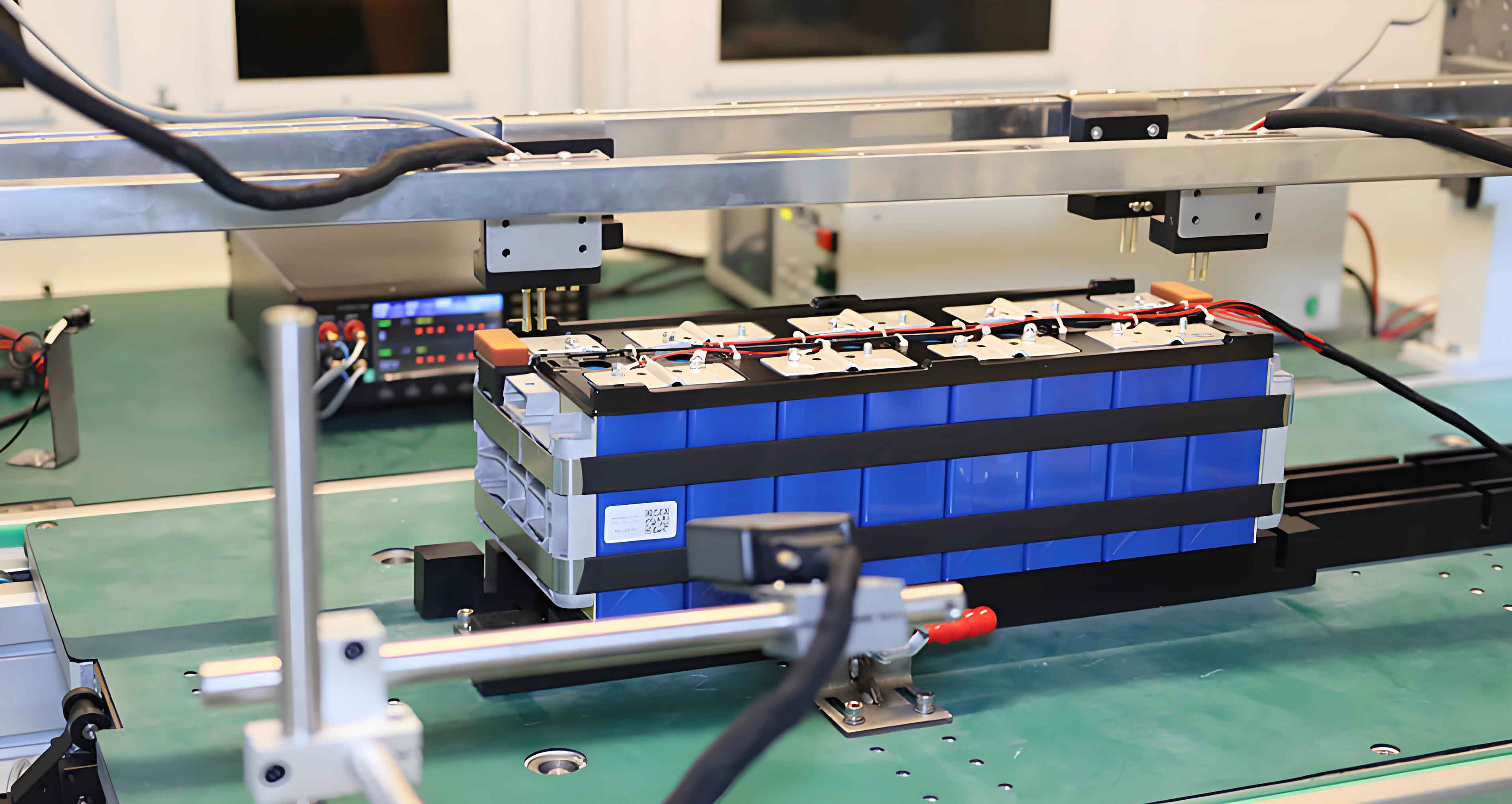
The LiFePO4 battery specifications are summarized below:
| Parameter | Value |
|---|---|
| Cathode Material | LiFePO4 |
| Anode Material | Graphite |
| Capacity | 120 Ah |
| Mass | 2,860 g |
Thermal runaway was induced via lateral heating, with temperature sensors (T1–T11) monitoring surface and ambient zones. Gas composition analysis utilized GC chromatography, while pressure dynamics were calculated using the ideal gas law:
$$
pV = nRT
$$
where \( p \) is pressure, \( V \) is chamber volume, \( n \) is gas moles, \( R \) is the gas constant, and \( T \) is temperature.
2. Thermal Runaway Progression
The TR process exhibited four distinct phases:
- Heating Phase (0–904 s): Linear temperature rise (0.2–0.5°C/s).
- Vent Opening (904–1,290 s): Valve activation at 117.5°C, initial gas release (4.4 L/s).
- Thermal Runaway (1,290–1,750 s): Peak surface temperature (218°C) and maximum gas emission (19.7 L/s).
- Cooling Phase (>1,750 s): Gradual temperature decline.
Ambient temperatures decreased vertically by 46°C/m (10–20 cm) and 32°C/m (20–30 cm) above the battery, while horizontal measurements showed asymmetric heating (131.7°C at left vs. 96.3°C at right).
3. Gas Emission Analysis
Gas composition under inert atmosphere revealed combustible dominance:
| Component | Volume Fraction (%) |
|---|---|
| H₂ | 52.8 |
| CO₂ | 26.5 |
| CO | 7.4 |
| CH₄ | 6.2 |
| C₂H₄ | 5.0 |
Total gas production reached 35.5 L with a flammability limit (\( L_{mix} \)) of 6.3–67.9%, calculated using Le Chatelier’s principle:
$$
L_{mix} = \frac{1}{\sum_{i=1}^{n} \frac{x_i}{L_i}} \times 100\%
$$
where \( x_i \) is component fraction and \( L_i \) is individual flammability limit.
4. Atmospheric Effects
Air atmosphere significantly amplified TR severity:
| Parameter | Nitrogen | Air | Difference (%) |
|---|---|---|---|
| Peak Temperature (°C) | 218 | 256 | +17.6 |
| TR Duration (s) | 460 | 524 | +14 |
| Gas Volume (L) | 35.5 | 38.4 | +8.2 |
Enhanced reactivity in air increased CH₄ (7.1%) and C₂H₄ (5.8%) fractions while reducing H₂ (49.2%). The modified flammability limit (5.9–62.7%) remained hazardous.
5. Conclusion
High-capacity LiFePO4 batteries demonstrate atmospheric-dependent TR behavior. Air environments exacerbate temperature rise (Δ+38°C), prolong thermal runaway duration, and amplify gas production. These findings emphasize the necessity for atmosphere-specific safety protocols in energy storage systems utilizing LiFePO4 batteries.