
The escalating deployment of lithium-ion batteries (LIBs) in large-scale applications, particularly for energy storage, imposes increasingly stringent demands on their safety performance. The thermal characteristics of the battery electrolyte constitute one of the most critical factors in ensuring this safety. Currently, semisolid electrolytes, representing a transitional technology between conventional liquid electrolytes and all-solid-state counterparts, have achieved favorable technical and economic viability through sustained research and development. Among various semisolid electrolyte configurations, the solid-liquid mixed electrolyte (SLe), composed of a solid electrolyte matrix and a minimal quantity of liquid electrolyte, is the most widely applied. Therefore, to effectively enhance the safety of LIBs, a thorough assessment of the thermal characteristics of SLe is paramount. This investigation focuses on two prevalent SLe systems, formulated by combining a conventional ternary high-voltage liquid electrolyte with lithium titanium aluminum phosphate (Li1.3Al0.3Ti1.7(PO4)3, LATP) and tantalum-doped lithium lanthanum zirconium oxide (Li6.25Al0.25La3Zr2O12, LLZTO) solid electrolytes, respectively. Employing characterization techniques including scanning electron microscopy (SEM), X-ray diffraction (XRD), differential scanning calorimetry (DSC) coupled with thermogravimetric analysis (TG), and thermogravimetric-mass spectrometry (TG-MS), this study systematically explores the thermal behavior and stability of these SLe systems.
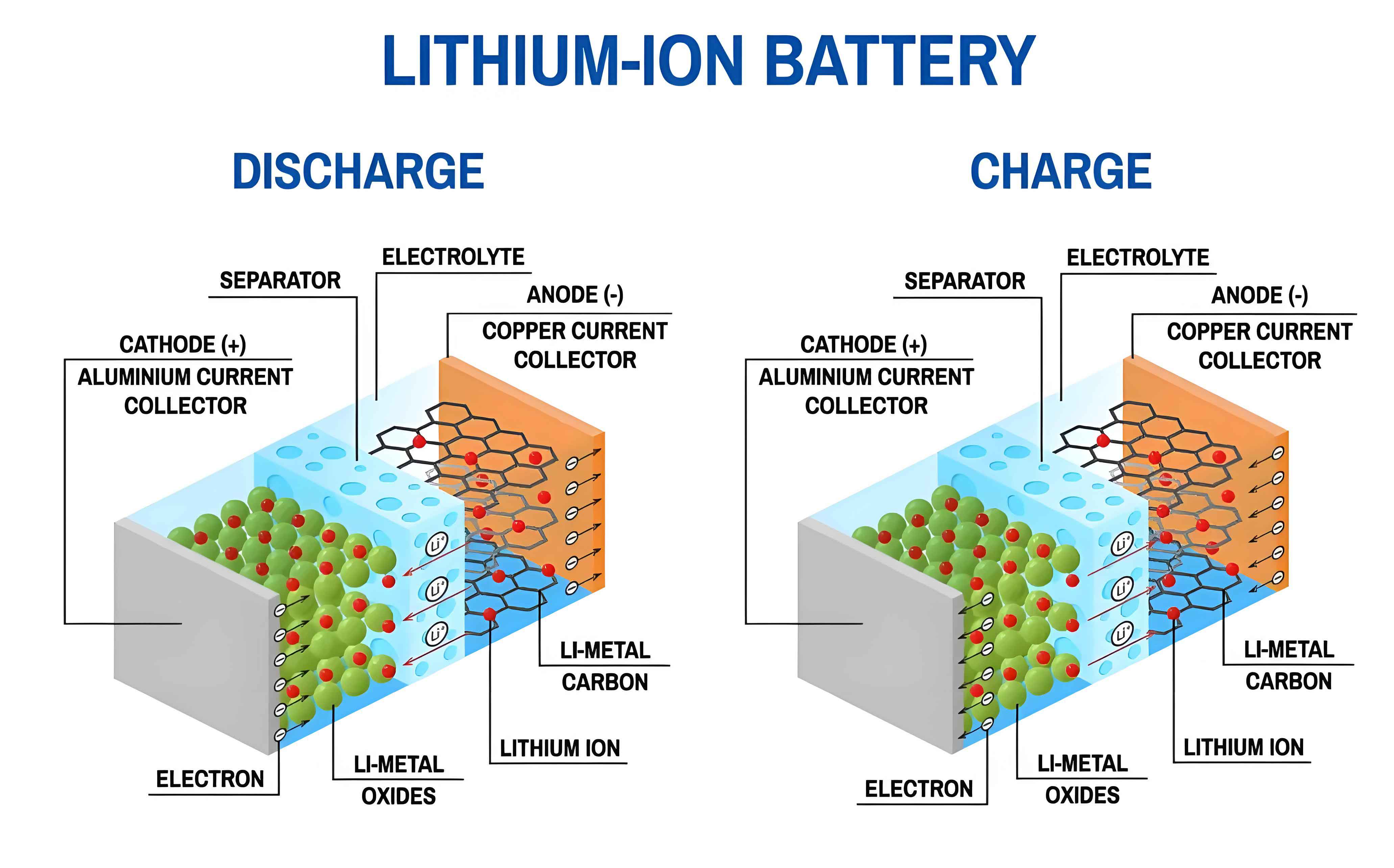
The liquid dexamethasone electrolyte (LDE) used consists of a lithium salt blend (LiPF6 and LiTFSI) in a solvent mixture of EC, EMC, DMC, and DTD. The SLe samples, denoted as LATP-1 and LLZTO-1, were prepared by mixing LATP and LLZTO powders with the LDE at a mass ratio of 1:6, followed by aging, centrifugation, and vacuum drying. To examine the effects of elevated temperature, portions of these solid precipitates were heated at 250°C and 350°C under vacuum to obtain samples LATP-2 and LLZTO-2.
Thermal Characteristics of the Liquid Electrolyte (LDE)
The thermal decomposition behavior of the LDE serves as a baseline for comparison. DSC-TG analysis at various heating rates reveals a two-stage decomposition process. The first endothermic stage, occurring between approximately 97°C and 129°C, is associated with the initial decomposition of LiPF6 and volatilization of solvent components. The second endothermic stage, between 232°C and 261°C, corresponds to the vigorous decomposition of solvent molecules, likely catalyzed by PF5 generated from LiPF6 decomposition. A fundamental reaction is the hydrolysis of LiPF6:
$$ \text{LiPF}_6 + \text{H}_2\text{O} \rightarrow \text{POF}_3 + 2\text{HF} + \text{LiF} $$
Subsequent reactions of POF3 and PF5 with solvents drive further decomposition. The characteristic temperatures shift to higher values with increasing heating rate due to thermal lag. TG-MS analysis confirms the evolution of gaseous products including CO, C2H4, CH4, CO2, C2H6, C3H6, and others, highlighting the high gas generation potential of conventional electrolytes during thermal abuse, a key concern for lithium-ion battery safety.
| Heating Rate (°C/min) | Peak 1 Temp. (°C) | Q1 (J/g) | Peak 2 Temp. (°C) | Q2 (J/g) |
|---|---|---|---|---|
| 5 | 99.6 | -277.7 | 232.8 | -58.4 |
| 10 | 108.7 | -281.9 | 239.7 | -67.8 |
| 15 | 116.7 | -166.0 | 249.7 | -77.0 |
| 20 | 127.9 | -140.2 | 261.4 | -56.8 |
Thermal Characteristics of the LATP-based SLe System
SEM analysis reveals that pristine LATP particles are irregular and loosely packed. After interaction with LDE (LATP-1), particles agglomerate, and surface coatings or reaction products are observed, indicating interfacial reactions. EDS confirms the presence of F, C, N, and S from the electrolyte residues and reaction products. XRD shows that while the primary phase remains LATP, peak broadening and minor shifts in LATP-1 suggest the formation of secondary phases or structural distortion due to chemical interaction, primarily with HF:
$$ \text{Li}_{1.3}\text{Al}_{0.3}\text{Ti}_{1.7}(\text{PO}_4)_3 + 9\text{HF} \rightarrow 1.3\text{LiF} + 0.3\text{AlF}_3 + 1.7\text{TiF}_4 + 3\text{H}_3\text{PO}_4 $$
High-temperature treatment (LATP-2) leads to particle sintering and densification, but the core LATP structure is preserved.
The thermal stability of LATP itself is excellent, showing no significant thermal events up to 450°C. In contrast, LATP-1 exhibits a distinct endothermic event between 175°C and 250°C in DSC, accompanied by a mass loss of ~25.4%. This endotherm occurs partly within the temperature range of the LDE’s second decomposition stage but with significantly lower absorbed heat (Q ≈ -39 to -70 J/g). This suggests that the heat absorption is not solely from residual LDE decomposition but also involves the decomposition of the solid reaction products formed at the LATP/LDE interface. The solid components in this SLe system thus provide a heat sink mechanism. TG-MS analysis of LATP-1 confirms gas evolution (H2O, CO, CO2, light hydrocarbons) but with ion current intensities orders of magnitude lower than those from pure LDE, indicating drastically reduced gas generation. This suppressed gas production is a critical safety advantage for a lithium-ion battery employing such an SLe.
| Heating Rate (°C/min) | Peak Temp. (°C) | Q (J/g) | Onset Temp. (°C) | Endset Temp. (°C) |
|---|---|---|---|---|
| 5 | 182.9 | -39.2 | 158.7 | 347.3 |
| 10 | 202.0 | -42.0 | 162.9 | 368.1 |
| 15 | 213.4 | -69.5 | 171.8 | 388.6 |
| 20 | 222.2 | -54.4 | 176.6 | 394.1 |
Thermal Characteristics of the LLZTO-based SLe System
Pristine LLZTO exhibits a polycrystalline cubic structure. After interaction with LDE (LLZTO-1), significant surface roughening, particle agglomeration, and the possible formation of Li2CO3 and fluorides are observed. EDS shows a high fluorine content, corroborating extensive fluorination reactions with HF, such as:
$$ \text{La}_2\text{O}_3 + 6\text{HF} \rightarrow 2\text{LaF}_3 + 3\text{H}_2\text{O} $$
XRD confirms the retention of the primary garnet LLZTO structure in both LLZTO-1 and LLZTO-2, albeit with peak shifts indicative of minor lattice parameter changes due to interfacial products.
Like LATP, pure LLZTO shows high thermal inertia with no reactive events up to 450°C. The DSC-TG profile of LLZTO-1 is markedly different from that of LATP-1. It features two consecutive events: an endothermic peak between 165°C and 225°C, followed by a sharp exothermic peak between 275°C and 350°C. The first endothermic stage, with heat absorption (Q1 ≈ -42 to -75 J/g), is attributed to the decomposition of interfacial reaction products and possibly residual solvent. Crucially, the second, strongly exothermic stage (Q2 ≈ +52 to +105 J/g) suggests a vigorous chemical reaction, likely the oxidation or further decomposition of carbonaceous residues or specific metastable fluorides formed during the initial LLZTO-LDE interaction. TG-MS analysis again shows gas evolution (dominantly H2O, CO, CO2) but at intensities far below those of pure LDE, confirming the gas-suppression capability of the SLe architecture. The presence of a subsequent exotherm, however, indicates a more complex thermal behavior that requires careful management in a lithium-ion battery design.
| Heating Rate (°C/min) | Endo. Peak Temp. (°C) | Q1 (J/g) | Exo. Peak Temp. (°C) | Q2 (J/g) |
|---|---|---|---|---|
| 5 | 172.8 | -54.9 | 292.3 | +52.1 |
| 10 | 184.4 | -74.6 | 299.7 | +59.8 |
| 15 | 190.1 | -56.1 | 310.9 | +65.4 |
| 20 | 203.8 | -42.1 | 311.3 | +105.4 |
Conclusion
This comparative study on the thermal characteristics of LDE/LATP and LDE/LLZTO solid-liquid mixed electrolytes reveals significant insights for enhancing lithium-ion battery safety. Both SLe systems demonstrate substantially improved thermal stability compared to the conventional liquid electrolyte, primarily through drastically reduced gas generation. The solid components interact with the liquid electrolyte, forming interfacial products that alter the thermal decomposition pathway.
The LATP-based SLe system exhibits a primarily endothermic behavior in the critical temperature range, providing a heat-absorbing buffer that can delay the onset and mitigate the severity of thermal runaway in a lithium-ion battery. In contrast, the LLZTO-based SLe system presents a more complex biphasic thermal response: an initial endothermic stage followed by a pronounced exothermic stage at higher temperatures. This implies that while the LLZTO system also suppresses gas emission effectively, its high-temperature exothermic reaction requires careful consideration in cell design and thermal management systems. The choice between these SLe systems for a specific lithium-ion battery application may depend on the expected worst-case temperature scenario and the trade-off between early-stage heat absorption and potential high-temperature exothermic activity.
These findings provide a fundamental thermal database and theoretical guidance for optimizing the safety of semisolid lithium-ion batteries employing solid-liquid mixed electrolytes. The research underscores the potential of SLe technology to bridge the gap between high energy density and intrinsic safety, which is vital for the reliable deployment of lithium-ion batteries in large-scale energy storage systems.