
As a researcher deeply immersed in the renewable energy sector, I have witnessed the immense potential of solar power to transform our global energy landscape. The sun offers an abundant, clean, and inexhaustible source of energy, yet the widespread adoption of solar photovoltaic (PV) technology has been hindered by high costs. Currently, solar electricity generation costs are significantly higher than those of fossil fuels, but through relentless technological innovation, we are on the cusp of making solar energy not only viable but dominant. In this article, I will explore how advancements across the entire solar system value chain—from materials to installation—can drive down costs, enhance efficiency, and pave the way for a sustainable future.
The current cost disparity between solar and conventional energy sources is stark. To illustrate, let’s compare the levelized cost of electricity (LCOE) for various technologies:
| Energy Source | Cost Range (USD per kWh) |
|---|---|
| Coal | 0.03 – 0.05 |
| Nuclear | ~0.08 |
| Wind | ~0.10 |
| Solar Photovoltaic | >0.32 |
This table highlights the competitive challenge: for solar to gain market share, its cost must drop to match or undercut fossil fuels. The key lies in innovation at every stage of the solar system, from raw material production to end-user deployment. I believe that by focusing on technological breakthroughs, we can achieve this goal within the next decade.
Technological innovation is the cornerstone of cost reduction in solar PV. The entire solar system process—encompassing materials, equipment, cells (including crystalline silicon and thin-film variants), modules (such as standard and building-integrated photovoltaics), and utility-scale plants—remains far from mature. Each step offers opportunities for improvement. For instance, in cell manufacturing, enhancing photoconversion efficiency directly lowers the cost per watt. The overall cost of a solar system can be modeled as:
$$ C_{\text{total}} = C_{\text{materials}} + C_{\text{manufacturing}} + C_{\text{installation}} + C_{\text{O\&M}} $$
where \( C_{\text{materials}} \) often dominates, especially for silicon-based systems. By innovating in material synthesis and device architecture, we can reduce these components significantly.
A critical area is the cost of polysilicon, which constitutes about 70% of total solar system expenses for conventional PV. Reducing this is paramount. If polysilicon costs drop from 70% to 20% of the total, the LCOE for solar could fall to approximately $0.16 per kWh, as derived from:
$$ \text{LCOE}_{\text{new}} = \text{LCOE}_{\text{base}} \times \frac{C_{\text{polysilicon, new}}}{C_{\text{polysilicon, base}}} $$
Assuming a base LCOE of $0.32 per kWh, this yields:
$$ \text{LCOE}_{\text{new}} = 0.32 \times \frac{0.20}{0.70} \approx 0.091 \text{ USD/kWh} $$
Further refinements in manufacturing could push it lower. The table below outlines potential cost reductions through polysilicon innovation:
| Component | Current Cost Share (%) | Target Cost Share (%) | Impact on LCOE (USD/kWh) |
|---|---|---|---|
| Polysilicon | 70 | 20 | ~0.09 |
| Other Materials | 15 | 10 | |
| Manufacturing | 10 | 5 | |
| Installation & O&M | 5 | 5 |
Such reductions require advances in silicon purification, recycling, and alternative substrates. As we develop more efficient solar system designs, the cost trajectory will continue downward.
Improving cell efficiency is equally vital. Current commercial silicon solar cells have conversion efficiencies around 18-20%, but the theoretical limit for silicon is 31%. Much of the solar energy is lost as heat through “hot electrons.” Research shows that using semiconductor nanocrystals to capture these hot electrons can boost efficiency up to 66% or more. The efficiency \( \eta \) of a solar cell is given by:
$$ \eta = \frac{P_{\text{out}}}{P_{\text{in}}} \times 100\% $$
where \( P_{\text{out}} \) is the electrical power output and \( P_{\text{in}} \) is the solar irradiance. By integrating novel materials like perovskites or quantum dots, we can approach the Shockley-Queisser limit more closely. For a solar system with enhanced efficiency, the cost per kWh decreases proportionally, as shown by:
$$ \text{Cost}_{\text{kWh}} \propto \frac{1}{\eta} $$
Thus, doubling efficiency could halve costs. Additionally, to mitigate intermittency from clouds and night, space-based solar system concepts—where PV arrays in orbit transmit power via microwave or laser—hold promise. While still emerging, such technologies could revolutionize continuous solar energy supply.
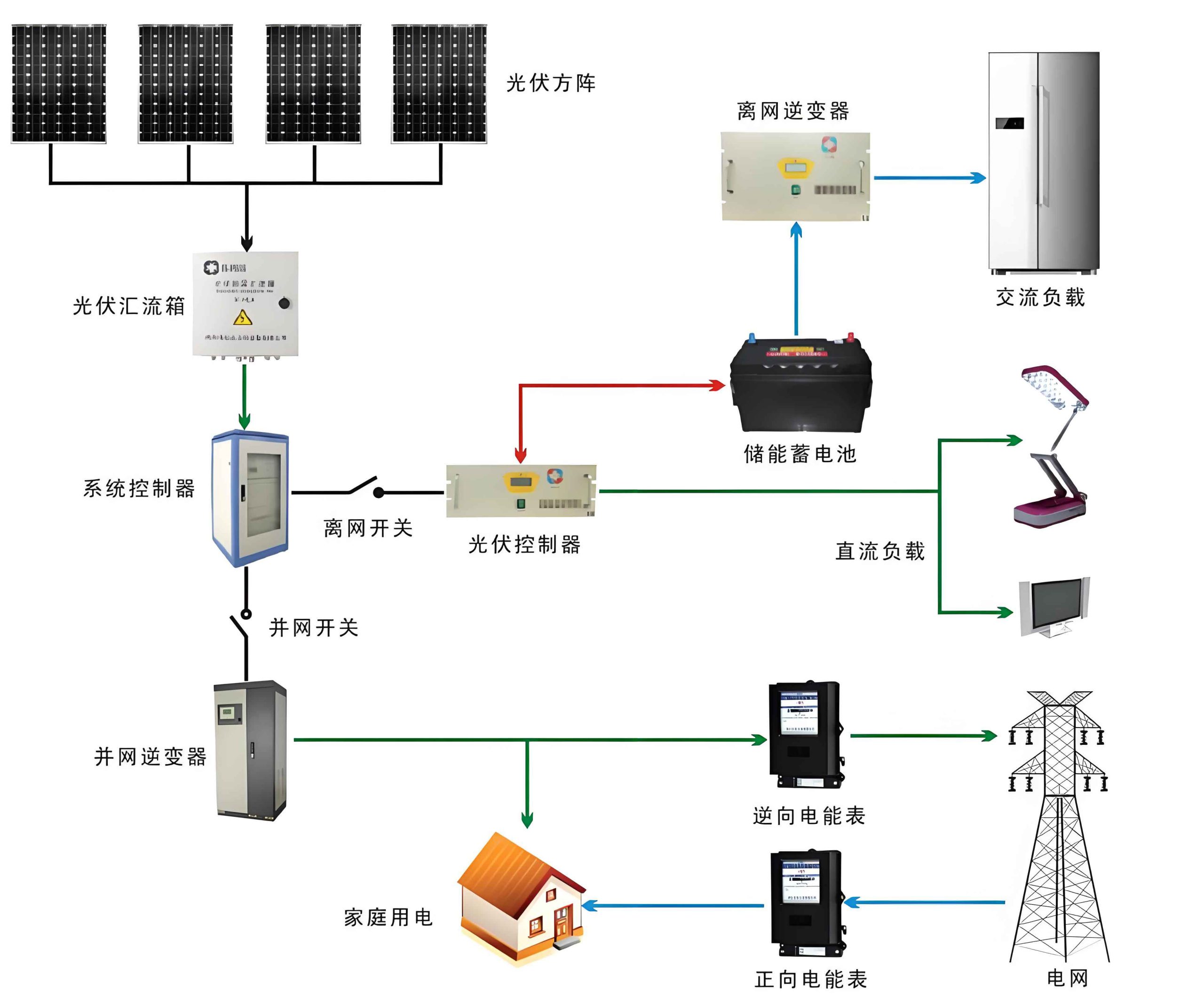
Thin-film solar cells, particularly those based on copper indium gallium selenide (CIGS), are challenging crystalline silicon with their cost advantages. Recent developments, such as those from Swiss labs, have achieved efficiencies of 20.4% on flexible polymer substrates, rivaling polycrystalline silicon. The LCOE for CIGS-based solar system installations can reach $0.05 per kWh, making it competitive with fossil fuels. This is summarized below:
| Solar Cell Type | Efficiency (%) | Estimated LCOE (USD/kWh) | Key Advantages |
|---|---|---|---|
| Monocrystalline Silicon | 20 | 0.32+ | High stability |
| Polycrystalline Silicon | 18 | 0.30+ | Lower material cost |
| CIGS Thin-Film | 20.4 | 0.05 | Flexibility, low cost |
| Emerging Nanocrystal | 66 (theoretical) | <0.10 (projected) | High efficiency potential |
The versatility of thin-film technologies allows for integration into diverse solar system applications, from rooftops to portable devices, further driving adoption.
The future of solar energy is exceptionally bright. According to the International Energy Agency (IEA), rapid declines in PV module and system costs are unlocking new prospects for solar as a primary electricity source. Solar PV expansion is expected to be led by China, followed by the United States. By 2030, solar LCOE could fall below $100 per MWh (or $0.10 per kWh), competing directly with fossil fuels even with carbon pricing. The IEA projects that with a carbon price of $50 per ton, rising to $150 per ton by 2050, solar will surpass oil, wind, hydro, and nuclear to become the dominant power source. This transition could reduce global CO₂ emissions by over 6 billion tons annually. The growth of the solar system market is underpinned by both photovoltaic and concentrated solar power (CSP) technologies, with CSP likely expanding in sunny regions like the U.S., Africa, India, and the Middle East.
To accommodate solar’s rising role, we must evolve our energy infrastructure. Currently, power grids rely on fossil fuels for baseload, with renewables as supplements. In the future, solar system networks will form the backbone, with legacy plants providing peak shaving. This necessitates grid modernization, including smart inverters, energy storage, and demand-response mechanisms. The equation for grid integration balance is:
$$ P_{\text{grid}} = P_{\text{solar}} + P_{\text{storage}} + P_{\text{backup}} $$
where \( P_{\text{solar}} \) represents the output from distributed and utility-scale solar system installations. Regulatory reforms in electricity pricing will also be crucial to reflect the true cost of carbon and incentivize clean energy.
China’s leadership in solar development is a testament to the global shift. As the top producer of solar cells, China accounts for over 50% of global PV product share. National plans aim for renewable energy to meet 40% of total energy demand by 2050, with coal’s share in power generation dropping from 72.5% to 30%. In this scenario, green energy, led by solar, will reach 70% of electricity mix. The following table outlines China’s projected energy transition:
| Year | Total Energy Demand (Billion Tons Coal Equivalent) | Renewable Share (%) | Solar PV Contribution (%) |
|---|---|---|---|
| 2030 | ~40 | 25 | 15 |
| 2040 | ~46 | 35 | 25 |
| 2050 | 52 | 40 | 30+ |
This ambitious roadmap underscores the critical role of technological innovation in scaling the solar system ecosystem worldwide.
In conclusion, the journey to cost-competitive solar energy is multifaceted, demanding continuous innovation across the entire solar system lifecycle. From slashing polysilicon expenses to boosting cell efficiency with nanocrystals, and from deploying flexible thin-film solutions to reimagining grid infrastructure, each advancement brings us closer to a sustainable energy future. As we intensify R&D efforts, the solar system will evolve from a niche alternative to the cornerstone of global electricity generation. The integration of advanced solar system technologies into our daily lives will not only cut costs but also mitigate environmental degradation, offering a cleaner, brighter tomorrow. Let us embrace this transformation with urgency and creativity, for the sun’s power is ours to harness efficiently and affordably for all.