
The relentless march of globalization and the ever-increasing demands of modern civilization have placed energy and environmental sustainability at the forefront of global challenges. The search for efficient, clean, and reliable energy storage solutions has thus become a defining pursuit of our era. From my vantage point as someone deeply engaged with the evolution of energy technologies, it is clear that the lithium-ion battery (LIB) stands out as the most transformative and performant electrochemical storage system developed to date. Its journey from a laboratory curiosity to the powerhouse behind portable electronics, electric vehicles, and even aerospace systems is a testament to decades of fundamental and applied research. In this extensive analysis, I will share my perspective on the current state of li-ion battery technology, delve into its core components and ongoing challenges, and explore the promising pathways that will define its future, particularly in demanding sectors like aviation. The keyword here, and the protagonist of our discussion, is undeniably the li-ion battery.
1. Foundational Principles and Defining Characteristics
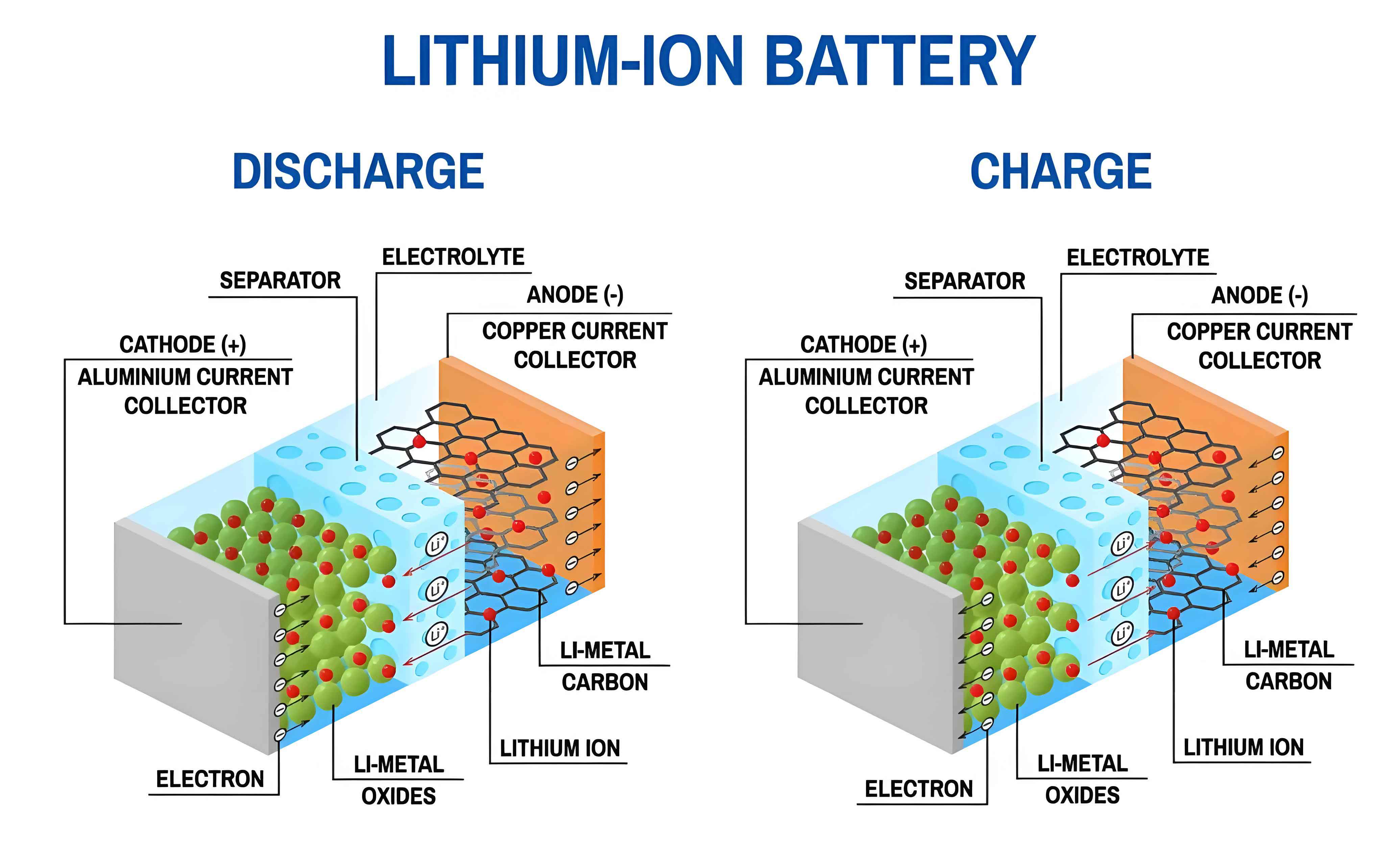
At its heart, a modern li-ion battery is an elegant system based on the reversible shuttling of lithium ions between two host electrodes. Unlike batteries with metallic lithium anodes, the li-ion battery operates on an “ion shuttle” or “rocking-chair” principle. During charging, lithium ions are extracted (de-intercalated) from the cathode material, travel through an ion-conducting electrolyte, and are inserted (intercalated) into the anode material. Electrons flow through the external circuit to maintain charge balance. This process is reversed during discharge. A classic example is the system using lithium cobalt oxide (LiCoO2) as the cathode and graphite as the anode. The electrochemical reactions can be summarized as follows:
Cathode Reaction: $$ \text{LiCoO}_2 \ \xrightleftharpoons[Discharge]{Charge} \ \text{Li}_{1-x}\text{CoO}_2 + x\text{Li}^+ + xe^- $$
Anode Reaction: $$ \text{C}_n + x\text{Li}^+ + xe^- \ \xrightleftharpoons[Discharge]{Charge} \ \text{Li}_x\text{C}_n $$
Overall Cell Reaction: $$ \text{LiCoO}_2 + \text{C}_n \ \xrightleftharpoons[Discharge]{Charge} \ \text{Li}_{1-x}\text{CoO}_2 + \text{Li}_x\text{C}_n $$
The widespread success of the li-ion battery is attributed to a combination of superior properties that, when taken together, outperform other rechargeable chemistries:
- High Specific Energy: With gravimetric energy densities ranging from 120 to over 250 Wh/kg and volumetric densities exceeding 300 Wh/L, the li-ion battery offers the best energy-to-weight/volume ratio among commercial rechargeable batteries.
- High Voltage: The average discharge voltage typically lies between 3.2V and 3.8V (or higher for some chemistries), which reduces the number of cells needed in series for a given application voltage.
- Low Self-Discharge: A well-designed li-ion battery loses only about 2-5% of its charge per month at room temperature, a significant advantage over nickel-based systems.
- Long Cycle Life: Modern LIBs can achieve hundreds to thousands of charge-discharge cycles with minimal capacity fade, especially when operated within controlled voltage windows. Some specialized chemistries like lithium iron phosphate (LFP) and lithium titanate (LTO)-based cells boast cycle lives exceeding 5,000 cycles.
- High Coulombic Efficiency: The energy efficiency during cycling is very high, often above 99% for a single cycle, meaning most of the energy put in during charging is recovered on discharge.
These characteristics make the li-ion battery uniquely suited for applications where weight, volume, and longevity are critical, from smartphones to satellites.
2. The Pillars of Performance: Electrode Materials
The relentless pursuit of better li-ion battery performance is fundamentally a quest for advanced materials. The capacity, voltage, safety, cost, and longevity of a li-ion battery are dictated by the chemical and physical properties of its cathode, anode, and electrolyte.
2.1 Cathode Materials: The Lithium Source and Voltage Limiter
The cathode is often considered the performance-limiting component in a li-ion battery. An ideal cathode must provide high specific capacity, high operating potential, structural stability over repeated lithium extraction/insertion, high electronic and ionic conductivity, low cost, and environmental benignity. The evolution of cathode materials has followed several distinct structural families, each with its own trade-offs.
Layered Oxide Structures (LiMO2, M = Co, Ni, Mn, Al): LiCoO2 (LCO) has been the workhorse for consumer electronics due to its high volumetric energy density, good rate capability, and well-established manufacturing. However, its high cost, limited practical capacity (~140 mAh/g out of a theoretical 274 mAh/g for stability reasons), and thermal instability at high states of charge are significant drawbacks. Research has focused on partial substitution of cobalt with nickel and manganese to form NMC (LiNixMnyCozO2) and NCA (LiNixCoyAlzO2) compounds. These materials offer higher capacity and better cost/performance profiles. For instance, high-nickel NMC (e.g., NMC811) can deliver capacities over 200 mAh/g but often at the expense of cycle life and thermal stability. Lithium-rich layered oxides (xLi2MnO3•(1-x)LiMO2) promise even higher capacities (>250 mAh/g) but suffer from voltage fade and poor kinetics.
Spinel Structure (LiMn2O4): Lithium manganese oxide (LMO) offers advantages of low cost, high abundance of manganese, good rate capability, and high thermal safety due to its three-dimensional lithium diffusion pathways. Its main limitation is capacity fade, especially at elevated temperatures, caused by manganese dissolution via disproportionation (2Mn3+ → Mn2+ + Mn4+) and Jahn-Teller distortion. Doping with cations like Al, Ni, or Mg and surface coatings (e.g., Al2O3, Li3PO4) are common strategies to stabilize the structure.
Polyanion Olivine Structures (LiMPO4, M = Fe, Mn, Co, Ni): The discovery of lithium iron phosphate (LiFePO4 or LFP) was a milestone. Its strong P-O covalent bonds give it exceptional thermal and chemical stability, making it one of the safest li-ion battery cathodes. It has a flat voltage plateau at ~3.45 V vs. Li/Li+, good cycle life, and is environmentally friendly. Its main drawbacks are a relatively low theoretical capacity (170 mAh/g) and low intrinsic electronic and ionic conductivity. Nanostructuring and carbon coating are universally employed to overcome these kinetic limitations. Variants like LiMnPO4 and LiCoPO4 offer higher voltage plateaus but bring their own synthesis and stability challenges.
The following table compares key parameters of major cathode families for li-ion battery technology:
| Cathode Material | Structure | Avg. Voltage (V vs. Li/Li+) | Theoretical Capacity (mAh/g) | Practical Capacity (mAh/g) | Key Advantages | Key Challenges |
|---|---|---|---|---|---|---|
| LiCoO2 (LCO) | Layered | ~3.8 | 274 | 135-155 | High tap density, good kinetics, mature | Cost, thermal instability, Co toxicity |
| LiNi0.8Mn0.1Co0.1O2 (NMC811) | Layered | ~3.8 | ~275 | 190-220 | High capacity, lower Co content | Structural degradation, gas evolution, thermal runaway risk |
| LiMn2O4 (LMO) | Spinel | ~4.1 | 148 | 100-120 | Low cost, high power, good safety | Mn dissolution, capacity fade at >55°C |
| LiFePO4 (LFP) | Olivine | ~3.45 | 170 | 150-165 | Excellent safety, long life, low cost, stable voltage | Lower energy density, sensitive to synthesis |
| LiNi0.8Co0.15Al0.05O2 (NCA) | Layered | ~3.75 | ~275 | 190-220 | High specific energy, good power | Thermal stability, sensitivity to moisture |
2.2 Anode Materials: The Host for Lithium
The anode of a li-ion battery has evolved significantly from metallic lithium to intercalation, alloying, and conversion materials. The ideal anode operates at a low potential versus Li/Li+ to maximize cell voltage, has high capacity, experiences minimal volume change, and forms a stable solid-electrolyte interphase (SEI).
Intercalation Anodes (Carbon-based): Graphite remains the dominant commercial anode due to its low cost, low working potential (~0.1 V vs. Li/Li+), long cycle life, and relatively good safety. Its theoretical capacity is 372 mAh/g (for LiC6). The success of graphite is enabled by a stable, albeit irreversible, SEI formed from electrolyte decomposition during the first cycle. “Hard carbon” (non-graphitizable carbon) can exhibit higher capacities (up to 500-600 mAh/g) by storing lithium in nanopores and defects, but it often suffers from a sloping voltage profile and higher first-cycle irreversibility.
Alloying Anodes (Si, Sn, Ge, etc.): These materials offer order-of-magnitude higher theoretical capacities than graphite. Silicon is the most promising, with a colossal theoretical capacity of ~3579 mAh/g (for Li15Si4) at a reasonable potential. However, the alloying reaction with lithium involves enormous volume expansion (>300%), leading to particle pulverization, loss of electrical contact, and continuous SEI reformation, which rapidly consumes lithium and electrolyte. Strategies to mitigate this include nanostructuring (nanoparticles, nanowires), using porous or yolk-shell structures, and creating silicon-carbon composites. The goal is to accommodate the strain while maintaining electrical connectivity. Even partial replacement of graphite with silicon (5-10% wt.) in commercial li-ion battery anodes is now common to boost energy density.
Conversion Anodes (Transition Metal Oxides, Sulfides, etc.): Materials like Co3O4, Fe3O4, MnO, and MoS2 undergo a conversion reaction: $$ \text{M}_x\text{O}_y + 2y\text{Li}^+ + 2ye^- \leftrightarrow y\text{Li}_2\text{O} + x\text{M}^0 $$ These reactions are highly reversible in nanoscale materials and can deliver high capacities (500-1000 mAh/g). However, they typically suffer from large voltage hysteresis between charge and discharge, low initial Coulombic efficiency, and significant volume changes. Their higher operating voltage (~1-2 V) can be a safety advantage against lithium plating.
Intercalation/Titanate Anodes (Li4Ti5O12): Lithium titanate (LTO) operates at a relatively high voltage of ~1.55 V vs. Li/Li+, which eliminates lithium plating and SEI formation, granting it exceptional safety and cycle life (>10,000 cycles). It is a “zero-strain” material with negligible volume change during cycling, leading to superb power capability and calendar life. Its main drawback is low specific energy due to the high operating voltage and moderate capacity (175 mAh/g). It finds niche applications where safety, power, and longevity are paramount over energy density.
3. The Vital Medium: Electrolytes and Interfaces
The electrolyte in a li-ion battery is the critical medium for ionic conduction and a major determinant of safety, temperature performance, and cycle life. Conventional electrolytes are composed of lithium salts (e.g., LiPF6) dissolved in organic carbonate solvents (e.g., ethylene carbonate, dimethyl carbonate). While functional, this system has well-known limitations: flammability, limited electrochemical stability window (<4.3V for many), poor performance at sub-zero temperatures, and sensitivity to moisture. Research is intensely focused on next-generation electrolytes to enable advanced li-ion battery chemistries.
Liquid Electrolyte Innovations: The primary approach involves formulating novel salts, solvents, and functional additives. Salts like LiFSI and LiTFSI offer better thermal stability and conductivity than LiPF6. Solvents such as fluorinated carbonates or sulfones can improve stability at high voltages. Additives are the secret sauce of modern electrolytes; small amounts (0.5-5%) can dramatically improve performance. For example:
– SEI-forming additives (e.g., vinylene carbonate, fluoroethylene carbonate) create a more stable and conductive passivation layer on the anode.
– Cathode protection additives (e.g., tris(trimethylsilyl) phosphite) scavenge harmful HF and form protective coatings on high-voltage cathodes.
– Flame-retardant additives (e.g., organic phosphates) reduce electrolyte flammability.
Solid-State Electrolytes (SSEs): Replacing the flammable liquid with a non-flammable solid is considered the ultimate solution for li-ion battery safety and a potential enabler for lithium metal anodes. SSEs fall into three categories:
1. Inorganic Ceramics/Glasses: Materials like garnets (e.g., Li7La3Zr2O12 or LLZO), sulfides (e.g., Li10GeP2S12 or LGPS), and NASICON-types (e.g., Li1+xAlxTi2−x(PO4)3 or LATP) can achieve high ionic conductivities rivaling liquids (>10−3 S/cm). Their challenges include brittleness, high interfacial resistance with electrodes, and stability against lithium metal.
2. Solid Polymer Electrolytes (SPEs): Typically based on complexes of PEO with lithium salts. They are flexible and easier to process but have lower ionic conductivity at room temperature. Composite polymer electrolytes (CPEs), which incorporate ceramic fillers, aim to improve both mechanical strength and ionic transport.
3. Quasi-Solid/ Gel Electrolytes: These contain a liquid phase immobilized within a polymer or ceramic matrix, offering a compromise between the performance of liquids and the safety of solids.
The interface between any electrolyte and the electrodes, especially the cathode at high voltage and the anode (or lithium metal), is a complex and dynamic region. Its stability governs the long-term performance of the entire li-ion battery.
4. The High-Stakes Arena: Li-Ion Batteries in Aviation
The aerospace sector presents perhaps the most demanding set of requirements for any energy storage system: extreme weight sensitivity, operation across a vast temperature range, uncompromising safety and reliability, and very long service life. The adoption of li-ion battery technology in this field is a story of immense promise punctuated by sobering challenges.
The benefits are clear: the high specific energy of li-ion battery packs directly translates to reduced aircraft weight, which improves fuel efficiency, payload capacity, and range for electric or hybrid-electric propulsion concepts. They are used for main or auxiliary power units (APU), emergency systems, and providing power for avionics in next-generation aircraft like the Boeing 787 and Airbus A350. In unmanned aerial vehicles (UAVs) and high-altitude pseudo-satellites (HAPS), li-ion battery technology is often the only viable power source for propulsion and payloads.
However, the 2013 incidents involving thermal runaway in Boeing 787 li-ion battery systems highlighted the catastrophic consequences of failure. An internal short circuit, likely due to a manufacturing defect or mechanical abuse, can initiate localized heating. This can trigger exothermic reactions with the electrolyte and cathode, leading to a self-accelerating thermal runaway event where temperatures exceed 700°C, causing fire, ejection of molten material, and significant damage. In the confined, oxygen-rich, and safety-critical environment of an aircraft, such an event is unacceptable.
This has spurred rigorous advancements in aerospace li-ion battery safety:
– Cell Design: Using inherently safer chemistries (e.g., LFP or LTO-based cells) even at the cost of some energy density. Enhanced quality control and defect screening.
– Module and Pack Design: Robust mechanical containment to prevent propagation. Advanced thermal management systems (liquid cooling, phase-change materials) to maintain optimal temperature and quench thermal events. Sophisticated battery management systems (BMS) for precise monitoring of voltage, temperature, and state of charge for each cell.
– System-Level Protocols: Strict operating windows, redundant safety circuits, and fire containment barriers.
The current specific energy of aerospace li-ion battery systems (~100-150 Wh/kg at the pack level) is sufficient for auxiliary roles but falls short for primary propulsion in large commercial aircraft. The industry target for viable all-electric regional aircraft is often cited as being >400-500 Wh/kg at the pack level—a goal that requires breakthroughs in cell chemistry, not just packaging. Research into solid-state li-ion battery technology is particularly active in aerospace due to its potential for both higher energy density and intrinsic safety.
5. The Global Industrial Landscape and Persistent Challenges
The li-ion battery industry has grown into a global powerhouse, driven by the electric vehicle revolution. The geographical and technological landscape is dynamic. While early dominance came from Japan, South Korea and China have made massive investments and now lead in manufacturing capacity. The United States and Europe are striving to build resilient local supply chains through policy and innovation.
From my observation, the key challenges facing the broader li-ion battery industry are interconnected:
- Energy Density Plateau: Incremental improvements in existing graphite/NMC systems are slowing. Breaking the 300 Wh/kg barrier at the cell level consistently and safely requires new paradigms: silicon-dominant anodes, lithium metal anodes (paired with solid electrolytes), or novel high-capacity/high-voltage cathodes like sulfur or air.
- The Cost Challenge: While pack prices have fallen dramatically, further reductions are needed for mass EV adoption and grid storage. This involves not only cheaper materials but also innovations in manufacturing scale, process efficiency (like dry electrode coating), and cell design to reduce inactive material.
- Supply Chain Vulnerabilities: The concentration of mining and refining for critical materials like lithium, cobalt, and nickel in a few regions poses geopolitical and ethical risks. This drives research into cobalt-free cathodes (e.g., LFP, high-Mn spinels), new lithium extraction methods, and efficient recycling technologies to create a circular economy for li-ion battery materials.
- Fast Charging: Enabling reliable 10-15 minute charging without causing lithium plating or accelerating degradation is a multi-faceted problem involving anode materials (e.g., LTO, engineered graphite), electrolyte formulations for high ionic conductivity, and sophisticated thermal management.
- Sustainability and Recycling: As gigawatt-hours of batteries reach end-of-life, developing cost-effective, high-yield recycling processes to recover valuable metals is imperative to reduce environmental impact and secure material supply.
6. A Forward-Looking Synthesis: Pathways and Prospects
Based on the trajectory of research and market forces, I foresee several key directions for the evolution of the li-ion battery:
Material Innovation Remains King. The next decade will see the gradual commercialization of advanced materials already in the R&D pipeline. Silicon-composite anodes will become more prevalent, pushing cell-level energy densities toward 350-400 Wh/kg. Cobalt content in layered oxides will continue to decrease, potentially to zero. There will be a resurgence of interest in manganese-based systems (spinel, disordered rocksalts) for their cost and sustainability benefits. The success of LFP is a powerful reminder that safety and cost can be winning metrics, especially for stationary storage and entry-level EVs.
The Solid-State Transition. Solid-state li-ion battery technology (or more accurately, solid-state lithium metal battery technology) is the most anticipated frontier. Its potential benefits are transformative: higher energy density (by enabling lithium metal), near-absolute safety (non-flammable), longer life, and possibly wider operating temperature ranges. The path to commercialization is fraught with technical hurdles—interface stability, manufacturability, cost—but progress is steady. We are likely to see incremental adoption, starting in premium consumer electronics and specialized applications (e.g., aerospace, medical devices) before reaching the automotive mass market.
Application-Specific Optimization. The era of a “one-size-fits-all” li-ion battery is over. The future will see tailored solutions:
– High-Energy for Aviation/Long-Range EVs: Leveraging high-nickel NMC/NCA with silicon anodes or, eventually, solid-state designs.
– High-Power & Ultra-Safe for Urban Mobility/Grid Frequency Regulation: Using LFP or LTO-based chemistries.
– Low-Cost/Long-Duration for Stationary Storage: Optimized LFP or emerging aqueous or sodium-ion systems for very long cycle life and lowest levelized cost of storage.
Beyond the Cell: System Intelligence. The li-ion battery of the future will be inseparable from its “digital twin.” Advanced BMS with embedded AI will predict cell failure, optimize charging protocols in real-time, and enable second-life applications. Smart manufacturing with in-line quality control will push defect rates toward zero, directly improving safety.
In conclusion, the li-ion battery is not a static technology but a vibrant and evolving platform. Its foundational principles remain sound, but its constituent materials and systems are in a state of continuous refinement and revolution. The challenges—in energy density, safety, cost, and sustainability—are significant, but they are acting as powerful catalysts for innovation across chemistry, materials science, and engineering. As we look to an electrified future in transportation, grid modernization, and advanced aerospace, the li-ion battery, in its myriad future forms, will undoubtedly remain at the very center of the energy conversation, powering not just our devices, but our collective progress.