
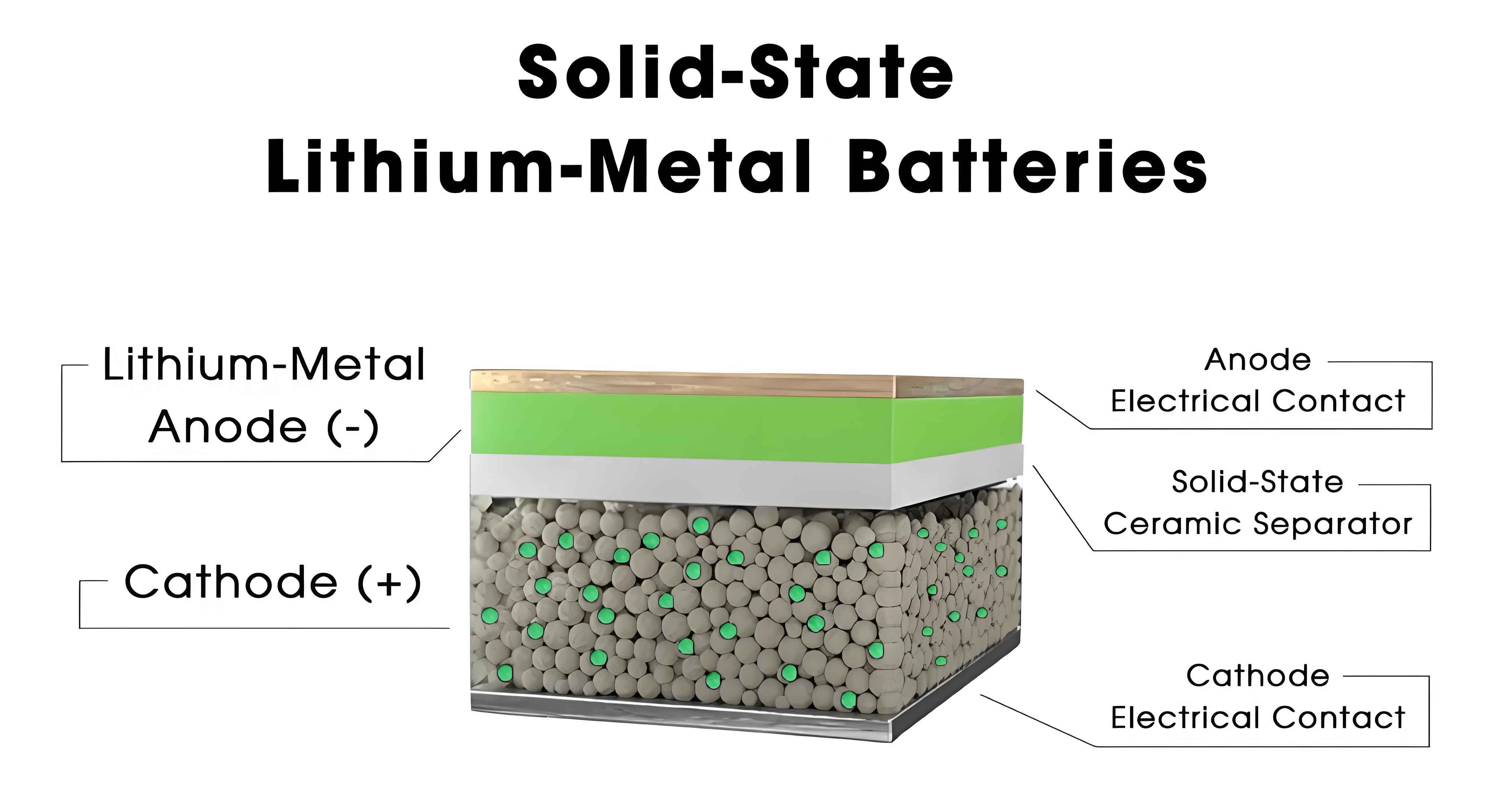
As a pivotal technology for next-generation power batteries, solid-state batteries promise to address the full-scenario application demands of new energy vehicles with enhanced safety and energy density. This article systematically analyzes technological pathways, global policy landscapes, and industrial progress while identifying key challenges impeding large-scale commercialization.
1. Technical Pathways of Solid-State Batteries
Solid-state batteries are categorized into three primary technical routes based on electrolyte materials:
| Electrolyte Type | Materials | Ionic Conductivity (S/cm) | Advantages | Challenges | Key Players |
|---|---|---|---|---|---|
| Polymer | PEO, PAN | 10⁻⁷–10⁻⁵ (RT) 10⁻⁴ (HT) |
Flexible interface Scalable processing |
Low RT conductivity Narrow voltage window |
Bolloré, Solid Power |
| Oxide | LLZO, LATP | 10⁻⁶–10⁻³ | High stability Wide voltage window |
High interfacial resistance | ProLogium, QuantumScape |
| Sulfide | LiGPS, LGPS | 10⁻⁷–10⁻² | Highest RT conductivity Good formability |
Oxidation sensitivity | Toyota, Samsung SDI |
2. Global Industrial Progress
2.1 International Developments
- Japan: Launched ¥120.5B national project for solid-state battery R&D, with Toyota achieving 1,200 km range prototypes.
- South Korea: Samsung SDI developed 900 Wh/L cells targeting 2027 mass production under $15B government initiative.
- Europe: Approved €3.2B IPCEI project focusing on solid-state battery value chain integration.
2.2 Chinese Advancements
- Commercialized semi-solid-state batteries with 360 Wh/kg energy density (WeLion/NAIO collaboration).
- CATL’s condensed battery achieves 500 Wh/kg with hybrid electrolyte technology.
3. Key Technical Challenges
The ionic transport mechanism in solid-state electrolytes follows:
$$ \sigma = n \cdot q \cdot \mu $$
Where σ = ionic conductivity, n = carrier concentration, q = charge, μ = mobility. Current limitations stem from:
- Interfacial Impedance: Contact resistance between rigid electrolytes and electrodes:
$$ R_{interface} = \frac{\rho}{A} \cdot \sqrt{\frac{\pi}{2C}} $$ - Lithium Dendrites: Growth kinetics described by:
$$ t_{short} = \frac{\pi \eta L}{4j^2 RT} $$ - Thermal Management: Heat generation during cycling:
$$ Q = I^2R_{total} + \Delta H_{side} $$
4. Cost Analysis
Current cost breakdown comparison (USD/kWh):
| Component | Liquid LIB | Semi-Solid | Full Solid-State |
|---|---|---|---|
| Electrolyte | 12 | 35 | 85 |
| Anode | 8 | 15 | 40 |
| Manufacturing | 25 | 45 | 120 |
| Total | 110 | 210 | 480 |
5. Strategic Recommendations
- National Coordination: Establish cross-ministerial task forces for resource allocation and standardization.
- Technical Roadmaps: Prioritize oxide-based semi-solid batteries for immediate commercialization while investing in sulfide R&D.
- Circular Economy: Develop recycling protocols for lithium metal residues:
$$ \eta_{recovery} = \frac{m_{recycled}}{m_{initial}} \times 100\% $$
6. Conclusion
While solid-state battery technology demonstrates transformative potential, its industrialization requires solving fundamental scientific challenges and establishing cost-competitive supply chains. China’s dual approach of advancing semi-solid batteries while building foundational research capabilities positions it strategically in the global solid-state battery race.