
In the global push toward sustainability, the new energy vehicle industry has witnessed explosive growth. As a researcher deeply involved in battery technology, I believe that innovation in power batteries is the core breakthrough direction. From early lead-acid batteries to the currently dominant lithium-ion systems like lithium iron phosphate and ternary lithium batteries, each advancement has propelled the industry forward. However, with increasing market demands for higher performance, the limitations of traditional liquid electrolytes in energy density and safety have become apparent. In this context, the solid-state battery emerges as a pivotal next-generation technology, offering a transformative solution. In this article, I will systematically analyze the working principles, structural features, and industrialization status of solid-state batteries, comparing them with existing technologies to highlight their potential and hurdles.
The fundamental operation of a solid-state battery shares similarities with conventional liquid lithium-ion batteries, both relying on the intercalation and deintercalation of lithium ions between the cathode and anode during charge and discharge cycles. During charging, lithium ions detach from the cathode material, migrate through the electrolyte, and embed into the anode; the reverse occurs during discharging. The key distinction lies in the physical state of the electrolyte: solid-state batteries replace the liquid electrolyte with a solid electrolyte, which serves as the ion-conducting medium. This solid electrolyte must exhibit high ionic conductivity to facilitate efficient lithium-ion transport while maintaining excellent electronic insulation to prevent internal short circuits. Moreover, its superior chemical stability reduces risks associated with volatilization or leakage, common in liquid electrolytes. The basic electrochemical reaction can be represented as:
$$ \text{Cathode: } \text{LiMO}_2 \rightleftharpoons \text{Li}_{1-x}\text{MO}_2 + x\text{Li}^+ + x e^- $$
$$ \text{Anode: } \text{C} + x\text{Li}^+ + x e^- \rightleftharpoons \text{Li}_x\text{C} $$
where M represents transition metals like Co or Ni. In solid-state batteries, the solid electrolyte enables these reactions without the fluid medium, enhancing safety and performance.
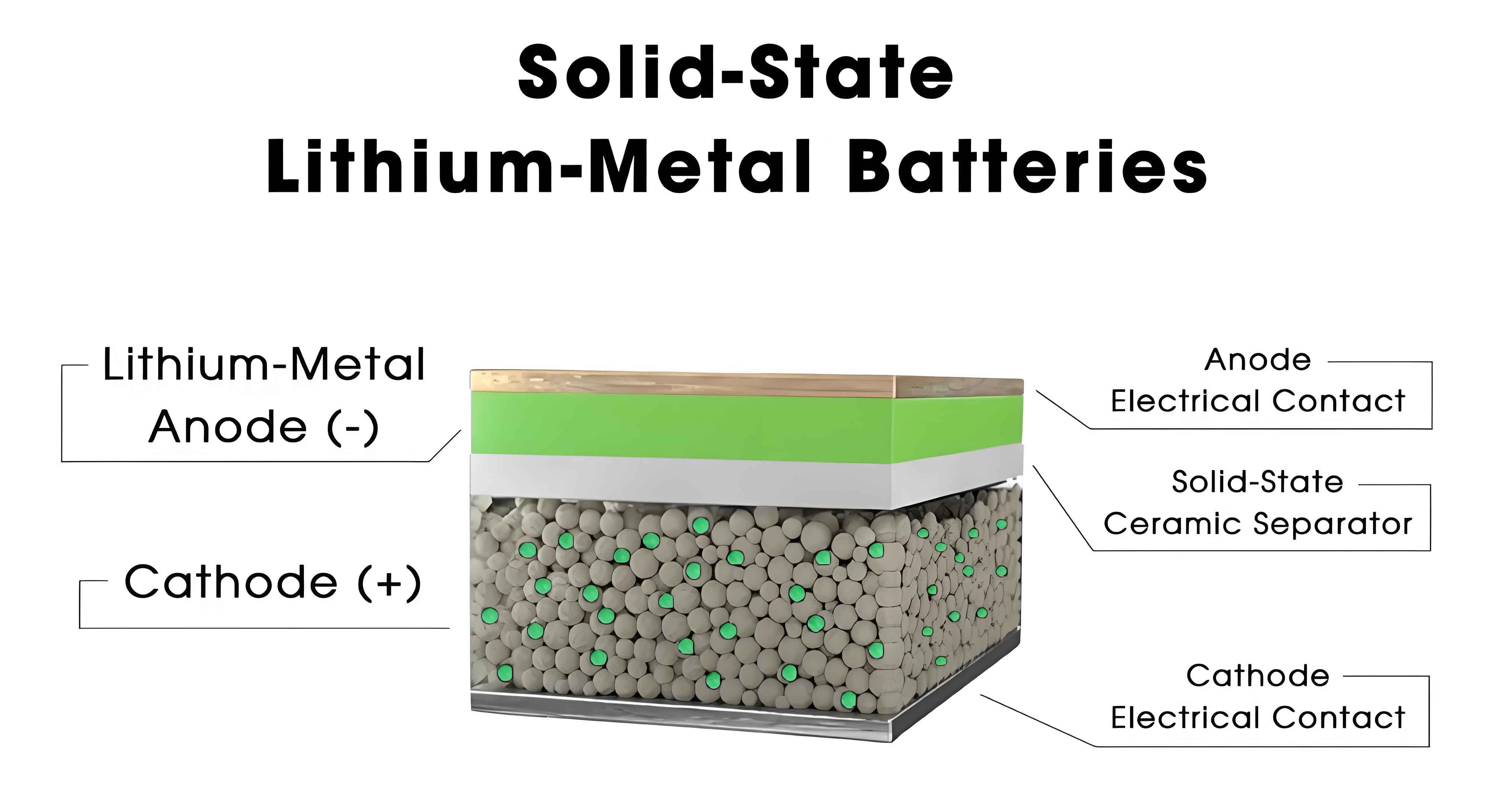
The structure of a solid-state battery is meticulously designed to optimize ion transport and stability. It primarily consists of cathode materials, anode materials, solid electrolyte, current collectors, and other components. Unlike liquid batteries, which use porous separators soaked in electrolyte, solid-state batteries integrate the electrolyte as a solid layer, eliminating the need for liquid filling. This structural shift reduces inactive materials, allowing for higher energy density. To illustrate the material composition, I have compiled a table summarizing key components and their characteristics:
| Component | Material Types | Key Properties | Role in Solid-State Battery |
|---|---|---|---|
| Cathode | Layered oxides (e.g., LiCoO2), polyanion compounds (e.g., LiFePO4), lithium-rich manganese-based materials | High capacity, structural stability, voltage range | Stores and releases lithium ions during cycling |
| Anode | Graphite, metallic lithium, lithium alloys, silicon-based materials | High specific capacity (e.g., Li: 3860 mAh/g), but prone to dendrite growth | Hosts lithium ions; metallic lithium offers high energy |
| Solid Electrolyte | Oxides (e.g., Li7La3Zr2O12), sulfides (e.g., Li3PS4), halides, polymers (e.g., PEO) | Ionic conductivity, chemical stability, mechanical strength | Facilitates ion transport while insulating electrons |
| Current Collectors | Aluminum foil (cathode), copper foil (anode) | High conductivity, thin profile, surface quality | Collects and conducts current to external circuit |
The solid electrolyte is the heart of the solid-state battery, and its ionic conductivity is critical for performance. The conductivity (σ) can be expressed as:
$$ \sigma = n \cdot e \cdot \mu $$
where n is the charge carrier concentration, e is the elementary charge, and μ is the mobility. For solid electrolytes, achieving high σ at room temperature remains a challenge, with values often below 10-3 S/cm for many materials, compared to liquid electrolytes that exceed 10-2 S/cm. Research focuses on doping and nanostructuring to enhance this property.
Globally, the development of solid-state batteries has accelerated, with significant investments from both academia and industry. In my analysis, I observe that research efforts are concentrated on novel materials and fabrication techniques. For instance, sulfide-based solid electrolytes are being optimized for higher conductivity and air stability, while protective coatings are developed to suppress lithium dendrite growth on metallic anodes. In terms of industrialization, companies like Toyota have announced plans to launch electric vehicles equipped with solid-state batteries, targeting energy densities above 400 Wh/kg. Similarly, Chinese firms such as CATL and Ganfeng Lithium are advancing pilot production lines. However, the transition to mass production faces hurdles, including cost and process complexity. To contextualize these efforts, here is a table comparing the status of key players:
| Entity | Focus Area | Key Achievements | Challenges |
|---|---|---|---|
| Toyota | Sulfide solid electrolytes | Prototype batteries with fast charging and high energy density | Scalability and cost reduction |
| CATL | Oxide-polymer composites | Demonstrated semi-solid-state batteries with improved safety | Interfacial resistance and production yield |
| Samsung SDI | Sulfide-based systems | High-capacity prototypes for EVs | Long-term cycling stability |
| Start-ups (e.g., QuantumScape) | Ceramic separators and anode-free designs | Multi-layer cell designs with high performance | Manufacturing consistency and supply chain |
The advantages of solid-state batteries are profound, making them a promising candidate for future vehicles. Firstly, they offer higher energy density, which is crucial for extending driving range. The energy density (E) can be calculated as:
$$ E = \frac{C \times V}{m} $$
where C is the capacity, V is the voltage, and m is the mass. Solid-state batteries theoretically achieve 400–500 Wh/kg, surpassing lithium iron phosphate (140–200 Wh/kg) and ternary lithium (200–300 Wh/kg) batteries. This leap stems from the ability to use high-capacity electrodes like metallic lithium and reduce inert components. Secondly, safety is enhanced due to the non-flammable nature of solid electrolytes, which mitigate thermal runaway risks. The thermal stability can be modeled using Arrhenius equations:
$$ k = A \exp\left(-\frac{E_a}{RT}\right) $$
where k is the rate of degradation, A is a pre-exponential factor, Ea is activation energy, R is the gas constant, and T is temperature. Solid electrolytes typically have higher Ea, slowing degradation. Thirdly, cycle life is extended, often exceeding 3000 cycles, compared to 2000–3000 for lithium iron phosphate and 1500–2500 for ternary lithium batteries. This is attributed to stable interfaces that minimize side reactions. Finally, solid-state batteries operate over a wider temperature range, from -30°C to 100°C, owing to the consistent ionic conductivity of solid electrolytes. This robustness is vital for diverse climatic conditions.
Despite these benefits, the solid-state battery faces significant shortcomings that hinder commercialization. Cost is a primary concern, with raw materials like sulfide electrolytes being expensive and manufacturing processes—such as thin-film deposition and hot pressing—requiring precision equipment. I estimate that current solid-state battery costs are 2–3 times higher than liquid counterparts, though economies of scale could reduce this over time. Ionic conductivity remains a technical bottleneck; while some solid electrolytes approach liquid-like values, many still suffer from low room-temperature conductivity, increasing internal resistance and reducing power output. The interface compatibility issue is equally critical: the solid-solid contact between electrolyte and electrodes often leads to high interfacial resistance due to poor adhesion or chemical reactions. This can be described by the equation for interfacial resistance (Rint):
$$ R_{\text{int}} = \frac{\delta}{\sigma_{\text{int}}} $$
where δ is the interfacial layer thickness and σint is its conductivity. Minimizing Rint requires advanced engineering, such as surface coatings or composite designs. Additionally, manufacturing complexity arises from the need for uniform layers and precise control, which current techniques like slurry casting struggle to achieve. To quantify these challenges, I present a comparison table:
| Challenge | Impact on Solid-State Battery | Current Solutions | Future Directions |
|---|---|---|---|
| High Cost | Limits market competitiveness and adoption | Material substitution (e.g., cheaper oxides), process optimization | Scale-up production, recycling of critical materials |
| Low Ionic Conductivity | Reduces charge/discharge rates and efficiency | Doping, nanostructuring, hybrid electrolytes | Discovery of new solid electrolyte phases with superior conduction |
| Interfacial Issues | Causes capacity fade and increased resistance | Interfacial layers, annealing treatments, pressure application | In-situ characterization and AI-driven material design |
| Manufacturing Complexity | Hampers mass production and consistency | Roll-to-roll processing, additive manufacturing | Integration with existing battery production lines |
Looking ahead, the potential of solid-state batteries to revolutionize the new energy vehicle sector is undeniable. In my view, overcoming these challenges will require interdisciplinary collaboration, combining materials science, electrochemistry, and engineering. For instance, research into hybrid solid-liquid electrolytes or gradient structures may bridge the gap between performance and practicality. Moreover, policy support and investment in infrastructure, such as fast-charging networks compatible with high-energy batteries, will accelerate adoption. The solid-state battery is not just an incremental improvement but a paradigm shift—one that could eliminate range anxiety and enhance safety, thereby fostering broader acceptance of electric vehicles.
In conclusion, as I reflect on the trajectory of battery technology, the solid-state battery stands out as a beacon of innovation. Its advantages in energy density, safety, longevity, and temperature tolerance position it as a key enabler for the next generation of new energy vehicles. However, the path forward is fraught with technical and economic hurdles that demand sustained effort. By addressing cost, conductivity, interfaces, and manufacturing, we can unlock the full potential of this technology. Ultimately, the solid-state battery promises to complement existing systems, creating a robust energy storage ecosystem that drives global sustainability. As research progresses, I am optimistic that solid-state batteries will soon transition from labs to roads, powering a greener future for transportation.
To further illustrate the principles, consider the diffusion of lithium ions in a solid electrolyte, governed by Fick’s law:
$$ J = -D \frac{\partial C}{\partial x} $$
where J is the flux, D is the diffusion coefficient, C is concentration, and x is distance. In solid-state batteries, enhancing D through material design is crucial for fast charging. Additionally, the overall cell voltage (Vcell) can be expressed as:
$$ V_{\text{cell}} = V_{\text{cathode}} – V_{\text{anode}} – \eta $$
where Vcathode and Vanode are electrode potentials, and η represents overpotentials from resistance. Solid-state batteries aim to minimize η through optimized interfaces. Through such fundamental insights, we can continue to refine the solid-state battery, making it a cornerstone of modern energy solutions.