
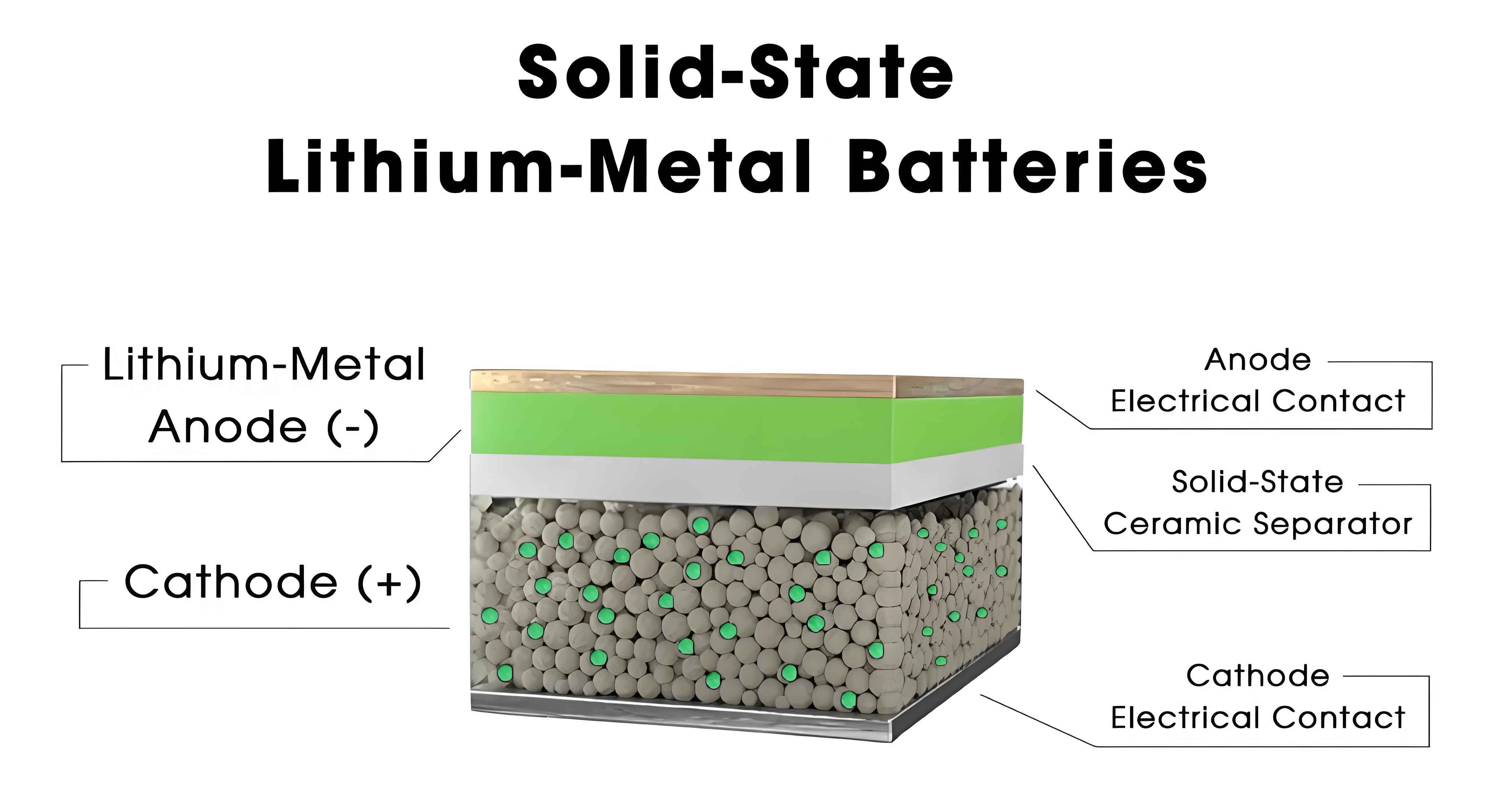
The evolution of energy storage technologies has been pivotal in driving advancements in portable electronics, electric vehicles, and grid-scale storage. Among these, lithium-ion batteries (LIBs) have dominated the market due to their high energy density and reliability. However, conventional LIBs with organic liquid electrolytes face intrinsic challenges such as flammability, electrochemical instability at high voltages, and lithium dendrite growth, which compromise safety and limit energy density. To address these issues, solid-state batteries (SSBs) have emerged as a promising next-generation solution. SSBs replace liquid electrolytes with solid-state electrolytes (SEs), offering enhanced safety, higher energy density, and longer cycle life. The solid-state battery architecture fundamentally mitigates risks associated with leakage, thermal runaway, and dendrite penetration, making it a critical technology for future energy storage systems.
The performance of a solid-state battery is heavily influenced by the choice of cathode material. While conventional cathodes like LiCoO2 and LiFePO4 provide moderate capacities, they fall short in meeting the escalating demand for higher energy densities. In this context, Li-rich Mn-based layered oxides (LRMOs) have garnered significant attention as cathode materials for SSBs due to their exceptionally high specific capacities (≥250 mAh g−1) and energy densities (≥1000 Wh kg−1). LRMOs are represented by the general formula xLi2MnO3·(1−x)LiMO2 (0 < x < 1, M = Mn, Ni, Co), which form a solid-solution structure. Their high capacity stems from the synergistic contribution of transition metal (TM) cation redox and anion (oxygen) redox reactions. Notably, the reduced reliance on costly and scarce elements like Co and Ni, coupled with the abundance of Mn, makes LRMOs economically viable and environmentally sustainable. When integrated into a solid-state battery, LRMO cathodes can potentially enable energy densities exceeding 600 Wh kg−1, surpassing the limits of liquid-electrolyte systems. However, the practical implementation of LRMOs in SSBs is hindered by challenges such as low electronic conductivity, irreversible oxygen loss, voltage decay, and poor interfacial stability with SEs. This article comprehensively reviews the structural characteristics, electrochemical properties, and recent advancements in LRMO cathodes for SSBs, with an emphasis on design strategies to enhance performance and interfacial compatibility.
The crystal structure of LRMOs is a key factor governing their electrochemical behavior. As a composite of Li2MnO3 and LiMO2 phases, LRMOs adopt a layered α-NaFeO2-type structure with a cubic close-packed oxygen array. In the LiMO2 component, Li+ and TM ions occupy octahedral sites in alternating layers. The Li2MnO3 component can be described as Li[LixMn1−x]O2, where Li atoms partially replace Mn in the TM layer, forming a honeycomb-like ordering. This unique configuration gives rise to unhybridized O 2p states (often referred to as Li–O–Li configurations), which are responsible for the reversible oxygen redox activity. The structural integrity of LRMOs is influenced by cation mixing, particularly Li/Ni disordering due to their similar ionic radii. While excessive disordering can degrade kinetics, moderate mixing can act as a “pillar” to mitigate electrostatic repulsion during cycling, reducing lattice strain. The evolution of LRMO structures during electrochemical operation can be described using crystallographic parameters. For instance, the lattice constants a and c in the hexagonal setting change with Li+ extraction/insertion, impacting volume changes. The volume strain (εv) can be expressed as:
$$ \epsilon_v = \frac{V_{\text{charged}} – V_{\text{discharged}}}{V_{\text{discharged}}} \times 100\% $$
where V represents the unit cell volume. In ideal “zero-strain” LRMOs, εv approaches zero, minimizing mechanical degradation—a critical attribute for solid-state battery longevity.
The electrochemical performance of LRMOs is characterized by high capacity but also by issues like low initial Coulombic efficiency (CE), voltage fade, and oxygen release. During the first charge, two distinct regions are observed: a sloping region below ~4.45 V corresponding to Li+ extraction from the LiMO2 component with TM oxidation, and a plateau above ~4.45 V where the Li2MnO3 component is activated. In the plateau region, oxygen redox occurs, leading to the extraction of Li2O (i.e., 2Li+ + O2− → Li2O). This process generates oxygen vacancies and transforms Li2MnO3 into electroactive MnO2. The net reaction can be summarized as:
$$ \text{Li}_2\text{MnO}_3 \rightarrow \text{MnO}_2 + \frac{1}{2}\text{O}_2 + 2\text{Li}^+ + 2e^- $$
However, the irreversible loss of oxygen as O2 results in a low first-cycle CE (typically 70–80%) and triggers structural degradation. Over cycling, oxygen vacancies facilitate TM migration (especially Mn) from octahedral to tetrahedral sites, leading to the formation of spinel-like and rock-salt phases. This phase transformation is a primary cause of voltage decay, as the average discharge voltage decreases progressively. The voltage fade (ΔV) over n cycles can be modeled empirically as:
$$ \Delta V(n) = V_0 – k \log(n) $$
where V0 is the initial voltage and k is a degradation constant. In a solid-state battery, the absence of liquid electrolytes mitigates TM dissolution, but oxygen release can still oxidize SEs, forming insulating interphases that increase impedance.
The integration of LRMOs into SSBs requires careful design to address interfacial incompatibility and sluggish kinetics. Various classes of SEs—sulfides, halides, polymers, and oxides—have been explored with LRMO cathodes, each presenting unique advantages and challenges. To compare the electrochemical performance of LRMO-based SSBs across different SEs, the following table summarizes key parameters from recent studies:
| LRMO Cathode Composition | Solid Electrolyte Type | Initial Discharge Capacity / CE | Cycling Performance (Rate / Cycles / Retention) | Operating Temperature (°C) |
|---|---|---|---|---|
| Li1.2Ni0.13Co0.13Mn0.54O2 | Sulfide (e.g., Li6PS5Cl) | ~225 mAh g−1 / ~70% | 0.5 C / 1000 / 83% | 27 |
| Li1.2Ni0.13Co0.13Mn0.54O2 | Sulfide | ~220 mAh g−1 / ~67.7% | 0.5 C / 1000 / 87% | 27 |
| Li1.2Ni0.13Co0.13Mn0.54O2 | Sulfide | 204 mAh g−1 / 67.8% | 1 C / 2022 / 72% | 55 |
| Li1.2Ni0.13Co0.13Mn0.54O2 | Halide (e.g., Li3YCl6) | 248 mAh g−1 / 94% | 1 C / 300 / 81.2% | 25 |
| Li1.2Ni0.13Co0.13Mn0.54O2 | Halide | 230 mAh g−1 / 83% | 0.5 C / 431 / 60% | 25 |
| Li1.2Ni0.13Co0.13Mn0.54O2 | Halide | 231 mAh g−1 / 90% | 1 C / 2000 / 80.4% | 25 |
| Li1.2Ni0.13Co0.13Mn0.54O2 | Halide | 244 mAh g−1 / 73% | 1 C / 750 / 88.6% | 45 |
| Li1.2Ni0.13Co0.13Mn0.54O2 | Halide | 235.4 mAh g−1 / 74.83% | 1 C / 1200 / 84.1% | 25 |
| Li1.2Ni0.2Mn0.6O2 | Polymer (e.g., PEO-based) | ~245 mAh g−1 / 84% | 1 C / 200 / 82.7% | 25 |
| Li1.2Ni0.16Co0.08Mn0.56O2 | Polymer | Not available | 1 C / 400 / 84.8% | 25 |
| Li1.2Ni0.2Mn0.6O2 | Polymer | Not available | 0.2 C / 200 / 91% | 30 |
| Li1.2Ni0.167Co0.067Mn0.567O2 | Oxide (e.g., garnet-type) | 226 mAh g−1 / Not available | Not available / 30 / Not available | 80 |
| Li1.2Ni0.2Mn0.6O2 | Oxide | 245 mAh g−1 / Not available | 0.2 C / 200 / 100% | 25 |
From the table, halide-based solid-state battery systems often exhibit higher initial CEs and better cycling stability, attributed to their wider electrochemical stability windows and compatible interfaces. However, sulfide SEs offer high ionic conductivity but are prone to oxidation at high voltages, leading to interfacial degradation. Polymer SEs provide flexibility but suffer from limited ionic conductivity at room temperature. Oxide SEs are stable but require high sintering temperatures and have poor interfacial contact. Thus, the choice of SE significantly impacts the performance of LRMO-based SSBs.
To overcome the limitations of LRMOs in SSBs, various modification strategies have been developed, focusing on bulk doping, surface coating, and particle morphology control. These approaches aim to enhance ionic/electronic conductivity, suppress oxygen release, and stabilize the cathode/SE interface. A fundamental aspect is the optimization of Li+ transport kinetics, which can be described by the diffusion coefficient (DLi). Using electrochemical impedance spectroscopy (EIS), DLi can be estimated from the Warburg impedance (σw) using the equation:
$$ D_{\text{Li}} = \frac{R^2 T^2}{2 A^2 n^4 F^4 C^2 \sigma_w^2} $$
where R is the gas constant, T is temperature, A is electrode area, n is the number of electrons transferred, F is Faraday’s constant, and C is the Li+ concentration. For LRMOs, DLi typically ranges from 10−12 to 10−10 cm2 s−1, which is lower than that of conventional cathodes. Coating LRMOs with fast-ion conductors (e.g., Li3PO4, Li2ZrO3) can improve DLi at the interface, facilitating Li+ transfer in the solid-state battery.
Bulk doping with elements such as Ru, Mo, or W is another effective strategy. These dopants strengthen the TM–O bonds, increasing the energy required for oxygen oxidation and thus suppressing oxygen release. The stabilization energy (ΔEstab) due to doping can be approximated using density functional theory (DFT) calculations:
$$ \Delta E_{\text{stab}} = E_{\text{doped}} – E_{\text{pristine}} $$
where negative values indicate enhanced stability. For instance, Ru doping in LRMOs has been shown to lower ΔEstab by ~0.5 eV, significantly reducing oxygen loss. Additionally, dopants can reduce cation mixing and inhibit phase transitions, mitigating voltage fade. The impact of doping on capacity retention over cycles can be modeled with a exponential decay function:
$$ C(n) = C_0 \exp(-\beta n) $$
where C0 is the initial capacity, n is cycle number, and β is the decay constant. Doped LRMOs exhibit smaller β values, indicating slower capacity fade.
Surface engineering via coatings or functional layers is crucial for protecting LRMOs from side reactions with SEs. Common coatings include Li3PO4, Li2SiO3, and Li2MoO4, which act as physical barriers against oxygen diffusion and electronic insulators to prevent SE oxidation. The effectiveness of a coating depends on its thickness (d), ionic conductivity (σi), and electronic resistivity (ρe). The total interfacial resistance (Rint) in a solid-state battery cathode can be expressed as:
$$ R_{\text{int}} = \frac{d}{\sigma_i} + R_{\text{ct}} + R_{\text{SEI}} $$
where Rct is the charge-transfer resistance and RSEI is the resistance from any interphase layers. Optimal coatings minimize Rint while blocking electron tunneling. For example, a 5–10 nm Li3PO4 coating can reduce Rint by up to 50% compared to uncoated LRMOs.
Particle morphology plays a vital role in the electrochemical performance of LRMOs in SSBs. Polycrystalline LRMOs consist of agglomerated primary nanoparticles, which provide short Li+ diffusion paths but are susceptible to intergranular cracking due to anisotropic volume changes. The stress (σ) generated at grain boundaries during cycling can be estimated using Hooke’s law for isotropic materials:
$$ \sigma = E \cdot \epsilon_v $$
where E is Young’s modulus. Repeated stress cycles lead to crack propagation, increasing impedance and capacity loss. In contrast, single-crystal LRMOs with sub-micrometer sizes exhibit minimal grain boundaries, higher mechanical strength, and better contact with SEs. The advantage of single-crystal morphology can be quantified by the specific surface area (SBET), which is lower for single crystals, reducing side reactions. The capacity contribution from surface vs. bulk processes can be differentiated using the equation:
$$ Q_{\text{total}} = Q_{\text{bulk}} + k \cdot S_{\text{BET}} $$
where Q is capacity and k is a constant related to surface activity. Single-crystal LRMOs show higher Qbulk due to reduced surface degradation.
Mechanochemical synthesis methods, such as high-energy ball milling, have been employed to fabricate LRMO/SE composites with intimate interfacial contact. This process can create three-dimensional ion-conducting networks within the cathode composite, enhancing Li+ percolation. The ionic conductivity (σcomposite) of such a composite follows the percolation theory model:
$$ \sigma_{\text{composite}} = \sigma_0 (\phi – \phi_c)^t $$
where σ0 is the conductivity of the SE, φ is the volume fraction of SE, φc is the percolation threshold, and t is the critical exponent. For LRMO/SE composites, φc is typically around 0.3, and optimizing φ above this value ensures continuous ion pathways in the solid-state battery.
Despite progress, several challenges persist in deploying LRMOs in practical SSBs. First, the irreversible oxygen redox leads to continuous oxygen loss, which not only degrades capacity but also causes gas buildup and interface deterioration. The oxygen release rate (rO2) can be empirically related to the charging voltage (V) and temperature (T):
$$ r_{\text{O}_2} = A \exp\left(-\frac{E_a}{RT}\right) V^m $$
where A is a pre-exponential factor, Ea is activation energy, and m is a voltage exponent. Strategies to lower rO2 include surface oxygen stabilization via coatings or doping. Second, the high interfacial impedance between LRMOs and SEs limits rate capability. This impedance arises from chemical incompatibility, space-charge layers, and poor physical contact. Advanced characterization techniques, such as in situ electron microscopy and X-ray photoelectron spectroscopy, are essential to probe these interfaces and guide material design.
Future research directions for LRMO-based SSBs should focus on: (1) Developing zero-strain LRMO cathodes with minimal volume change to prevent mechanical failure; (2) Designing multifunctional interfacial layers that combine ionic conductivity, electronic insulation, and self-healing properties; (3) Exploring machine learning and computational screening to identify optimal dopants, coatings, and SE pairings; (4) Scaling up fabrication processes, such as dry electrode technology, to produce Ah-level cells with high areal capacities; and (5) Enhancing the thermal stability of SSBs through SE selection and thermal management systems. The integration of LRMOs with emerging SEs, such as hydride or borohydride-based materials, may also open new avenues for high-performance solid-state battery systems.
In conclusion, Li-rich Mn-based layered oxides represent a pivotal cathode material for advancing solid-state batteries toward higher energy densities and improved safety. Their unique biphasic structure enables high capacities through anion redox, but challenges like oxygen release, voltage fade, and interfacial instability must be addressed. Through strategic modifications—including bulk doping, surface coating, particle morphology control, and mechanochemical processing—the performance of LRMOs in SSBs can be significantly enhanced. As research progresses, the synergy between material innovation, interface engineering, and scalable manufacturing will be crucial to realizing the full potential of LRMO-based solid-state batteries for next-generation energy storage applications.