
In today’s world, the development and utilization of renewable energy sources is crucial for achieving green and sustainable development. Among these, solar energy stands out due to its abundance and cleanliness. I have been deeply involved in researching and promoting solar photovoltaic (PV) water pumping systems for irrigation, particularly in remote areas where grid electricity is unavailable. These regions often face water scarcity and ecological degradation, but they also receive ample sunlight, making solar energy an ideal solution. In this article, I will share my insights on the principles, applications, and benefits of solar photovoltaic water pumping irrigation technology, emphasizing how integrated solar systems can transform agriculture and pastoralism.
The core of a solar photovoltaic water pumping irrigation system lies in its ability to harness sunlight and convert it into electrical energy to drive water pumps. This solar system typically consists of solar panels, inverters, pump sets, water storage facilities, and field irrigation equipment. The basic principle is straightforward: solar panels capture solar radiation and convert it into electricity, which then powers the pump to lift water from a source to a storage tank or directly to fields for irrigation. This entire solar system operates without reliance on conventional energy sources, reducing carbon emissions and operational costs. Over the years, I have seen how such solar systems can be tailored to local conditions, ensuring efficient water and energy use.
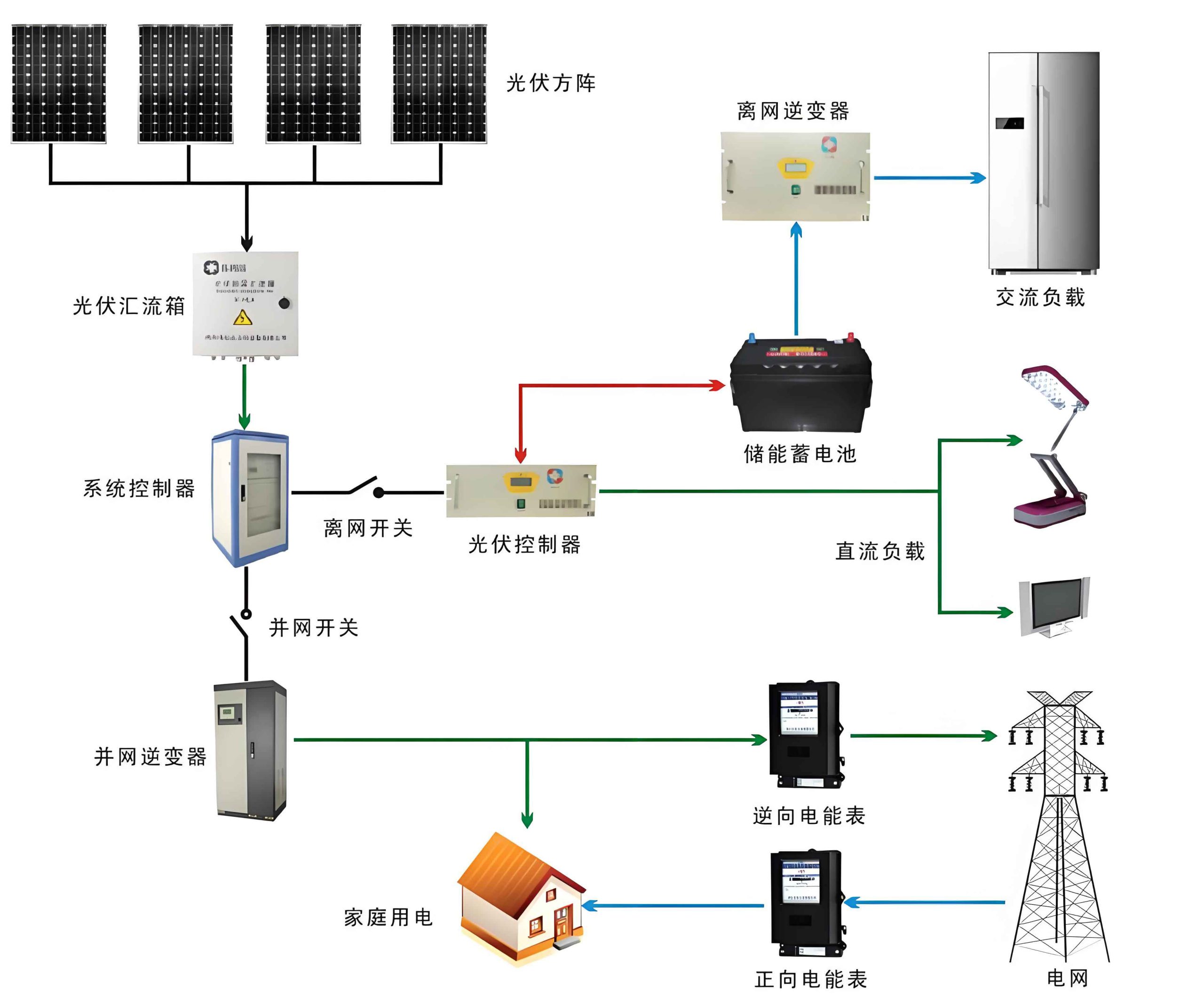
Let me delve into the key components of this solar system. First, solar panels are the heart of the setup. They are composed of photovoltaic cells that generate direct current (DC) electricity when exposed to sunlight. The output power of a solar panel can be expressed as: $$ P_{pv} = \eta_{pv} \cdot A_{pv} \cdot G $$ where \( P_{pv} \) is the power output in watts, \( \eta_{pv} \) is the conversion efficiency of the panel, \( A_{pv} \) is the surface area in square meters, and \( G \) is the solar irradiance in watts per square meter. Common types include monocrystalline silicon, polycrystalline silicon, and amorphous silicon panels, with monocrystalline offering the highest efficiency but at a higher cost. In my projects, I often use polycrystalline panels for their balance of cost and performance. These panels have a lifespan of around 25 years, making them a long-term investment. To optimize the solar system, panels are arranged in arrays, and their configuration can be adjusted based on power requirements. For instance, a typical solar system for a small farm might involve a 3 kWp array, which can power a pump for several hours daily.
Next, the inverter plays a critical role in converting DC electricity from the panels into alternating current (AC) to run standard AC pumps. Modern inverters in a solar system incorporate maximum power point tracking (MPPT) technology, which ensures that the panels operate at their optimal power output despite varying sunlight conditions. The inverter’s output frequency can be adjusted to control the pump speed, enhancing efficiency. For example, if the solar irradiance drops, the inverter reduces the frequency to prevent pump stall, and it shuts down automatically below a set threshold. The power relationship for the pump can be described as: $$ P_{pump} = \frac{\rho g Q H}{\eta_{pump}} $$ where \( \rho \) is the water density (approximately 1000 kg/m³), \( g \) is the acceleration due to gravity (9.81 m/s²), \( Q \) is the flow rate in cubic meters per second, \( H \) is the total dynamic head in meters, and \( \eta_{pump} \) is the pump efficiency. By integrating an inverter, the solar system can use cost-effective AC pumps, which are widely available and easy to maintain.
The pump set is selected based on the water source and irrigation needs. In a solar system, submersible pumps are common for deep wells, while centrifugal pumps suit surface water sources. The choice depends on factors like head, flow rate, and power availability. For instance, a solar system designed for a 50-meter well might use a 3 kW submersible pump with a flow rate of 5 m³/h. To ensure reliability, the solar system includes water storage facilities, such as tanks or ponds, to buffer against cloudy days. The storage capacity \( V_{storage} \) can be calculated based on daily water demand \( D \) and the number of autonomy days \( n \): $$ V_{storage} = n \cdot D $$ In practice, I recommend sizing storage to cover 2-3 days of irrigation to account for weather variability. This holistic approach to the solar system design ensures consistent water supply.
Field irrigation equipment, such as drip or micro-sprinkler systems, is integrated to maximize water use efficiency. When combined with a solar system, these technologies enable precise water application, reducing waste and enhancing crop yields. For example, drip irrigation can achieve water application efficiencies above 90%, compared to 60-70% for traditional flood irrigation. The synergy between the solar system and efficient irrigation is key to sustainable agriculture. In my work, I have implemented solar-powered drip systems that use solar energy to pump water directly into drip lines, minimizing energy losses.
To illustrate the technical aspects, here is a table summarizing typical components and specifications for a medium-scale solar photovoltaic water pumping system:
| Component | Specification | Role in Solar System |
|---|---|---|
| Solar Panels | Polycrystalline, 300 W each, 20 panels total (6 kWp) | Convert sunlight to DC electricity |
| Inverter | MPPT type, 5.5 kW output, with frequency control | Convert DC to AC and optimize power |
| Pump Set | Submersible AC pump, 4 kW, 100 m head, 8 m³/h flow | Lift water from source |
| Storage Tank | 50 m³ capacity, elevated for gravity feed | Store water for uninterrupted supply |
| Irrigation Network | Drip lines with emitters, pressure regulators | Deliver water efficiently to crops |
The economic viability of a solar system is a major consideration. Compared to diesel-powered pumping, solar photovoltaic systems have higher upfront costs but lower operating expenses. I have conducted analyses showing that the break-even point occurs within 3-4 years, after which the solar system becomes more cost-effective. For instance, a 5.5 kW solar system might cost around $20,900 initially, while a comparable diesel system costs $1,650 but incurs annual fuel and maintenance expenses of $5,484. Over 25 years, the solar system saves significant costs and reduces carbon emissions. The net present value (NPV) of a solar system can be calculated as: $$ NPV = -C_0 + \sum_{t=1}^{T} \frac{S_t – O_t}{(1 + r)^t} $$ where \( C_0 \) is the initial investment, \( S_t \) is the savings in year \( t \), \( O_t \) is the operating cost, \( r \) is the discount rate, and \( T \) is the system lifespan. In many cases, the NPV turns positive within a decade, affirming the long-term benefits of adopting a solar system.
Here is a detailed table comparing the economics of solar photovoltaic and diesel pumping systems for various power ratings, based on data from my projects:
| Pump Power (kW) | Solar System Cost ($) | Diesel System Cost ($) | Annual Diesel Opex ($) | Break-even Point (years) | CO₂ Reduction over 25 years (tons) |
|---|---|---|---|---|---|
| 3 | 13,500 | 620 | 3,337 | 3.86 | 286.8 |
| 4 | 16,200 | 1,550 | 4,747 | 3.09 | 545.75 |
| 5.5 | 20,900 | 1,650 | 5,484 | 3.51 | 682.8 |
| 7.5 | 23,530 | 2,225 | 7,446 | 2.86 | 1,023.5 |
| 11 | 34,100 | 2,280 | 9,304 | 3.42 | 1,365 |
| 15 | 45,000 | 2,280 | 10,802 | 3.96 | 1,643.3 |
| 18.5 | 49,300 | 2,312 | 13,042 | 3.60 | 2,047.3 |
| 22 | 58,000 | 2,875 | 16,768 | 3.29 | 2,733 |
Beyond economics, the solar system delivers substantial agronomic benefits. In demonstration projects across arid regions, solar-powered irrigation has boosted crop and forage yields dramatically. For example, in grassland areas, irrigated pastures produced up to 21.65 times more biomass than natural grazing lands. This is because the solar system enables consistent water supply, allowing for the cultivation of high-value crops like alfalfa and legumes. The yield increase \( \Delta Y \) can be modeled as: $$ \Delta Y = \alpha \cdot W_{applied} $$ where \( \alpha \) is a crop-specific coefficient and \( W_{applied} \) is the water applied via the solar system. Additionally, water-saving technologies integrated with the solar system reduce consumption by 20-55%, depending on the irrigation method. The table below summarizes yield improvements and income gains from various solar system installations I have overseen:
| Location | Solar System Power | Crop/Pasture Type | Yield Increase (%) | Water Savings (%) | Farmer Income Rise (fold) |
|---|---|---|---|---|---|
| Inner Mongolia | 1.4-1.5 kWp | Alfalfa, maize | 600 | 25 | 6 |
| Qinghai | 3.84 kWp | Mixed grasses | 20-45 | 55.56 | Significant |
| Xinjiang | 3 kWp | Alfalfa | 210.71 | 22.9 | 2.1 |
| Tibet | 3 kWp | Alfalfa, barley | 2,065 | 49-57 | 2.1-2.7 |
The social benefits of deploying a solar system are equally impressive. By providing clean energy for irrigation, these systems reduce reliance on fossil fuels, lower greenhouse gas emissions, and improve air quality. In remote communities, a solar system can power not only pumps but also small household appliances, enhancing living standards. Moreover, the solar system reduces labor intensity—women and children no longer need to fetch water manually—and fosters economic stability by increasing agricultural productivity. From an ecological perspective, a well-designed solar system helps rehabilitate degraded lands. For instance, irrigating one hectare with a solar system can produce fodder equivalent to 10-30 hectares of natural pasture, allowing overgrazed areas to recover. This aligns with global efforts to combat desertification and promote biodiversity.
However, challenges remain in widespread adoption of solar systems. The high initial investment is a barrier for smallholder farmers, though declining panel costs and government subsidies are mitigating this. Technical issues like system sizing and weather dependence require careful planning. I address this by using simulation tools to match solar system components to local solar resources and water needs. The performance ratio \( PR \) of a solar system can be assessed as: $$ PR = \frac{E_{actual}}{E_{theoretical}} $$ where \( E_{actual} \) is the actual energy output and \( E_{theoretical} \) is the expected output under standard conditions. By optimizing PR, the solar system’s reliability improves. Additionally, integrating battery storage or hybrid designs can buffer against intermittency, though this adds cost. In my experience, farmer training and after-sales support are crucial for sustaining solar system operations.
Looking ahead, advancements in solar technology promise to make solar systems even more efficient and affordable. Innovations like bifacial panels, which capture sunlight from both sides, can boost energy yield by up to 30%. Smart controllers that use IoT sensors to adjust pumping based on soil moisture and weather forecasts are enhancing the autonomy of solar systems. Furthermore, policy incentives, such as feed-in tariffs and carbon credits, could accelerate deployment. I envision a future where solar systems are ubiquitous in rural areas, powering not just irrigation but entire agro-ecological cycles. Research into organic photovoltaic materials may lead to flexible, low-cost panels, further democratizing access.
In conclusion, solar photovoltaic water pumping irrigation represents a transformative approach to sustainable agriculture. Through my work, I have seen how a properly implemented solar system can alleviate water and energy poverty while safeguarding the environment. The synergy between solar energy, efficient irrigation, and agronomic practices creates a virtuous cycle of productivity and resilience. As solar system costs continue to fall and awareness grows, I am confident that this technology will play a pivotal role in achieving food security and climate goals worldwide. By embracing solar systems, we can harness the sun’s power to nourish both people and the planet.
To further illustrate the technical design, consider the equation for sizing a solar system based on daily water requirement: $$ P_{pv} = \frac{\rho g Q H_{total}}{G_{peak} \cdot \eta_{system} \cdot t_{sun}} $$ where \( P_{pv} \) is the peak PV power in watts, \( Q \) is the daily water volume in m³, \( H_{total} \) is the total head in meters, \( G_{peak} \) is the peak solar irradiance (typically 1000 W/m²), \( \eta_{system} \) is the overall system efficiency (including inverter and pump), and \( t_{sun} \) is the equivalent sunshine hours per day. For example, if a farm needs 50 m³/day at a 30 m head, with 5 sun hours and 40% efficiency, the required PV power is: $$ P_{pv} = \frac{1000 \cdot 9.81 \cdot 50 \cdot 30}{1000 \cdot 0.4 \cdot 5 \cdot 3600} \approx 2.04 \text{ kW} $$ This calculation helps in designing a robust solar system. Additionally, the levelized cost of water (LCOW) for a solar system can be derived as: $$ LCOW = \frac{C_{capital} + \sum_{t=1}^{T} O_t}{(1 + r)^t \cdot V_{water}} $$ where \( V_{water} \) is the total water pumped over the system’s life. In many cases, LCOW for solar systems becomes lower than diesel after a few years, underscoring their economic merit.
Finally, I emphasize that the success of a solar system hinges on holistic planning—from site assessment to community engagement. By sharing these insights, I hope to inspire wider adoption of solar photovoltaic water pumping, paving the way for a greener, more prosperous future. The solar system is not just a technology; it is a catalyst for sustainable development, empowering communities to thrive in harmony with nature.