
In my years of experience in the field of highway infrastructure and automation, I have witnessed a significant shift towards sustainable energy solutions. As energy crises loom and environmental pressures mount, the adoption of renewable sources has become imperative. Among these, solar energy stands out as a promising alternative, particularly in remote applications like highway monitoring. This article delves into the application of solar photovoltaic systems in highway monitoring, exploring their advantages, technical intricacies, and future potential. I will emphasize the role of solar systems in transforming how we power surveillance and control equipment along roadways, ensuring reliability and efficiency while reducing carbon footprints.
The growing awareness of energy scarcity has propelled solar power to the forefront of technological innovation. Fossil fuels, being finite and polluting, are increasingly unsustainable for long-term development. Solar energy, in contrast, offers an abundant and clean alternative. The photovoltaic effect, which converts sunlight directly into electricity, forms the basis of solar systems. In highway monitoring, these systems provide a decentralized power source, eliminating the need for extensive grid connections. From my perspective, the integration of solar systems into highway networks is not just a trend but a necessity for future-proof infrastructure. The solar system, with its modular design and scalability, can be tailored to meet the diverse power demands of cameras, sensors, and communication devices.
Let me begin by outlining the key advantages of using solar photovoltaic systems in highway monitoring. Traditional AC power supply, typically at 220V, poses several challenges. First, the cost of laying cables over long distances is prohibitive, often limiting the range to under 2 kilometers. Second, grid power is prone to instability, with frequent outages or voltage fluctuations that can damage sensitive monitoring equipment. In contrast, a solar system offers a robust solution. It eliminates cable costs and the risk of theft associated with exposed wiring. Moreover, solar energy is inexhaustible; once installed, the system provides free power for decades, leading to substantial savings on electricity bills. A well-designed solar system can ensure uninterrupted operation even during extended cloudy periods, typically up to 14 days, thanks to efficient battery storage. The stable DC output from batteries protects devices from power surges, enhancing their lifespan. To illustrate these benefits, consider the following comparison table:
| Aspect | Traditional AC Power | Solar Photovoltaic System |
|---|---|---|
| Initial Cost | High (cabling and infrastructure) | Moderate (components and installation) |
| Operational Cost | Ongoing electricity bills | Minimal (free solar energy) |
| Reliability | Prone to grid failures | High (with battery backup) |
| Environmental Impact | Carbon emissions from grid power | Zero emissions |
| Maintenance | Regular checks on cables and transformers | Low (mostly battery replacement) |
| Scalability | Limited by grid capacity | Easy to expand with additional panels |
As shown, the solar system outperforms traditional methods in multiple dimensions. This makes it an ideal choice for highway monitoring, where equipment is often deployed in isolated areas. In my work, I have seen how solar systems reduce downtime and maintenance visits, leading to cost savings over the system’s lifetime, which can exceed 20 years for the photovoltaic panels.
Now, let’s delve into the technical details of a solar photovoltaic system for highway monitoring. The system is essentially a standalone DC power supply that harnesses solar energy through photovoltaic panels, stores it in batteries, and manages distribution via a controller. It is designed for unmanned operation, with remote monitoring capabilities from a central control center. The core components include the solar array, battery bank, charge controller, emergency charging unit, load distribution panel, online monitoring system, and auxiliary equipment. Each part plays a critical role in ensuring the solar system’s efficiency and reliability.
The solar array, composed of photovoltaic modules, is the primary energy harvester. These modules convert sunlight into electricity using semiconductor materials, typically silicon. The power output depends on factors like solar irradiance, panel efficiency, and orientation. For instance, the power generated by a panel can be expressed as:
$$P = \eta \times A \times G$$
where \(P\) is the power in watts, \(\eta\) is the conversion efficiency, \(A\) is the surface area in square meters, and \(G\) is the solar irradiance in watts per square meter. High-efficiency monocrystalline silicon cells, with efficiencies above 17%, are preferred for highway applications due to their superior performance in varied weather conditions. The modules are encapsulated with materials like ethylene-vinyl acetate (EVA) and a Tedlar-polyester-Tedlar (TPT) backsheet to protect against environmental degradation. An aluminum frame provides mechanical strength, while low-iron tempered glass ensures high transmittance across the solar spectrum. To optimize energy capture, the panels are mounted on adjustable支架 that can be angled based on geographic location. The following table summarizes typical specifications for solar panels used in highway monitoring:
| Parameter | Value | Description |
|---|---|---|
| Cell Type | Monocrystalline Silicon | High efficiency and durability |
| Efficiency | 17-20% | Percentage of sunlight converted to electricity |
| Power Rating | 300-400 W per panel | Standard for off-grid systems |
| Operating Temperature | -40°C to 85°C | Suitable for harsh environments |
| Warranty | 25 years | Long-term performance guarantee |
The battery bank is the energy storage heart of the solar system. It ensures power availability during nights and cloudy days. Selection of batteries is crucial, as they must withstand extreme temperatures and deep discharge cycles. Lead-acid batteries, particularly valve-regulated lead-acid (VRLA) types, are common due to their cost-effectiveness and reliability. However, lithium-ion batteries are gaining popularity for their higher energy density and longer cycle life. The battery capacity is determined by the load demand and autonomy requirements. For a highway monitoring system, the load might include cameras, sensors, and communication modules consuming, say, 100 Wh per day. To account for autonomy during 14 days of low sunlight, the required battery capacity can be calculated as:
$$C = \frac{L \times D}{\eta_b \times \text{DoD}}$$
where \(C\) is the battery capacity in watt-hours, \(L\) is the daily load in watt-hours, \(D\) is the number of autonomy days, \(\eta_b\) is the battery efficiency (typically 0.9), and DoD is the depth of discharge (recommended at 0.8 to prolong life). For example, if \(L = 100 \text{ Wh}\), \(D = 14\), \(\eta_b = 0.9\), and \(\text{DoD} = 0.8\), then:
$$C = \frac{100 \times 14}{0.9 \times 0.8} = \frac{1400}{0.72} \approx 1944 \text{ Wh}$$
This translates to a battery bank of approximately 2000 Wh, which might consist of multiple 12V batteries in series or parallel. Proper thermal management is essential; batteries are often housed in insulated boxes to mitigate temperature effects on performance and lifespan.
The charge controller, or energy manager, is the brain of the solar system. It regulates the flow of electricity between the panels, batteries, and loads. Modern controllers use maximum power point tracking (MPPT) technology to optimize energy harvest from the panels. They also prevent overcharging and deep discharge of batteries, which can cause damage. The controller’s algorithms can be programmed for different operating modes, such as load shedding during low battery voltage. For instance, if the battery voltage drops below a set threshold (e.g., 11.5V for a 12V system), the controller disconnects non-critical loads to conserve energy. When voltage recovers, loads are reconnected automatically. This intelligent management enhances the reliability of the solar system. The controller’s efficiency can be modeled as:
$$\eta_c = \frac{P_{\text{out}}}{P_{\text{in}}}$$
where \(P_{\text{out}}\) is the power delivered to the battery or load, and \(P_{\text{in}}\) is the power from the panels. High-quality controllers achieve efficiencies above 95%. Additionally, they include communication ports for remote monitoring, allowing integration with central control systems.
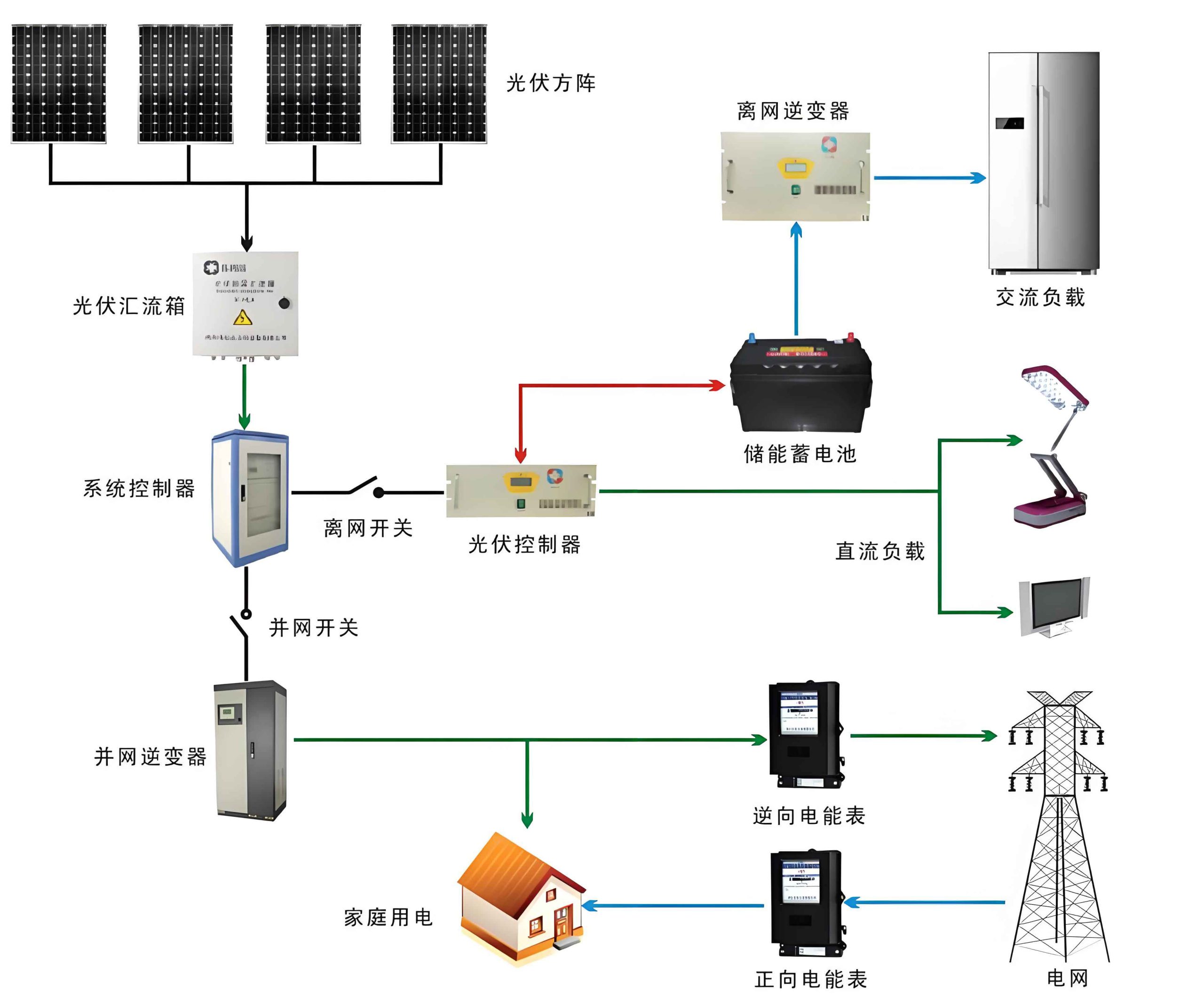
As visualized above, a typical solar system for highway monitoring integrates these components into a cohesive unit. The image shows the solar panels mounted on a支架, connected to a control box housing the batteries and controller, all designed for rugged outdoor use. This setup exemplifies how solar systems can be deployed efficiently along roadways.
Emergency charging is a vital backup feature in the solar system. During prolonged periods of inclement weather, the batteries may deplete beyond safe levels. To address this, an emergency charging interface allows for quick replenishment using external sources like a generator or grid power. A portable generator, such as a 5kW unit mounted on a vehicle, can provide AC power that is converted to DC via a charger. The charging current, often around 100A, can restore 90% of battery capacity within 4 hours. This ensures that the monitoring system remains operational even in extreme conditions, without compromising the solar system’s autonomy. The emergency charger’s output can be described by:
$$I_{\text{charge}} = \frac{C \times (1 – \text{SOC})}{t}$$
where \(I_{\text{charge}}\) is the charging current in amperes, \(C\) is the battery capacity in ampere-hours, SOC is the state of charge (e.g., 0.1 for 10%), and \(t\) is the desired charging time in hours. This feature adds resilience to the solar system, making it suitable for critical infrastructure.
Load distribution is another key aspect. The solar system’s output must be safely delivered to various monitoring devices. A load distribution panel, equipped with circuit breakers and fuses, protects against overloads and short circuits. It ensures that each device, such as cameras or sensors, receives stable DC power at the required voltage (e.g., 12V or 24V). The panel also allows for easy expansion, accommodating additional loads as the highway network grows. In my designs, I prioritize modularity so that the solar system can be scaled up without major reconfiguration. The power balance in the system can be expressed as:
$$P_{\text{solar}} + P_{\text{emergency}} = P_{\text{load}} + P_{\text{loss}}$$
where \(P_{\text{solar}}\) is the power from panels, \(P_{\text{emergency}}\) is backup power, \(P_{\text{load}}\) is the load consumption, and \(P_{\text{loss}}\) accounts for losses in wiring and components. Optimizing this balance is crucial for efficiency.
Online monitoring enhances the solar system’s manageability. A dedicated system tracks parameters like solar irradiation, battery voltage, and load status in real-time. Data is transmitted to a central control center via wireless communication (e.g., GSM or satellite). This allows for proactive maintenance, such as detecting panel soiling or battery degradation. The monitoring system uses sensors with high accuracy and isolation to avoid interfering with the power circuits. It can generate alerts for anomalies, ensuring timely intervention. For example, if the battery temperature rises above 40°C, an alarm can prompt cooling measures. The reliability of the monitoring system is quantified by its mean time between failures (MTBF), often exceeding 100,000 hours. This integration transforms the solar system into a smart grid element, contributing to overall highway automation.
Auxiliary equipment supports the core components. This includes mounting structures for panels, which are designed to withstand wind loads and corrosion. Batteries are housed in防盗 and insulated enclosures to protect against theft and temperature extremes. Cables and connectors are rated for outdoor use, with UV resistance and waterproofing. These elements, though often overlooked, are essential for the long-term performance of the solar system. In harsh environments, such as highways in northern regions, auxiliary measures like heating pads for batteries may be incorporated to maintain optimal operating temperatures.
To further illustrate the design process, let’s consider a case study for a highway monitoring point. Assume we have a load of 150W operating 24 hours a day, totaling 3600 Wh daily. The site receives an average solar irradiance of 5 kWh/m²/day. We need to size the solar system for 14 days of autonomy. First, calculate the required panel area using the efficiency formula. With panel efficiency of 18%, the daily energy output per square meter is:
$$E_{\text{panel}} = \eta \times G \times A = 0.18 \times 5 \times 1 = 0.9 \text{ kWh/m}^2$$
Thus, to meet the daily load of 3.6 kWh, the panel area needed is:
$$A = \frac{3.6}{0.9} = 4 \text{ m}^2$$
This corresponds to about two 400W panels. For battery capacity, using the formula earlier with \(L = 3600 \text{ Wh}\), \(D = 14\), \(\eta_b = 0.9\), and \(\text{DoD} = 0.8\):
$$C = \frac{3600 \times 14}{0.9 \times 0.8} = \frac{50400}{0.72} = 70000 \text{ Wh}$$
This is equivalent to a 7000 Ah battery bank at 12V. Such calculations demonstrate how the solar system can be tailored to specific needs. The following table summarizes key design parameters for different load scenarios:
| Load Power (W) | Daily Energy (Wh) | Panel Area (m²) | Battery Capacity (Wh) | Recommended Solar System Config |
|---|---|---|---|---|
| 50 | 1200 | 1.33 | 23333 | 1x300W panel, 2000Ah battery |
| 100 | 2400 | 2.67 | 46667 | 2x300W panels, 4000Ah battery |
| 200 | 4800 | 5.33 | 93333 | 4x300W panels, 8000Ah battery |
These examples highlight the scalability of solar systems. In practice, I often oversize components to account for inefficiencies and future expansions. The modular nature of the solar system allows for incremental upgrades, such as adding more panels or batteries as monitoring needs evolve.
The economic benefits of solar systems are substantial. While the initial investment may be higher than traditional wiring, the lifecycle cost is lower due to zero fuel costs and minimal maintenance. A simple payback period can be estimated as:
$$\text{Payback Period} = \frac{\text{Initial Cost}}{\text{Annual Savings}}$$
For instance, if a solar system costs $5000 to install and saves $1000 annually on electricity and maintenance, the payback is 5 years. Over a 20-year lifespan, this translates to significant savings. Moreover, solar systems reduce dependency on grid infrastructure, which is vulnerable to outages and price fluctuations. In remote highway sections, where grid extension is costly, solar systems offer a cost-effective solution. Governments and agencies worldwide are incentivizing such deployments through subsidies and policies, accelerating adoption.
Environmental impact is another critical factor. Solar systems generate clean energy, reducing greenhouse gas emissions. For a typical highway monitoring point powered by a solar system, the annual carbon offset can be calculated based on the equivalent grid electricity displacement. If the system produces 1000 kWh per year, and the grid emission factor is 0.5 kg CO₂ per kWh, the reduction is 500 kg CO₂ annually. Scaling this across multiple units along a highway network contributes meaningfully to climate goals. The solar system thus aligns with global sustainability initiatives, making highways greener and more resilient.
Technological advancements continue to enhance solar systems. Innovations like bifacial panels, which capture light from both sides, increase energy yield. Smart controllers with artificial intelligence optimize charging strategies based on weather forecasts. Battery technologies, such as solid-state or flow batteries, promise longer lifespans and faster charging. Integration with the Internet of Things (IoT) enables real-time data analytics for predictive maintenance. In my view, these developments will make solar systems even more attractive for highway monitoring, enabling smarter and more autonomous operations. The convergence of solar power with 5G communication and edge computing could revolutionize how traffic data is collected and processed.
In conclusion, the application of solar photovoltaic systems in highway monitoring represents a paradigm shift towards sustainable infrastructure. From my firsthand experience, these systems offer unparalleled advantages in terms of reliability, cost savings, and environmental benefits. The technical components—solar panels, batteries, controllers, and monitoring systems—work in harmony to deliver uninterrupted power in challenging environments. As solar technology evolves and costs decline, I anticipate widespread adoption across global highway networks. The solar system is not just a power source; it is a cornerstone of future-ready transportation ecosystems. By embracing this technology, we can build safer, smarter, and more sustainable roads for generations to come.
To reiterate, the solar system’s versatility allows it to meet diverse demands, from powering a single camera to an entire surveillance network. Its modular design facilitates easy installation and expansion, while intelligent management ensures optimal performance. As energy landscapes transform, solar systems will play a pivotal role in decoupling infrastructure growth from fossil fuel dependence. I encourage engineers and planners to consider solar solutions in their highway projects, leveraging this clean energy to enhance operational efficiency and resilience. The journey towards a solar-powered future is already underway, and highway monitoring is a prime arena for its realization.