
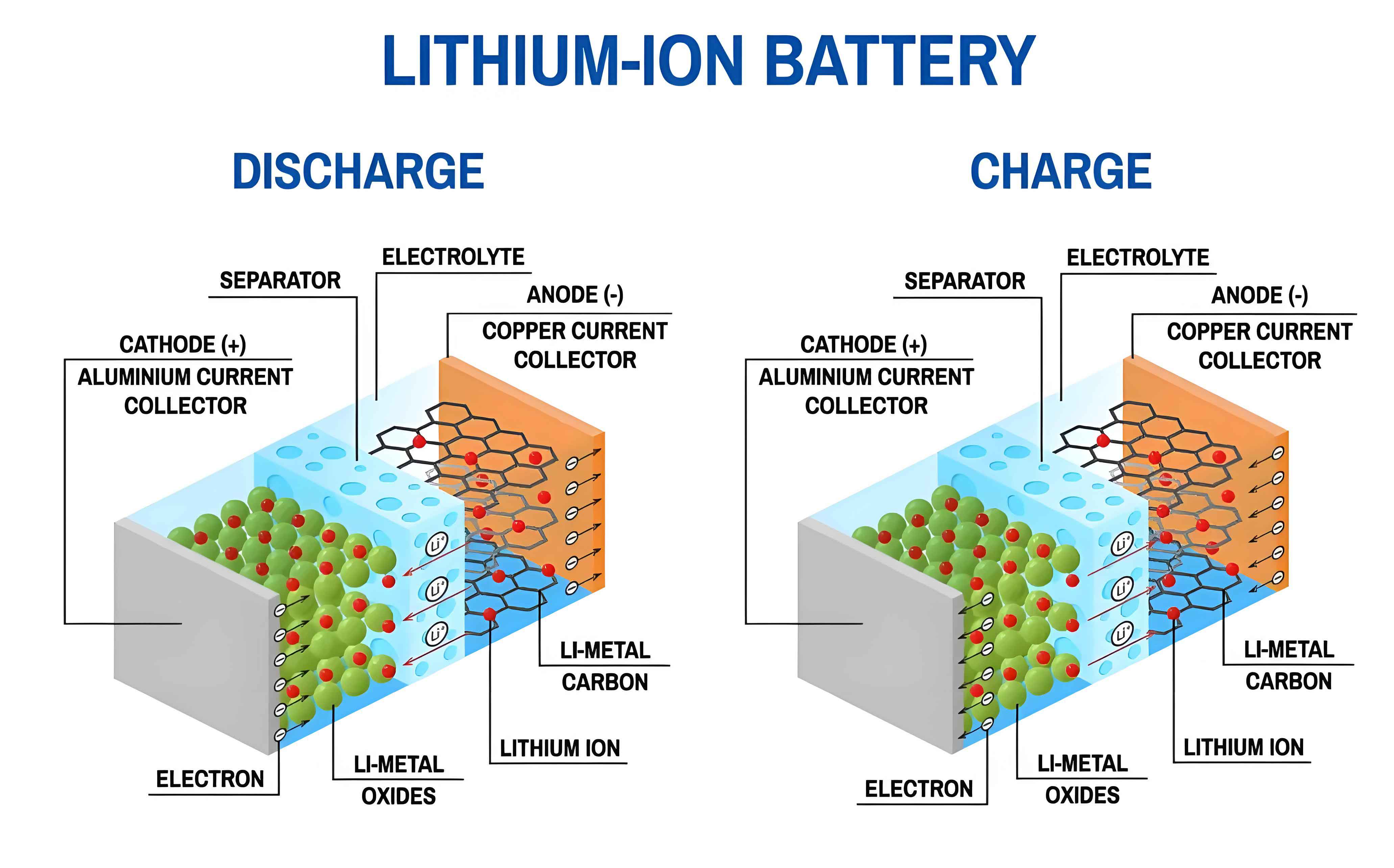
Amidst the dual challenges of energy depletion and environmental protection, the transition from traditional internal combustion engine vehicles to new energy vehicles has become a significant trend. The lithium-ion battery, renowned for its high energy density, long cycle life, and relatively low environmental footprint, has emerged as the predominant power source for electric vehicles and a cornerstone for large-scale energy storage systems. However, the pursuit of higher energy density to meet the demand for extended driving range often comes at the cost of safety. Incidents involving thermal runaway—an uncontrolled increase in temperature leading to fire or explosion—pose a major barrier to the widespread adoption of lithium-ion battery technology. A critical aspect of this hazardous process is the generation of significant volumes of flammable and toxic gases. A comprehensive investigation into the gas generation characteristics during the thermal runaway of lithium-ion batteries is therefore essential. It provides crucial insights for accurate risk assessment, the development of effective early warning systems, and the formulation of mitigation strategies. This article reviews the underlying mechanisms, detection methodologies, and recent research progress concerning gas generation under various abuse conditions, with a focus on the influence of key parameters.
1. Gas Generation Mechanism and Detection in Lithium-Ion Battery Thermal Runaway
1.1 The Process of Gas Generation
The thermal runaway of a lithium-ion battery is a complex chain of exothermic reactions triggered by abuse conditions such as overheating, overcharging, or mechanical damage. These reactions involve various battery components including the solid electrolyte interphase (SEI), anode, cathode, electrolyte, and binder, concurrently releasing substantial heat and gas.
The sequence typically initiates with the decomposition of the thermally unstable SEI layer on the anode, producing gases like ethylene (C2H4), carbon dioxide (CO2), and oxygen (O2). A representative reaction is:
$$ \text{(CH}_2\text{OCOOLi)}_2 \rightarrow \text{Li}_2\text{CO}_3 + \text{C}_2\text{H}_4 \uparrow + \text{CO}_2 \uparrow + \frac{1}{2}\text{O}_2 \uparrow $$
Subsequently, the exposed lithiated anode (e.g., graphite intercalated with lithium) reacts exothermically with the organic electrolyte solvents (e.g., ethylene carbonate, dimethyl carbonate), generating various hydrocarbon gases:
$$ 2\text{Li} + \text{CH}_2\text{OCOOCH}_2 \rightarrow \text{Li}_2\text{CO}_3 + \text{C}_2\text{H}_4 \uparrow $$
$$ 2\text{Li} + \text{C}_2\text{H}_5\text{OCOOC}_2\text{H}_5 \rightarrow \text{Li}_2\text{CO}_3 + \text{C}_2\text{H}_4 \uparrow + \text{C}_2\text{H}_6 \uparrow $$
As temperature escalates, the polyolefin separator melts, leading to internal short circuits. The cathode materials, especially those with layered structures, undergo decomposition at high temperatures, releasing oxygen which further fuels exothermic reactions. For instance:
$$ \text{Li}_x\text{CoO}_2 \rightarrow x\text{LiCoO}_2 + \frac{1-x}{3}\text{Co}_3\text{O}_4 + \frac{1-x}{3}\text{O}_2 \uparrow $$
$$ \text{Li}_{0.35}(\text{NiCoMn})_{1/3}\text{O}_2 \rightarrow \text{Li}_{0.35}(\text{NiCoMn})_{1/3}\text{O}_{2-y} + \frac{y}{2}\text{O}_2 \uparrow $$
The released oxygen and high temperature promote the oxidation and decomposition of the electrolyte and lithium salts (e.g., LiPF6), yielding gases such as carbon monoxide (CO), CO2, and hydrogen fluoride (HF):
$$ \text{CH}_2\text{OCOOCH}_2 + \text{O}_2 \rightarrow 3\text{CO} \uparrow + 2\text{H}_2\text{O} $$
$$ \text{CH}_2\text{OCOOCH}_2 + \frac{5}{2}\text{O}_2 \rightarrow 3\text{CO}_2 \uparrow + 2\text{H}_2\text{O} $$
$$ \text{LiPF}_6 + \text{H}_2\text{O} \rightarrow \text{LiF} + 2\text{HF} \uparrow + \text{POF}_3 $$
Furthermore, binder materials like polyvinylidene fluoride (PVDF) can decompose or react, contributing to the gas mixture:
$$ \text{-CH}_2\text{-CF}_2\text{-} \rightarrow \text{-CH=CF-} + \text{HF} \uparrow $$
$$ \text{-CH}_2\text{-CF}_2\text{-} + \text{Li} \rightarrow \text{-CH=CF-} + \text{LiF} + \text{H}_2 \uparrow $$
The cumulative effect is a rapid pressure build-up inside the lithium-ion battery cell, leading to venting, jet fires, and potentially catastrophic failure. The gas mixture is typically composed of H2, CO, CO2, and various hydrocarbons (CH4, C2H4, C2H6, etc.), along with toxic species like HF and CO.
1.2 Gas Detection Methods
Accurately characterizing the gas composition is vital for understanding the hazards. Three primary analytical techniques are commonly employed:
Gas Chromatography-Mass Spectrometry (GC-MS): This technique offers high sensitivity and excellent capability for both qualitative and quantitative analysis of complex gas mixtures from a lithium-ion battery. However, it requires sampling, which can alter the gas composition, and its analysis is relatively slow, making real-time monitoring challenging.
Fourier-Transform Infrared Spectroscopy (FTIR): FTIR allows for fast, non-invasive, and online monitoring of gas evolution. It can detect multiple gases simultaneously by analyzing infrared absorption spectra. While faster than GC-MS, its quantitative accuracy can be lower, especially for gases at low concentrations.
Raman Spectroscopy: As a non-destructive technique, Raman spectroscopy can provide real-time information on gas composition during the thermal runaway of a lithium-ion battery. It has good qualitative ability but generally suffers from weaker signal intensity compared to MS, making detection of low-concentration species more difficult.
Often, a combination of these techniques is used to leverage their respective strengths for a comprehensive analysis.
2. Gas Generation Characteristics Under Different Abuse Conditions
2.1 Thermal Abuse
Thermal abuse, where the lithium-ion battery is exposed to an external heat source, is a primary method for studying thermal runaway kinetics. Researchers commonly use tools like Accelerating Rate Calorimeters (ARC) coupled with gas analyzers.
Lithium Iron Phosphate (LFP) Cathode: Known for its safety, LFP batteries still undergo thermal runaway primarily due to reactions involving the electrolyte and other components. Studies show that a large-format LFP lithium-ion battery can release several moles of gas, with CO2, CH4, H2, and CO being dominant. The state of charge (SOC) significantly impacts the gas generation. Higher SOC generally leads to higher peak gas temperatures and increased generation of toxic gases like CO and HF. The toxicity of the emitted gas cocktail can be assessed using the Fractional Effective Dose (FED) index. Simulations suggest that the gas from multiple failing LFP lithium-ion battery cells in an enclosed space can reach critically toxic levels rapidly, emphasizing the need for robust ventilation in storage areas.
Lithium Cobalt Oxide (LCO) Cathode: LCO cathodes decompose at lower temperatures, releasing oxygen. The gas composition is rich in CO and H2. The Lower Explosive Limit (LEL) of the vent gas mixture is often found to be lower than that of methane, indicating higher flammability risk. The SOC also modulates the explosion limits, with mid-range SOCs (e.g., 50%) sometimes showing a narrower flammability range.
Lithium Nickel Manganese Cobalt Oxide (NCM) Cathode: The gas generation behavior of NCM lithium-ion batteries varies with the specific composition (e.g., NCM523, NCM622, NCM811). Generally, as SOC increases, total gas volume increases, with H2 and CO proportions rising while CO2 decreases. This leads to a widening of the flammability range (lower LEL, higher UEL), increasing the explosion risk. Higher nickel content (e.g., in NCM811) is associated with more violent reactions and greater CO/CO2 generation. Comparative studies indicate that while LFP batteries may produce gas with a lower LEL, high-nickel NCM batteries can release larger volumes of gas with a higher proportion of toxic CO.
Lithium Nickel Cobalt Aluminum Oxide (NCA) Cathode: Similar to high-nickel NCM, NCA lithium-ion batteries exhibit intense thermal runaway. They produce significant amounts of CO and H2, and their vent gas tends to have a wide flammability range, posing a substantial hazard.
Modeling Efforts: Computational models are being developed to predict gas generation during the thermal runaway of a lithium-ion battery. These models can estimate peak temperatures, onset conditions, and gas volumes with reasonable accuracy, providing a valuable tool for safety design and risk assessment without extensive testing.
2.2 Electrical Abuse (Overcharging)
Overcharging forces excess lithium out of the cathode, leading to structural collapse and oxygen release, while also promoting lithium plating and dendrite growth on the anode. For LFP lithium-ion batteries, overcharging-induced thermal runaway produces gases where H2 and CO2 are prominent. Interestingly, gas sensors often detect H2 significantly earlier than other signs like smoke or temperature spike, highlighting its potential as an early warning signal. Compared to pure thermal abuse, overcharging may lead to a lower total gas volume from an LFP lithium-ion battery but can generate toxic gas levels above the critical threshold even before full thermal runaway occurs. Higher charging rates (C-rates) during overcharge exacerbate the hazard, increasing the proportion of H2 and CO and lowering the LEL of the mixture.
2.3 Mechanical Abuse (Crush, Penetration)
Mechanical damage causes internal short circuits, rapidly generating heat and gas. Studies comparing mechanical penetration with thermal heating show that penetration typically generates less total gas from the lithium-ion battery. The gas composition also differs; for instance, heating in air produces more gas than penetration. The toxicity profile varies with the trigger method and cathode chemistry. For example, LFP cells heated in nitrogen can produce a highly toxic gas mix. In prismatic and pouch NCM lithium-ion batteries, the triggering method (side heating, nail penetration, overcharge, oven heating) influences the relative proportions of H2, CO, and hydrocarbons in the vent gas.
2.4 Summary and Comparative Analysis
The gas generation characteristics of a lithium-ion battery during thermal runaway are highly dependent on its chemistry, state of charge, and the triggering abuse condition. The table below summarizes key findings from various studies on different cathode materials.
| Cathode Material | Key Gas Components (Typical Order) | Influence of High SOC | Notable Hazards |
|---|---|---|---|
| LFP | CO2, H2, CH4, CO | Increases CO, HF, and peak temperature; may increase total gas volume. | Vent gas can have a low LEL, indicating high flammability risk. Toxic FED can be very high in enclosed spaces. |
| NCM (e.g., 523, 622) | CO2, CO, H2, CH4, C2H4 | Increases H2/CO, decreases CO2; widens flammability range (↓LEL, ↑UEL). | High gas volume and toxic CO generation. Flammability risk increases with SOC. |
| NCM811 / High-Ni | CO, CO2, H2, CH4 | Greatly increases gas volume and violence of reaction. | Very high combustion heat and gas production rate. |
| LCO | CO, H2, CO2, Hydrocarbons | Increases gas variety and concentration. | Vent gas mixture often more flammable than methane. |
| NCA | CO, H2, CO2 | Increases CO and H2 yield. | Wide flammability range, posing significant explosion hazard. |
3. Conclusion and Future Perspectives
The thermal runaway of lithium-ion batteries remains a critical safety concern, with gas generation being a central aspect of the hazard. Research has significantly advanced our understanding of how factors like cathode chemistry, SOC, and abuse condition influence the volume, composition, toxicity, and flammability of the emitted gases. This knowledge is fundamental for designing safer cells, developing reliable early warning systems based on gas detection, and implementing appropriate mitigation and emergency response protocols.
Future research should focus on several key areas to further enhance the safety of lithium-ion battery technology:
1. Aged Lithium-ion Batteries: Most studies focus on fresh cells. The gas generation characteristics of aged lithium-ion batteries, with degraded electrodes and thickened SEI layers, can differ substantially and require dedicated investigation using advanced characterization techniques.
2. Comprehensive Hazard Metrics: Risk assessment should move beyond gas composition and explosion limits to include parameters like flame propagation speed, jet fire temperature, and aerosol dynamics from vented smoke.
3. Module and Pack Level Studies: Experiments must scale up to large-format modules and packs to realistically simulate the cascading failure and gas accumulation hazards in actual electric vehicle or storage system applications.
4. Advanced Multi-Technique Detection: Integrating the strengths of GC-MS, FTIR, and Raman spectroscopy into unified monitoring systems will enable more accurate, real-time analysis of gas evolution from a failing lithium-ion battery.
5. Holistic Safety Design: Improving safety requires a multi-pronged approach: developing thermally stable materials (e.g., modified cathodes, solid-state electrolytes, flame-retardant additives), optimizing battery pack thermal management and fireproofing structures, and advancing Battery Management Systems (BMS) for integrated monitoring and active protection.
Through continued research in these directions, a deeper understanding of thermal runaway gas generation in lithium-ion batteries will be achieved, paving the way for the development of inherently safer energy storage solutions that support the sustainable energy transition.