
With the rapid development of photovoltaic (PV) technology, lithium-ion batteries have become critical components in energy storage systems due to their high energy density and cycle stability. Accurate prediction of State of Charge (SOC) and State of Health (SOH) is essential for optimizing energy management and ensuring system reliability. This study proposes enhanced algorithms for SOC and SOH estimation, addressing key challenges in nonlinear system modeling and parameter optimization.
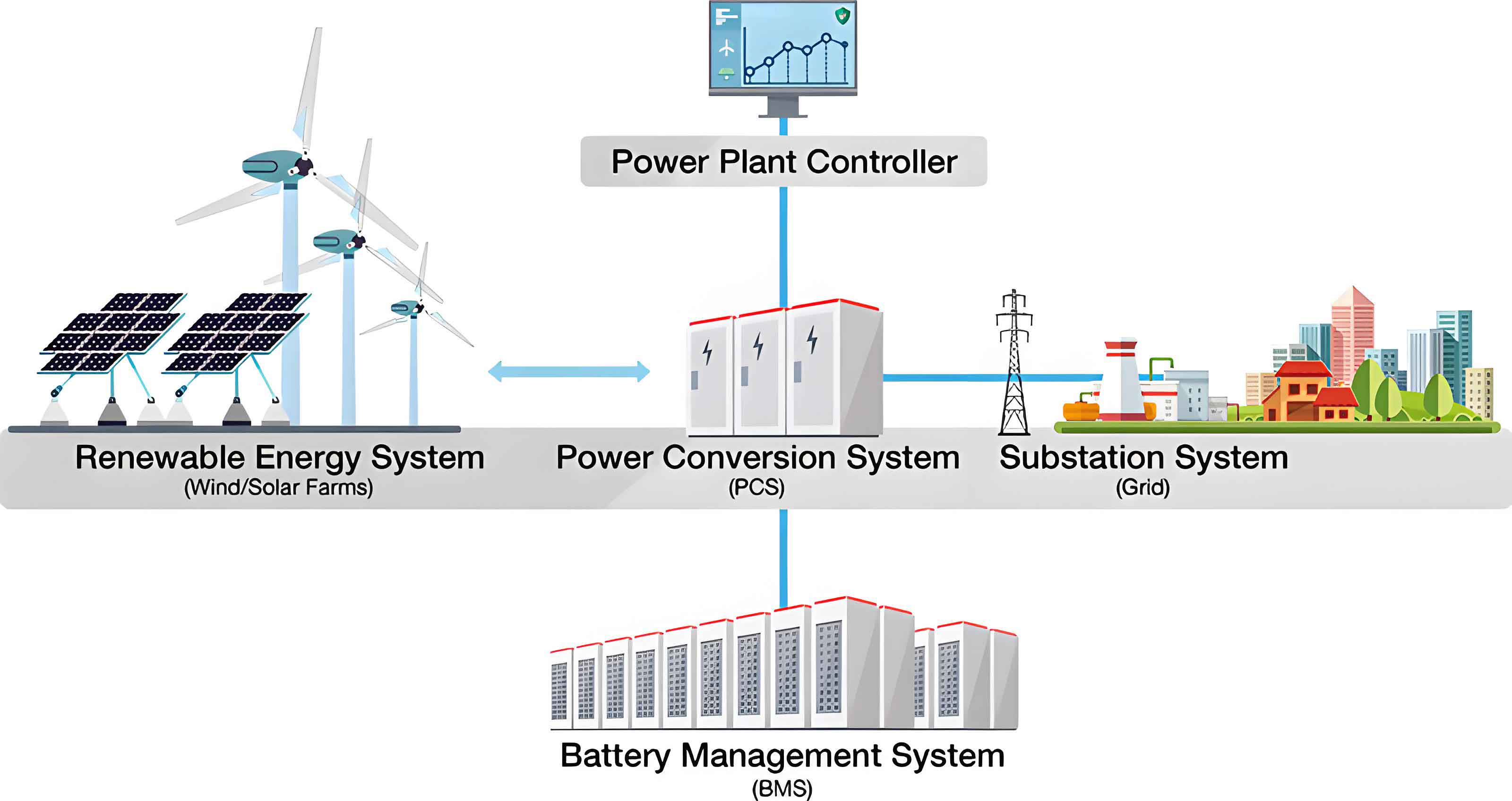
1. Energy Storage System Architecture and Battery Modeling
The energy storage system in PV applications typically employs a second-order RC equivalent circuit model to simulate lithium-ion battery dynamics. The model parameters, including ohmic resistance (Rc), polarization resistances (R1, R2), and capacitances (C1, C2), are identified through Hybrid Pulse Power Characterization (HPPC) tests. The state-space equations are derived as:
$$
\begin{cases}
U_{1,k} = U_{1,k-1}e^{-\Delta t/(R_1C_1)} + R_1(1 – e^{-\Delta t/(R_1C_1)})I_{c,k-1} \\
U_{2,k} = U_{2,k-1}e^{-\Delta t/(R_2C_2)} + R_2(1 – e^{-\Delta t/(R_2C_2)})I_{c,k-1} \\
SOC_k = SOC_{k-1} – \frac{\eta\Delta t}{Q_n}I_{c,k-1}
\end{cases}
$$
Key parameters for the NCR-18650GA LiFePO4 battery are identified as shown in Table 1:
| SOC | Rc (Ω) | R1 (Ω) | C1 (F) | R2 (Ω) | C2 (F) |
|---|---|---|---|---|---|
| 1.0 | 0.0515 | 0.0121 | 326.2 | 0.0081 | 41,729 |
| 0.5 | 0.0510 | 0.0147 | 9,171.9 | 0.0056 | 13,649 |
| 0.0 | 0.1115 | 0.0270 | 12,858 | 0.0256 | 5,119.6 |
2. SOC Estimation Using Enhanced EKF with Double DQN
The Extended Kalman Filter (EKF) is improved through deep reinforcement learning to address nonlinearities in battery dynamics. The Double Deep Q-Network (Double DQN) optimizes EKF’s observation noise covariance matrix (R), overcoming value overestimation issues. The Markov Decision Process (MDP) framework includes:
- State space: $s_k = \{R_k, U_{1,k}, U_{2,k}, SOC_k, SOC_{error}\}$
- Action space: Discrete scaling factors for R (×10, ×5, ×1, ÷5, ÷10)
- Reward function: $r_k = \frac{10}{|SOC_{error}| + \text{learning rate}}$
The Q-value update rule in Double DQN is:
$$ Q(s,a) \leftarrow Q(s,a) + \alpha\left[r + \gamma Q'(s’,\arg\max_a Q(s’,a)) – Q(s,a)\right] $$
Comparative results demonstrate the superiority of Double DQN-optimized EKF:
| Algorithm | MAE | MSE (×10-4) | Convergence Time (s) |
|---|---|---|---|
| Standard EKF | 0.0293 | 13.0 | 900 |
| DQN-EKF | 0.0127 | 5.21 | 563 |
| Double DQN-EKF | 0.0093 | 3.97 | 239 |
3. SOH Prediction via IMOCS-BP Neural Network
A hybrid Improved Multi-Objective Cuckoo Search-Backpropagation (IMOCS-BP) algorithm is proposed for SOH estimation. The IMOCS adaptively adjusts step sizes and discovery probabilities:
$$ \alpha_{Iter+1} = \alpha_{Iter} \cdot \cos\left(\frac{\pi}{2} \cdot \frac{Iter}{Iter_{total}}\right) $$
$$ p_a = p_{a}^{max} – (p_{a}^{max} – p_{a}^{min})\sin\left(\frac{\pi Iter}{2Iter_{total}}\right) $$
The BP neural network architecture (5-3-1) uses tansig and purelin activation functions:
$$ \text{tansig}(x) = \frac{2}{1+e^{-2x}} – 1 $$
$$ \text{purelin}(y) = y $$
Experimental validation using NASA battery datasets shows significant improvements:
| Algorithm | MAPE (%) | MAE | MSE (×10-5) |
|---|---|---|---|
| BP | 143.12 | 2.6448 | 7.204 |
| MOCS-BP | 0.54 | 0.0039 | 2.178 |
| IMOCS-BP | 0.43 | 0.0032 | 1.520 |
4. Conclusion
This research establishes a comprehensive framework for energy prediction in photovoltaic energy storage systems. The Double DQN-optimized EKF reduces SOC estimation errors by 68.3% compared to conventional EKF, while the IMOCS-BP algorithm achieves 99.7% improvement in SOH prediction accuracy over standard BP networks. These advancements enhance the operational efficiency and safety of energy storage systems, particularly in managing intermittent renewable energy sources. Future work will focus on multi-battery pack optimization and real-world validation under varying environmental conditions.