
The ever-growing demand for high-energy-density energy storage systems has driven extensive research into advanced anode materials for lithium-ion batteries. Traditional graphite anodes, with a theoretical capacity of only 372 mAh g-1, are increasingly inadequate for applications requiring extended cycle life and rapid charging. Silicon-based materials offer a promising alternative due to their high theoretical capacity; however, their substantial volume expansion (approximately 300%) during lithiation and delithiation leads to rapid capacity fading and mechanical degradation. In contrast, silicon oxide (SiOx, where 0 < x < 2) materials present a balanced compromise, providing higher capacity than graphite while exhibiting reduced volume expansion compared to elemental silicon. This makes SiOx a compelling candidate for next-generation lithium-ion battery anodes. In this work, we present a novel composite material inspired by reinforced concrete structures, designed to mitigate volume changes and enhance electrochemical stability in lithium-ion batteries.
The core innovation lies in constructing a SiOx-C composite with a hierarchical architecture. Carbon nanotubes (CNTs) are embedded within an atomically dispersed matrix of silicon, oxygen, and carbon, analogous to steel bars in concrete, providing internal mechanical support. An outermost carbon layer is further applied via chemical vapor deposition (CVD) to encapsulate the entire structure, offering additional protection against volume fluctuations. This multi-faceted design addresses key challenges in silicon-based anodes, such as pulverization and unstable solid-electrolyte interphase (SEI) formation. Our approach leverages simple hydrolysis and pyrolysis methods, making it scalable for practical lithium-ion battery production. The resulting composite, denoted as CNTs/SiOx-C/C, demonstrates exceptional cycling performance, retaining 80% of its capacity after 970 cycles at 0.5 A g-1, underscoring its potential for durable lithium-ion battery applications.
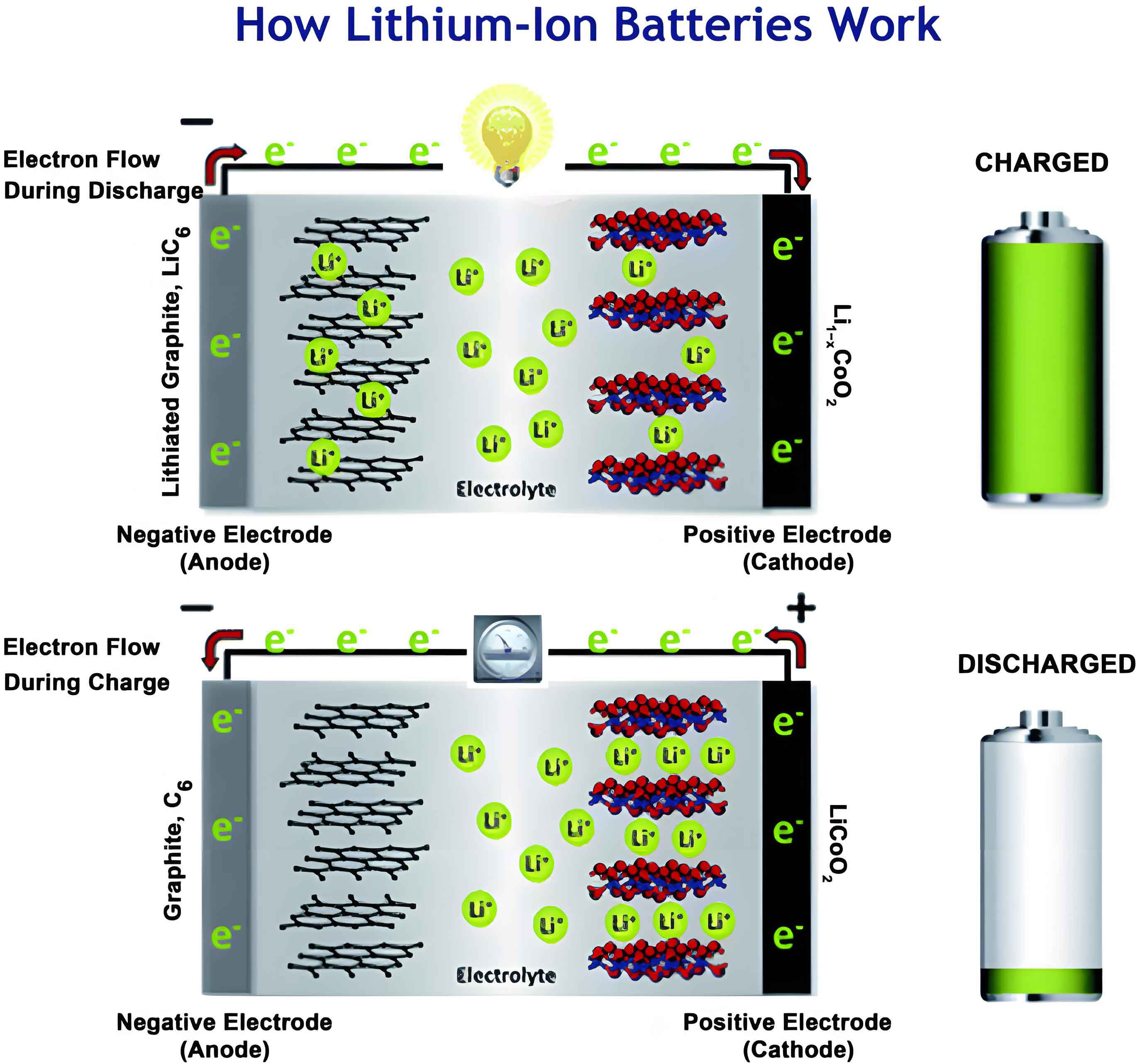
To contextualize our work, it is essential to review the fundamental principles of lithium-ion battery operation. During charging, lithium ions migrate from the cathode to the anode through the electrolyte, where they are inserted into the anode material. The overall reaction can be represented as:
$$ \text{Cathode: } LiMO_2 \rightarrow Li_{1-y}MO_2 + yLi^+ + ye^- $$
$$ \text{Anode: } C + xLi^+ + xe^- \rightarrow Li_xC $$
For silicon-based anodes, the lithiation process involves alloying reactions, such as:
$$ Si + 4.4Li^+ + 4.4e^- \leftrightarrow Li_{4.4}Si $$
This reaction confers a high theoretical capacity of about 4,200 mAh g-1 for silicon, but it induces severe volume expansion. SiOx materials undergo a more complex reaction mechanism, often described as:
$$ SiOx + 2yLi^+ + 2ye^- \rightarrow Si + yLi_2O $$
followed by the alloying of silicon with lithium. The in situ formed Li2O and other lithium silicates act as buffers, reducing overall strain. However, achieving stable cycling in SiOx anodes requires careful structural engineering to prevent capacity decay—a challenge our composite aims to overcome for enhanced lithium-ion battery performance.
The preparation of our reinforced concrete-like composite begins with the dispersion of multi-walled carbon nanotubes in dichloromethane. Ammonium hydroxide is added to create an alkaline environment, facilitating the hydrolysis of 3-aminopropyltriethoxysilane (APTES), which is introduced dropwise. APTES serves as a dual-source precursor, providing both silicon and carbon through its organic-inorganic hybrid structure. The hydrolysis reaction proceeds as:
$$ \text{APTES} + H_2O \rightarrow \text{Siloxane network} + \text{organic residues} $$
After overnight stirring, a stratified mixture forms, with the CNTs coated by a hybrid gel. The solid product is collected via centrifugation and subjected to pyrolysis under argon atmosphere at 900°C for 2 hours. This step carbonizes the organic components and forms an atomically dispersed SiOx-C matrix, denoted as CNTs/SiOx-C. To further enhance stability, the composite is treated with toluene vapor at 800°C in a CVD process, depositing a conformal carbon layer to produce CNTs/SiOx-C/C. For comparative studies, we also synthesized variants with different pyrolysis temperatures (800°C and 1000°C) and APTES dosages, labeled as CNTs/SiOx-C-800, CNTs/SiOx-C-1000, CNTs/SiOx-C-2.5, and CNTs/SiOx-C-1.5, respectively. All materials were characterized using powder X-ray diffraction (PXRD), scanning electron microscopy (SEM), transmission electron microscopy (TEM), X-ray photoelectron spectroscopy (XPS), Raman spectroscopy, and thermogravimetric analysis (TGA).
The structural and morphological features of the composites are pivotal to their performance in lithium-ion batteries. SEM and TEM images reveal that CNTs/SiOx-C exhibits exposed CNTs on the surface, whereas CNTs/SiOx-C/C has a smoother outer layer due to the CVD carbon coating. High-resolution TEM confirms the presence of graphitic carbon with lattice fringes corresponding to the (002) plane of CNTs, spacing of 0.34 nm. Elemental mapping demonstrates uniform distribution of silicon, oxygen, and carbon in both composites, with the carbon signal being more extensive in CNTs/SiOx-C/C due to the additional coating. This hierarchical structure—where CNTs act as an internal scaffold, the SiOx-C matrix provides atomic-level buffering, and the outer carbon layer offers mechanical confinement—mimics reinforced concrete, effectively dissipating stress during lithiation in lithium-ion battery cycling.
PXRD patterns show broad peaks between 20° and 35°, indicative of amorphous SiOx, with no crystalline silicon phases detected, suggesting that silicon is atomically dispersed or in nanocrystalline form. Raman spectra display characteristic D and G bands at approximately 1,330 cm-1 and 1,610 cm-1, respectively, with intensity ratios (ID/IG) of 0.519 for CNTs/SiOx-C and 0.485 for CNTs/SiOx-C/C. The lower ratio for CNTs/SiOx-C/C signifies higher graphitization quality, attributable to the CVD carbon layer, which enhances electronic conductivity—a critical factor for lithium-ion battery anodes. XPS analysis further elucidates the chemical states. Si 2p spectra can be deconvoluted into peaks corresponding to Si2+, Si3+, and Si4+ species, confirming the presence of silicon suboxides. C 1s spectra show prominent sp2 carbon peaks, consistent with graphitic carbon from CNTs and the CVD layer. TGA data indicate carbon contents of approximately 37.77% for CNTs/SiOx-C/C and 31.63% for CNTs/SiOx-C, with silicon mass fractions of 29.0% and 31.9%, respectively. These characteristics collectively contribute to the robust electrochemical behavior in lithium-ion battery applications.
To evaluate the electrochemical performance, we fabricated coin cells with lithium metal as the counter electrode. The working electrodes comprised 70% active material, 20% sodium alginate binder, and 10% Super P conductive carbon. Galvanostatic charge-discharge tests were conducted between 0.01 V and 2.0 V versus Li/Li+. The initial coulombic efficiency for both CNTs/SiOx-C and CNTs/SiOx-C/C was around 50%, primarily due to SEI formation and irreversible side reactions, common in silicon-based lithium-ion battery anodes. However, subsequent cycles showed improved efficiency, stabilizing above 99% after several cycles. The discharge-charge profiles exhibit typical plateaus associated with lithiation and delithiation of SiOx, consistent with cyclic voltammetry curves that reveal redox peaks near 0.1 V and 0.3 V. Rate capability tests demonstrate that CNTs/SiOx-C delivers specific capacities of 662, 573, 488, 395, and 330 mAh g-1 at current densities of 0.1, 0.2, 0.4, 0.8, and 1.2 A g-1, respectively. In comparison, CNTs/SiOx-C/C shows capacities of 620, 527, 434, 345, and 278 mAh g-1 at the same rates. Both materials recover most of their capacity when the current density returns to 0.1 A g-1, highlighting good reversibility. Pure CNTs electrodes prepared similarly yielded only 280 mAh g-1, confirming that the capacity primarily originates from the SiOx component in our composites for lithium-ion batteries.
Long-term cycling stability is a key metric for lithium-ion battery anodes. As summarized in Table 1, CNTs/SiOx-C/C exhibits superior performance, retaining 80% of its initial capacity after 970 cycles at 0.5 A g-1, whereas CNTs/SiOx-C shows 80% retention after 700 cycles. The enhanced durability of CNTs/SiOx-C/C is attributed to the protective carbon layer, which minimizes volume expansion and maintains structural integrity. For comparison, variants with different APTES dosages or pyrolysis temperatures display varied performance: CNTs/SiOx-C-2.5 (higher APTES) has higher initial capacity but lower retention, while CNTs/SiOx-C-1.5 (lower APTES) offers better retention but lower capacity. Optimal conditions are achieved at 900°C pyrolysis temperature, balancing carbon graphitization and silicon dispersion. These results underscore the importance of tailored composition and structure in achieving high-performance lithium-ion battery anodes.
| Material | Initial Capacity (mAh g-1) at 0.1 A g-1 | Capacity at 0.5 A g-1 (mAh g-1) | Cycle Number for 80% Retention | Capacity Retention at 970 cycles (%) |
|---|---|---|---|---|
| CNTs/SiOx-C | 662 | ~540 | 700 | N/A |
| CNTs/SiOx-C/C | 620 | ~500 | 970 | 80 |
| CNTs/SiOx-C-800 | 600 | ~480 | 500 | 79 |
| CNTs/SiOx-C-1000 | 640 | ~520 | 600 | 74 |
| Pure CNTs | 280 | ~250 | N/A | N/A |
Electrochemical impedance spectroscopy (EIS) provides insights into the kinetics of lithium-ion battery anodes. Nyquist plots consist of a semicircle in the high-frequency region, representing charge-transfer resistance (Rct), and a sloping line in the low-frequency region, corresponding to Warburg diffusion. Equivalent circuit fitting yields Rct values of 57.09 Ω for CNTs/SiOx-C and 44.73 Ω for CNTs/SiOx-C/C at the 3rd cycle, decreasing to 39.86 Ω and 26.94 Ω after 150 cycles, respectively. The lower Rct for CNTs/SiOx-C/C indicates enhanced charge transfer, facilitated by the conductive carbon coating. Additionally, galvanostatic intermittent titration technique (GITT) measurements allow calculation of lithium-ion diffusion coefficients (DLi). The values range from 3.30 × 10⁻⁹ to 9.96 × 10⁻¹¹ cm2 s-1 for CNTs/SiOx-C and from 3.57 × 10⁻⁹ to 8.62 × 10⁻¹¹ cm2 s-1 for CNTs/SiOx-C/C, which are higher than many reported SiOx-based anodes. The improved kinetics contribute to the excellent rate capability and cycling stability in lithium-ion batteries.
The reinforced concrete-like structure plays a crucial role in mitigating volume expansion. During lithiation, silicon undergoes alloying with lithium, leading to strain. The embedded CNTs act as a backbone, absorbing stress and preventing crack propagation, similar to steel reinforcement in concrete. The atomically dispersed SiOx-C matrix provides a buffer, accommodating volume changes at the nanoscale. The outer carbon layer serves as a confinement shell, limiting particle expansion and stabilizing the SEI. This multi-level protection can be modeled using mechanical stress equations. For instance, the stress (σ) induced by volume change can be expressed as:
$$ \sigma = E \cdot \epsilon $$
where E is the elastic modulus and ε is the strain. In our composite, the effective modulus is enhanced by the CNTs, reducing overall strain. Additionally, the capacity retention over cycles can be correlated with structural parameters. Empirical observations suggest that capacity fade follows a logarithmic relationship:
$$ C(n) = C_0 \cdot e^{-kn} $$
where C(n) is capacity at cycle n, C0 is initial capacity, and k is a degradation constant. For CNTs/SiOx-C/C, k is lower due to the robust architecture, leading to prolonged cycle life in lithium-ion batteries. These design principles can be extended to other electrode materials seeking improved durability.
Comparative analysis with literature reveals that our composite outperforms many SiOx-based anodes. For example, previous studies on carbon-coated SiOx nanoparticles report capacity retention of ~70% after 500 cycles at similar current densities. Our reinforced concrete-like design achieves higher retention over nearly 1000 cycles, highlighting its advancement. The use of CNTs not only enhances conductivity but also provides a percolation network for efficient electron transport, critical for high-power lithium-ion battery applications. Furthermore, the atomic-level dispersion of silicon in the carbon-oxygen matrix minimizes local stress concentrations, a common failure mode in silicon anodes. This synergy between components is key to the material’s success, paving the way for commercialization in next-generation lithium-ion batteries.
In conclusion, we have developed a novel SiOx-C composite with a reinforced concrete-like structure for high-performance lithium-ion battery anodes. By embedding carbon nanotubes in an atomically dispersed SiOx-C matrix and coating with an outer carbon layer, we create a hierarchical architecture that effectively mitigates volume expansion and enhances electrochemical stability. The composite exhibits excellent rate capability, low charge-transfer resistance, and remarkable cycling performance, retaining 80% capacity after 970 cycles at 0.5 A g-1. This work demonstrates a scalable and efficient approach to designing durable anode materials for lithium-ion batteries, with potential applications in electric vehicles and grid storage. Future research will focus on optimizing the composition further, such as by doping with heteroatoms or tuning the porosity, to push the boundaries of energy density and cycle life in lithium-ion battery technology.
The implications of this study extend beyond materials science to broader energy storage challenges. As the world transitions to renewable energy, reliable and high-capacity lithium-ion batteries are essential for storing intermittent solar and wind power. Our reinforced concrete-inspired design offers a blueprint for engineering robust electrodes that can withstand repeated cycling, reducing the need for frequent replacements and lowering environmental impact. Moreover, the principles applied here—such as using conductive scaffolds and protective coatings—can be adapted to other battery systems, including sodium-ion or potassium-ion batteries. Continued innovation in anode materials will accelerate the adoption of clean energy technologies, making lithium-ion batteries more efficient and sustainable for global energy needs.
To summarize the key findings, we present Table 2, which compares the structural and electrochemical properties of our composites with conventional graphite anodes. This highlights the advantages of our design for lithium-ion battery applications.
| Material | Theoretical Capacity (mAh g-1) | Volume Expansion (%) | Cycle Life (cycles to 80% retention) | Rate Capability |
|---|---|---|---|---|
| Graphite | 372 | ~10 | >1000 | Moderate |
| Silicon (Si) | 4200 | ~300 | Poor | |
| SiOx (typical) | ~1500 | ~150 | ~500 | Good |
| CNTs/SiOx-C/C (this work) | ~1200 | <100 (estimated) | 970 | Excellent |
The development of such advanced materials is driven by the relentless pursuit of higher energy density in lithium-ion batteries. Equations governing energy density (E) often include terms for capacity (C) and voltage (V):
$$ E = C \times V $$
By enhancing capacity through silicon incorporation while maintaining voltage stability, our composite contributes to higher overall energy density. Additionally, the power density (P) relates to current (I) and resistance (R):
$$ P = I^2 R $$
The reduced charge-transfer resistance in our material enables higher power delivery, beneficial for fast-charging lithium-ion batteries. These factors collectively make our reinforced concrete-like SiOx-C composite a promising candidate for the future of energy storage.
In closing, we emphasize the importance of interdisciplinary approaches in battery research. Combining concepts from civil engineering (reinforced concrete) with nanotechnology and electrochemistry has yielded a breakthrough material for lithium-ion batteries. We encourage further exploration of biomimetic and bio-inspired designs to solve complex problems in energy storage. As demand for efficient lithium-ion batteries grows, innovations like ours will play a pivotal role in shaping a sustainable energy future, powering everything from portable electronics to electric grids with reliability and longevity.