
Lithium-ion batteries stand as a cornerstone technology for portable electronics, electric vehicles, and grid-scale energy storage due to their high energy density, long cycle life, and negligible memory effect. However, as the demand for higher energy density intensifies, particularly for applications like electric vehicles and emerging aerial mobility, conventional graphite anodes are approaching their theoretical limits. Graphite, an intercalation-type material, offers a moderate specific capacity of approximately 372 mAh g−1 and operates at a potential dangerously close to lithium plating (~0.1 V vs. Li/Li+), posing challenges for fast charging and safety.
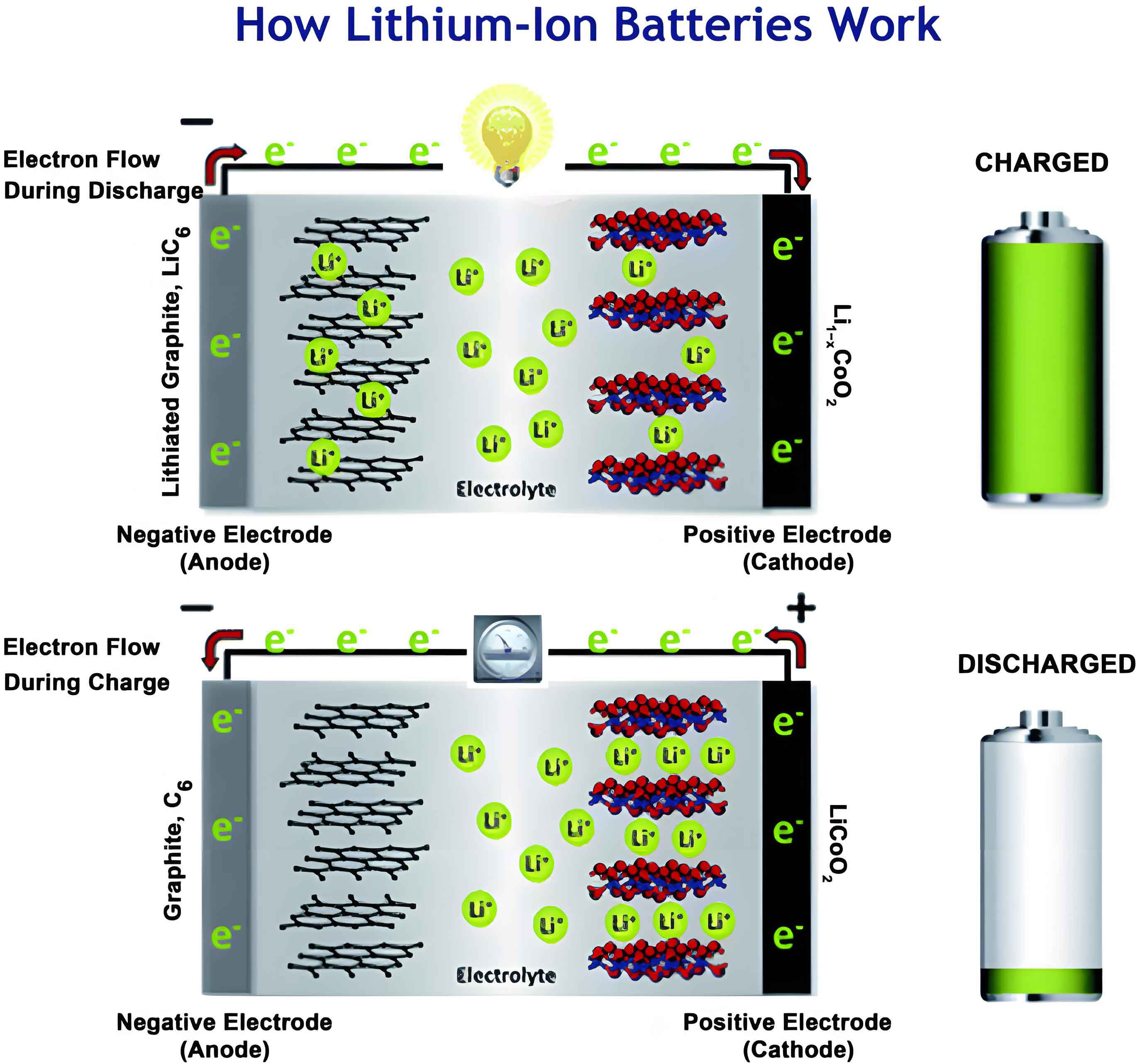
Schematic representation of a lithium-ion battery cell illustrating the working principle and key components, such as cathode, anode, separator, and electrolyte.
To break through this barrier, research has pivoted towards high-capacity non-graphite anode materials, primarily falling into two categories: alloy-type (e.g., Si, Ge, P, Sn) and conversion-type (e.g., transition metal oxides TMOs, including high-entropy oxides HEOs). These materials promise significantly higher theoretical capacities. For instance, silicon can alloy with lithium to form Li15Si4, offering a staggering capacity of about 3,579 mAh g−1. Similarly, conversion materials like Fe3O4 can deliver capacities exceeding 900 mAh g−1 through a reaction mechanism distinct from intercalation.
Despite their promise, these high-capacity anodes suffer from a critical flaw: a low initial Coulombic efficiency (ICE). The first charge-discharge cycle in a lithium-ion battery is notoriously inefficient due to irreversible consumption of active lithium ions. This loss stems primarily from the formation of the Solid Electrolyte Interphase (SEI), a passivating layer that forms on the anode surface as electrolyte components decompose at low potentials. For alloy and conversion materials, this problem is severely exacerbated by their substantial volume changes during lithiation/delithiation (often >300% for Si). This volumetric swing continuously fractures the SEI, exposing fresh anode material to the electrolyte and triggering further, irreversible side reactions that permanently trap lithium ions. Consequently, a significant portion of lithium extracted from the cathode during the first charge is never returned, drastically reducing the ICE (often to 60-85% vs. >90% for graphite) and depleting the finite lithium inventory from the start. This inefficiency directly compromises the achievable energy density and cycle life of the full lithium-ion battery.
Prelithiation has emerged as a pivotal strategy to overcome this hurdle. By introducing an additional, sacrificial source of lithium to the anode before cell assembly, the lithium lost during SEI formation and other irreversible processes is compensated. This “pre-filling” of the anode with lithium boosts the ICE, enhances the practical energy density, and improves long-term cycling stability by stabilizing the electrode-electrolyte interface from the very first cycle. This article provides a comprehensive review of recent advances in prelithiation techniques tailored for non-graphite anodes in lithium-ion batteries, categorizing them into physical, electrochemical, and chemical methods, and discusses their mechanisms, effectiveness, and prospects for industrialization.
The Imperative for Prelithiation in Non-Graphite Anodes
The electrochemical reactions governing alloy and conversion anodes inherently involve phases and volume changes that drive irreversibility. For a silicon-based anode, the lithiation proceeds as:
$$ \text{Si} + x\text{Li}^+ + x\text{e}^- \rightarrow \text{Li}_x\text{Si} \quad \text{(Alloying)} $$
For oxides like SiO, which contains both active Si and inactive SiO2 matrices, the reaction is more complex:
$$ 4\text{SiO} + 4\text{Li}^+ + 4\text{e}^- \rightarrow \text{Li}_4\text{SiO}_4 + \text{Si} $$
$$ \text{Si} + y\text{Li}^+ + y\text{e}^- \rightarrow \text{Li}_y\text{Si} $$
The formed Li4SiO4 can further react, leading to electrochemically inactive or partially active silicate phases that irreversibly bind lithium.
For conversion-type transition metal oxide anodes (TMOs), the reaction is:
$$ \text{TMO} + 2\text{Li}^+ + 2\text{e}^- \rightarrow \text{TM} + \text{Li}_2\text{O} \quad \text{(Conversion)} $$
Subsequently, some of the nanosized transition metal (TM) particles may further alloy with lithium:
$$ \text{TM} + z\text{Li}^+ + z\text{e}^- \rightarrow \text{Li}_z\text{TM} \quad \text{(Alloying, if applicable)} $$
The initial conversion step to form Li2O and metal nanoparticles is often associated with a large voltage hysteresis and significant irreversibility. The decomposition of Li2O upon delithiation is incomplete, and the restructuring of the material leads to trapped lithium. Furthermore, the massive volume change and pulverization during these reactions cause continuous SEI reformation. The net effect is a substantial deficit of active lithium when the anode is paired with a cathode in a full lithium-ion battery. Prelithiation addresses this deficit directly at the source.
Physical Prelithiation Methods
Physical methods involve the direct application of metallic lithium or lithium-containing species onto the anode electrode through mechanical or vapor-phase processes.
Direct Contact with Lithium Foil
This simple approach involves pressing a lithium metal foil directly against the dry or slightly electrolyte-wetted anode electrode. The potential difference drives the oxidation of Li and the reduction of the anode material at the points of contact.
Mechanism: Li+ ions diffuse from the foil into the anode particle, while electrons travel through the conductive network, leading to local lithiation: $\text{Anode} + \text{Li} \rightarrow \text{Li}_x\text{Anode}$.
Advantages: Conceptually simple and can be integrated into roll-to-roll manufacturing.
Challenges: Poor control over uniformity and degree of lithiation. Incomplete reaction leaves unreacted, insulating Li on the surface, increasing impedance and risk of lithium plating. Pressure, time, and interfacial contact are critical, hard-to-control parameters.
Recent Development: An advanced roll-to-roll transfer printing method has been developed. Lithium is first electrodeposited onto a carrier foil, which is then laminated and pressed against the anode electrode. The shear and compressive stresses during lamination control the transfer of a precise amount of lithium, enabling highly uniform prelithiation. This method significantly improved the ICE of a Si/C anode to 99.05% in half-cells and the full-cell energy density when paired with a high-Ni cathode.
Direct Contact with Lithium Powder
Stabilized lithium metal powder (SLMP), typically consisting of Li particles coated with a thin Li2CO3 layer, is dispersed onto the anode surface. A calendaring step breaks the coating, allowing direct Li-anode contact.
Mechanism: Similar to foil contact, but the powder form allows for better distribution. The pressure during calendaring fractures the passivation layer: $\text{Li}_2\text{CO}_3 \text{(shell)} \xrightarrow{\text{Pressure}} \text{Cracked}$, exposing fresh Li to the anode.
Advantages: Better uniformity than foil; dosage can be more easily adjusted by powder loading.
Challenges: SLMP is expensive and highly pyrophoric, requiring dry-room handling. Achieving a perfectly homogeneous distribution is difficult, and excess powder can lead to safety hazards and cell failure.
Recent Development: Research has clarified that prelithiation via SLMP is most effective in “anode-limited” full-cell designs (where the anode capacity is the limiting factor). In such designs, prelithiation of Si anodes increased ICE from ~80% to over 95% and dramatically extended cycle life in solid-state lithium-ion battery configurations.
Lithium Thermal Evaporation
This technique uses physical vapor deposition (PVD) in a vacuum chamber to coat the anode electrode with a thin, controlled layer of lithium metal.
Mechanism: Metallic lithium is heated to its vaporization point in a vacuum. The vapor condenses uniformly on the cooler anode substrate, forming a nanometric Li layer that reacts instantaneously with the top layer of anode particles.
$$ \text{Li (vapor)} \rightarrow \text{Li (film on anode)} \xrightarrow{\text{Reaction}} \text{Li}_x\text{Anode (surface)} $$
Advantages: Exceptional control over the prelithiation amount (via deposition time/rate) and superior uniformity. Allows for the pre-formation of a uniform SEI.
Challenges: High cost of vacuum equipment, low throughput, and incompatibility with standard electrode manufacturing. The deposited lithium is highly reactive and must be handled in inert atmospheres.
Recent Development: A roll-to-roll compatible vapor deposition process has been demonstrated. By controlling the Li evaporation rate and the web speed of the anode electrode roll, a consistent prelithiation layer was achieved. This raised the ICE of a silicon-based anode from 84% to 96% in half-cells and improved capacity retention in subsequent full-cell cycling within a lithium-ion battery.
| Method | Typical Anode Material | Key Advantage | Major Challenge | Industrial Scalability |
|---|---|---|---|---|
| Li Foil Contact | Si/C, SiOx/C | Simple, compatible with existing lines | Poor uniformity, difficult control | Moderate (with advanced transfer methods) |
| Li Powder (SLMP) | Si, SiOx | Dosage control, improved uniformity | Safety hazard (pyrophoric), cost | Moderate (requires dry rooms) |
| Thermal Evaporation | Si thin films, composite anodes | Excellent uniformity & thickness control | Very high cost, low throughput | Low (primarily for niche applications) |
Electrochemical Prelithiation Methods
These methods involve using an electrochemical cell to controllably drive lithium ions from a lithium source into the anode.
Half-Cell (Pre-Cycling) Method
The anode electrode is assembled against a lithium metal counter electrode in a temporary half-cell (coin or pouch). It is then subjected to one or more galvanostatic charge-discharge cycles before being disassembled, washed, and paired with its intended cathode.
Mechanism: Standard electrochemical lithiation in a Li||Anode cell: $\text{Anode} + x\text{Li}^+ + x\text{e}^- \xrightarrow{\text{Applied Current}} \text{Li}_x\text{Anode}$.
Advantages: Precise control over the state-of-charge (SOC) and degree of prelithiation. Allows for the formation of a stable, electrochemically formed SEI.
Challenges: Extremely labor-intensive, non-continuous, and generates waste (electrolyte, separators, Li foil). The harvesting and drying of the prelithiated electrode risk material degradation and contamination.
Recent Development: Applied to SiO2/C anodes, this method achieved an ICE of 95.82% in the subsequent full lithium-ion battery. The study noted that the stability of the pre-formed SEI was crucial for long-term cycling performance.
Electrochemical Short-Circuit Method
A simplified version of half-cell prelithiation. The anode is wetted with electrolyte and brought into direct contact with a Li foil under slight pressure, creating a spontaneous short circuit.
Mechanism: The potential difference between Li (0 V vs. Li/Li+) and the anode (e.g., ~0.3 V for Si) drives a spontaneous current until their potentials equalize. The reaction is diffusion-limited.
$$ E_{\text{cell}} = E_{\text{anode}} – E_{\text{Li}} > 0 \quad \Rightarrow \quad \text{Spontaneous Discharge (Lithiation)} $$
Advantages: Simpler and faster than full half-cell cycling; no need for a potentiostat/galvanostat.
Challenges: Control is based on contact time and pressure, which still leads to variability. High local currents can cause inhomogeneous lithiation and heating.
Recent Development: A 3-minute short-circuit treatment on a Si/C anode raised its ICE from 64.89% to 96.18%. The pre-formed LixSi phase helped buffer volume expansion in subsequent cycles.
Three-Electrode Cell Method
Similar to the half-cell method but conducted in a cell with a dedicated reference electrode (e.g., Li wire). This allows for precise potential control during prelithiation.
Mechanism: Potentiostatic or galvanostatic lithiation while monitoring the anode potential versus Li/Li+ precisely. Enables targeting specific voltage plateaus associated with phase transformations.
Advantages: Highest level of electrochemical control. Ideal for studying the fundamentals of prelithiation and for achieving a very specific, uniform lithiation state.
Challenges: Even more complex and low-throughput than the standard half-cell method. Not feasible for mass production of lithium-ion batteries.
Recent Development: Used to prelithiate a magnetite-based (Fe3O4) conversion anode. Controlled prelithiation created an active lithium reservoir, compensated for losses, and formed a thinner, more ionically conductive SEI. The full-cell cycle life was doubled compared to the non-prelithiated counterpart.
| Method | Control Parameter | Precision | Throughput | Suitable for |
|---|---|---|---|---|
| Half-Cell Pre-Cycling | Capacity (mAh/g) or Cycle Number | High | Very Low | Lab-scale research, small batches |
| Short-Circuit | Contact Time & Pressure | Low to Moderate | Low | Lab-scale, proof-of-concept |
| Three-Electrode Cell | Potential (V vs. Li/Li+) | Very High | Very Low | Fundamental mechanistic studies |
Chemical Prelithiation Methods
Chemical methods involve reacting the anode material with a lithium-containing chemical reagent, either during synthesis (in-situ) or as a post-synthesis treatment (ex-situ).
Lithium Salt Reduction (In-situ and Ex-situ)
In-situ: Lithium salts (e.g., Li2CO3, LiNO3) are mixed with other metal precursors during the synthesis of the anode material, typically for conversion-type High-Entropy Oxides (HEOs). For example, (CoNiZnFeMnLi)3O4 is synthesized via solid-state or solution combustion methods.
$$ \text{MO}_x + \text{Li}_2\text{CO}_3 \xrightarrow{\text{High T}} \text{Li}_y\text{M}_{1-y}\text{O}_z \quad \text{(M = combination of metals)} $$
Effect: Incorporates Li into the lattice, which can enhance electronic conductivity and create defects but often does not significantly improve ICE, as the lithium is in a stable, oxidized state.
Ex-situ: The synthesized anode powder is treated with a strong chemical reducing agent that contains lithium. A common example is using Lithium Hydride (LiH).
$$ \text{SiO} + \text{LiH} \xrightarrow{\Delta, \text{Inert Atm.}} \text{Li}_x\text{Si} + \text{Li}_y\text{SiO}_z + \text{H}_2 \uparrow $$
Effect: Directly reduces the active material (e.g., Si in SiO) and introduces metallic Li or lithium-rich phases. This can effectively prelithiate the material, boosting ICE. However, the reaction must be carefully controlled to prevent over-reduction or structural collapse.
Solution Immersion Method
The anode electrode or powder is immersed in a solution containing a stabilized lithium-arene complex, such as Lithium Naphthalenide or Lithium Biphenylide, in an ether-based solvent (e.g., Tetrahydrofuran – THF).
Mechanism: The complex acts as a single-electron transfer agent. The arene radical anion transfers an electron to the anode material, and the Li+ ion accompanies it to maintain charge neutrality.
$$ \text{Li(C}_{10}\text{H}_8) + \text{Anode} \rightarrow \text{Li}_x\text{Anode} + \text{C}_{10}\text{H}_8 $$
Advantages: Can achieve very uniform prelithiation at room temperature. The degree can be controlled by concentration and immersion time. The by-product (arene) is typically washed away.
Challenges: The reagents are extremely air- and moisture-sensitive, requiring strict inert atmosphere handling. The solvents are often flammable and volatile. The process may swell or damage certain polymer binders used in the electrode.
Recent Development (Scalable Process): A process has been developed to perform this chemistry outside a glovebox using a sealed reactor. After prelithiation of SiO/C anodes, a subsequent treatment with NF3 gas created a protective LiF-rich surface layer. This process achieved an ICE of 93.2% in half-cells and excellent capacity retention (96.1% after 200 cycles) in a full lithium-ion battery with a high-Ni cathode.
Recent Development (for HEOs): Applied to a spinel (FeCoNiCrMn)3O4 high-entropy oxide anode. Immersion in a lithium-arene solution created a graded, lithium-rich surface layer that effectively suppressed volume changes and raised the ICE from 78% to 97.5%. The full cell with an LFP cathode showed significantly improved rate capability and cycling stability.
| Method | Reagent Type | Primary Target | ICE Improvement | Key Issue |
|---|---|---|---|---|
| In-situ Li Salt | Li2CO3, LiNO3 | HEOs, TMOs | Moderate (mainly structural benefit) | Lithium is in oxidized state |
| Ex-situ Reduction (LiH) | Strong Reductant (LiH) | SiOx, Alloy materials | High (e.g., 65% → 85%) | Hazardous H2 generation, high T |
| Solution Immersion | Li-Arene Complex | Si, SiOx, TMOs, HEOs | Very High (e.g., 78% → 97.5%) | Extreme sensitivity, solvent hazards |
Conclusions and Future Perspectives
Prelithiation is no longer just a lab-scale curiosity but a critical enabler for the next generation of high-energy-density lithium-ion batteries based on alloy and conversion anodes. Each class of techniques offers distinct trade-offs between control, uniformity, scalability, safety, and cost.
- Physical Methods: Direct contact methods (foil/powder) are the closest to industrialization, especially advanced roll-to-roll transfer printing, offering a balance of performance and manufacturability. Thermal evaporation provides unparalleled control but remains a high-cost option for specialized applications.
- Electrochemical Methods: Offer the highest degree of control and are invaluable for research and establishing fundamental understanding. However, their discontinuous nature and material handling complexities present formidable barriers to mass production.
- Chemical Methods: Particularly the solution immersion approach, have demonstrated remarkable effectiveness in boosting ICE for both alloy and conversion materials, including complex HEOs. The development of scalable, closed-system reactors for handling air-sensitive reagents is a promising step toward commercialization.
Looking forward, the evolution of prelithiation technology for lithium-ion batteries will focus on several key areas:
- From Lab to Fab: The paramount challenge is transitioning high-efficacy methods (like controlled transfer printing or sealed chemical reactors) to cost-effective, high-throughput, and safe manufacturing processes that integrate seamlessly with existing lithium-ion battery production lines.
- Safety and Stability: Any industrial process must rigorously address the safety risks associated with handling reactive lithium (fire, explosion) and toxic/flammable solvents. Developing inherently safer prelithiation agents or stable prelithiated anode powders for ambient handling is crucial.
- Material-Specific Optimization: Prelithiation strategies must be tailored not just to Si or TMOs broadly, but to specific composite formulations (e.g., SiOx/C ratios, nanostructured morphologies, HEO compositions). The interaction between prelithiation agents and different binders (PVDF, CMC, PAA) also needs deeper study.
- Holistic Cell Design: The benefits of prelithiation are maximized in “anode-limited” cell designs. Therefore, its implementation must be co-optimized with cathode selection, electrolyte formulation, and cell engineering to unlock the full potential in energy density and cycle life.
- Leveraging Advanced Tools: Machine learning and computational modeling can accelerate the discovery of new prelithiation reagents, predict optimal processing parameters, and elucidate the complex interfacial reactions during prelithiation, guiding more rational design.
In conclusion, as the quest for superior lithium-ion batteries pushes the boundaries of anode chemistry, prelithiation stands out as an indispensable strategy. By mitigating the intrinsic inefficiencies of high-capacity non-graphite materials, it paves the way for the commercial realization of lithium-ion batteries that are safer, longer-lasting, and capable of meeting the strenuous demands of future mobility and storage applications.