
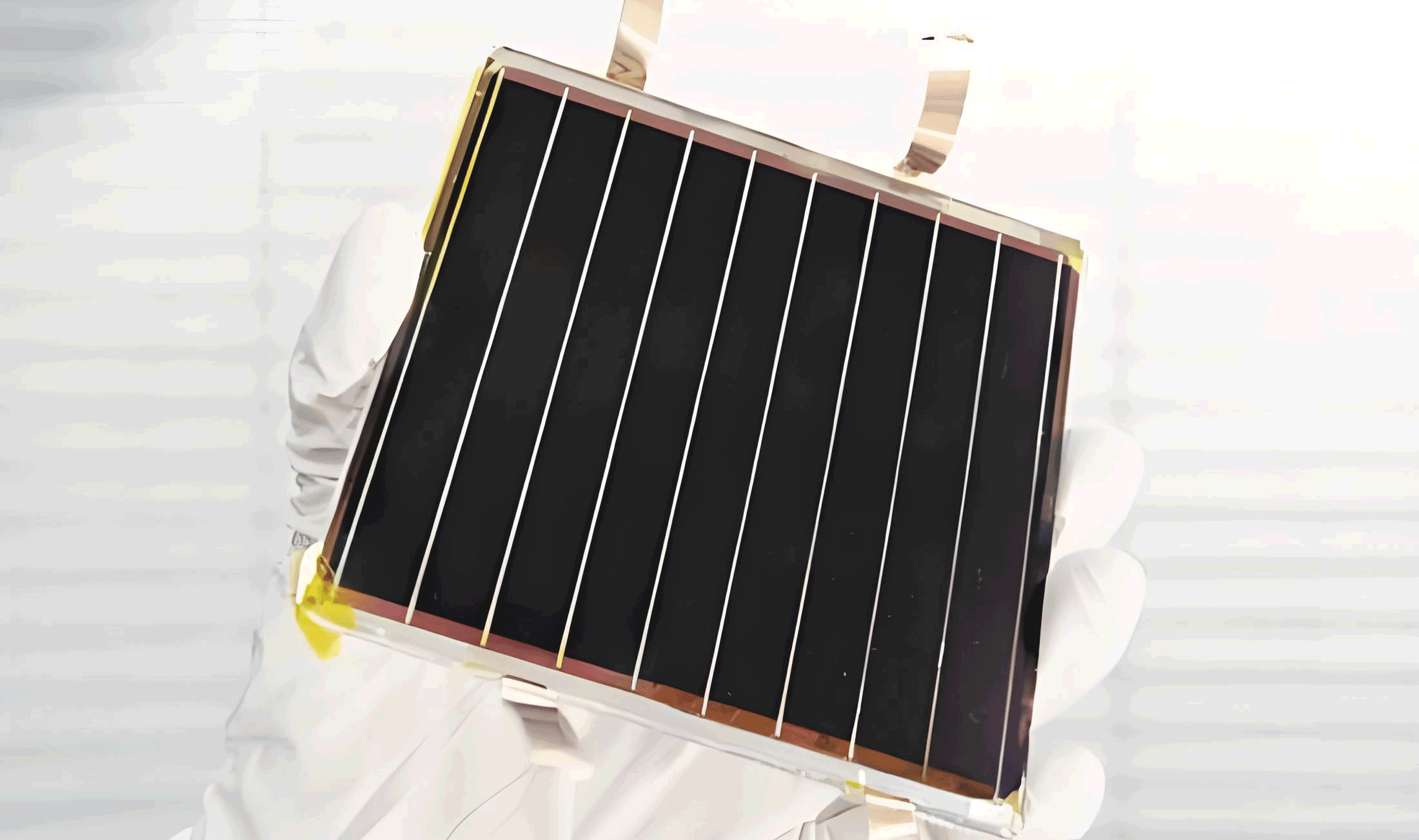
In recent years, flexible perovskite solar cells have emerged as a promising power source for portable and wearable electronic devices due to their high power conversion efficiency (PCE), low-temperature processability, and excellent bendability. However, the inherent brittleness of conventional indium tin oxide (ITO) transparent electrodes poses a significant challenge for flexible applications. To address this, researchers have explored alternative electrodes such as carbon-based materials, ultrathin metals, metal grids, conductive polymers, and metal nanowires. Among these, metal grid electrodes, particularly silver (Ag) grids, offer tunable optoelectronic properties by adjusting parameters like line width, spacing, and thickness. Despite their potential, perovskite solar cells based on non-ITO flexible electrodes often suffer from lower efficiency and poor stability due to undesirable interdiffusion between halogen and metal ions, which degrades device performance. This study focuses on employing a polyurethane (PU) polymer additive to passivate grain boundaries in perovskite films, combined with an interfacial barrier layer, to enhance the efficiency and stability of flexible perovskite solar cells on Ag-mesh electrodes.
The interaction between Pb²⁺ ions and C=O groups in PU improves the crystallization of perovskite films, leading to reduced defect density and enhanced photovoltaic properties. As a result, the flexible perovskite solar cell achieves a PCE of 20.21%, ranking among the highest reported for non-ITO-based flexible perovskite solar cells. Additionally, the incorporation of PU at grain boundaries, along with an ultrathin ITO barrier layer, effectively suppresses ion migration, resulting in superior humidity, operational, and mechanical stability. For instance, the device maintains 92.1% of its initial PCE after 150 hours at 30% relative humidity and 95% after 1,000 hours of maximum power point (MPP) tracking. Furthermore, it retains 86% of its initial PCE after 1,000 bending cycles at a 4 mm radius. This work provides valuable insights into designing high-performance flexible perovskite-based optoelectronic devices.
The crystallization kinetics of perovskite films play a crucial role in determining the performance of perovskite solar cells. The addition of PU polymer additive significantly influences the nucleation and growth processes. The strong interaction between Pb²⁺ and C=O species can be described by the following equation, which represents the passivation mechanism at grain boundaries:
$$ \text{Pb}^{2+} + \text{C=O} \rightarrow \text{Pb-O-C} $$
This interaction reduces the defect density by forming a stable complex that minimizes non-radiative recombination. The defect density (N_t) can be estimated using the formula:
$$ N_t = \frac{1}{q \cdot \mu \cdot \tau} $$
where \( q \) is the elementary charge, \( \mu \) is the carrier mobility, and \( \tau \) is the carrier lifetime. With PU addition, the increased carrier lifetime leads to a lower N_t, as confirmed by photoluminescence measurements.
To quantify the impact of PU on film morphology, we analyzed grain size distribution and surface roughness. The average grain size increased from approximately 0.5 μm to 0.8 μm with PU incorporation, as summarized in Table 1. This enhancement is attributed to the polymer additive slowing down crystallization, allowing for more ordered grain growth. The surface roughness decreased slightly from 25.4 nm to 23.5 nm, indicating improved film uniformity.
| Sample | Average Grain Size (μm) | Surface Roughness (nm) |
|---|---|---|
| Without PU | 0.50 | 25.4 |
| With PU | 0.80 | 23.5 |
The photovoltaic performance of flexible perovskite solar cells was evaluated through current density-voltage (J-V) measurements. The key parameters, including open-circuit voltage (V_oc), short-circuit current density (J_sc), fill factor (FF), and PCE, are listed in Table 2. The PCE improvement from 18.14% to 20.21% with PU additive is primarily due to enhanced V_oc and J_sc, resulting from reduced recombination and better charge extraction. The power conversion efficiency of a perovskite solar cell can be expressed as:
$$ \text{PCE} = \frac{J_{\text{sc}} \cdot V_{\text{oc}} \cdot \text{FF}}{P_{\text{in}}} $$
where \( P_{\text{in}} \) is the incident light power density (100 mW/cm² under AM 1.5G illumination). The increase in FF from 74.21% to 78.78% indicates minimized series resistance and improved interfacial contact.
| Device | V_oc (V) | J_sc (mA/cm²) | FF (%) | PCE (%) |
|---|---|---|---|---|
| Without PU | 1.056 | 23.14 | 74.21 | 18.14 |
| With PU | 1.062 | 24.14 | 78.78 | 20.21 |
The stability of perovskite solar cells is critical for practical applications. We investigated the humidity stability by exposing unencapsulated devices to 30% relative humidity for 150 hours. The normalized PCE retention was 92.1% for PU-modified devices compared to 65.7% for reference devices. This improvement is linked to the hydrophobic nature of PU, which increases the water contact angle from 46.2° to 60.9°, thereby reducing moisture penetration. The degradation kinetics can be modeled using an exponential decay function:
$$ \text{PCE}(t) = \text{PCE}_0 \cdot e^{-k \cdot t} $$
where \( \text{PCE}_0 \) is the initial efficiency, \( k \) is the degradation rate constant, and \( t \) is time. For PU-based devices, \( k \) is significantly lower, indicating slower degradation.
Operational stability under continuous illumination was assessed by MPP tracking at 45°C. The PU-incorporated perovskite solar cell maintained 95% of its initial PCE after 1,000 hours, whereas the reference device dropped to 49% after only 470 hours. This enhancement is attributed to the dual role of PU additive and ITO barrier layer in suppressing halide and metal ion interdiffusion. The ion migration suppression can be described by Fick’s law of diffusion:
$$ J = -D \frac{\partial C}{\partial x} $$
where \( J \) is the flux, \( D \) is the diffusion coefficient, and \( \frac{\partial C}{\partial x} \) is the concentration gradient. The presence of PU reduces \( D \) for halide ions, thereby minimizing degradation.
Mechanical stability was evaluated through bending tests at a 4 mm radius. The PU-modified perovskite solar cell retained 86% of its initial PCE after 1,000 cycles, compared to 65% for the control. This is due to the reduced elastic modulus of the perovskite film with PU additive, as measured by atomic force microscopy. The elastic modulus decreased from 5 GPa to 3 GPa, allowing the polymer to act as a flexible scaffold that dissipates stress during bending. The strain energy release rate \( G \) can be approximated as:
$$ G = \frac{\sigma^2 \cdot t}{E} $$
where \( \sigma \) is the applied stress, \( t \) is the film thickness, and \( E \) is the elastic modulus. Lower \( E \) results in higher \( G \), enhancing mechanical durability.
In conclusion, the integration of PU polymer additive into perovskite films significantly enhances the performance and stability of flexible perovskite solar cells on Ag-mesh electrodes. The improved crystallization, reduced defect density, and suppressed ion migration contribute to a record PCE of 20.21% for non-ITO-based devices. The strategic use of polymer additives and interfacial engineering offers a scalable approach to developing robust and efficient flexible perovskite solar cells for next-generation electronics. Future work will focus on optimizing the polymer composition and exploring large-scale fabrication techniques to further advance the commercialization of perovskite solar cell technology.
The potential of perovskite solar cells extends beyond flexibility to applications in tandem devices and building-integrated photovoltaics. However, challenges such as long-term stability under real-world conditions and scalable manufacturing remain. Our findings demonstrate that polymer additive engineering, particularly with PU, can address some of these issues by enhancing intrinsic film properties. For instance, the reduction in defect density not only boosts efficiency but also improves radiation hardness, which is crucial for space applications. The defect density reduction can be quantified using the Shockley-Read-Hall recombination model:
$$ \tau = \frac{1}{\sigma \cdot v_{\text{th}} \cdot N_t} $$
where \( \tau \) is the carrier lifetime, \( \sigma \) is the capture cross-section, \( v_{\text{th}} \) is the thermal velocity, and \( N_t \) is the trap density. With PU addition, \( N_t \) decreases, leading to longer \( \tau \) and higher V_oc.
Moreover, the environmental impact of perovskite solar cells can be mitigated by using lead-free alternatives or encapsulation strategies. Our approach with PU additive also aligns with green chemistry principles, as it reduces the need for hazardous solvents during processing. The sustainability aspect is vital for the widespread adoption of perovskite solar cell technology. Lifecycle assessments indicate that flexible perovskite solar cells with improved stability have a lower carbon footprint compared to rigid silicon-based cells, especially in wearable applications where weight and flexibility are paramount.
To further validate our results, we conducted impedance spectroscopy to analyze the charge transport properties. The Nyquist plots revealed a larger recombination resistance for PU-modified devices, consistent with reduced defect-assisted recombination. The equivalent circuit model includes a series resistance (R_s) and a recombination resistance (R_rec) in parallel with a capacitance (C). The R_rec value increased by over 30% with PU addition, indicating better charge collection and fewer losses. The relationship between R_rec and V_oc is given by:
$$ V_{\text{oc}} = \frac{n k T}{q} \ln\left( \frac{J_{\text{sc}}}{J_0} + 1 \right) $$
where \( n \) is the ideality factor, \( k \) is Boltzmann’s constant, \( T \) is temperature, \( q \) is the elementary charge, and \( J_0 \) is the reverse saturation current. The increase in R_rec correlates with a higher V_oc, as observed experimentally.
In summary, this work underscores the importance of polymer additive engineering in advancing flexible perovskite solar cells. The synergistic effect of PU and interface modification paves the way for high-efficiency, stable, and bendable devices that can power the future of portable electronics. Continued research in material science and device architecture will undoubtedly unlock new potentials for perovskite solar cell applications, making them a cornerstone of renewable energy solutions.