
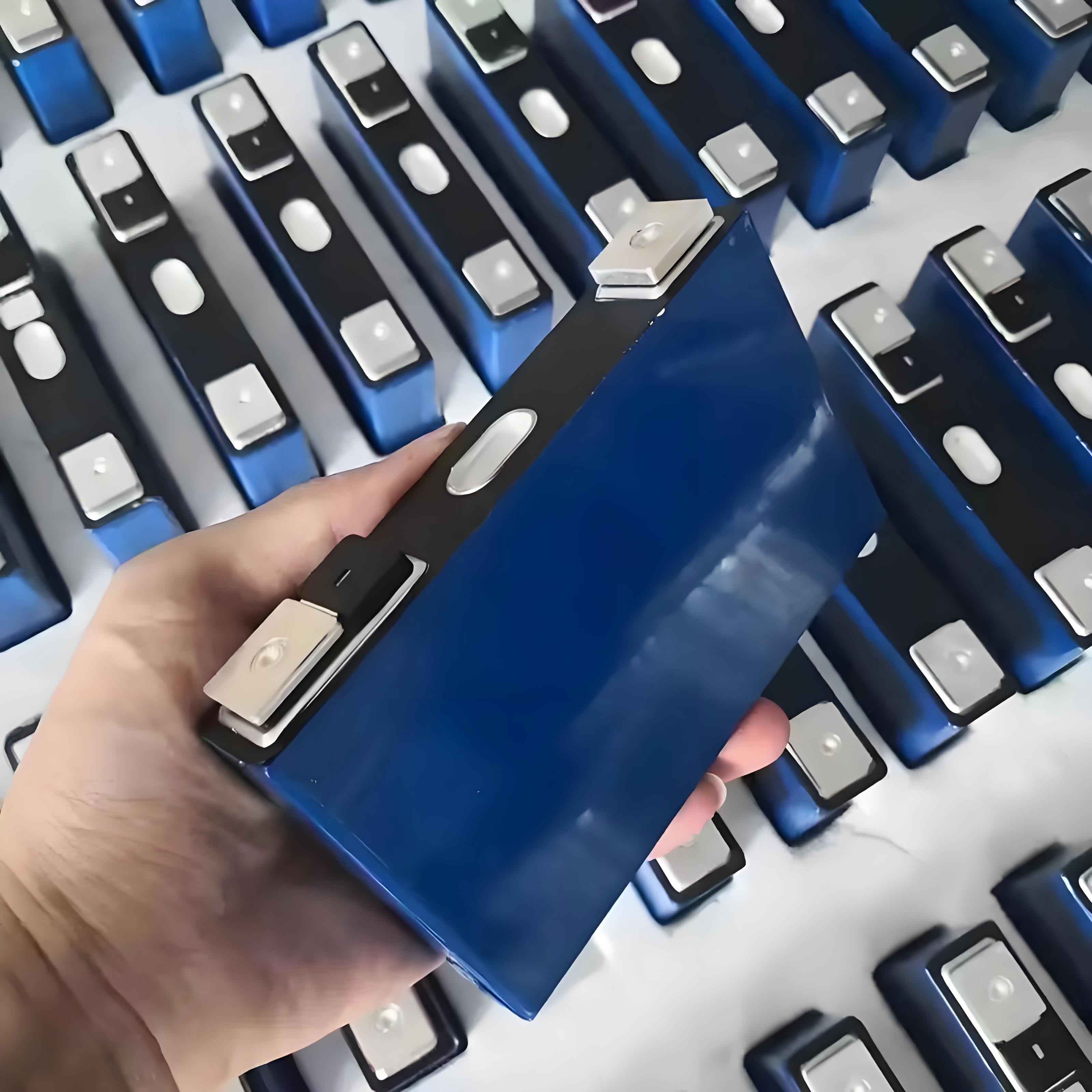
This study investigates the enhancement of LiFePO4 battery performance through microwave-assisted cathode modification with metal ion doping. The methodology combines carbon coating and strategic doping to address inherent limitations in conductivity and discharge capacity while maintaining cost-effectiveness and cycle stability.
1. Material Synthesis and Characterization
The LiFePO4/C composite was synthesized through microwave processing at optimized parameters. The reaction mechanism can be expressed as:
$$ \text{Li}_2\text{CO}_3 + 2\text{FePO}_4 + \text{C}_6\text{H}_{12}\text{O}_6 \xrightarrow{\Delta} 2\text{LiFePO}_4/\text{C} + 3\text{H}_2\text{O} + 3\text{CO}_2\uparrow $$
Table 1 compares crystallinity and electrochemical properties under different synthesis temperatures:
| Temperature (°C) | Crystallite Size (nm) | Specific Capacity (mAh/g) | Conductivity (S/cm) |
|---|---|---|---|
| 550 | 32 ± 4 | 98 | 2.1×10⁻⁴ |
| 650 | 45 ± 3 | 112 | 5.8×10⁻⁴ |
| 700 | 58 ± 5 | 127 | 9.3×10⁻⁴ |
2. Doping Mechanism Analysis
The enhanced conductivity through Ti⁴⁺ and Mn²⁺ dual-doping follows the defect chemistry model:
$$ \text{Li}_{1-x}\text{Ti}_x\text{Fe}_{1-y}\text{Mn}_y\text{PO}_4/\text{C} $$
Where x = 0.005 and y = 0.01 achieve optimal lattice parameters:
$$ a = 10.328\ \text{Å},\ b = 6.005\ \text{Å},\ c = 4.692\ \text{Å} $$
3. Electrochemical Performance
The modified LiFePO4 battery demonstrates improved kinetics described by the Butler-Volmer equation:
$$ i = i_0\left[\exp\left(\frac{\alpha nF\eta}{RT}\right) – \exp\left(-\frac{(1-\alpha)nF\eta}{RT}\right)\right] $$
Where charge transfer coefficient α increases from 0.42 (pristine) to 0.58 (dual-doped).
Table 2 compares cycling performance under different doping schemes:
| Doping Configuration | Initial Capacity (mAh/g) | Capacity Retention (500 cycles) | Polarization (mV) |
|---|---|---|---|
| Undoped | 142 | 81.2% | 396 |
| Ti Single-doping | 155 | 89.7% | 312 |
| Ti/Mn Dual-doping | 168 | 95.3% | 278 |
| Ti/Mn/Mg Triple-doping | 163 | 93.1% | 285 |
4. Kinetic Enhancement Mechanism
The improved Li⁺ diffusion coefficient (DLi) was calculated using the Randles-Sevcik equation:
$$ i_p = 2.69 \times 10^5 n^{3/2} A D^{1/2} C v^{1/2} $$
Where dual-doped samples show DLi = 3.2×10⁻¹² cm²/s, 2 orders higher than undoped LiFePO4 (1.8×10⁻¹⁴ cm²/s).
5. Thermal Stability Analysis
The Arrhenius relationship demonstrates improved thermal stability:
$$ \sigma = \sigma_0 \exp\left(-\frac{E_a}{kT}\right) $$
Activation energy decreases from 0.68 eV (pristine) to 0.52 eV (modified LiFePO4 battery), confirming enhanced thermal stability.
6. Industrial Application Potential
The optimized LiFePO4 battery configuration achieves:
$$ \text{Energy Density} = 155\ \text{Wh/kg},\ \text{Power Density} = 2,380\ \text{W/kg} $$
With cycle life exceeding 2,000 cycles at 1C rate, meeting commercial energy storage requirements.