
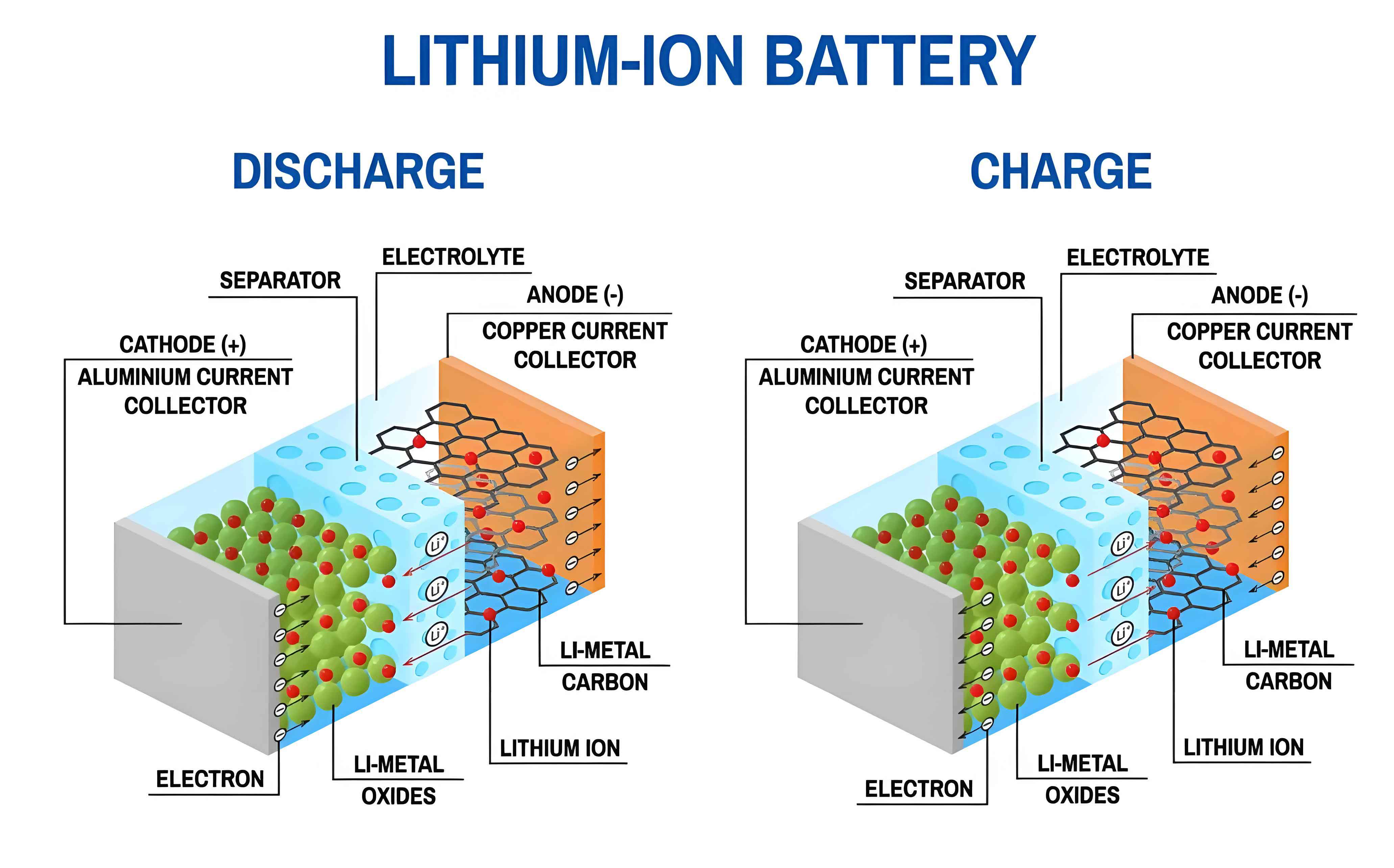
The pervasive integration of lithium-ion battery technology into electric vehicles (EVs), grid-scale energy storage, and portable electronics has cemented its role as a cornerstone of the modern energy landscape. However, the operational safety and long-term reliability of these high-energy-density systems remain paramount concerns. Catastrophic failures, often culminating in thermal runaway, pose significant risks. Consequently, developing robust, accurate, and early fault diagnosis methods is critical for ensuring the safety, extending the lifespan, and optimizing the performance of lithium-ion battery systems. Traditional diagnostic approaches, heavily reliant on physical or equivalent circuit models and expert-derived thresholds, often struggle with the complex, nonlinear, and evolving nature of battery degradation and failure modes under real-world operating conditions.
The advent of data-driven techniques, particularly machine learning (ML), has ushered in a transformative era for lithium-ion battery prognostics and health management. ML algorithms excel at discovering intricate patterns and correlations within large, multi-dimensional datasets—precisely the kind of data generated by battery management systems (BMS), including voltage, current, temperature, and sometimes impedance. This capability allows for moving beyond simple threshold-based alarms towards predictive and proactive diagnosis. This article provides a comprehensive review of the application of machine learning paradigms in diagnosing faults in lithium-ion battery systems. We will systematically explore the taxonomy of common faults, the data pipeline for ML, and a detailed analysis of supervised, unsupervised, semi-supervised, and reinforcement learning methods, culminating in a discussion of prevailing challenges and future research trajectories.
1. Taxonomy of Common Faults in Lithium-Ion Batteries
Effective fault diagnosis begins with a clear understanding of potential failure mechanisms. Faults in a lithium-ion battery system can be broadly categorized based on their root cause: mechanical abuse, electrical abuse, and thermal abuse. Furthermore, system-level issues like inconsistency within a battery pack are critical diagnostic targets.
| Fault Category | Specific Fault Mode | Primary Mechanism & Trigger | Observable Signatures/Features |
|---|---|---|---|
| Mechanical Abuse | Crush, Penetration, Deformation | External physical impact causing internal structure damage, separator rupture, and internal short circuit (ISC). | Sudden voltage drop, localized temperature spike, possible deformation. |
| Electrical Abuse | Overcharge | Exceeding upper voltage limit; lithium plating, electrolyte oxidation, cathode material degradation. | Voltage plateau beyond cut-off, temperature rise, gas generation, capacity fade. |
| Over-discharge | Falling below lower voltage limit; copper dissolution, SEI layer breakdown. | Voltage drop below minimum, capacity loss, increased internal resistance. | |
| External Short Circuit (ESC) | Low-resistance path between terminals; high current surge. | Extremely high current followed by rapid drop to zero, significant temperature increase. | |
| Internal Short Circuit (ISC) | Micro-scale contact between anode and cathode due to dendrites, impurities, or separator failure. | Subtle, persistent voltage drop, self-discharge, mild localized heating. Hard ISC mimics ESC. | |
| Thermal Abuse | Overheating | Excessive ambient temperature or internal heat generation triggering exothermic side reactions. | Rapid, uncontrollable temperature rise, venting, thermal runaway. |
| System-Level | Pack Inconsistency | Manufacturing variances, uneven aging, or thermal gradients leading to capacity, resistance, or SOC imbalance. | Diverging voltage/current/temperature among cells, reduced usable pack capacity, accelerated aging. |
The diagnostic challenge varies significantly across these faults. For instance, detecting an early-stage micro-ISC is notoriously difficult due to its weak signal amidst normal operational noise, whereas an overcharge event presents more pronounced electrical signatures. A robust diagnostic system must be capable of addressing this wide spectrum of fault detectability.
2. Data Acquisition and Feature Engineering for ML Diagnostics
The efficacy of any machine learning model is fundamentally tied to the quality and relevance of its input data. For lithium-ion battery fault diagnosis, the data pipeline is a critical preparatory stage.
2.1 Data Sources and Acquisition: Primary data is sourced from the BMS sensors:
- Electrical Time-Series: Terminal voltage (V), current (I), and sometimes derived coulomb count.
- Thermal Data: Temperature (T) measured at one or multiple points on the cell or module surface.
- Operational State: Estimated State of Charge (SOC) and State of Health (SOH).
Increasingly, complementary data from electrochemical impedance spectroscopy (EIS) or acoustic sensors is being explored to provide richer degradation signatures.
2.2 Feature Engineering: Raw sensor data is often transformed into discriminative features that better represent the underlying health or fault state. This can be done manually (feature engineering) or automatically (via deep learning).
- Statistical Features: Mean, variance, skewness, kurtosis of voltage/current/temperature over a time window.
- Direct Measurement Features: Charge/discharge capacity, internal resistance (estimated), relaxation voltage.
- Domain-Specific Features: Incremental Capacity Analysis (ICA) or Differential Voltage Analysis (DVA) peak attributes, voltage curve shape descriptors.
- Information-Theoretic Features: Entropy measures to quantify signal disorder, which can increase during certain faults.
$$ H(X) = -\sum_{i=1}^{n} P(x_i) \log_2 P(x_i) $$
where $H(X)$ is the Shannon entropy of a discrete variable $X$ with possible values ${x_1, …, x_n}$ and probability mass function $P(x)$. - Time-Domain Features: Rise time, settling time of voltage transients.
2.3 Data Preprocessing: This step is essential for robust model performance.
- Denoising: Applying filters (e.g., moving average, low-pass) to reduce sensor noise.
- Normalization/Standardization: Scaling features to a common range (e.g., [0,1]) or distribution (zero mean, unit variance) to prevent features with larger magnitudes from dominating the model.
- Handling Missing Data: Imputation or interpolation techniques for gaps in sensor readings.
- Data Segmentation: Partitioning continuous time-series data into fixed-length windows for sequential analysis.
3. Machine Learning Paradigms for Fault Diagnosis
Machine learning offers a diverse toolkit, with each paradigm suited to different diagnostic scenarios based on data availability and the nature of the learning task.
3.1 Supervised Learning
Supervised learning algorithms learn a mapping function from input features to known output labels (e.g., “normal,” “overcharge,” “ISC”). They require a fully labeled dataset for training.
- Support Vector Machines (SVM): Effective for high-dimensional, smaller datasets. They find the optimal hyperplane that separates different fault classes with the maximum margin. Kernel functions (e.g., Radial Basis Function) allow them to handle nonlinear relationships. Research has shown SVMs achieving high accuracy (>95%) in classifying faults like overcharge and external short circuits when fed with well-engineered features.
- Random Forest (RF) & Gradient Boosting Machines (GBM): Ensemble methods that combine multiple decision trees. They are robust to overfitting, can handle mixed data types, and provide feature importance rankings, offering some interpretability. They are widely used for SOH estimation and multi-fault classification.
- Artificial Neural Networks (ANN) & Deep Learning:
- Multilayer Perceptrons (MLP): Can model complex nonlinear relationships for fault classification and regression (e.g., SOH value prediction).
- Convolutional Neural Networks (CNN): Excel at automatically extracting spatial or local temporal patterns. In battery diagnostics, 1D-CNNs are applied directly to time-series sequences of V, I, T, or to transformed representations like ICA curves, treating them as “images” of battery health.
- Recurrent Neural Networks (RNN), Long Short-Term Memory (LSTM), Gated Recurrent Units (GRU): Specifically designed for sequential data. They capture temporal dependencies and long-range context, making them exceptionally powerful for predicting RUL and diagnosing faults that evolve over time, such as gradual internal shorts or aging-related inconsistencies.
$$ h_t = \tanh(W_{hh}h_{t-1} + W_{xh}x_t + b_h) $$
(Simple RNN cell), where $h_t$ is the hidden state at time $t$, $x_t$ is the input, $W$ are weight matrices, and $b$ is a bias.
3.2 Unsupervised Learning
Unsupervised learning discovers inherent structures, patterns, or anomalies in data without pre-existing labels. This is invaluable for novelty detection or when labeling fault data is expensive or impractical.
- Clustering Algorithms (K-means, DBSCAN, Gaussian Mixture Models): Group similar data points together. In a battery pack, clustering cell voltage/temperature profiles can identify abnormal cells deviating from the majority, indicating potential inconsistency or early failure. DBSCAN is particularly useful as it does not require specifying the number of clusters and can find arbitrarily shaped clusters while labeling outliers.
- Dimensionality Reduction (Principal Component Analysis – PCA, t-SNE): Project high-dimensional data onto a lower-dimensional space while preserving major trends. Fault conditions often cause data to diverge along specific principal components, enabling visual or quantitative detection.
- Anomaly Detection Algorithms (Isolation Forest, One-Class SVM): Model the distribution of “normal” operational data. Any new data point that significantly deviates from this learned distribution is flagged as an anomaly or potential fault. This is a promising approach for early warning of unforeseen fault modes.
3.3 Semi-Supervised Learning
This paradigm occupies the middle ground, leveraging a small amount of labeled data together with a large amount of unlabeled data. It is highly practical for lithium-ion battery applications where obtaining fully labeled datasets (especially for rare fault events) is challenging.
- Self-Training: A model is first trained on the labeled data. It then makes predictions on the unlabeled data, and the most confident predictions are added to the training set with their pseudo-labels. The process iterates.
- Label Propagation: Based on graph theory, it propagates label information from labeled nodes to unlabeled nodes through the data’s similarity graph.
- Semi-Supervised Graph Neural Networks: Can model relationships between cells in a pack, using known fault labels from some cells to infer the state of neighboring unlabeled cells based on their connectivity and feature similarity.
3.4 Reinforcement Learning (RL)
RL frames the diagnostic or management task as a sequential decision-making problem. An agent learns an optimal policy by interacting with an environment (the battery system) to maximize a cumulative reward (e.g., maintaining health, avoiding fault conditions).
- Application: RL can be used to develop adaptive charging protocols that minimize degradation, or for optimal sensor placement and scheduling for fault detection. An RL agent could learn to adjust diagnostic thresholds dynamically based on operating conditions and aging state.
- Challenge: Training requires a realistic simulator or extensive real-world interaction, which can be risky for fault induction. Therefore, RL is often combined with high-fidelity battery models (electrochemical or thermal) to create a safe training environment.
4. Algorithm Selection and Performance Synopsis
The choice of machine learning paradigm and specific algorithm is contingent upon the fault type, data conditions, and application constraints. The following table synthesizes this “fault-type-data-algorithm” matching logic.
| Diagnostic Task / Fault Type | Data Condition | Recommended ML Paradigms & Algorithms | Key Advantages & Considerations |
|---|---|---|---|
| Early Micro-Internal Short Circuit (ISC) | Weak, noisy signals; lack of labeled fault data. | Unsupervised Anomaly Detection (Isolation Forest, Autoencoders), Semi-supervised methods. | Does not require pre-labeled ISC data; sensitive to subtle deviations from normal operation. |
| Overcharge / Over-discharge / External Short | Clear, labeled signatures available; well-defined classes. | Supervised Learning (SVM, Random Forest, 1D-CNN). | High classification accuracy (>95%); fast inference suitable for real-time BMS. |
| State of Health (SOH) Estimation & RUL Prediction | Long-term cyclical aging data; strong temporal dependencies. | Supervised Sequential Models (LSTM, GRU), Hybrid CNN-LSTM models. | Excels at modeling long-term degradation trends and capturing capacity fade trajectory. |
| Battery Pack Inconsistency & Cell Fault Localization | Multi-cell data (V, I, T); partially labeled or unlabeled. | Unsupervised Clustering (DBSCAN), Graph-Based Semi-supervised Learning. | Identifies outlier cells without prior fault labels; models inter-cell relationships. |
| Thermal Anomaly & Runaway Precursor Detection | Multi-sensor time-series (T, V, I); need for early warning. | Sequential Anomaly Detection (LSTM-based predictors), Multi-modal Deep Learning (fusing V, I, T). | Models temporal progression of thermal behavior; can fuse heterogeneous sensor data. |
Performance Metrics: Evaluating diagnostic models requires careful metric selection beyond simple accuracy, especially for imbalanced datasets where faults are rare events.
- For Classification/Detection: Precision, Recall (Sensitivity), F1-Score, and Area Under the ROC Curve (AUC-ROC) are critical.
$$ \text{F1-Score} = 2 \times \frac{\text{Precision} \times \text{Recall}}{\text{Precision} + \text{Recall}} $$ - For SOH/RUL Regression: Root Mean Square Error (RMSE), Mean Absolute Error (MAE), and Mean Absolute Percentage Error (MAPE).
- For Anomaly Detection: False Positive Rate (FPR), Detection Delay, and score functions tailored to early warning.
5. Challenges and Future Perspectives
Despite significant progress, several challenges persist in the practical deployment of machine learning for lithium-ion battery fault diagnosis.
- Data Scarcity and Imbalance: Real-world fault data, especially for catastrophic events, is scarce due to safety and cost concerns. Models trained on limited or synthetic data may not generalize well. Future work will rely more on advanced data augmentation, transfer learning (using knowledge from lab or simulation data), and physics-informed generative models to create realistic fault data.
- Interpretability and Trust: Deep learning models, while powerful, are often “black boxes.” For safety-critical applications, understanding why a model predicted a fault is essential. Research into explainable AI (XAI) techniques like SHAP (SHapley Additive exPlanations) or LIME (Local Interpretable Model-agnostic Explanations) for battery diagnostics is growing.
- Generalization Across Diverse Conditions: A model trained on one battery type, chemistry, or specific drive cycle may fail under different conditions (temperature, loading profiles, aging states). Developing adaptive, lifelong learning models and robust feature representations that are invariant to operational conditions is a key frontier.
- Integration with Physics-Based Models: The most promising direction is the fusion of data-driven ML with physics-based or electrochemical models. This “gray-box” or hybrid modeling approach can leverage the interpretability and extrapolation capability of physical models with the pattern recognition strength of ML, leading to more robust and generalizable diagnostic systems. For example, an ML model could be used to identify a fault, while an electrochemical model simulates its propagation to assess severity.
- Edge Deployment and Computational Efficiency: Ultimately, diagnostic algorithms must run in real-time on resource-constrained BMS hardware. This necessitates the development of lightweight, optimized models (e.g., model pruning, quantization, knowledge distillation) and efficient feature extraction pipelines.
In conclusion, machine learning has fundamentally expanded the horizons of lithium-ion battery fault diagnosis, transitioning the field from reactive monitoring to predictive analytics. From supervised classifiers that pinpoint known faults to unsupervised methods that uncover novel anomalies, each paradigm offers unique strengths. The future of lithium-ion battery safety and reliability lies in intelligent, adaptive systems born from the synergistic integration of multi-source data, advanced machine learning algorithms, and foundational battery physics. As computational power increases and algorithms become more sophisticated and efficient, their role in ensuring the safe and durable operation of lithium-ion battery systems across all applications will become indispensable.