
The rapid development of photovoltaic (PV) grid-connected systems has revolutionized renewable energy utilization. This article analyzes critical technical components and proposes optimization strategies, focusing on advancements in solar inverter technology and system integration.
1. Core Technologies in PV Grid-Connected Systems
1.1 Maximum Power Point Tracking (MPPT)
MPPT algorithms optimize energy harvest under varying conditions. The fundamental equation for PV module power output is:
$$P = V \times I = V \times [I_{ph} – I_0(e^{\frac{q(V+IR_s)}{nkT}} – 1)]$$
Common MPPT methods include:
| Algorithm | Efficiency | Response Time |
|---|---|---|
| Perturb & Observe | 97-98% | 0.3s |
| Incremental Conductance | 98-99% | 0.25s |
| Neural Network | 99%+ | <0.1s |
1.2 Solar Inverter Architectures
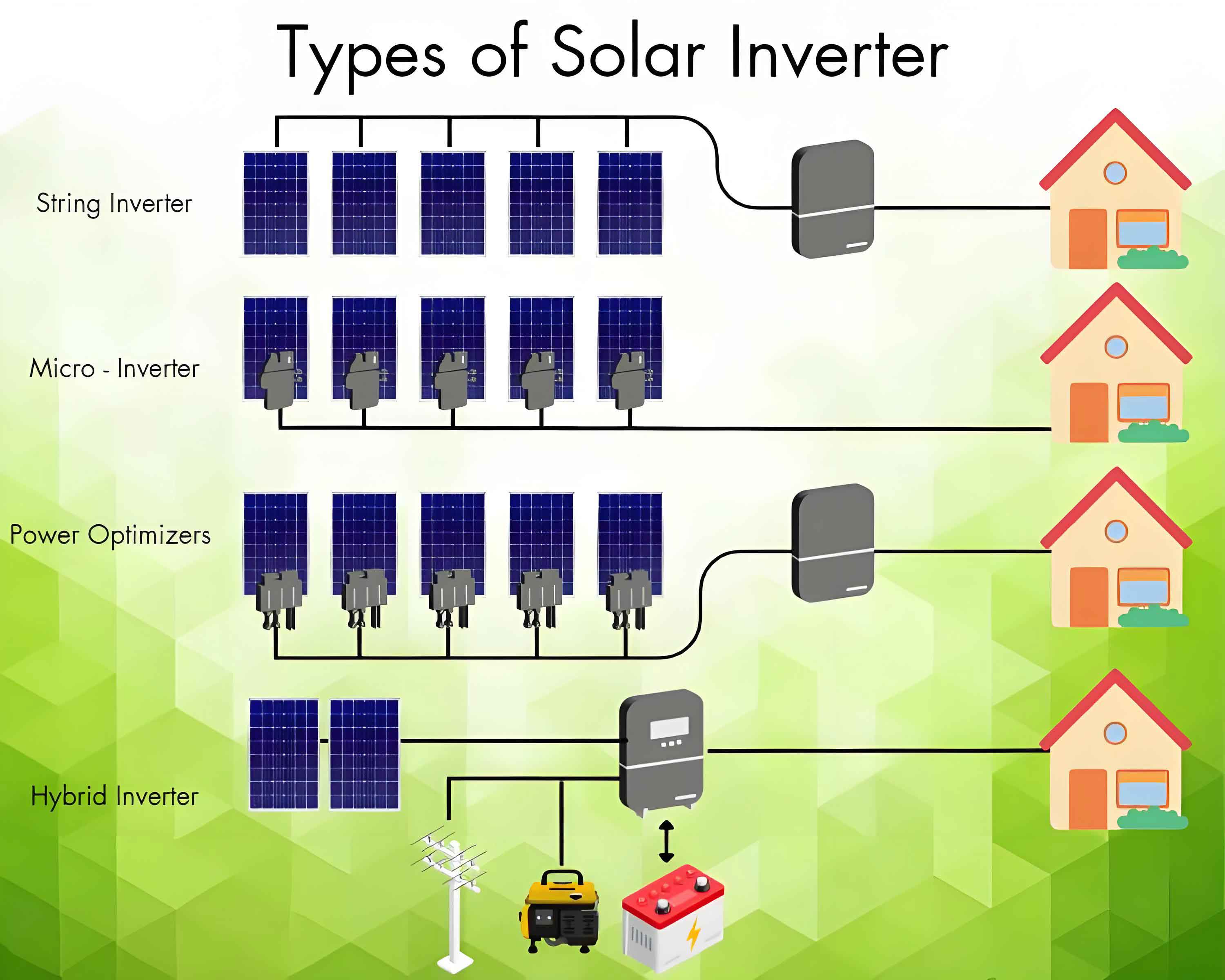
Modern solar inverters employ advanced topologies:
$$THD = \sqrt{\sum_{h=2}^{50}\left(\frac{I_h}{I_1}\right)^2} \times 100\%$$
Where THD < 3% for grid compliance
2. System Optimization Strategies
2.1 Hybrid Control Techniques
Combining PID with repetitive control enhances solar inverter performance:
$$G_c(s) = K_p + \frac{K_i}{s} + K_ds + \frac{1}{1-e^{-sT}}$$
| Parameter | Conventional | Hybrid |
|---|---|---|
| Voltage Regulation | ±5% | ±1.2% |
| Harmonic Distortion | 4.8% | 2.1% |
2.2 Advanced Grid Synchronization
Phase-locked loop (PLL) design for solar inverters:
$$H_{PLL}(s) = \frac{K_p s + K_i}{s^2 + K_p s + K_i}$$
3. Emerging Technologies in Solar Inverters
3.1 Wide Bandgap Semiconductors
SiC/GaN devices enable higher efficiency:
$$P_{loss} = \frac{1}{T_{sw}}\int_0^{T_{sw}}V(t)I(t)dt$$
| Device | Switching Loss | Frequency |
|---|---|---|
| Si IGBT | 15μJ | 20kHz |
| SiC MOSFET | 3μJ | 100kHz |
3.2 Smart Inverter Functions
Modern solar inverters integrate:
- Reactive power control: $$Q = \frac{V^2}{X} \sin \theta$$
- Frequency-watt response
- PV ramp-rate control
4. System Reliability Enhancements
4.1 Fault Detection Algorithms
Arc fault detection in solar inverters:
$$f_{arc} = \frac{1}{2\pi\sqrt{LC}}$$
4.2 Thermal Management
Junction temperature prediction:
$$T_j = T_a + P_{diss}(R_{\theta jc} + R_{\theta ca})$$
| Cooling Method | Rθ (℃/W) |
|---|---|
| Natural Convection | 25 |
| Forced Air | 8 |
| Liquid Cooling | 2 |
The evolution of solar inverter technology continues to drive PV system efficiency improvements, with modern designs achieving over 99% conversion efficiency and advanced grid support capabilities. Future developments will focus on AI-driven optimization and seamless integration with energy storage systems.