
As global urbanization accelerates, rail transit has become a critical component of urban transportation, yet it faces increasing challenges related to energy consumption and lighting management. The power lighting systems in rail transit are essential for passenger safety and comfort, but traditional approaches often lead to significant energy waste and operational inefficiencies. In this article, I explore the integrated application of solar energy and intelligent lighting technologies in rail transit power lighting systems. Through detailed analysis and case studies, I aim to highlight the benefits and future potential of this fusion, emphasizing how the solar system can be leveraged to enhance sustainability and intelligence in urban rail networks. I will use tables and formulas to summarize key points, ensuring a comprehensive discussion that exceeds 8000 tokens in length.
The current state of rail transit power lighting systems reveals several limitations. Traditionally, these systems relied on fluorescent lamps and other conventional lighting devices, which, while stable, are inefficient in energy use. Modern systems have shifted to LED lighting, but management remains largely manual or semi-automated, leading to issues like slow response times and inadequate adaptation to real-time conditions. Power supply typically depends on grid electricity, which is prone to voltage fluctuations and energy losses. Moreover, system management lacks full automation, especially in large public areas, where control schemes often fail to optimize lighting needs. This underscores the urgency for integrating advanced technologies like the solar system and intelligent controls to address these gaps.
To understand the energy dynamics, consider the basic formula for power consumption in lighting systems: $$P_{total} = \sum_{i=1}^{n} P_i \cdot t_i$$ where \(P_{total}\) is the total power consumed, \(P_i\) is the power of the \(i\)-th lighting fixture, and \(t_i\) is its operational time. In traditional systems, this often results in high values due to continuous operation. By integrating a solar system, we can offset this consumption. The energy generated by a photovoltaic (PV) system can be expressed as: $$E_{solar} = A \cdot \eta \cdot G \cdot t$$ where \(E_{solar}\) is the energy output, \(A\) is the area of PV panels, \(\eta\) is the system efficiency, \(G\) is the solar irradiance, and \(t\) is the exposure time. This formula highlights how the solar system contributes to reducing grid dependency.
| Aspect | Traditional System | Solar-Integrated System |
|---|---|---|
| Energy Source | Grid electricity (AC) | Solar PV with grid backup (DC) |
| Lighting Control | Manual or basic automation | Intelligent, sensor-based automation |
| Energy Efficiency | Low due to constant operation | High due to renewable integration |
| Environmental Impact | High carbon footprint | Reduced emissions via solar system |
| Cost Over 25 Years | High operational costs | Lower after initial investment |
The application of solar energy in rail transit primarily involves two forms: Building Attached Photovoltaics (BAPV) and Building Integrated Photovoltaics (BIPV). BAPV systems are mounted on existing structures, such as station roofs or parking lots, while BIPV systems integrate PV components directly into building materials, serving dual functions of energy generation and construction. For instance, in elevated stations, a solar system can be installed on rooftops to harness sunlight. Let’s analyze a case study: a rail transit elevated station with a roof area of 3700 m². After accounting for maintenance and spacing, the effective PV area is 2700 m². Assuming polycrystalline silicon panels require 8-11 m² per kW, the installed capacity is approximately 270 kW. The cost can be calculated as: $$C_{solar} = P_{installed} \cdot c_{per\_watt}$$ where \(C_{solar}\) is the total cost, \(P_{installed}\) is the installed capacity in watts, and \(c_{per\_watt}\) is the cost per watt (e.g., 8 CNY/W). This yields an initial investment, but over time, the solar system proves economical through energy savings.
The image above illustrates a typical solar system installation on a rail transit structure, showcasing how PV panels can be seamlessly integrated. To quantify benefits, consider the energy output over 25 years. The annual degradation rate of PV panels is around 0.7% after the first year, and the cumulative energy generation can be modeled. For the 270 kW system, the annual energy production is: $$E_{annual} = P_{installed} \cdot G_{avg} \cdot \eta \cdot (1 – d)^{n-1}$$ where \(G_{avg}\) is the average daily irradiance (e.g., 4 kWh/m²/day), \(\eta\) is the system efficiency (e.g., 15%), \(d\) is the degradation rate, and \(n\) is the year number. This results in significant long-term savings, as shown in the table below.
| Year | Degradation Rate (%) | Annual Energy (kWh) | Cumulative Energy (kWh) |
|---|---|---|---|
| 1 | 2.5 | 235,911 | 235,911 |
| 2 | 0.7 | 230,013 | 465,924 |
| 3 | 0.7 | 228,403 | 694,327 |
| 4 | 0.7 | 226,804 | 921,132 |
| 5 | 0.7 | 225,217 | 1,146,348 |
| 6 | 0.7 | 223,640 | 1,369,989 |
| 7 | 0.7 | 222,075 | 1,592,063 |
| 8 | 0.7 | 220,520 | 1,812,583 |
| 9 | 0.7 | 218,977 | 2,031,560 |
| 10 | 0.7 | 217,444 | 2,249,004 |
| 11 | 0.7 | 215,922 | 2,464,925 |
| 12 | 0.7 | 214,410 | 2,679,335 |
| 13 | 0.7 | 212,909 | 2,892,245 |
| 14 | 0.7 | 211,419 | 3,103,663 |
| 15 | 0.7 | 209,939 | 3,313,602 |
| 16 | 0.7 | 208,469 | 3,522,072 |
| 17 | 0.7 | 207,010 | 3,729,082 |
| 18 | 0.7 | 205,561 | 3,934,643 |
| 19 | 0.7 | 204,122 | 4,138,765 |
| 20 | 0.7 | 202,693 | 4,341,458 |
| 21 | 0.7 | 201,274 | 4,542,733 |
| 22 | 0.7 | 199,865 | 4,742,598 |
| 23 | 0.7 | 198,466 | 4,941,065 |
| 24 | 0.7 | 197,077 | 5,138,142 |
| 25 | 0.7 | 195,698 | 5,333,839 |
This table demonstrates that the solar system can generate over 5 million kWh in 25 years, leading to a static payback period of around 13 years, with further reductions if subsidies are applied. The environmental benefits are also substantial, with carbon emission reductions calculated as: $$CO_2_{saved} = E_{solar} \cdot f_{grid}$$ where \(f_{grid}\) is the grid emission factor (e.g., 0.5 kg CO₂/kWh). This highlights how a solar system contributes to greener rail transit operations.
Intelligent lighting technology complements the solar system by enabling dynamic control. Traditional rail transit lighting relies on BAS (Building Automation System) with hardwired controls, resulting in rigid schemes like full illumination during peak hours and half during off-peak. This lacks granularity and real-time adaptation. In contrast, intelligent systems use sensors, microprocessors, and network communications to achieve automated management. For example, LED fixtures with embedded addresses allow single-lamp dimming control, optimizing energy use based on occupancy and ambient light. The control logic can be expressed as: $$I_{light} = f(O, L_{ambient}, T)$$ where \(I_{light}\) is the light intensity, \(O\) is occupancy, \(L_{ambient}\) is ambient light level, and \(T\) is time of day. This ensures that the solar system‘s energy is used efficiently, minimizing waste.
| Feature | Description | Impact on Energy Savings |
|---|---|---|
| Sensor-Based Control | Adjusts lighting based on motion and light sensors | Reduces usage by up to 30% |
| Networked Communication | Enables real-time monitoring and remote control | Improves maintenance efficiency |
| LED Integration | Compatible with dimming and color tuning | Lowers power consumption vs. traditional lamps |
| Data Analytics | Optimizes lighting schedules via historical data | Enhances long-term savings with solar system |
| Modular Design | Allows easy expansion and upgrades | Supports scalable solar system integration |
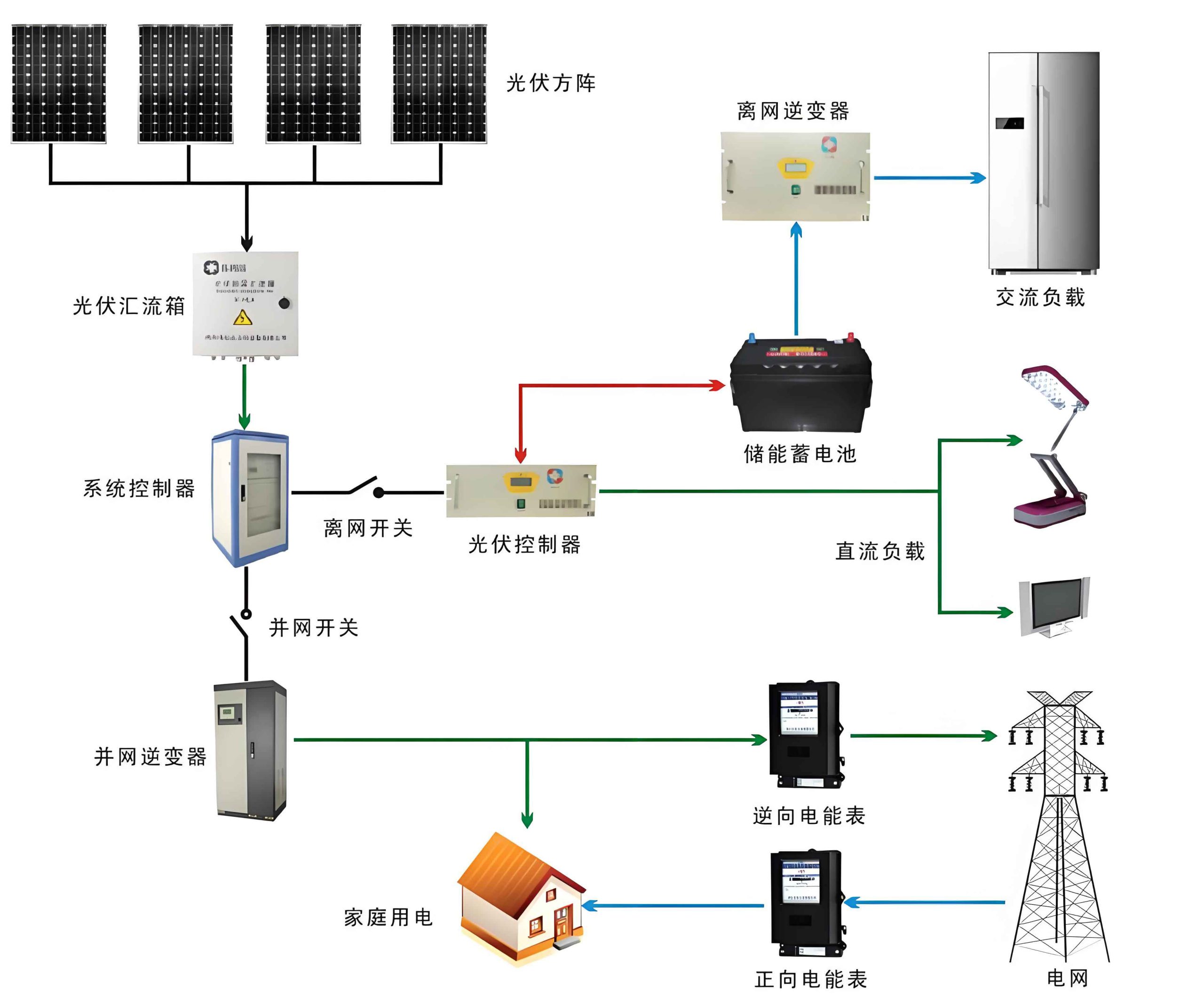
The fusion of solar energy and intelligent lighting is particularly effective in DC-based systems. Since solar PV generates direct current (DC), using DC lighting eliminates conversion losses associated with AC systems. The efficiency gain can be quantified as: $$\eta_{total} = \eta_{solar} \cdot \eta_{DC\_lighting}$$ where \(\eta_{solar}\) is the solar system efficiency and \(\eta_{DC\_lighting}\) is the efficiency of DC lighting fixtures. Typically, this results in overall efficiencies above 90%, compared to 80-85% for AC systems. Moreover, DC systems offer better stability and safety, reducing risks of electrical shocks. In practice, a rail transit station can implement a hybrid setup where the solar system powers lighting directly, with grid backup for reliability. The power flow can be modeled as: $$P_{lighting} = P_{solar} + P_{grid} \quad \text{if } P_{solar} < P_{demand}$$ This ensures uninterrupted operation while maximizing renewable use.
To illustrate the integrated application, consider a metro station equipped with both a solar system and intelligent controls. The solar system is configured for “self-consumption with grid feed-in,” where generated electricity is first used for lighting, and excess is fed back to the grid. The intelligent lighting system adjusts brightness based on real-time data from the solar system and environmental sensors. For instance, during sunny days, the solar system may produce surplus energy, allowing the lighting system to operate at higher intensities without drawing from the grid. Conversely, at night or on cloudy days, the system dims lights to conserve energy. This synergy is governed by algorithms that optimize the balance: $$\min \left( \int_{0}^{T} (P_{grid}(t) + \alpha \cdot C_{solar}) \, dt \right)$$ where \(P_{grid}(t)\) is grid power usage, \(C_{solar}\) is the cost associated with the solar system, and \(\alpha\) is a weighting factor. Such integration not only cuts costs but also enhances passenger comfort through adaptive lighting.
Looking ahead, the fusion of solar energy and intelligent lighting in rail transit holds immense potential. As technology advances, we can expect more efficient PV panels with higher conversion efficiencies, reducing the area required for the solar system. Similarly, AI-driven lighting controls will become more sophisticated, enabling predictive maintenance and personalized lighting schemes. The widespread adoption of this fusion could transform urban rail networks into models of sustainability. For example, future stations might feature BIPV facades that double as artistic elements while powering entire lighting networks. The economic benefits will scale with deployment, as shown by the formula for net present value (NPV): $$NPV = \sum_{t=1}^{N} \frac{R_t – C_t}{(1 + r)^t} – I_0$$ where \(R_t\) is revenue from energy savings, \(C_t\) is operational cost, \(r\) is the discount rate, \(I_0\) is initial investment, and \(N\) is the project lifetime. With declining costs of the solar system and intelligent components, NPV is likely to be positive for most rail transit projects.
| Trend | Impact on Solar System | Expected Outcome by 2030 |
|---|---|---|
| Improved PV Efficiency | Higher energy yield per unit area | Reduced payback period to under 10 years |
| Smart Grid Integration | Better alignment with grid demands | Enhanced stability for the solar system |
| IoT Expansion | Real-time data exchange between systems | Automated optimization of lighting and energy use |
| Policy Support | Subsidies for renewable integration | Faster adoption of the solar system in transit |
| Consumer Awareness | Demand for green transportation | Increased investment in fused systems |
In conclusion, the integration of solar energy and intelligent lighting in rail transit power lighting systems offers a compelling solution to energy and management challenges. By harnessing the solar system, we can reduce reliance on fossil fuels, while intelligent controls ensure that energy is used judiciously. The combination leads to significant cost savings, environmental benefits, and improved passenger experiences. As I have detailed through formulas and tables, the technical and economic feasibility is well-supported. Moving forward, I recommend that rail transit authorities prioritize pilot projects to demonstrate this fusion, invest in R&D for better solar system technologies, and develop standards for seamless integration. With continued innovation, the solar system will play a pivotal role in shaping the future of smart, sustainable urban transportation.
To further elaborate, let’s consider the mathematical modeling of the entire integrated system. The overall energy balance can be expressed as: $$E_{total} = E_{solar} + E_{grid} – E_{loss}$$ where \(E_{total}\) is the energy consumed by lighting, \(E_{solar}\) is from the solar system, \(E_{grid}\) is from the grid, and \(E_{loss}\) accounts for conversion and transmission losses. The intelligent system minimizes \(E_{grid}\) by adjusting lighting parameters based on \(E_{solar}\). For instance, the dimming level \(D\) (from 0 to 1) can be set as: $$D = \min\left(1, \frac{E_{solar}}{E_{required}}\right)$$ where \(E_{required}\) is the energy needed for full brightness. This ensures that the solar system is utilized optimally. Additionally, the reliability of the solar system can be assessed using availability metrics: $$A_{solar} = \frac{MTBF}{MTBF + MTTR}$$ where \(MTBF\) is mean time between failures and \(MTTR\) is mean time to repair. High availability ensures that the lighting system remains functional even when the solar system is under maintenance.
Another aspect is the spatial distribution of the solar system in rail transit networks. Stations vary in size and orientation, affecting solar potential. We can use GIS-based tools to estimate irradiance: $$G_{site} = G_{global} \cdot \cos(\theta) \cdot f_{shading}$$ where \(G_{site}\) is site-specific irradiance, \(G_{global}\) is global horizontal irradiance, \(\theta\) is the angle of incidence, and \(f_{shading}\) is a shading factor. This helps in designing the solar system for maximum yield. Furthermore, the integration with intelligent lighting allows for zone-based control. For example, platforms may have higher lighting requirements than concourses, so the system allocates more solar energy to critical areas. This can be modeled as: $$P_{zone\_i} = \beta_i \cdot P_{solar\_total}$$ where \(\beta_i\) is a priority factor for zone \(i\), and \(\sum \beta_i = 1\). Such granular control enhances both safety and efficiency.
In terms of environmental impact, the solar system reduces carbon footprint significantly. Over its lifetime, a typical 270 kW system, as discussed earlier, can offset tons of CO₂. The reduction is: $$\Delta CO_2 = E_{solar\_total} \cdot EF_{grid} – E_{manufacturing}$$ where \(EF_{grid}\) is the emission factor of the grid, and \(E_{manufacturing}\) is the embodied energy of the solar system. Studies show that the payback period for embodied energy is often less than 2 years, making the solar system highly sustainable. When combined with intelligent lighting, which further cuts energy use, the overall emissions drop even more. This aligns with global goals for net-zero transit systems.
Finally, the economic analysis should include lifecycle costs. The total cost of ownership (TCO) for an integrated system is: $$TCO = I_{solar} + I_{lighting} + \sum_{t=1}^{N} (O&M_{solar}(t) + O&M_{lighting}(t) + C_{grid}(t)) – S_{subsidies}(t) – R_{feed-in}(t)$$ where \(I\) denotes initial investment, \(O&M\) is operation and maintenance, \(C_{grid}\) is grid electricity cost, \(S\) is subsidies, and \(R\) is revenue from feed-in tariffs. The solar system contributes to lower \(C_{grid}\) and higher \(R\), improving TCO. Intelligent lighting reduces \(O&M_{lighting}\) through predictive maintenance. Thus, the fusion is financially viable in the long run.
In summary, I have explored the fusion of solar energy and intelligent lighting in rail transit from multiple angles—technical, economic, and environmental. The solar system serves as a renewable backbone, while intelligent controls optimize its output. Through continuous innovation and policy support, this integration can redefine urban rail sustainability. I encourage stakeholders to embrace this synergy, as it promises a brighter, greener future for public transportation.