
The safe and efficient operation of high-capacity lithium-ion battery systems, particularly under demanding conditions such as high ambient temperatures and rapid charging/discharging, is critically dependent on advanced thermal management strategies. Effective thermal control is paramount to prevent performance degradation, cycle life reduction, and mitigate the risks associated with thermal runaway. Among the various cooling techniques, refrigerant-based direct cooling systems have emerged as a highly promising solution. Unlike conventional liquid cooling that relies solely on sensible heat transfer, direct cooling systems leverage the substantial latent heat absorbed during the phase transition of a refrigerant from liquid to vapor. This mechanism offers a superior heat removal capacity per unit mass of coolant, leading to more compact system designs and potentially higher energy efficiency. This article presents a comprehensive numerical investigation into the influence of refrigerant phase change dynamics on the thermal regulation of a large-capacity lithium-ion battery module. We develop a coupled electro-thermal model for battery heat generation and employ a multiphase model to simulate the refrigerant’s boiling process. The performance of the direct cooling system is evaluated and compared against traditional liquid cooling, with detailed parametric studies conducted to elucidate the effects of key operational and design parameters on cooling efficacy and refrigerant utilization.
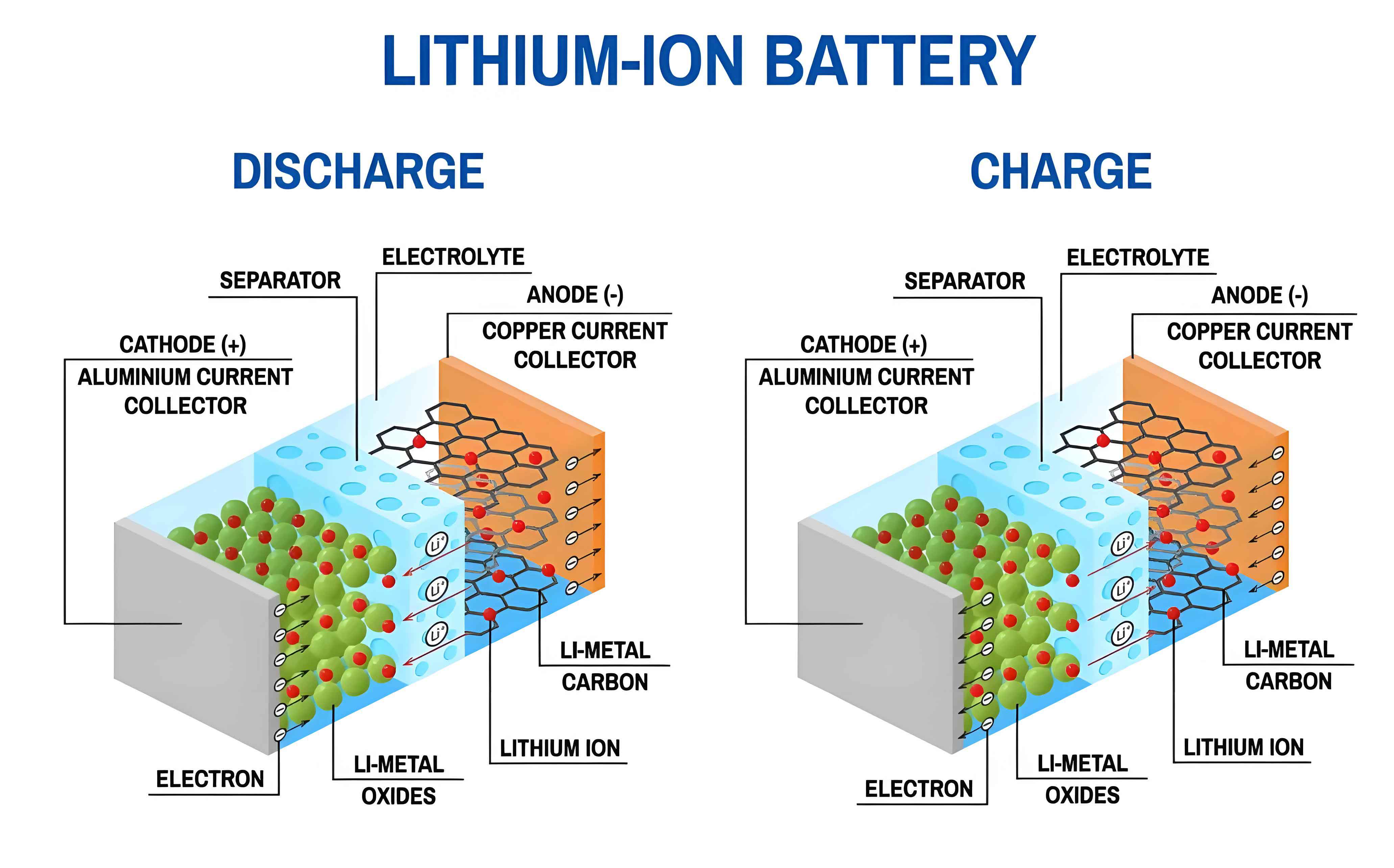
The geometric model for this study centers on a module comprising 16 series-connected large-format prismatic lithium-ion battery cells, each with a nominal capacity of 228 Ah. The module’s thermal management is facilitated by a cold plate attached to its base, through which the refrigerant flows. The key dimensions of the cell and the initial cold plate flow channel design are summarized in the table below.
| Cell Parameter | Value | Flow Channel Parameter | Value |
|---|---|---|---|
| Cell Length (mm) | 52.8 | Channel Height (mm) | 8 |
| Nominal Capacity (Ah) | 228 | Channel Width (mm) | 16 |
| Rated Voltage (V) | 51.2 | Hydraulic Diameter (mm) | ~10.67 |
The mathematical framework for this study is built upon two core models: an electro-thermal model for the lithium-ion battery and a multiphase model for the refrigerant. The heat generation within the lithium-ion battery is governed by the energy conservation equation. Assuming constant properties and anisotropic thermal conductivity, the three-dimensional heat conduction equation is applied:
$$ \rho_b c_b \frac{\partial T_b}{\partial t} = \lambda_{b,x} \frac{\partial^2 T_b}{\partial x^2} + \lambda_{b,y} \frac{\partial^2 T_b}{\partial y^2} + \lambda_{b,z} \frac{\partial^2 T_b}{\partial z^2} + \dot{q} $$
where \( \rho_b \), \( c_b \), and \( T_b \) are the density, specific heat capacity, and temperature of the battery, respectively. \( \lambda_{b,x}, \lambda_{b,y}, \lambda_{b,z} \) are the thermal conductivities in different directions, and \( \dot{q} \) is the volumetric heat generation rate. The heat generation rate is calculated using the Bernardi equation, which accounts for irreversible joule heating and reversible reaction heat:
$$ \dot{q} = \frac{I}{V_b} \left[ (E_{ocv} – E) + T_b \frac{\partial E_{ocv}}{\partial T} \right] $$
Here, \( I \) is the current, \( V_b \) is the battery volume, \( E_{ocv} \) is the open-circuit voltage, and \( E \) is the terminal voltage. The relationship between the state of charge (SOC) and discharge time at a constant rate (C-rate) is given by:
$$ \text{SOC} = 1 – \frac{I \cdot \tau}{C_N} $$
where \( C_N \) is the nominal capacity and \( \tau \) is the discharge time. The thermal parameters for the lithium-ion battery model are as follows:
| Density (kg/m³) | Specific Heat (J/(kg·K)) | In-plane Conductivity (W/(m·K)) | Through-plane Conductivity (W/(m·K)) |
|---|---|---|---|
| 2202.95 | 1086.75 | 22.5 | 0.93 |
The simulation of the refrigerant’s phase change is critical for modeling the direct cooling system. The governing equations for mass, momentum, and energy are solved for the multiphase flow. The phase change between liquid and vapor refrigerant is modeled using the Lee model, which defines the mass transfer rates based on the deviation from the saturation temperature \( T_{sat} \).
The mass transfer from liquid to vapor (evaporation) occurs when the liquid temperature exceeds the saturation temperature:
$$ \dot{m}_{lv} = k \alpha_l \rho_l \frac{T_l – T_{sat}}{T_{sat}} \quad \text{for} \quad T_l > T_{sat} $$
The mass transfer from vapor to liquid (condensation) occurs when the vapor temperature falls below the saturation temperature:
$$ \dot{m}_{vl} = k \alpha_v \rho_v \frac{T_{sat} – T_v}{T_{sat}} \quad \text{for} \quad T_v < T_{sat} $$
In these equations, \( \dot{m} \) represents the mass transfer rate, \( k \) is a mass transfer coefficient (taken as 0.1 s⁻¹), \( \alpha \) is the volume fraction, and \( \rho \) is the density. The subscripts \( l \) and \( v \) denote liquid and vapor phases, respectively. The energy equation incorporates the latent heat effects associated with this phase change. The thermodynamic properties of the cooling media used for comparison, water for liquid cooling and R134a for direct cooling, are listed below:
| Cooling Medium | Density ρ (kg/m³) | Specific Heat c (J/(kg·K)) | Thermal Conductivity λ (W/(m·K)) |
|---|---|---|---|
| Water | 998.21 | 4179.4 | 0.5981 |
| R134a (Liquid) | 1225.31 | 1404.9 | 0.0833 |
| R134a (Vapor) | 27.79 | 1000.7 | 0.0134 |
The reliability of the proposed coupled model was rigorously validated. First, the electro-thermal model for the lithium-ion battery was validated against experimental surface temperature data at various discharge rates (0.5C, 1C, 2C) in a 25°C environment. The simulation results showed excellent agreement with experimental measurements, with a maximum deviation within 3%. Second, the refrigerant phase change and system-level cooling model were validated against published experimental data for a direct cooling system under similar operating conditions. The comparative results for maximum and minimum battery temperatures at different refrigerant flow velocities confirmed the model’s accuracy, with deviations within 5%. Furthermore, grid independence and time-step independence studies were conducted to ensure the numerical results were not influenced by discretization choices. A mesh size of approximately 821,125 elements and a time step of 1 second were selected for all subsequent simulations as they provided a balance between computational accuracy and efficiency.
The thermal performance of the refrigerant direct cooling system was first benchmarked against a conventional water-based liquid cooling system. The liquid cooling system used water at 20°C inlet temperature and 0.05 m/s velocity. The baseline direct cooling system used R134a with an inlet temperature of 20°C, a velocity of 0.05 m/s, an inlet liquid volume fraction of 0.8, and a saturation temperature of 15°C. The comparison was made at different discharge rates and during a 1C charge-discharge cycle.
At a 0.5C discharge rate, the liquid cooling system performed slightly better, maintaining a lower maximum temperature and temperature difference. However, as the load increased, the advantage of the direct cooling system became pronounced. At a 2C discharge rate, the direct cooling system successfully maintained a lower maximum temperature and a significantly more uniform temperature distribution. The maximum temperature and the maximum temperature difference within the lithium-ion battery module for the direct cooling system were 7.12% and 58.86% lower than those of the liquid cooling system, respectively. This demonstrates the superior heat dissipation capability of the phase-change mechanism under high thermal loads. During cyclic 1C operation, the direct cooling system also showed a smaller overall temperature spread, although it took slightly longer to reach a steady thermal state compared to liquid cooling. This is attributed to the involvement of both sensible and latent heat transfer processes in the direct cooling system, which provides a more gradual and effective heat absorption profile, leading to a smoother vertical temperature gradient within the lithium-ion battery pack.
A key operational parameter in a direct cooling system is the evaporation saturation temperature, which is directly linked to the system pressure. A parametric study was conducted by varying the saturation temperature while keeping other inlet conditions constant (inlet temperature 10°C, velocity 0.05 m/s, liquid fraction 0.8, 1C discharge). The relationship between saturation temperature and corresponding saturation pressure for R134a is shown below:
| Saturation Temperature (°C) | Saturation Pressure (MPa) |
|---|---|
| 12 | 0.443 |
| 14 | 0.472 |
| 16 | 0.504 |
| 18 | 0.537 |
The simulation results revealed a clear trend: lowering the evaporation temperature enhanced the peak heat dissipation capability but at the cost of temperature uniformity. As the evaporation temperature was decreased from 20°C to 10°C, the maximum temperature of the lithium-ion battery module decreased from 32.19°C to 28.78°C. However, the maximum temperature difference within the module increased from 5.03°C to 7.51°C. This is because a lower evaporation temperature creates a larger temperature difference between the battery and the refrigerant, driving a higher heat flux that can lead to greater local cooling and thus larger thermal gradients. Concurrently, the analysis of the refrigerant state showed that a lower evaporation temperature promoted more complete phase change. The pressure drop across the cold plate decreased from 45.74 Pa to 39.48 Pa as the evaporation temperature rose from 10°C to 20°C, indicating a change in the two-phase flow characteristics. The outlet liquid fraction was lower at a lower evaporation temperature, signifying a higher degree of vaporization and better utilization of the refrigerant’s latent heat capacity.
The inlet quality or liquid volume fraction of the refrigerant is another critical parameter controlling the cooling process. Simulations were run with varying inlet liquid fractions (0.2 to 0.8) while holding the inlet temperature at 12°C, saturation temperature at 15°C, and velocity at 0.05 m/s under a 1C discharge. The results indicate a trade-off. Increasing the inlet liquid fraction provided more liquid refrigerant to absorb heat, thereby effectively reducing the peak temperature of the lithium-ion battery module (from 33.85°C at 0.2 fraction to 29.69°C at 0.8 fraction). However, this also led to a larger temperature spread within the module, with the maximum difference increasing from 4.47°C to 7.51°C. This is likely due to the excessive liquid refrigerant not fully vaporizing, leading to uneven cooling along the flow path. The refrigerant utilization efficiency, defined as the fraction of inlet liquid that undergoes phase change, increased from 25% to 37.5% as the inlet liquid fraction rose from 0.2 to 0.8. Furthermore, the system pressure drop increased with higher liquid fraction due to greater fluid density and viscous effects. This analysis highlights the need for optimal refrigerant charge management in a direct cooling system for lithium-ion battery thermal management.
The design of the cold plate flow channel significantly impacts both the heat transfer from the lithium-ion battery and the flow dynamics of the refrigerant. Two alternative channel designs—a parallel arrangement and a serpentine channel—were compared against the baseline “harmonica” type channel. The geometrical parameters of these designs are summarized as follows:
| Channel Type | Number of Channels | Total Contact Area (mm²) | Single Channel Length (mm) |
|---|---|---|---|
| Harmonica | 5 | 86,080 | 860.8 |
| Parallel | 2 | 98,296 | 2,557.4 |
| Serpentine | 1 | 37,337 | 2,349.6 |
The thermal performance was evaluated under identical inlet conditions (12°C, 0.05 m/s, 15°C saturation, 1C discharge). The parallel channel design, offering the largest contact area with the battery base, achieved the best cooling performance with the lowest maximum temperature of 31.64°C and a moderate temperature difference of 3.72°C. The harmonica channel performed similarly in terms of maximum temperature (32.19°C) and exhibited the best temperature uniformity (3.57°C difference). The serpentine channel, with the smallest contact area, resulted in the poorest cooling, with the highest maximum temperature of 36.21°C and the largest temperature difference of 12.93°C. This underscores the importance of maximizing the effective heat transfer area between the cold plate and the lithium-ion battery for effective heat dissipation. Regarding refrigerant phase change utilization, the harmonica channel had the lowest utilization rate at 38%, while the parallel and serpentine channels achieved 55% and 66%, respectively. This is directly correlated with the total flow path length; longer channels provide more residence time and surface area for heat exchange, allowing more refrigerant to reach and complete the phase change process. Therefore, an optimal cold plate design for a direct cooling system must balance a large contact area for heat acquisition from the lithium-ion battery with an adequate flow path length for efficient refrigerant evaporation.
This comprehensive numerical investigation elucidates the significant influence of refrigerant phase transition dynamics on the thermal management of large-capacity lithium-ion battery systems. The direct cooling system, leveraging latent heat absorption, demonstrates superior thermal performance under high-load conditions compared to traditional sensible liquid cooling. The key findings can be summarized as follows: Firstly, the direct cooling system excels in high-stress scenarios, effectively lowering the peak temperature and dramatically improving temperature uniformity within the lithium-ion battery module during high-rate discharge. Secondly, operational parameters like evaporation temperature and inlet refrigerant quality present a critical trade-off. Lower evaporation temperatures enhance peak cooling and promote more complete phase change but can worsen temperature uniformity. Higher inlet liquid fractions reduce the maximum temperature but may lead to larger temperature spreads and suboptimal refrigerant utilization if not fully vaporized. Thirdly, the design of the cold plate flow channel is paramount. Increasing the effective contact area between the channel and the battery base is crucial for efficient heat acquisition, while providing sufficient flow path length is necessary to allow the refrigerant adequate time and surface area to undergo a complete liquid-to-vapor phase change. These insights provide a solid theoretical foundation and practical guidance for the design and optimization of advanced refrigerant-based direct cooling systems, ensuring the safe, durable, and efficient operation of high-energy-density lithium-ion battery packs in demanding applications such as electric vehicles and grid-scale energy storage.