
Perovskite solar cells have emerged as a promising photovoltaic technology due to their high efficiency, low cost, and tunable bandgap. However, interfacial issues in inverted perovskite solar cells, such as energy level mismatches in hole transport layers (HTLs), often limit performance. In this study, I explore a hybrid self-assembled monolayer (SAM) strategy to improve the hole transport capability in perovskite solar cells by combining MeO-2PACz and Me-4PACz. This approach aims to optimize energy level alignment and defect passivation at the NiOx HTL interface, leading to enhanced charge extraction and device efficiency. Through experimental analysis, I demonstrate that the hybrid SAM significantly boosts key photovoltaic parameters, including open-circuit voltage, short-circuit current density, and fill factor, resulting in a notable increase in power conversion efficiency for perovskite solar cells.
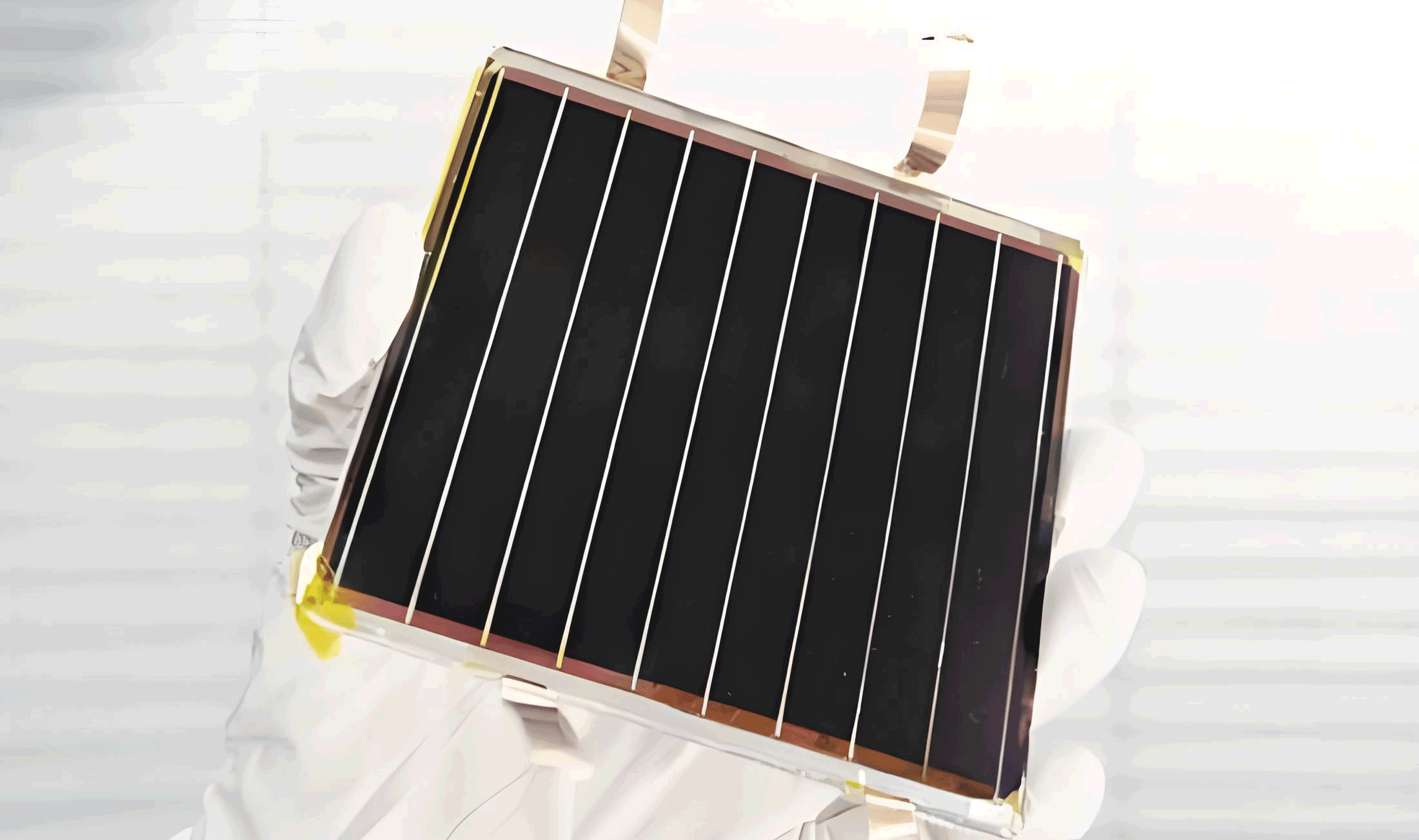
The development of perovskite solar cells has progressed rapidly, with efficiencies surpassing 26% in recent years. Despite this, challenges such as interfacial recombination and energy level misalignment persist, particularly in p-i-n structured perovskite solar cells. The NiOx HTL is widely used due to its stability and cost-effectiveness, but it suffers from high defect density and poor energy level matching with perovskite layers. SAMs, like MeO-2PACz, have been employed to address these issues by passivating defects and improving wettability. However, the low HOMO level of MeO-2PACz creates a hole transport barrier, hindering charge extraction in perovskite solar cells. To overcome this, I propose a hybrid SAM incorporating Me-4PACz, which has a larger dipole moment, to optimize the energy landscape and enhance the performance of perovskite solar cells.
In this work, I fabricated inverted perovskite solar cells with the structure ITO/NiOx/SAM/FA0.85Cs0.15PbBr0.15I0.85/PCBM/BCP/Ag. The hybrid SAM solutions were prepared by mixing MeO-2PACz and Me-4PACz in specific volume ratios (e.g., 5%, 10%, and 20% Me-4PACz) in ethanol. The NiOx layer was deposited via solution processing, followed by SAM coating and perovskite layer formation using spin-coating techniques. Characterization included current-voltage (J-V) measurements, external quantum efficiency (EQE), ultraviolet photoelectron spectroscopy (UPS), scanning electron microscopy (SEM), atomic force microscopy (AFM), X-ray diffraction (XRD), electrochemical impedance spectroscopy (EIS), and photoluminescence (PL) studies. These methods allowed me to analyze the structural, electronic, and optical properties of the perovskite solar cells.
The performance of perovskite solar cells with hybrid SAMs was evaluated through J-V curves under AM1.5G illumination. The results showed that devices with 10% Me-4PACz in the hybrid SAM achieved the highest power conversion efficiency (PCE), open-circuit voltage (VOC), short-circuit current density (JSC), and fill factor (FF) compared to those with pure MeO-2PACz or other ratios. For instance, the PCE increased from 18.7% to 20.76%, with VOC of 1.079 V, JSC of 24.23 mA/cm², and FF of 0.79. EQE measurements confirmed the enhanced photocurrent generation across the spectrum, indicating improved light harvesting in these perovskite solar cells. The steady-state photocurrent output further validated the stability and efficiency gains, underscoring the role of hybrid SAMs in optimizing charge transport in perovskite solar cells.
| SAM Type | VOC (V) | JSC (mA/cm²) | FF | PCE (%) |
|---|---|---|---|---|
| MeO-2PACz | 1.05 | 23.50 | 0.75 | 18.7 |
| 5% Me-4PACz | 1.06 | 23.80 | 0.77 | 19.5 |
| 10% Me-4PACz | 1.079 | 24.23 | 0.79 | 20.76 |
| 20% Me-4PACz | 1.07 | 23.90 | 0.76 | 19.8 |
To understand the electronic properties, I conducted UPS analysis to determine the work function (WF) and valence band maximum (VBM) of the HTL with different SAMs. The WF values were calculated as 4.40 eV for MeO-2PACz, 4.70 eV for 5% Me-4PACz, 4.76 eV for 10% Me-4PACz, and 4.84 eV for 20% Me-4PACz. The corresponding VBM values were 4.87 eV, 5.21 eV, 5.26 eV, and 5.33 eV, respectively. This shift in energy levels is attributed to the larger dipole moment of Me-4PACz, which enhances the interfacial dipole and improves energy level alignment in perovskite solar cells. The dipole moment (μ) can be described by the formula: $$ \mu = q \times d $$ where q is the charge and d is the separation distance. For Me-4PACz, the longer alkyl chain and methyl group contribute to a higher μ, approximately 1.7 D, compared to 0.2 D for MeO-2PACz. This facilitates better hole extraction and reduces recombination in perovskite solar cells.
The morphological properties of perovskite films on different HTLs were examined using SEM and AFM. SEM images revealed that the hybrid SAM promoted denser and more uniform perovskite crystal growth, with grain sizes increasing from around 0.13 μm for MeO-2PACz to 0.18 μm for 10% Me-4PACz. AFM analysis showed a reduction in root mean square roughness (Rms) from 12 nm for MeO-2PACz to 9.68 nm for 10% Me-4PACz, indicating smoother films that minimize defect states in perovskite solar cells. Water contact angle measurements increased from 69.3° for MeO-2PACz to 80.2° for 20% Me-4PACz, suggesting enhanced hydrophobicity that benefits perovskite crystallization but must be optimized to avoid excessive疏水性 that could impair film quality in perovskite solar cells.
| SAM Type | Grain Size (μm) | Rms (nm) | Contact Angle (°) |
|---|---|---|---|
| MeO-2PACz | 0.13 | 12.0 | 69.3 |
| 5% Me-4PACz | 0.15 | 11.1 | 73.7 |
| 10% Me-4PACz | 0.18 | 9.68 | 76.0 |
| 20% Me-4PACz | 0.16 | 10.9 | 80.2 |
XRD patterns confirmed improved crystallinity in perovskite films with hybrid SAMs, as evidenced by sharper and more intense peaks at the (110) plane. The full width at half maximum (FWHM) decreased for 10% Me-4PACz, indicating larger crystal domains and reduced structural disorder in perovskite solar cells. UV-visible absorption spectra showed enhanced light absorption in the visible range for devices with hybrid SAMs, correlating with the higher JSC values. EDS analysis revealed a decrease in Pb content from 12.67% for MeO-2PACz to 9.95% for hybrid SAMs, suggesting effective passivation of Pb²⁺ defects through coordination with phosphonic acid groups in the SAM, which is crucial for minimizing non-radiative recombination in perovskite solar cells.
Electrochemical impedance spectroscopy (EIS) was performed to assess charge recombination in perovskite solar cells. The Nyquist plots showed an increase in recombination resistance (Rrec) from 340 Ω for MeO-2PACz to 810 Ω for 10% Me-4PACz, indicating suppressed charge recombination. This aligns with the enhanced VOC and FF observed in J-V measurements. The time constant for recombination (τ) can be expressed as: $$ \tau = R_{rec} \times C $$ where C is the capacitance. The higher Rrec values for hybrid SAM-based devices underscore their role in improving charge carrier lifetime and overall efficiency in perovskite solar cells.
Steady-state PL and time-resolved PL (TRPL) measurements provided insights into charge carrier dynamics. The PL intensity decreased for hybrid SAM devices, particularly for 10% Me-4PACz, indicating efficient hole extraction from the perovskite layer. TRPL decay curves were fitted with a bi-exponential function: $$ I(t) = A_1 \exp(-t/\tau_1) + A_2 \exp(-t/\tau_2) + I_0 $$ where τ1 and τ2 represent fast and slow decay components, respectively. The average carrier lifetime (τavg) was calculated using: $$ \tau_{avg} = \frac{A_1 \tau_1^2 + A_2 \tau_2^2}{A_1 \tau_1 + A_2 \tau_2} $$ For MeO-2PACz, τavg was 62.28 ns, which reduced to 33.36 ns for 10% Me-4PACz, demonstrating faster charge extraction and reduced recombination in perovskite solar cells with hybrid SAMs.
| SAM Type | τ1 (ns) | A1 | τ2 (ns) | A2 | τavg (ns) |
|---|---|---|---|---|---|
| MeO-2PACz | 2.51 | 0.58 | 68.61 | 0.20 | 62.28 |
| 5% Me-4PACz | 2.94 | 0.61 | 55.16 | 0.19 | 47.66 |
| 10% Me-4PACz | 2.60 | 0.59 | 38.87 | 0.22 | 33.36 |
| 20% Me-4PACz | 2.03 | 0.62 | 46.87 | 0.19 | 41.40 |
The optimization of hybrid SAMs involves balancing the dipole moment and hydrophobicity to achieve superior performance in perovskite solar cells. The energy level alignment can be modeled using the Schottky-Mott rule: $$ \Phi_{HTL} = \chi + E_g – \Delta E $$ where ΦHTL is the HTL work function, χ is the electron affinity, Eg is the bandgap, and ΔE is the interface dipole. For hybrid SAMs, the adjusted ΦHTL reduces the energy barrier for hole injection, enhancing VOC and JSC in perovskite solar cells. Additionally, the defect passivation efficacy can be quantified by the trap density (Nt), given by: $$ N_t = \frac{C}{q k T} $$ where C is the capacitance, k is Boltzmann’s constant, and T is temperature. Lower Nt values in hybrid SAM devices correlate with improved FF and stability.
In conclusion, the hybrid SAM strategy effectively addresses the limitations of MeO-2PACz in perovskite solar cells by optimizing energy level alignment and interfacial properties. The incorporation of Me-4PACz at 10% volume ratio results in a PCE of 20.76%, with significant improvements in VOC, JSC, and FF. This approach enhances charge extraction, reduces recombination, and promotes high-quality perovskite film formation, making it a valuable interface engineering technique for advancing perovskite solar cells. Future work could explore other SAM combinations or scaling up for large-area perovskite solar cell modules to further boost commercialization prospects.