
In modern power systems, ensuring the reliable operation of substation DC backup power sources is critical for grid stability. Traditionally, lead-acid batteries have been widely used in such applications, but their limitations, including short lifespan and poor temperature performance, have prompted a shift toward more advanced energy storage solutions. Lithium-ion batteries, with their high energy density, long cycle life, and environmental friendliness, are emerging as a promising alternative for DC power systems in substations. However, the performance degradation of lithium-ion batteries over time necessitates accurate monitoring of their health state to ensure reliability. The state of health (SOH) of a lithium-ion battery is a key indicator that reflects its current capacity relative to its initial capacity, and it is essential for predicting remaining useful life and scheduling maintenance. Electrochemical impedance spectroscopy (EIS) is a non-destructive technique that can provide insights into the internal electrochemical processes of a lithium-ion battery, making it valuable for SOH estimation and aging mechanism analysis. However, conventional static EIS measurements require the lithium-ion battery to be at rest, which is impractical during operation. In contrast, fast EIS with DC bias can be acquired during battery operation but suffers from reduced interpretability due to distortions, especially in low-frequency regions. This study addresses these challenges by proposing a method for enhancing the interpretability of fast impedance spectra to enable accurate SOH estimation and aging analysis for lithium-ion batteries. We develop a hybrid convolutional-long short-term memory (CNN-LSTM) network to predict static EIS from fast EIS, and then use an extreme gradient boosting (XGBoost) algorithm to estimate SOH from the predicted static EIS. Additionally, we analyze aging mechanisms through equivalent circuit modeling. Our approach allows for real-time health monitoring of lithium-ion batteries in backup power systems without disrupting their operation, contributing to improved reliability and lifespan management.
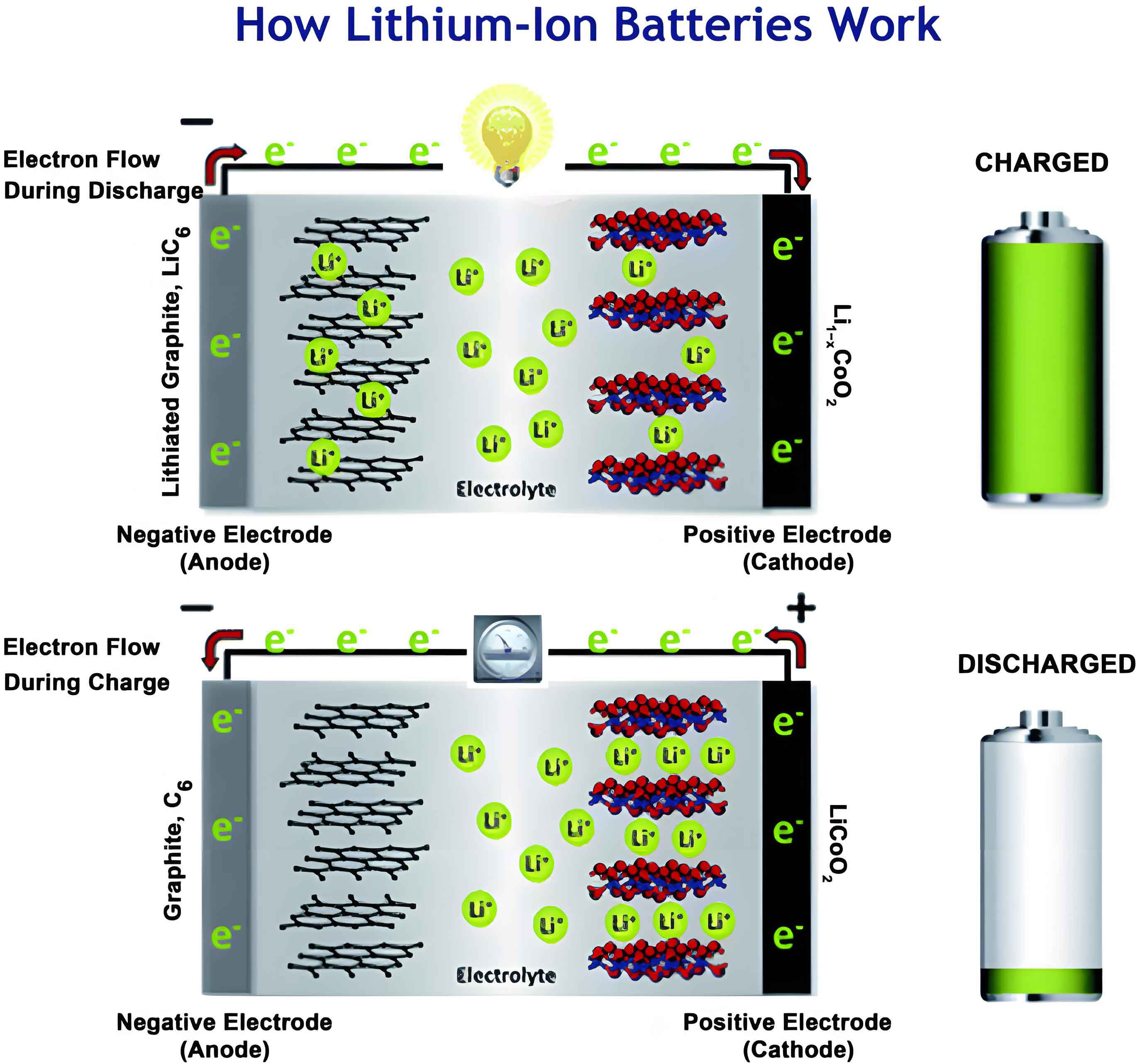
The degradation of lithium-ion batteries is a complex process influenced by factors such as cycling, temperature, and charge-discharge rates. For lithium-ion batteries used in substation backup systems, where they are often kept at high states of charge and infrequently discharged, understanding aging mechanisms is crucial for predicting failure and optimizing usage. The SOH of a lithium-ion battery is typically defined as the ratio of its current maximum capacity to its initial capacity, expressed as: $$ \text{SOH} = \frac{C_{\text{current}}}{C_{\text{initial}}} \times 100\% $$ where $C_{\text{current}}$ is the present capacity and $C_{\text{initial}}$ is the initial capacity. As the lithium-ion battery ages, its SOH decreases due to various degradation mechanisms, including loss of lithium inventory (LLI), loss of active material (LAM), and loss of conductivity (CL). These mechanisms affect the internal resistance and electrochemical kinetics of the lithium-ion battery, which can be captured by EIS. EIS measures the impedance of a lithium-ion battery across a range of frequencies by applying a small sinusoidal excitation signal. The resulting Nyquist plot provides information on ohmic resistance, charge transfer resistance, and diffusion processes. However, static EIS requires the lithium-ion battery to be in equilibrium, which is not feasible during operation. Fast EIS, obtained with a DC bias superimposed on the excitation signal, allows for measurements during charging or discharging but introduces distortions that complicate interpretation. Our goal is to leverage fast EIS for real-time monitoring by enhancing its interpretability through machine learning techniques.
To achieve this, we first focus on predicting static EIS from fast EIS data. We propose a CNN-LSTM model that combines convolutional neural networks (CNN) for local feature extraction and long short-term memory (LSTM) networks for capturing sequential dependencies in the frequency domain. The input to the model is the fast EIS data, represented as a sequence of complex impedance values at different frequencies. Each impedance point has a real part and an imaginary part, forming a two-channel input. The CNN layers apply one-dimensional convolutions to extract spatial features from the frequency points. The output of the CNN is then fed into an LSTM layer to model the long-range dependencies across frequencies. The LSTM unit uses gating mechanisms to retain important information and discard irrelevant details, which is crucial for reconstructing the static EIS curve. The mathematical formulation of the LSTM can be described as follows: $$ \begin{aligned} f_t &= \sigma(W_f \cdot [h_{t-1}, x_t] + b_f) \\ i_t &= \sigma(W_i \cdot [h_{t-1}, x_t] + b_i) \\ \tilde{C}_t &= \tanh(W_C \cdot [h_{t-1}, x_t] + b_C) \\ C_t &= f_t \circ C_{t-1} + i_t \circ \tilde{C}_t \\ o_t &= \sigma(W_o \cdot [h_{t-1}, x_t] + b_o) \\ h_t &= o_t \circ \tanh(C_t) \end{aligned} $$ where $f_t$, $i_t$, and $o_t$ are the forget, input, and output gates, respectively; $C_t$ is the cell state; $h_t$ is the hidden state; $x_t$ is the input at time step $t$; $W$ and $b$ are weight matrices and bias vectors; $\sigma$ is the sigmoid function; and $\circ$ denotes element-wise multiplication. For our CNN-LSTM model, the time steps correspond to frequency points in the EIS data. The model is trained using mean squared error loss between the predicted and actual static EIS values. This approach allows us to transform distorted fast EIS data into interpretable static EIS, facilitating subsequent analysis for the lithium-ion battery.
Once static EIS is predicted, we use it to estimate the SOH of the lithium-ion battery. We employ the XGBoost algorithm, which is an efficient implementation of gradient boosting designed for speed and performance. XGBoost builds an ensemble of decision trees sequentially, with each tree correcting the errors of its predecessor. The algorithm optimizes a regularized objective function that includes both the loss function and a penalty for model complexity. For a dataset with $n$ samples, the objective function at the $t$-th iteration is given by: $$ \mathcal{L}^{(t)} = \sum_{i=1}^n l(y_i, \hat{y}_i^{(t-1)} + f_t(x_i)) + \Omega(f_t) $$ where $y_i$ is the true SOH value, $\hat{y}_i^{(t-1)}$ is the prediction from the previous iteration, $f_t$ is the new tree, $l$ is a differentiable loss function (e.g., squared error), and $\Omega$ is a regularization term defined as: $$ \Omega(f) = \gamma T + \frac{1}{2} \lambda \sum_{j=1}^T w_j^2 $$ Here, $T$ is the number of leaves in the tree, $w_j$ are the leaf weights, and $\gamma$ and $\lambda$ are regularization parameters. We use the static EIS features as input to XGBoost, including the real part, imaginary part, magnitude, and phase of impedance at each frequency point. The model is trained to map these features to the SOH of the lithium-ion battery. Additionally, XGBoost provides feature importance scores based on the gain achieved when splitting on each feature, which helps in identifying key frequency regions for SOH estimation. This enhances the interpretability of the SOH prediction model for the lithium-ion battery.
To analyze the aging mechanisms of the lithium-ion battery, we fit the predicted static EIS to an equivalent circuit model (ECM). The ECM represents the electrochemical processes within the lithium-ion battery using electrical components such as resistors, capacitors, and constant phase elements (CPE). A typical ECM for a lithium-ion battery includes elements for ohmic resistance, charge transfer resistance, double-layer capacitance, and Warburg diffusion impedance. The impedance of a CPE is expressed as: $$ Z_{\text{CPE}} = \frac{1}{(j\omega)^\alpha Q} $$ where $Q$ is the magnitude parameter, $\alpha$ is the dispersion coefficient (between 0 and 1), $\omega$ is the angular frequency, and $j$ is the imaginary unit. By fitting the ECM to EIS data at different aging stages, we can track changes in parameters such as ohmic resistance ($R_0$) and charge transfer resistance ($R_{ct}$), which are linked to degradation mechanisms like electrolyte loss or SEI growth. For instance, an increase in $R_0$ often indicates loss of conductivity due to electrolyte decomposition in the lithium-ion battery. Similarly, changes in CPE parameters reflect alterations in electrode surface properties. This analysis provides insights into the dominant aging mechanisms affecting the lithium-ion battery, enabling targeted maintenance strategies.
We validate our method using experimental data from lithium-ion battery aging tests. The dataset includes multiple lithium-ion batteries cycled under different temperatures and conditions. We split the data into training and testing sets to evaluate performance. For the static EIS prediction, we compare the CNN-LSTM model with standalone CNN and LSTM models. The performance is measured using mean absolute error (MAE) and mean squared error (MSE), defined as: $$ \text{MAE} = \frac{1}{n} \sum_{i=1}^n |y_i – x_i|, \quad \text{MSE} = \frac{1}{n} \sum_{i=1}^n (y_i – x_i)^2 $$ where $y_i$ is the true static EIS value and $x_i$ is the predicted value. The results show that the CNN-LSTM model achieves the lowest errors, demonstrating its effectiveness for enhancing fast EIS interpretability in lithium-ion batteries. Below is a table summarizing the errors for different models in predicting static EIS from fast EIS data.
| Model | MAE | MSE |
|---|---|---|
| CNN | 1.93 × 10⁻⁵ | 2.40 × 10⁻⁷ |
| LSTM | 2.01 × 10⁻⁵ | 2.49 × 10⁻⁷ |
| CNN-LSTM | 1.75 × 10⁻⁵ | 1.83 × 10⁻⁷ |
For SOH estimation, we compare XGBoost with other machine learning algorithms such as support vector regression (SVR), random forest (RF), Gaussian process regression (GPR), and extra trees regressor (ETR). The SOH prediction accuracy is evaluated using MAE and root mean squared error (RMSE), where RMSE is defined as: $$ \text{RMSE} = \sqrt{\frac{1}{n} \sum_{i=1}^n (y_i – x_i)^2} $$ The results indicate that XGBoost outperforms the other methods, achieving the lowest MAE and RMSE for the lithium-ion battery SOH estimation. The following table presents the error metrics for each algorithm.
| Algorithm | MAE (%) | RMSE (%) |
|---|---|---|
| SVR | 5.67 | 6.50 |
| RF | 2.61 | 3.04 |
| XGBoost | 2.43 | 2.80 |
| GPR | 2.44 | 2.92 |
| ETR | 5.45 | 6.13 |
To further analyze the contribution of different EIS features to SOH prediction, we examine the feature importance scores from XGBoost. The features include the real part, imaginary part, magnitude, and phase of impedance at 60 frequency points. The importance is calculated based on the total gain of splits involving each feature. We find that phase features have the highest overall importance, followed by real and imaginary parts, while magnitude features contribute less. This suggests that phase information in EIS is particularly sensitive to aging in lithium-ion batteries. The table below summarizes the total importance percentages for each feature type across all frequency points.
| Feature Type | Total Importance (%) |
|---|---|
| Real Part | 31.00 |
| Imaginary Part | 24.99 |
| Magnitude | 5.03 |
| Phase | 38.98 |
In aging mechanism analysis, we fit the predicted static EIS to a second-order ECM for a lithium-ion battery at various cycle numbers. The ECM parameters, such as ohmic resistance $R_0$ and CPE parameters, are tracked over time. We observe that $R_0$ increases with cycling, indicating electrolyte loss and conductivity degradation in the lithium-ion battery. The correlation coefficient between SOH and $R_0$ is calculated as 0.78, suggesting a strong relationship. Additionally, changes in CPE parameters reflect SEI growth and electrode surface degradation. The Warburg impedance parameters also shift, indicating diffusion limitations due to active material loss. These findings highlight that electrolyte loss is a primary aging factor for the lithium-ion battery under study, which aligns with known degradation modes in lithium-ion batteries.
To ensure the physical plausibility of the predicted static EIS, we perform Kramers-Kronig (K-K) consistency checks. The K-K relations require that the real and imaginary parts of impedance are Hilbert transform pairs, ensuring linearity and causality. For a given impedance spectrum, the transformations are: $$ Z'(\omega) = \frac{2}{\pi} \int_0^\infty \frac{\omega’ Z”(\omega’)}{\omega’^2 – \omega^2} d\omega’, \quad Z”(\omega) = -\frac{2}{\pi} \int_0^\infty \frac{\omega’ Z'(\omega’)}{\omega’^2 – \omega^2} d\omega’ $$ where $Z’$ and $Z”$ are the real and imaginary parts, respectively. The residuals between the predicted EIS and K-K transformed values are low, with average deviations of 0.28% for the real part and 0.25% for the imaginary part. This confirms that the predicted static EIS adheres to fundamental physical constraints, making it suitable for aging analysis of the lithium-ion battery.
We also test the generalizability of our SOH estimation method on a separate dataset from lithium-ion batteries with higher capacities. The dataset includes lithium-ion batteries subjected to various aging conditions, and we use EIS measurements at different states of charge (SOC) for SOH prediction. The results show that using EIS data at multiple SOC levels, particularly around 30-70% SOC, improves prediction accuracy. For instance, combining EIS at 30% and 70% SOC yields the lowest MAE of 2.43% and RMSE of 3.36%, demonstrating the robustness of our XGBoost-based approach for lithium-ion battery SOH estimation across different operating conditions. This underscores the versatility of our method for real-world applications where lithium-ion batteries experience varying SOC levels.
The integration of fast EIS, machine learning, and ECM analysis offers a comprehensive framework for lithium-ion battery health monitoring. By predicting static EIS from operational data, we overcome the limitation of requiring battery rest periods. The CNN-LSTM model effectively captures the nonlinear mappings between fast and static EIS, while XGBoost leverages the rich information in EIS for accurate SOH estimation. The aging mechanism analysis via ECM provides actionable insights into degradation processes, enabling proactive maintenance for lithium-ion batteries in critical infrastructure like substation backup systems. Future work could explore the application of this method to larger-scale lithium-ion battery packs and under diverse environmental stresses to further validate its utility.
In conclusion, we have developed a novel method for enhancing the interpretability of fast impedance spectra to estimate the health state of lithium-ion batteries. Our approach combines a CNN-LSTM network for static EIS prediction and an XGBoost algorithm for SOH estimation, achieving high accuracy with MAE as low as 2.43%. The aging analysis reveals electrolyte loss as a key degradation mechanism in the studied lithium-ion battery. This method facilitates real-time, non-invasive health monitoring of lithium-ion batteries in operational settings, contributing to the reliability and longevity of energy storage systems. As lithium-ion batteries continue to gain adoption in grid applications, such advanced diagnostics will be essential for ensuring their safe and efficient operation.